Category Archives: My Styles of Drawing and Colouring

Definitions and descriptions of my style of drawing and colouring.

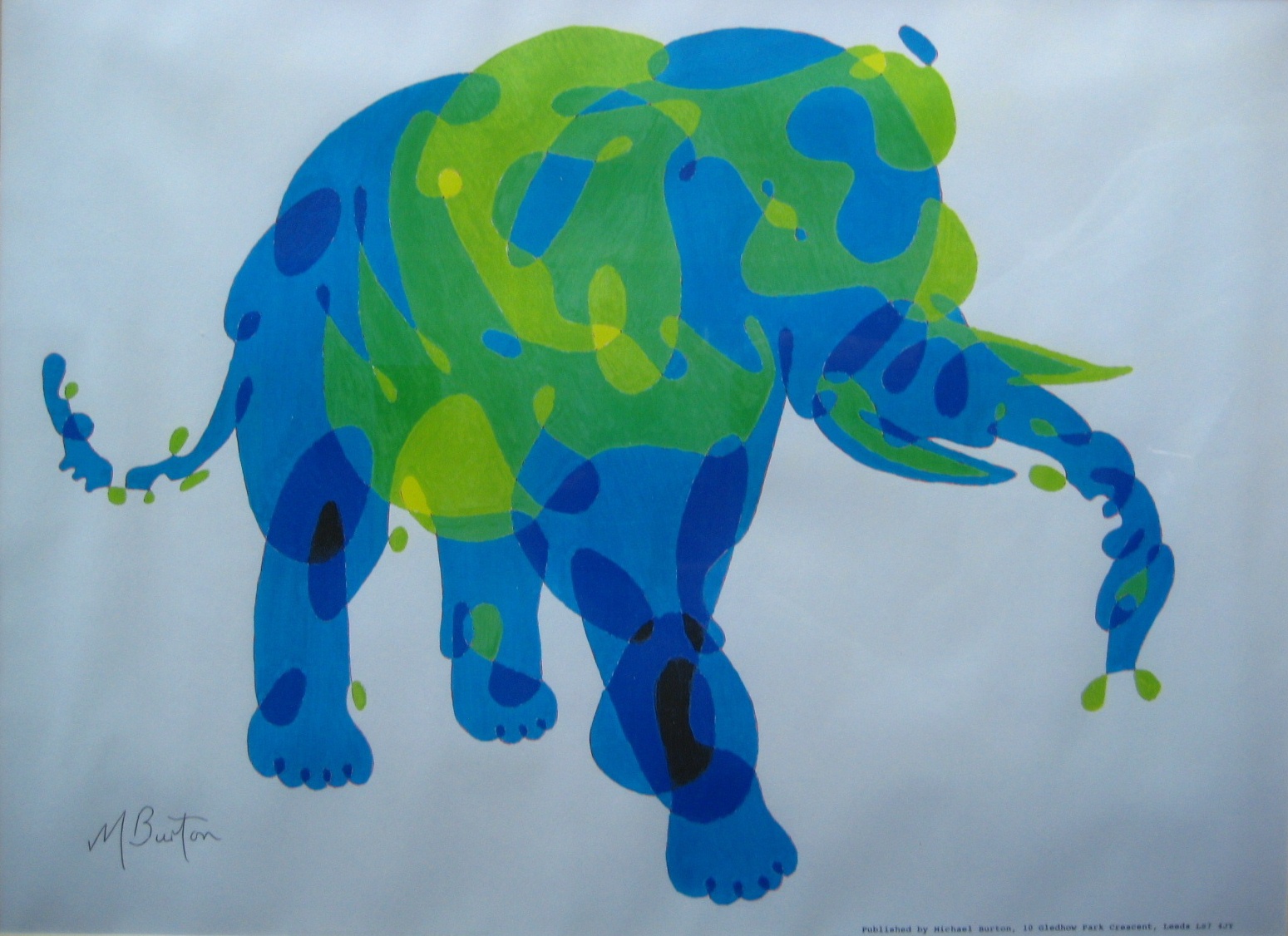
Twisting, Overlapping, Envelope Elephant. Continuous Line Drawing colouring.

“Fluorescephant”, the original version of “Elephant Grass” which is at the top of this continuous line blog, was my first successful Colour Sequence painting.  The sequence ran from yellow through greens to blues in steps of colour and tones which gave a natural three dimensional effect and dynamism.  Part of this was the overlapping nature of continuous lines which was reflected by the successive darker colouring.

The painting was accepted for the International Amateur Artist exhibition, in Warwick Square London, in February 1973 and then a month later in the National Society annual open exhibition in the Mall Galleries.

Fluorescephant. Continuous line drawing with colour sequence. National Society Open Exhibition, Mall Gallery, London, 1973. Mick Burton.

Fluorescephant. Continuous line drawing with colour sequence. National Society Open Exhibition, Mall Gallery, London, 1973. Mick Burton.

I was never totally happy with the colouring.  I thought that there was an extra natural effect, on top of the overlapping, which I was missing.  When I started my art again in 2012, after a gap of nearly 40 years, I once more tried to sort this out.  I realised that I could enhance the twisting of the design and highlight gaps where the outside would show through.

Here is the result, “Twisting, Overlapping, Envelope Elephant”.  Imagine that the continuous lines are describing a sheet of plastic, which is coloured Blue on the front and Red on the back.  Each time a twist occurs, against the outside background, then I colour it Red.  When the overlaps build up, the shades of the blue front go darker blue, and the shades of the twisted areas become darker red.  Where the blue front and the red back occasionally overlap, then I use violet to reflect the mix.

This continuous line drawing is coloured to represent a

This continuous line drawing is coloured to represent a “Twisting, Overlapping, Envelope Elephant”, which is Blue on one side and Red on the other. Mick Burton, 2013.

You can see considerable areas of background colour within the animal showing through. This looks natural within the form of the elephant.

The blue areas, including darker blue overlaps, are the same as the blue areas in the “Fluorescephant”, so it is good to keep a large part of the original colour sequence in this change of style.

Rhinoceros and Ostrich continuous line drawings

Rhinoceros, continuous line drawing with colour sequence.  Based on Mick Burton demonstration.

Rhinoceros, single continuous line drawing with colour sequence. Based on Mick Burton demonstration.

I did a demonstration and workshop at Horsforth Arts Society, in Leeds, in January 2015.  It was a freezing evening and I parked outside in a narrow back street.  This club is an end terrace house, extended into the next house I think, and they have sole use.  No one had arrived, but I was encouraged by a notice in the window “Demonstration of Continuous Line Drawing by Mick Burton at 7.30pm”.  Shirley, who arranged demonstrations, arrived but could not unlock the door.  I managed to open it.

So we were in and I could cart all my kit and pictures up the stairs and decide on my set up.  Joan came with me to help and the room soon filled up with friendly, expectant, members.  Shirley had seen me demonstrate at another club and gave an encouraging introduction.

After showing several pictures of my animals, mentioning a bit about my past and going through the basics of how to do a continuous line animal, it was time to do my first drawing before the members had a go themselves.

Firstly I put my key marks on a sketched Rhinoceros, showed how to join up the marks in the main areas such as the head and legs and asked the members to start on their own subjects whilst I connected up more lines.  I completed a rough and ready version of the Rhino, which a few weeks later I spruced up and added colours as above.  It is in the Harrogate and Nidderdale Art Club spring exhibition this weekend.

The members of the club completed pictures of animals or people with lines, but with a great variety of styles.  I did not insist on complete continuous lines, as the main idea was that their drawings could flow, and many good results emerged.  Several coloured in their creations.

Whilst they continued with their pictures, or started new ones, in the second half I started an Ostrich.  I did the head and neck and put some key marks elsewhere and invited members to come up and have a go at parts of the ostrich with my thick marker pen.  Several did and we arrived at the result below.  It has about three different lines going and a few dead ends.  This is fine at an early stage of my continuous line drawings, before loose ends are then connected up and one continuous line arrived at along with modifications to pattern and smoothing.

Ostrich continuous line, demonstration drawing by Mick Burton, with the assistance of members of Horsforth Arts Society.  January 2015.

Ostrich single continuous line drawing, demonstration by Mick Burton, with the assistance of members of Horsforth Arts Society. January 2015.

I thanked them for their help and in later weeks produced the picture “Ostrich Egg” below.  It has two continuous lines, one of which is the coloured Egg.

Ostrich Egg, continuous lines.  Based on Mick Burton demonstration.

Ostrich Egg, single continuous line drawing. Based on Mick Burton demonstration at Horsforth Arts Society.

A black pen version of the Ostrich is currently in the Association of Animal Artists annual exhibition.

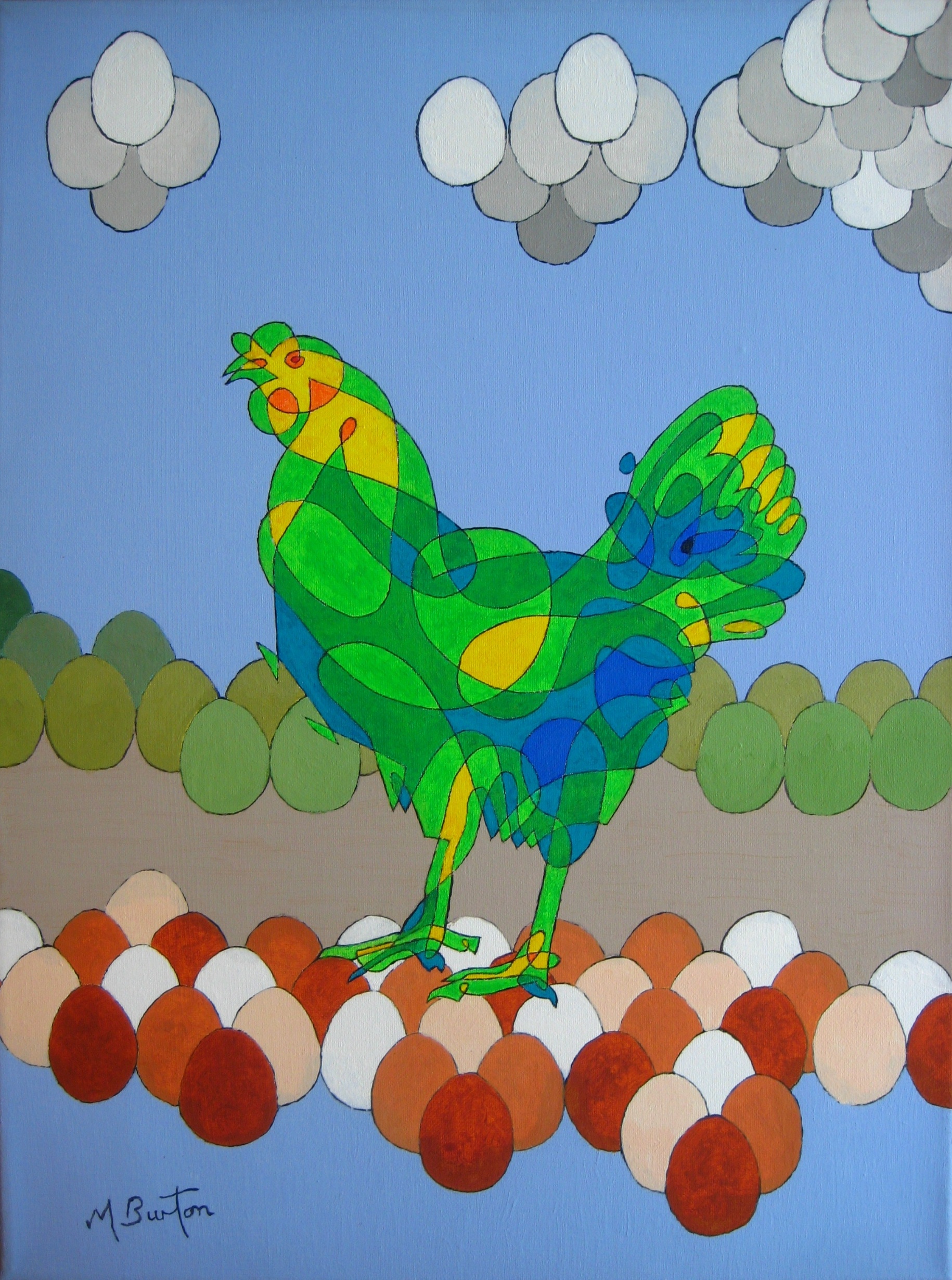
I quite like including eggs in pictures.  “Harriet’s Busy Day”, which now resides in Worcestershire, was a finalist in Britain’s Got Artists in July 2012.

Harriet's Busy day.  Continuous line with colour sequence.  Background based on eggs.  Mick Burton, 2012.

Harriet’s Busy day. Single continuous line drawing with colour sequence. Background based on eggs. Mick Burton, continuous line artist 2012.

 When I showed the Hen picture to my sister Wendy she said  “Why have you stuck all those eggs to the ceiling”.

Escher Islamic Mosaic Change to One Continuous Line. STAGE 5.

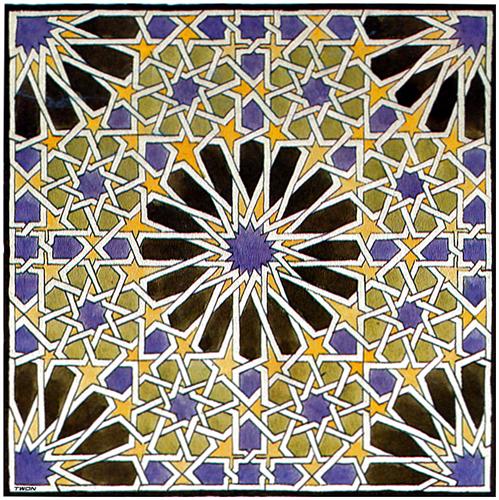
Escher painting 1922 of Islamic Mosaic tile at the Alhambra. WikiArt. Continuous line study by Mick Burton.

Escher painting 1922 of Islamic Mosaic tile at the Alhambra. WikiArt. Continuous line study by Mick Burton.

In my post of 4 April 2015, Continuous Lines in Escher Islamic Mosaic painting, STAGE 1, I mentioned that the original Islamic artist had deliberately created two Continuous Lines, when he could have just as easily created one, because he wanted to retain overall symmetry of design and border connections.

I stated that I had examined the design and worked out how to make a change to the border connections of lines to create one continuous line throughout the design, and this is how it’s done.

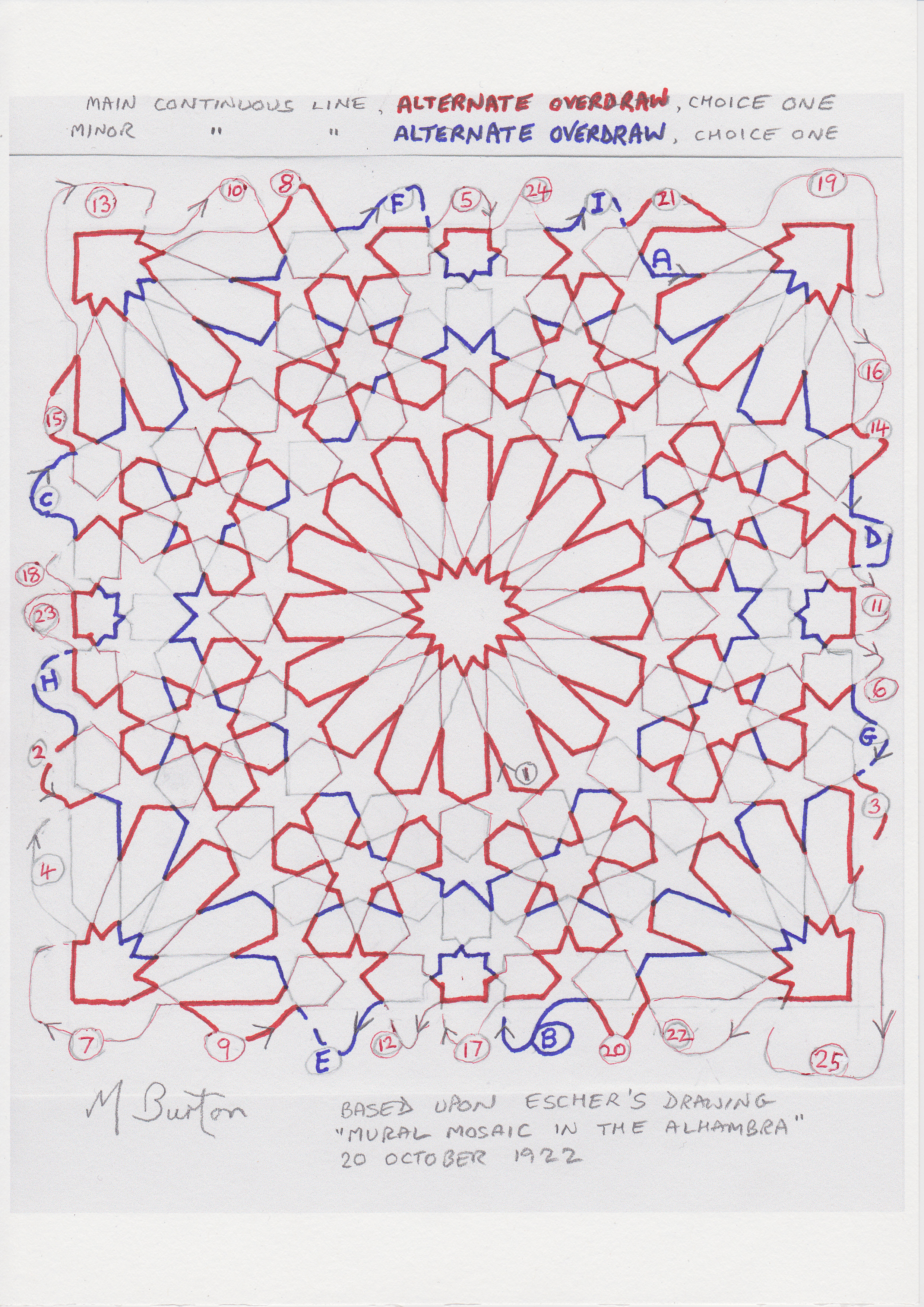
Here is the chart from STAGE 2 again, which shows the Main Continuous Line in Red and the Minor Continuous Line in Blue and the colours are also shown as the connections loop outside the Border.  The change has to be done without changing the Alternate Overdraw in the main design and this is done by linking a Red Overdraw with a Blue Overdraw at the same time as linking two not overdrawn lines.

Minor Continuous Line, Alternate Overdraws in Red and Blue. Mick Burton Escher Mosaic study.

Minor Continuous Line, Alternate Overdraws in Red and Blue. Mick Burton Escher Mosaic study.

We need a crossover on the Border involving a Red loop and a Blue loop.  If we part them at that junction and re-join the Red with the Blue, and then join both not overdrawn ends as well, we have united the Main and Minor continuous lines.  See Below.

Joining of Main Red Continuous Line to Minor Blue, leaving both non Alternate Overdraw lines joined at the former junction. Mick Burton Escher Mosaic study.

Joining of Main Red Continuous Line to Minor Blue, leaving both non Alternate Overdraw lines joined at the former junction. Mick Burton Escher Mosaic study.

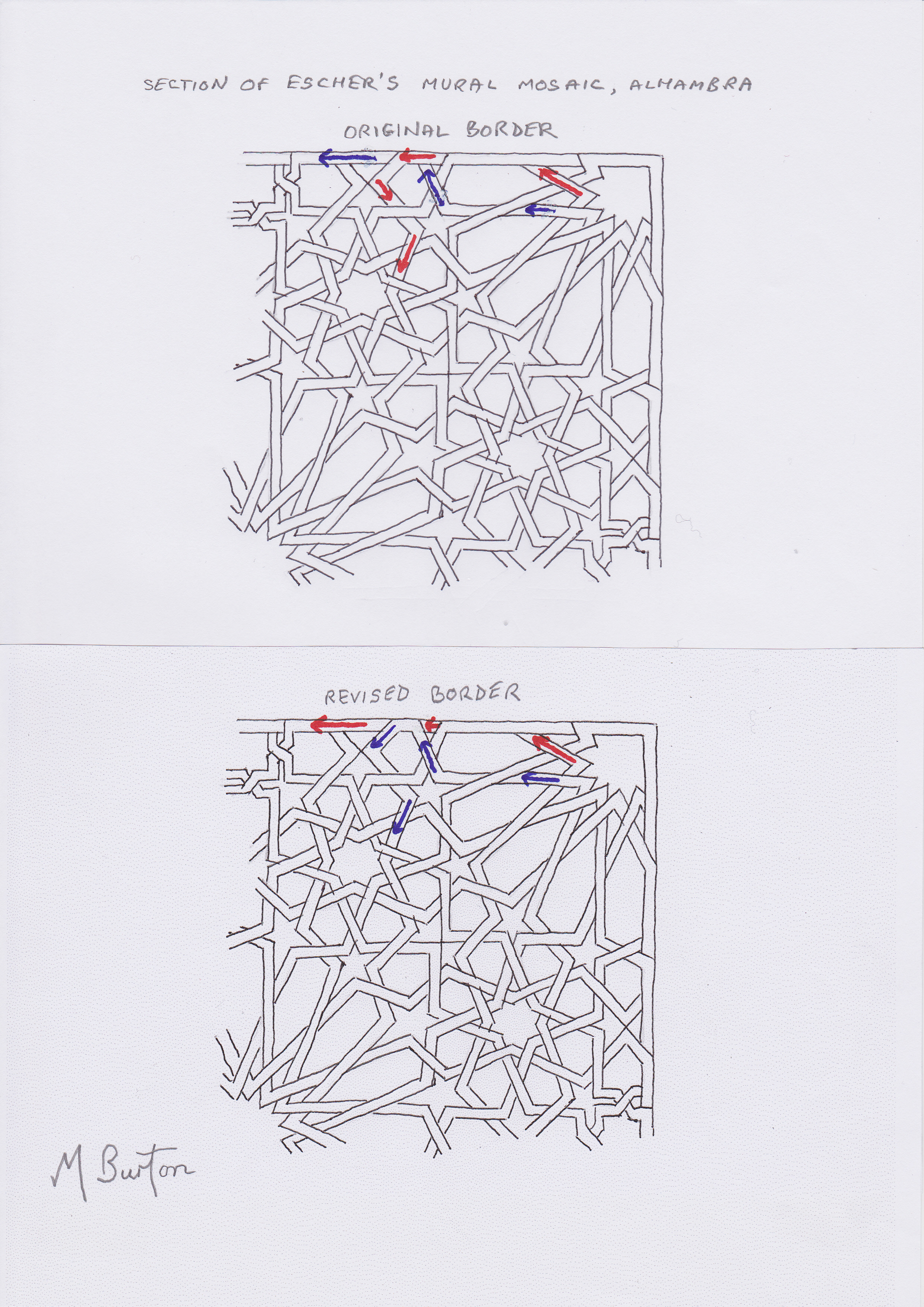
To show how this change is reflected in the Border, here is a before and after “Spot the difference” comparison which I have drawn.

Change of Border on Escher Mosaic to enable one continuous line. Mick Burton study.

Change of Border on Escher Mosaic to enable one continuous line. Mick Burton study.

As you can see, the difference between having two continuous lines and one is just a couple of flicks of a pen. Obviously, the artist would have known there was a one continuous line option and that he could have done it without losing any design or colouring options.

Presumably, the artists were required to retain overall symmetry above all else, including in the Border.  Eric Broug has also informed me that continuous line drawing is very rare in Islamic geometric design. 

I think that the Artist chose two continuous lines in the Mural Mosaic to demonstrate that he was only one step from having one line, and he made sure that the Border was drawn so that this change opportunity (which occurs on each of the four sides)  was as simple as possible.  He is saying “I could easily have drawn One Continuous Line ! “

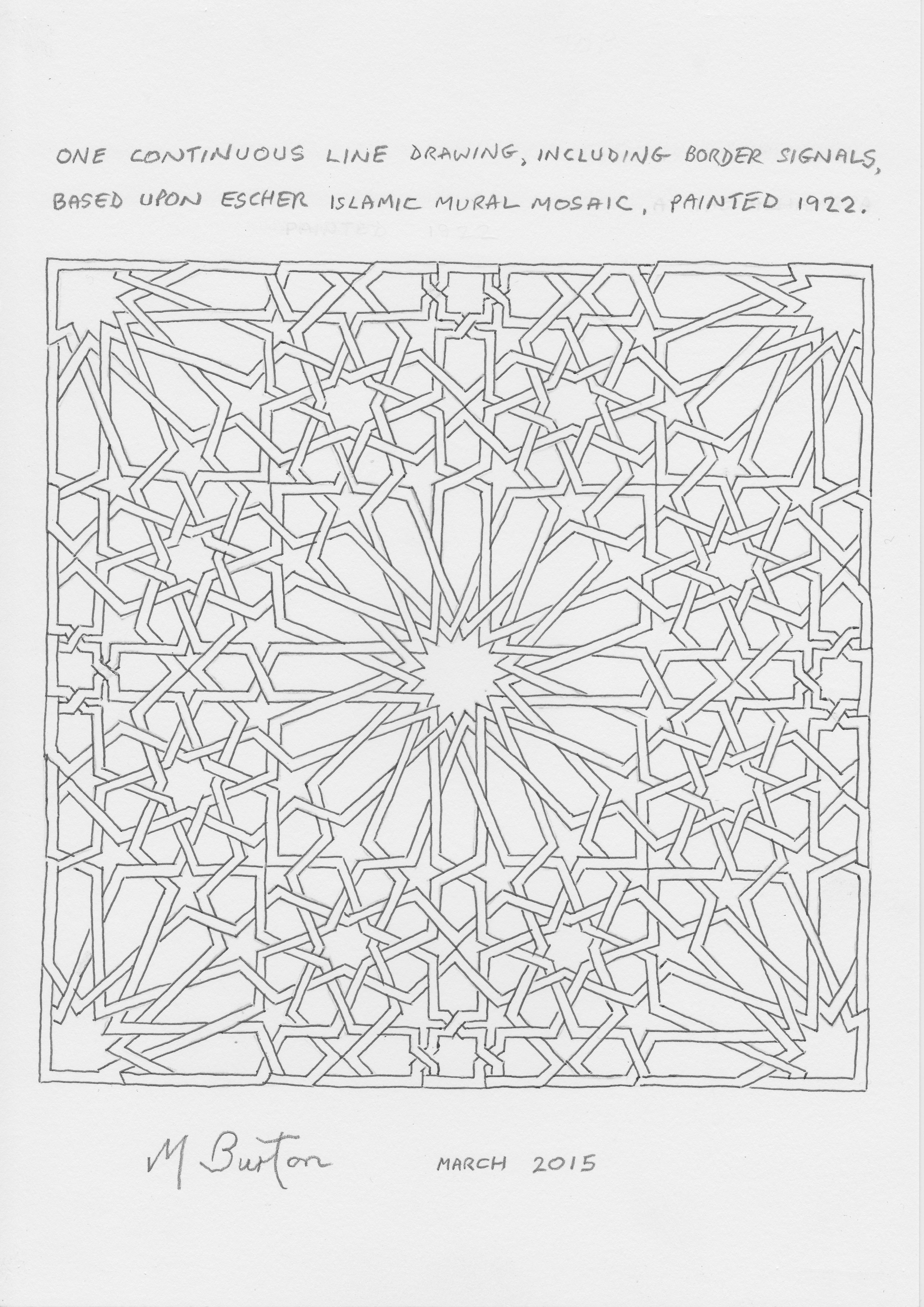
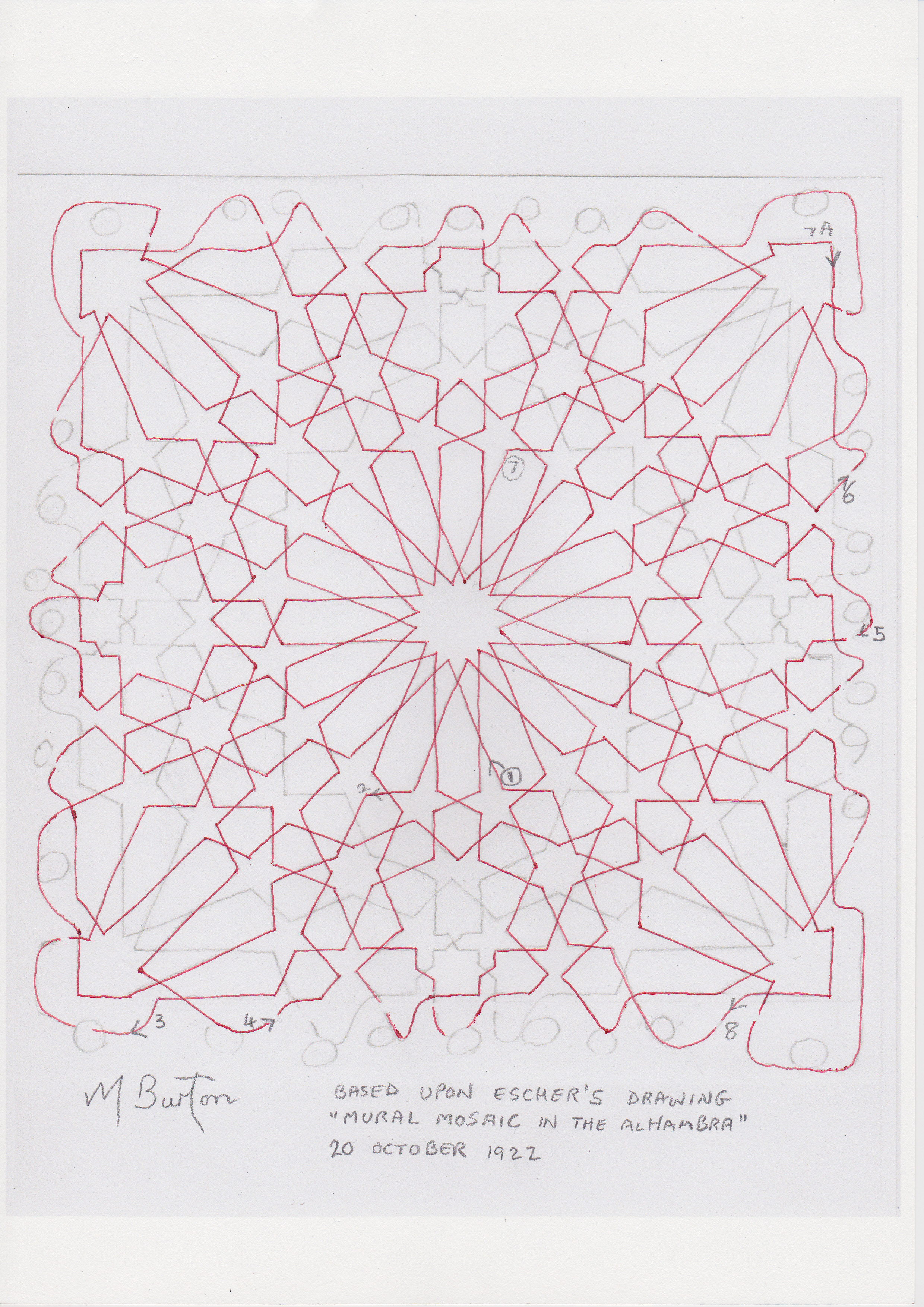
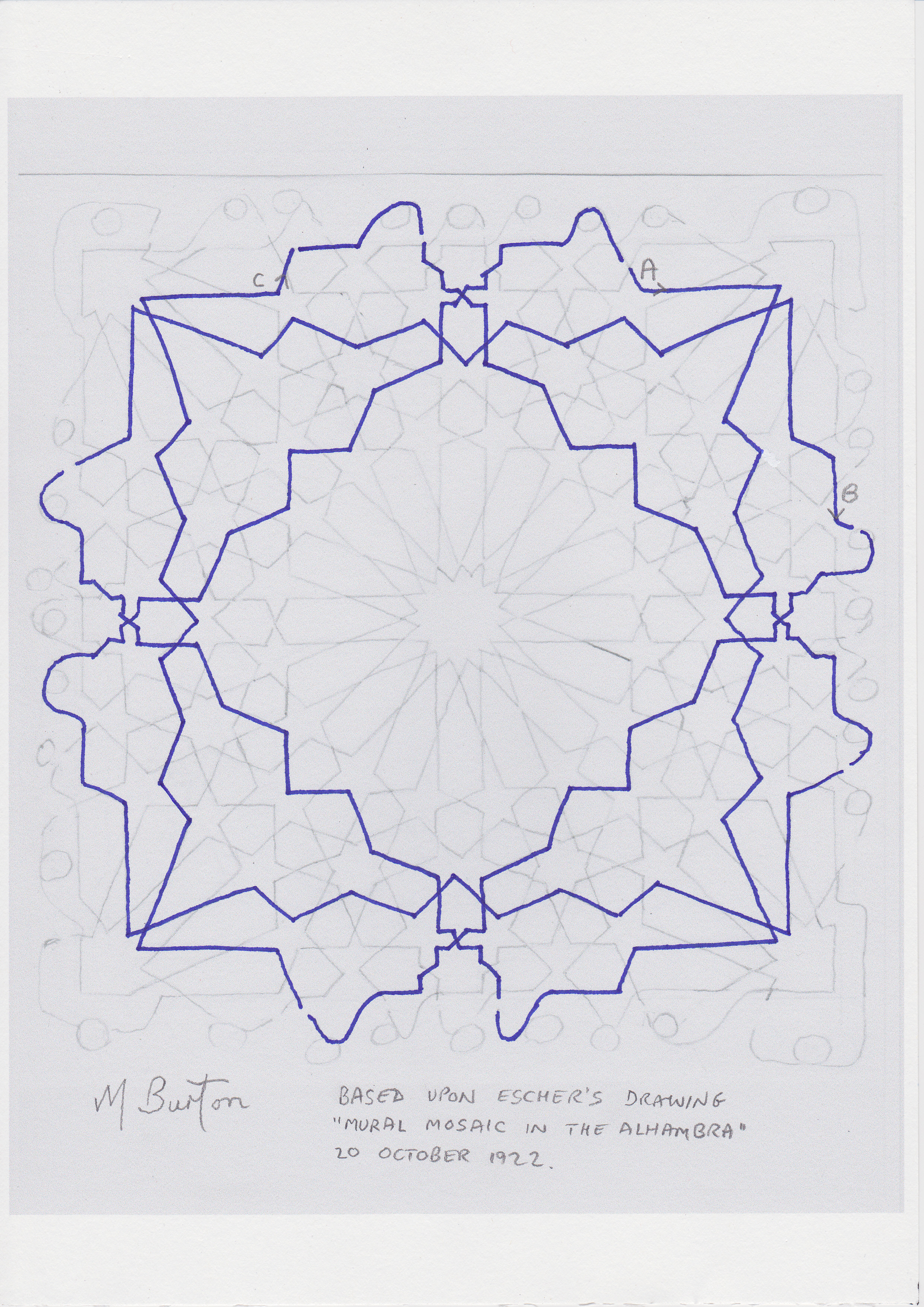
After completing my research into the Escher painting, and explaining the one continuous line alternative, I realised that I needed to draw the single continuous line myself.  Here it is.

One Continuous Line Drawing, including Border signals, based on Escher Islamic Mosaic. Mick Burton, March 2015.

One Continuous Line Drawing, including Border signals, based on Escher Islamic Mosaic. Mick Burton, March 2015.

 
This completes my five STAGES of explaining my thoughts on Escher’s terrific painting, in 1922, of the Islamic Mural Mosaic in the Alhambra.  I hope you found this abstract continuous line it to be interesting and stimulating.

Finally, I would like to thank Margaret Graves, Assistant Professor of Islamic Art and Architecture at Indiana University, for her encouragement and guidance after I completed my research.

Escher Islamic Mosaic Continuous Lines, Create and Change Border. STAGE 4.

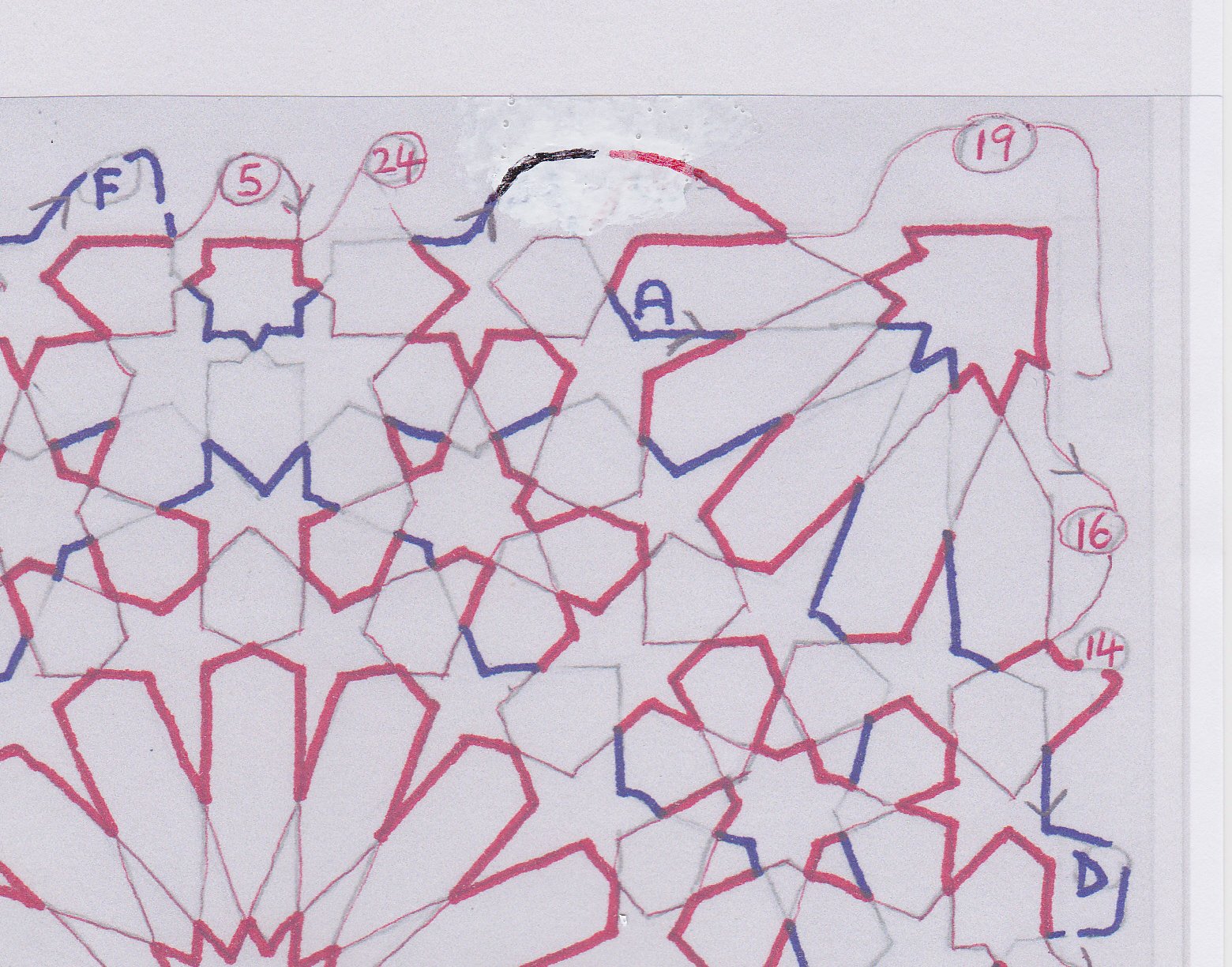
A key part of the Mural Mosaic tile painting by Escher in 1922, is that he has included the Border in detail. The Border gives an indication of what happens to the lines when they hit the sides and where they feed back into the design. In the quarter section detail of the mural below you can see marks on the Border.

A line leaving the design either joins the border (so that you can follow where it goes) or goes under the border (and you can deduce where it re-emerges).  It is not easy to work all these paths out at first, but there is a logic to it.  If in doubt between two choices, one of them usually has a clear answer leaving only one option for the other.  Another aid to us is that each side of the Border is identical in the same direction around the design, so if the marks are not clear on one side you can check at a corresponding point on another side.

Detail to show Border. Escher mural mosaic in the Alhambra. WikiArt. Mick Burton study.

Detail to show Border. Escher mural mosaic in the Alhambra. WikiArt. Mick Burton study.

.
When I first started this research I did a basic hand copy showing all the lines hitting the sides and then showed each one as a loose end outside the square.  I then studied the border on the Mosaic to work out how all the loose ends should be joined up and charted them – this initial chart was in STAGE 1, and I show it again at the end of this post.

That was relatively easy, observing the result of what artist had done.  The hard bit is working out  from scratch which loose ends to tie up to produce continuous lines in a way which would still enable the colours to be allocated by the Alternate Overdraw (or equivalent process used by the artist).

According to Eric Broug in his demonstration video’s, the tile rectangle containing the design would be selected out of a larger pattern area.  In my own art, when I have drawn a large continuous line pattern and completed the Alternate Overdraw (so that I know the colour sequence everywhere) I can pick out a small section to display which of course already has the Alternate Overdraws.  Similarly, the Islamic artist producing the Mosaic would know the full colouring etc for the tile section.

I show below the design with all the loose ends and Alternate Overdraws in Red.  At this stage the artist would not know how many continuous lines would occur in the tile section on its own.  He will have also needed to produce a straight edge on the corners and other parts of the perimeter to block unwanted lines which encroached from the outside pattern.

Section of larger pattern with Alternate Overdraws and loose ends showing whether overdrawn. Mick Burton study.

Section of larger pattern with Alternate Overdraws and loose ends showing whether overdrawn. Mick Burton study.

You will see from the loose ends that half of them are overdrawn in Red and half not. If you connect up pairs of the overdrawn, and pairs of the not overdrawn, loose ends then there will be continuous lines throughout the design and the Alternate Overdraw Template will be unaffected. If I connect up the not overdrawn pairs around each corner of the design, then working along the sides both overdrawn pairs and not overdrawn pairs work out consecutively. This matches the line direction message in the Border on the Mosaic design.  Here is a chart (previously in STAGE 1) showing all the loose end connections.  We know from STAGE 1 that there are two continuous lines, which makes the case strong regarding the artist using Alternate Overdraw, but it would not have mattered if there were more than two.

Escher Islamic Tile. Basic line structure, with border connections. Mick Burton continuous line study.

Escher Islamic Tile. Basic line structure, with border connections. Mick Burton continuous line study.

Having looked at Borders in detail, that prepares us for the final STAGE 5 where I show how we can turn this into a Single Continuous Line design.  

I will also give you my opinion on what the original Artist thought about a Single Continuous Line and why I think he is definitely an Artist and not just a craftsman.

Mick Burton Continuous Line Blog.

Colour Sequence Allocation on Escher Islamic Mosaic Continuous Lines, STAGE 3.

Now that we have applied my Alternate Overdraw to the Continuous Lines in the Escher Islamic design, I can show how I allocate colours.  We can then compare the result with the colours on the original Islamic design painted by Escher in 1922.

My basic method of allocating colours is covered in my Post on 27 September 2014 entitled “Colour Sequence on Continuous Line Drawing”.

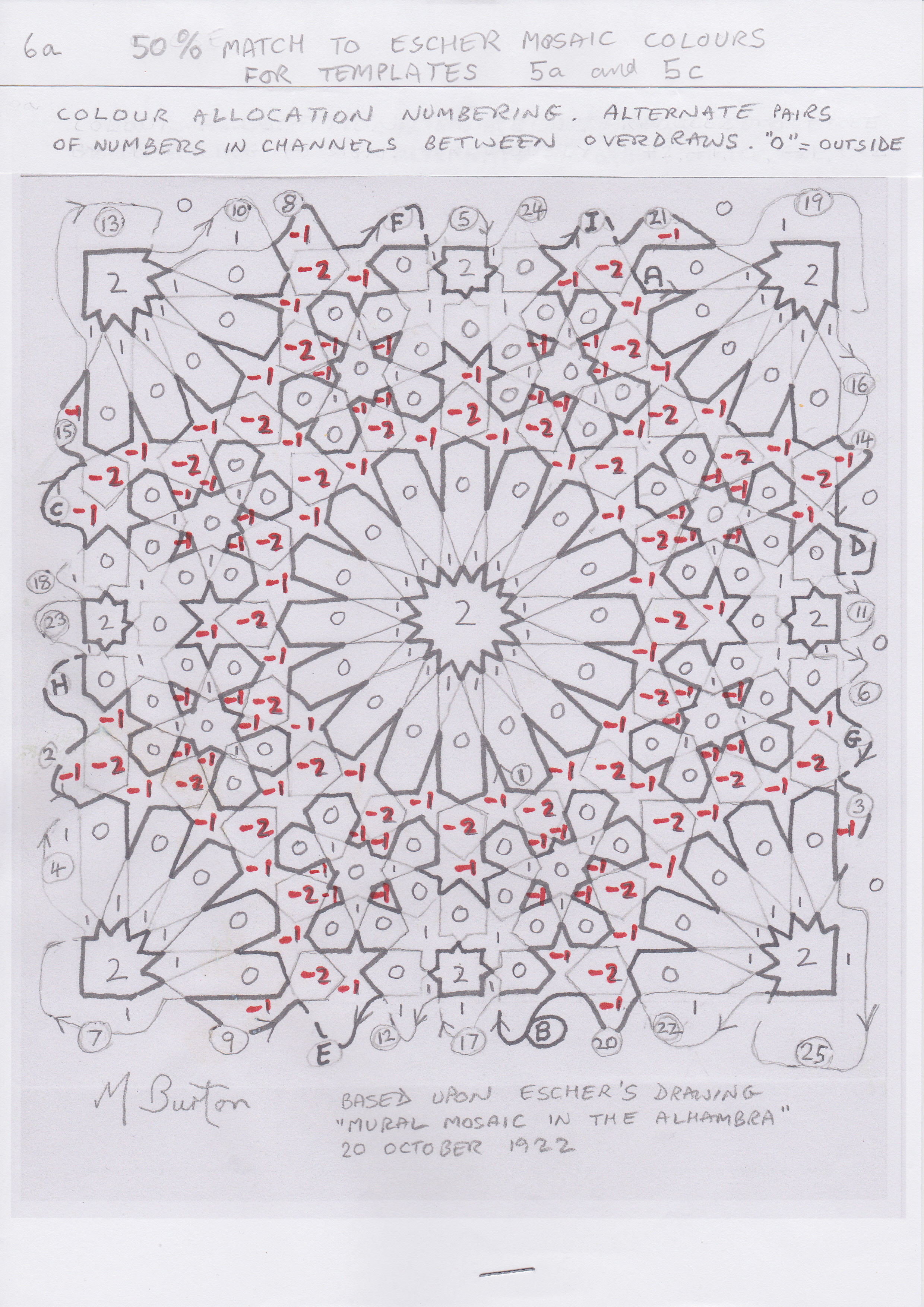
I will start with that same basic process where colour “0” is the outside of the drawing and this is alternated with “1” in its channel or channels.  When we cross through an overdraw from a “1” area we allocate “2” to this adjacent area on the other side and then alternate this with “3” (if there are any) in that channel.  In the negative direction, if we go from a “0” area through an overdraw we will allocate “(-)1” and alternate with “(-)2” in that channel.

Five colour number allocation on continuous lines for Escher Mosaic. Mick Burton study.

Five colour number allocation on continuous lines for Escher Mosaic. Mick Burton study.

There are no areas coloured “3” and so we have 5 colours allocated, compared to only 4 colours used in the original Mosaic.

At this stage things did not look promising.  Trying to equate the 4 original colours in the Mosaic to my 5 numbers produced a best set of matches of 156 out of 313 (I won’t go into much detail here) which is just under 50%.

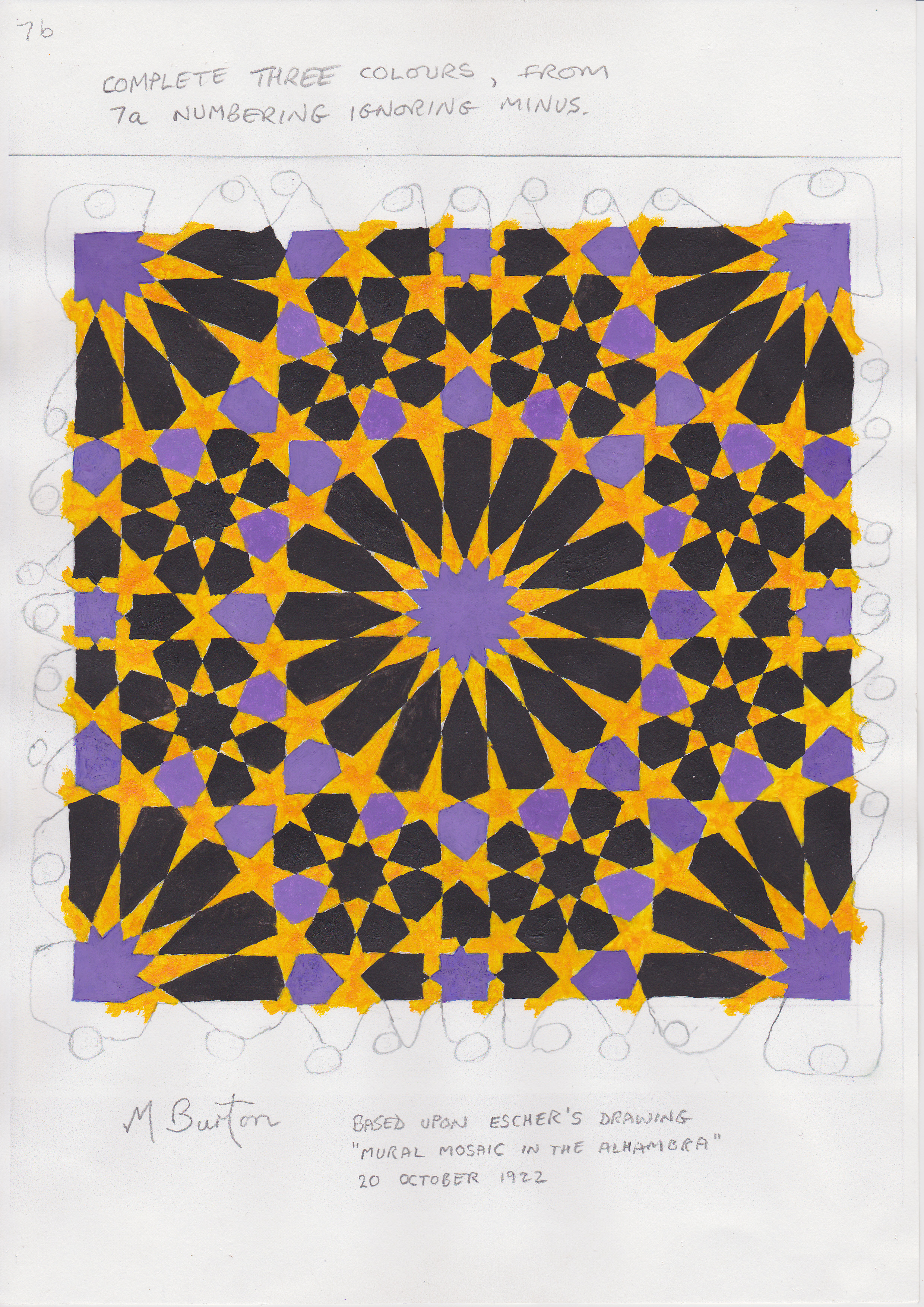
One thing that I did observe was that YELLOW matched “1” on 76 occasions and “(-)1” on 88 occasions.  This reminded me that I occasionally allocate colours positively by ignoring (-) signs.  When switched to simply using “0”, “1” and “2” I had 3 numbers to compare with the 4 original colours on the mosaic.  This now produced a best match of 241 colours out of 313 which gives 77% and was much more respectable.  Here is the 3 colour allocation.

Colour sequence allocation of 3 colours to continuous lines on Escher Mosaic. Mick Burton study.

Colour sequence allocation of 3 colours to continuous lines on Escher Mosaic. Mick Burton study.

Of course the fourth colour GREEN used in the mosaic does not appear at all in mine.

As with a lot of art, including craft, there may be processes (or even rules) which get you a long way in a design but you have to know when, and how, to break away from them.  I may be a bit rigid with my Continuous Lines but my studies of Picasso and Dali doing them demonstrates that nothing is certain.

This Islamic artist, who I regard as very special, probably used a method equivalent to mine to allocate most of his colours but probably made the following over riding decisions to finish the colouring off –

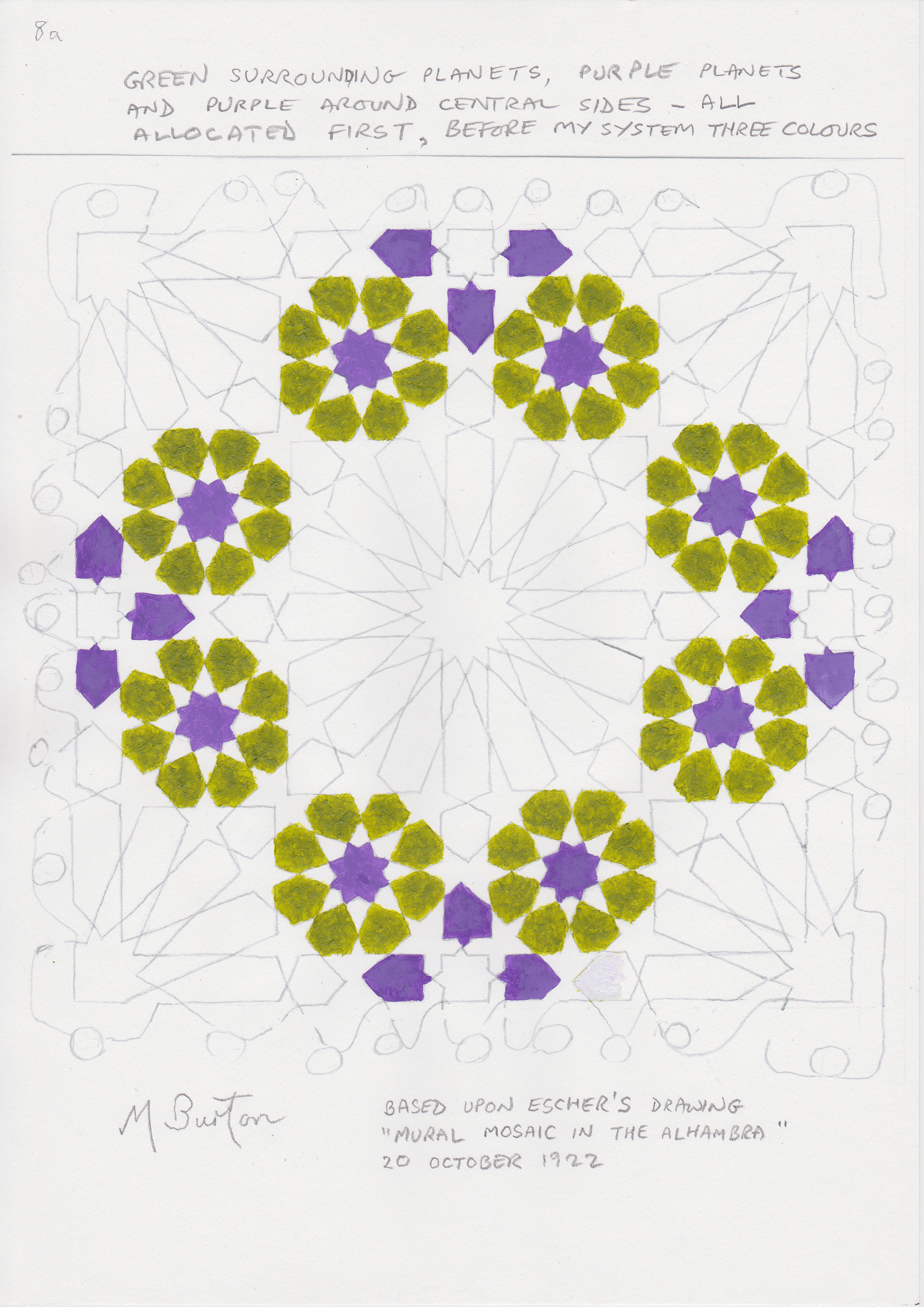
a.   GREEN was allocated to the 8 areas surrounding each of the 8 planets, and nowhere else.

b.  Each of the 8 planets was coloured PURPLE, instead of black, to mirror its use for the centres of the Suns.

c.  Each Purple junction block at the middle of each side has three directional areas surrounding it which are coloured PURPLE instead of black.  I originally considered these to be decorative.

Allocation of all green colours and changes of black to purple on Escher Mosaic. Mick Burton study.

Allocation of all green colours and changes of black to purple on Escher Mosaic. Mick Burton study.

If the above decisions were made first, then the remaining allocations would be made totally on my 3 colour allocation.  That is 229 areas remaining where my allocation matches 100% with the original Escher Mosaic colours.

229 colour sequence areas matching original Escher Mosaic colouring. Mick Burton study.

229 colour sequence areas matching original Escher Mosaic colouring. Mick Burton study.

So there we are. I hope you have found my attempt to explain how this Escher Islamic Mosaic contains two continuous lines, which I believe was deliberate by the artist, and how most colours matched a colour sequence directly linked to the continuous lines.

The basic elements in the design largely match the template produced by my Alternate Overdraw method and, after specific allocation decisions were made by the artist, there was a total match of all other colours allocated by my method using the template.  Whether of not the artist used a similar method to myself, there is a direct link between the colour sequence and the two continuous lines.

In my searches through other forms of art, on the look out for continuous lines, I have not found any other example of art which contained both continuous lines and a related colour sequence, or signs of possible use of Alternate Overdraw with its Template.

There is a modern mathematical theory called “The Winding Number Theory” which could allocate colours in an equivalent way to my initial 5 colours, but it is not as much fun.

I will do a FURTHER POST (STAGE 4) on how the artist could have used Alternate Overdraw to help him to connect up the loose ends on the borders when actually constructing his continuous lines.

Mick Burton Continuous Line Blog.

Alternate Overdraw Applied to Escher Islamic Mosaic Continuous Lines, STAGE 2.

Escher painting 1922 of Islamic Mosaic tile at the Alhambra. WikiArt. Continuous line study by Mick Burton.

Escher painting 1922 of Islamic Mosaic tile at the Alhambra. WikiArt. Continuous line study by Mick Burton.

Before applying my Alternate Overdraw, which I use to allocate colours to Continuous Lines, I will give you my analysis of the colours in the original Mosaic and what I feel were the artist’s ideas behind the design.

Eric Broug states, in his YouTube demonstration “How Grids and Patterns Work Together” that this is a 16 point star surrounded by 8 point stars.  Geometrically you can produce stars with many different numbers of points.  Having done many planetary paintings myself, I feel that the original artist has realised that in this case we have a central Sun and 8 planets surrounding it which can represent our solar system (we can ignore Pluto as a planet as it only featured as such for a part of the last century).  The colours the artist uses reflect many aspects of this planetary situation –

a.  YELLOW is used as the colour for the flaming surfaces of the central Sun and the corner Suns.  All other yellow areas have star like shapes and represent distant stars peppering the background.

b.  PURPLE is used for the centres of the Suns and the 8 Planets.  Purple is also used for the lines of areas along the sides, vertically and horizontally from the centres of the sides and diagonally (the lines of purple areas may simply be decorative).

c.  BLACK is used for the “fan blade” shapes emanating from the Suns.  In my planetary paintings I often use black for the background outside a drawing and for the gaps through the  drawing .  The artist here could be using the same idea, so that the blades are in fact deep space seen beyond the Suns.

d.  GREEN is used to surround each Planet and I interpret this as representing life on each Planet, not just ours.

The process for completing an Alternate Overdraw is covered in my Post dated 10 September, 2014  (9/10/2014)  entitled “Alternate Overdraw on Continuous Line Drawing”.

In the previous post, STAGE 1, I showed that there are two continuous lines in the Mosaic.  I apply my Alternate Overdraw to produce a template for me to work with to allocate a colour sequence.  I have to bear in mind that there are 2 Overdraw results and 1 colour sequence for a single continuous line and 4 Overdraw results and 2 colour sequences for two continuous lines.

My experience tells me that the Alternate Overdraw, which will produce a Template best representing this Planetary composition, will have –

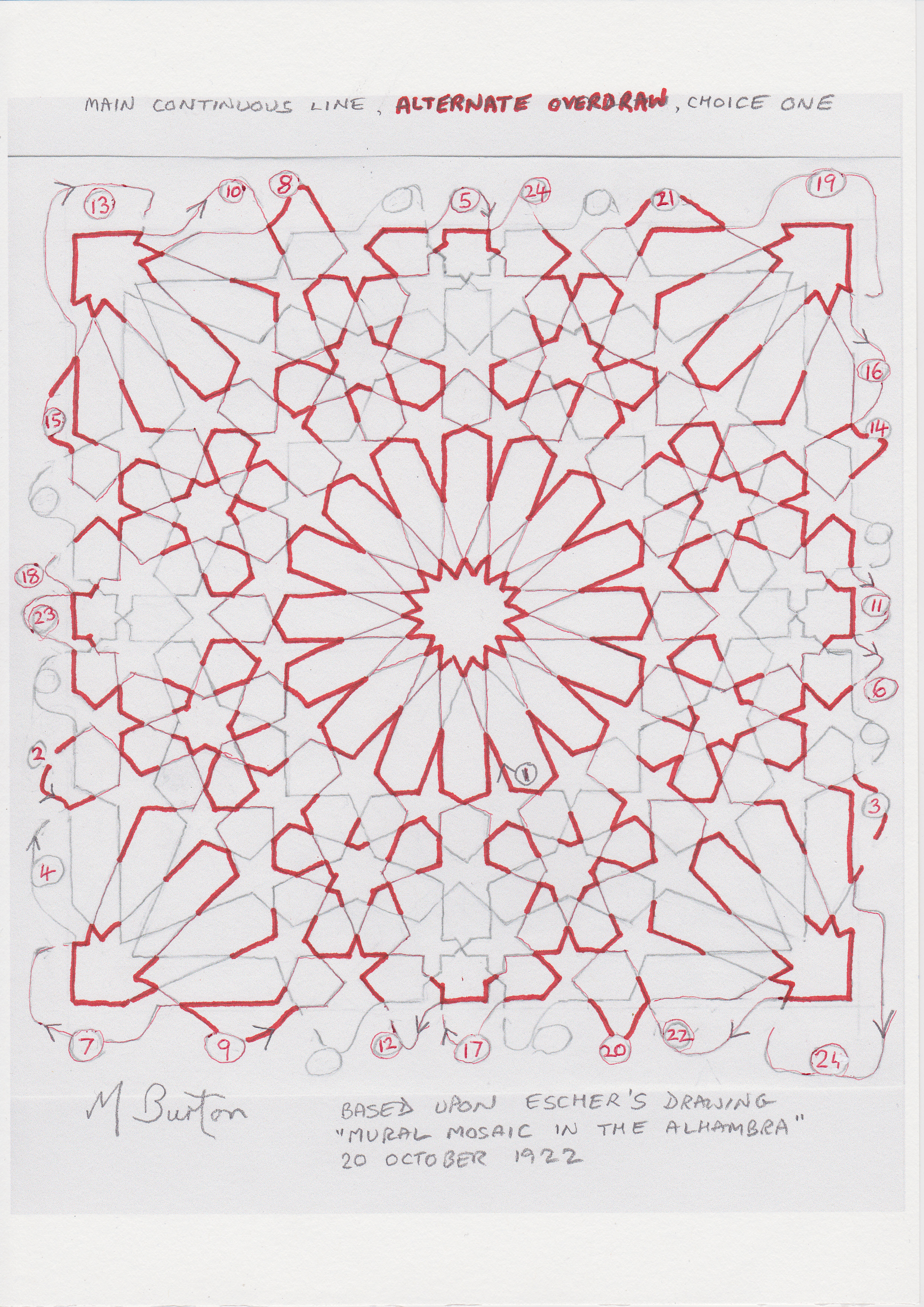
a.  An Overdraw for the Main continuous line commencing by overdrawing (in Red) a side of a fan blade of the central Sun, and

b.  An Overdraw for the Minor continuous line commencing by overdrawing (in Blue) a side of a fan blade on a corner Sun.

Main continuous line, Alternate Overdraw, choice 1. Mick Burton, Escher Mosaic study.

Main continuous line, Alternate Overdraw, choice 1. Mick Burton, Escher Mosaic study.

Minor Continuous Line, Alternate Overdraw in Blue, Choice 1. Mick Burton Escher Mosaic study.

Minor Continuous Line, Alternate Overdraw in Blue, Choice 1. Mick Burton Escher Mosaic study.

The aim  of the Alternate Overdraw is to create channels within the design where two colours can be allocated alternately within each channel and that adjacent channels have different pairs of colours.  An overall sequence of colours then follows across channel boundaries.

My experience told me, at this stage, that my colour sequence was likely to match the original Mosaic in and around the five Suns, but less so elsewhere.

I will show my attempts at allocating corresponding colours in the NEXT POST.  I will also explain why I feel that the original artist may have used the Alternate Overdraw or an equivalent method.

Mick Burton Continuous Line Blog.

Continuous Lines in Escher Islamic Mosaic painting, STAGE 1.

Escher painting 1922 of Islamic Mosaic tile at the Alhambra. WikiArt. Continuous line study by Mick Burton.

Escher painting 1922 of Islamic Mosaic tile at the Alhambra. WikiArt. Continuous line study by Mick Burton.

I look for continuous lines in all forms of art.  I first saw this design in my daughter Kate’s book “Escher, The Complete Graphic Work”, by J.L. Locher.   We are both long term admirers of this artist.  Escher did this detailed painting  in 1922 when in Granada at the Alhambra, and its quality really hit me.  It was of an Islamic mural Mosaic tile,  which was made up of those geometric lines which are often seen in Islamic art, and I assessed it for continuous lines.  

I could see that the overall symmetrical  pattern and I saw that Escher had painted the design BORDER, which seemed to indicate what happened to the lines after they hit the sides of the square.  I then worked out, from the Border Pattern, that the lines were fed back in the same routes on all four sides of the square.  From the point of view of finding a single continuous line, in my experience, such overall symmetry of the structure meant that it was very unlikely that there was only one line. 

Here is the basic structure which I arrived at, which shows the “wiring” connections indicated by the border.  Let’s see how many continuous lines there are.

Escher Islamic Tile. Basic line structure, with border connections. Mick Burton continuous line study.

Escher Islamic Tile. Basic line structure, with border connections. Mick Burton continuous line study.

When I traced over the lines I found that there were in fact two continuous lines making up the whole design.  Here are the two results, a Main continuous line (in red) and a Minor one (blue).

Main continuous line, one of two. Escher Islamic tile design. Mick Burton continuous line study.

Main continuous line, one of two. Escher Islamic tile design. Mick Burton continuous line study.

Minor continuous line, 2nd of two. Escher Islamic tile design. Mick Burton continuous line study.

Minor continuous line, 2nd of two. Escher Islamic tile design. Mick Burton continuous line study.


By experimenting with border changes, a bit like swapping wiring connections, I did come up with a single continuous line, but the borders were no longer symmetrical.  It seems likely that the artist realised that two continuous lines was the best he could hope for whilst retaining overall symmetry.   In a LATER POST I will show how a border can be “tweaked” by a slight alteration to make one continuous line in the mural mosaic, and how this answer is achieved.  I will also show how the artist is likely to have worked out how to achieve two continuous lines by connecting up the correct loose ends.

I now needed to know  “How important continuous lines were, within this design, to the artist?”   It could be that Continuous Lines were incidental to other aims, or they may have been of prime importance.

In my NEXT POST I will apply my Alternate Overdraw technique to produce a Template of closed lines, which I use to decide upon the colours to allocate.   I will also suggest what the artist’s ideas were for the design and his colour selection.  In a FURTHER POST you will see how my colour allocation compares with the original colours and to what extent I feel that my ideas were the same or similar to those used by the artist.

All this has been done without any reference to the construction of the original line structure.  I have taken the completed structure as a starting point to apply my ideas.  I did not research in any detail on Islamic line construction, until after my whole study was completed.

I have recently found YouTube demonstrations by Eric Broug entitled “How to Draw a Mamluk Quran Page” and “How Grids and Patterns Work Together”, which gave me a good insight into pattern construction and include an explanation of a larger tile containing this Escher Mosaic design as a section.  This is a fascinating process used by the Islamic artists over 500 years ago.  Otherwise, I have not found any reference to borders, colouring, or specific meaning of this design.

Possibly my ideas will generate a new view on aspects of the creation of this and other Islamic designs. 

Mick Burton, Continuous Line Blog. Continue reading

Winding Number Theory and Continuous Line Drawing


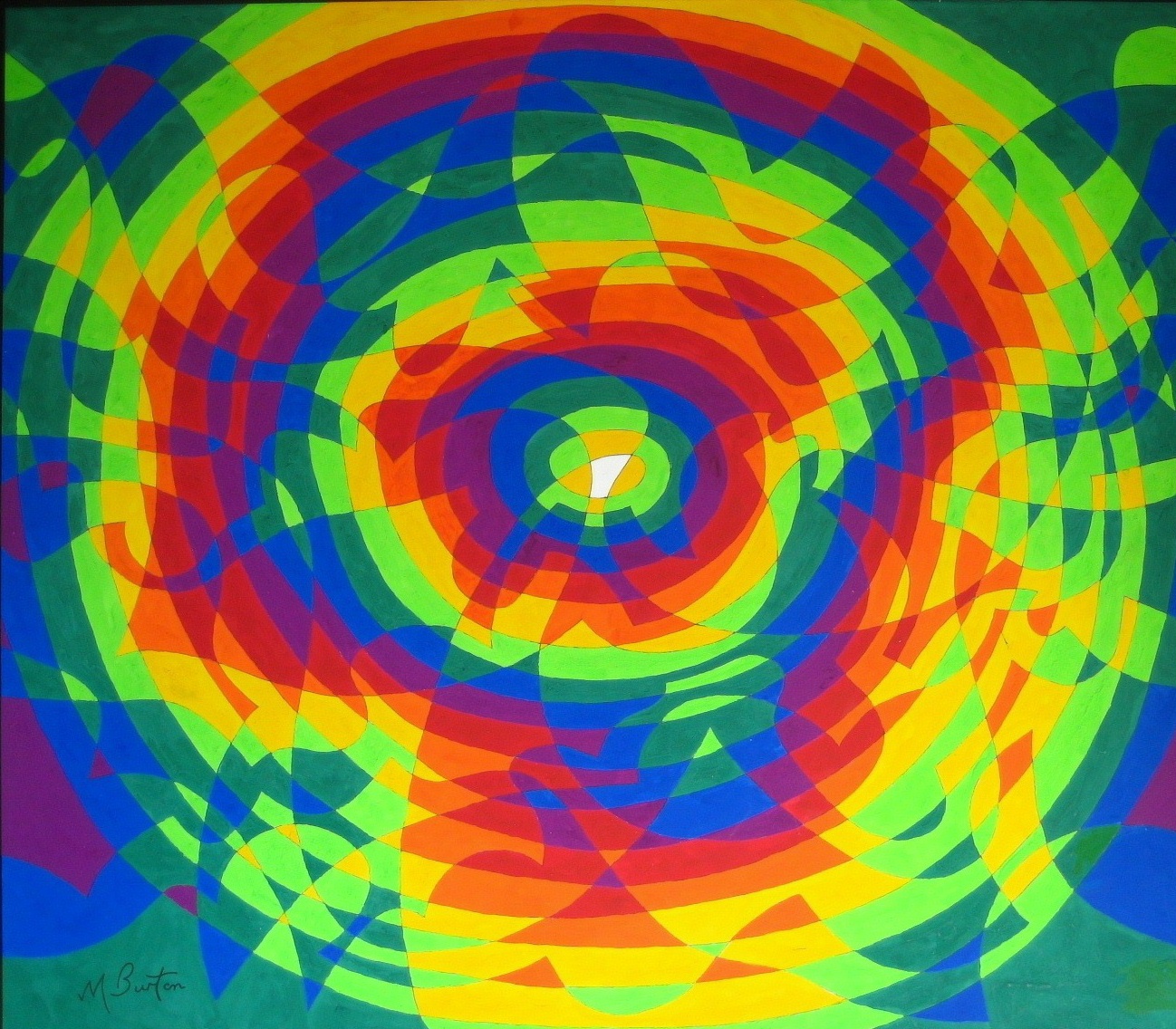
Whirlpool in Space, or Petrol Poluted Puddle. Spherical continuous line with repeat colour sequence with Rainbow colours. Mick Burton, Continuous Line, 1971.

Whirlpool in Space, or Petrol polluted Puddle. Spherical single continuous line drawing with repeat colour sequence with Rainbow colours. Mick Burton, Continuous Line, 1971.

This painting was one of two pictures hung at the Chelsea Painters Open Exhibition, held at the Chenil Galleries, Chelsea,1971.  I walked along the Kings Road looking for the gallery (I had submitted through and agency) and it was great to see the Whirlpool first in a window by the entrance.

The design was triggered by a browse through mathematics books in the library and coming across Winding Number Theory.  This used a continuous line and every time the line was drawn winding in a counter-clockwise direction a level was added and if you wound back in a clockwise direction a level was taken off.

So far, in my colour sequence numbering based upon Alternate Overdraw, I had not had a sequence of colours greater than about nine.  If I used the Winding Number method and continued to wind around counter-clockwise many times I could have a long colour sequence.  I went a bit mad with the Whirlpool, which was done on a spherical basis (allowing drawing out of one side of the paper and back in at the opposite side), and has a sequence of 20.

I did not simply go from light to dark over the whole 20 (the steps in shade between each colour would have been too small), but oscillated up and down with a smaller range of colours similar to a rainbow.  I had seen the rainbow effect produced by sunlight on petrol spilt on a puddle.

Alternate overdraw with colour sequence numbers. Continuous Line, Mick Burton.

Alternate overdraw with colour sequence numbers. Continuous Line, Mick Burton.

To illustrate the difference between my Alternate Overdraw and the Winding Number, I start with the Alternate Overdraw in Red on the left.  As shown in earlier posts, each channel of areas between overdraws has two numbers alternately.  You move naturally up to a higher channel or down to a lower channel, through the red line and continue the numbering.

As before, you start with “0” on the outside and 0 can also appear within the drawing.


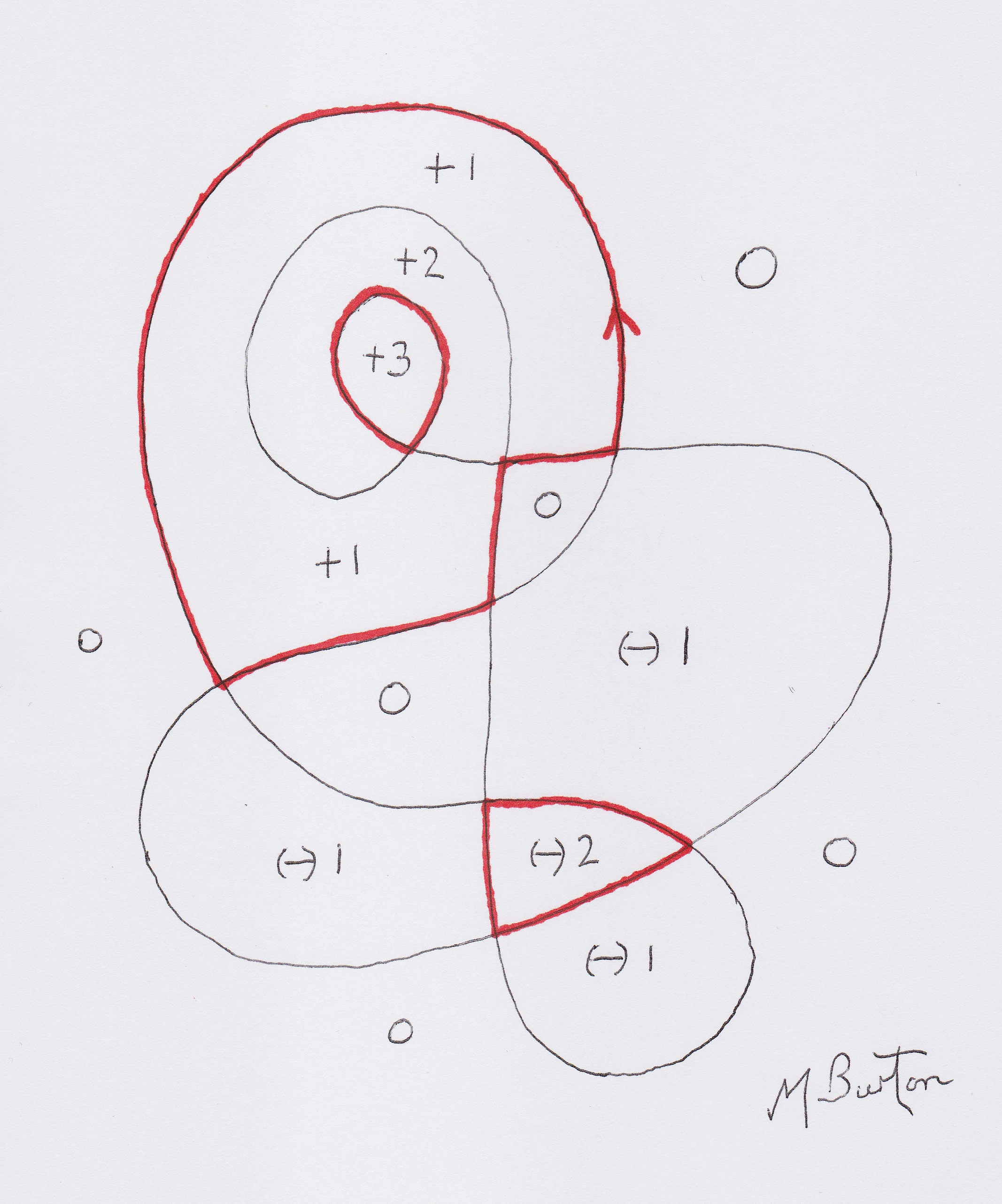
When we come to Winding Number allocation, we can use the same basic drawing with little arrows showing the direction it has been drawn.  It can be either direction of course, but I have chosen one which will match the result above.

Winding number allocation. Continuous Line, Mick Burton.

Winding number allocation. Continuous Line, Mick Burton.

Starting at “0” for the outside, if we cross to another area through a counter-clockwise border for that area, it will be a level higher.  If we cross through a clockwise line we reach a lower area.

Here the + areas are of course higher levels and the (-) areas are lower.

The numbering matches the Alternate Overdraw illustration above.


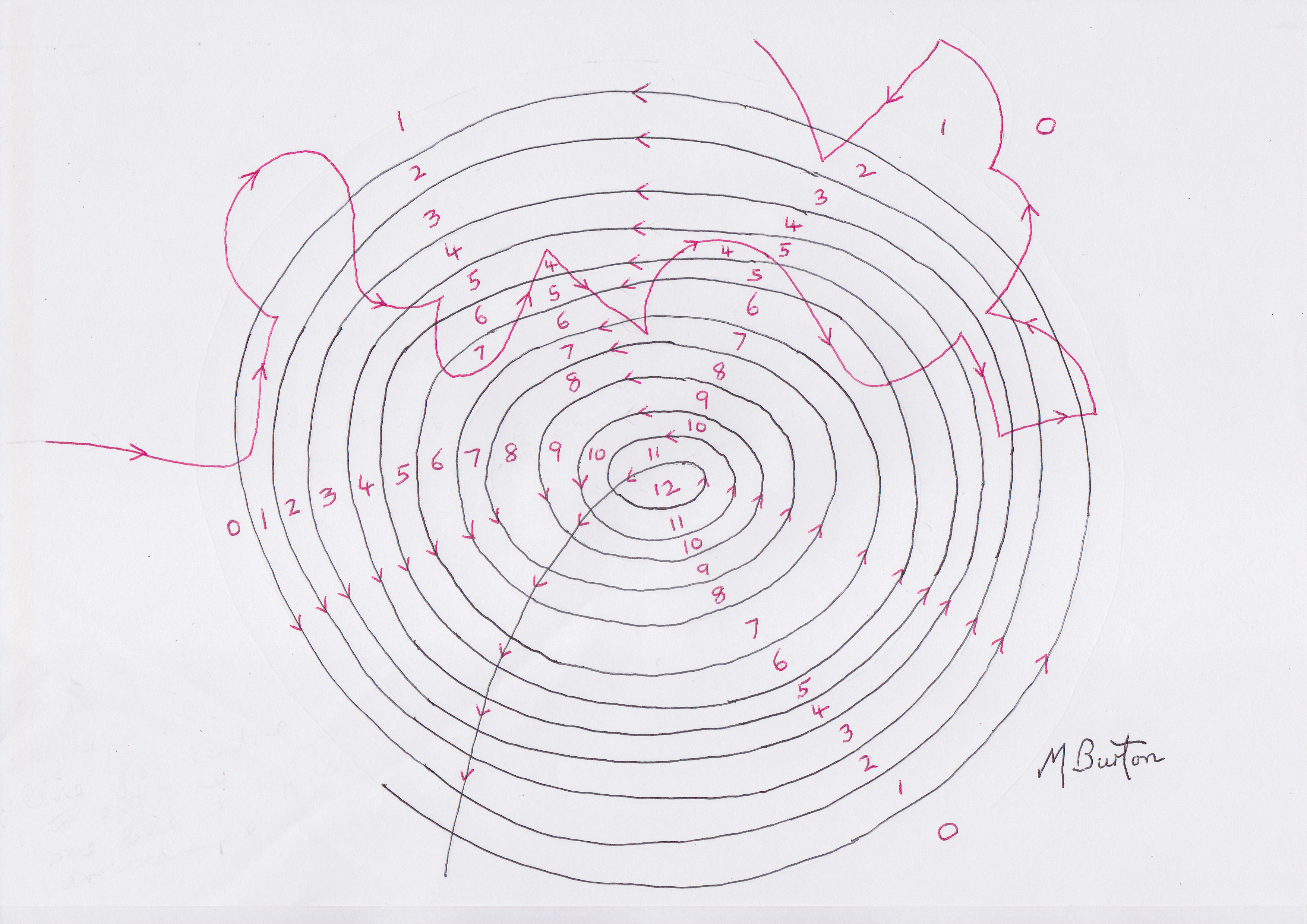
Now, just to show the initial thrust of the drawing for the Whirlpool, with many levels, the next illustration shows a line spiralling from the centre outwards and I have shown just 13 winds.

Part of initial Winding Number spiral for Whirlpool painting. Mick Burton, continuous line.

Part of initial Winding Number spiral for the Whirlpool in Space painting.    Mick Burton, single continuous line drawing.

Then I have drawn a line from the centre of the spiral directly back to the bottom of the picture as the first phase of breaking up the spiral so that lots more areas start to  appear.  The next such phase is a meandering line near the top of the picture. 

As I have said, this is a shorter version than the one usd for the main Whirlpool in Space picture above.

Next I have decided that the direction of  the line will be counter-clockwise starting from the bottom of the spiral, so that the levels go up towards the centre.  The numbers have then been added.

On the original painting, which is 24″ x 20″, I used alternate overdraw to allocate the colours.  This was because I was used to using that method and I think it is better for an artist anyway.  The Winding Number theory was simply the inspiration for producing a sequence of 20 or more.

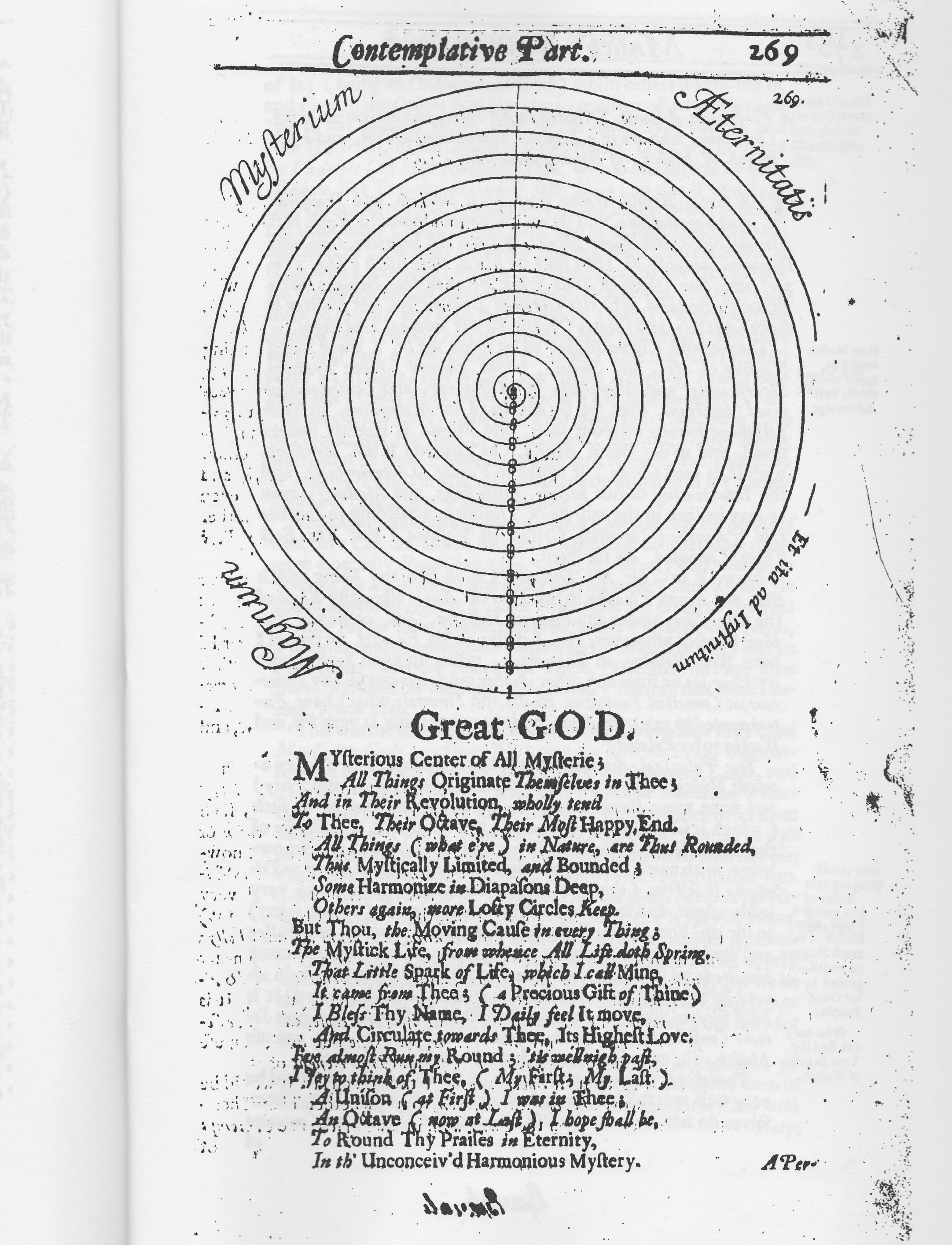
Now, to go off at a tangent, I am interested in other artists in the family who keep coming to light.  As part of my research into my mother’s family, the Mace’s from Bedale (from 1825) and much earlier from Cambridge, I have come across a book by Thomas Mace called “Musick’s Monument” published originally in 1676.  It was published again about six years ago.  Amongst his own illustrations within the book is this one of a spiral depicting his idea of God’s world.


“Mysterious Centre of All Mysterie…” in Musick’s Monument, by Thomas Mace, 1676. Continuous Line, Mick Burton.


Thomas was a famous composer of the 17th century, and craftsman who made lutes and viols, whose main job was a chorister at Trinity College, Cambridge.

To add to this “sort of” co-incidence, my Uncle Harry Mace from Bedale, North Yorkshire, was a joiner and builder.  When he retired he started to make old style instruments, such as viols, and sold them to a music shop in Leeds.  I am sure he did not know about Thomas of Cambridge.

Thomas was not too impressed with a relatively new instrument in his time, the violin.


Continuous Line Drawing Alternate Overdraw embedded image.


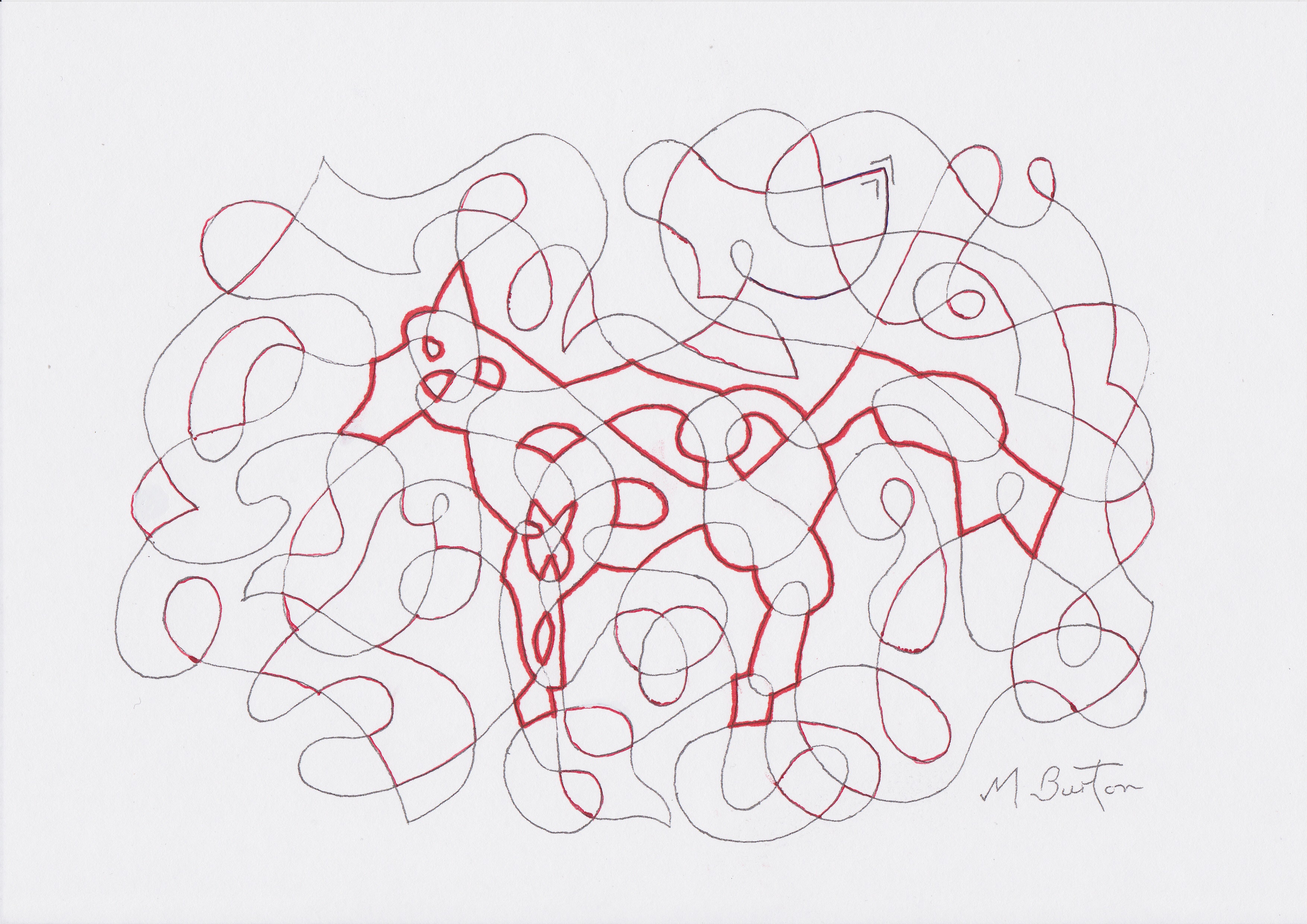
Abstract before Alternate Overdraw  embedded Dog appears.  Mick Burton, Continuous Line.
Abstract before Alternate Overdraw embedded Dog appears. Mick Burton, Single Continuous Line Drawing.


Here is an abstract Continuous Line Drawing which conceals an image of a dog.  Possibly you can see some clues as to where the outline of the dog is.  The idea is to carry out an Alternate Overdraw along the line throughout the picture which will produce the image of the dog.  Start the overdraw with the arc marked with chevrons.

After I developed Alternate Overdraw in 1970, which enabled me to allocate my colour sequence to continuous line drawings, other possibilities started to occur to me.  The first was that you could hide an image of an animal within what looked like a totally abstract continuous line drawing.

See below how the dog finally appears.  In fact it looks a bit like Ben, who we have been looking after this week.

Alternate Overdraw embedded dog appears.  Mick Burton, Continuous Line Drawing.

Alternate Overdraw embedded dog appears. Mick Burton, Single Continuous Line Drawing.

The start of the process was to sketch a simple dog outline and then , knowing that the outline had to include many crossing lines, I broke the outline down into short lines or arcs which were at an angle to each other.

Next, I needed to run lines through the dog, from various directions, which used these arcs.  For it to work, there had to be an odd number of arcs in each line which went across the dog, between each two outer arcs.  This was so that, after completion, when you drew an alternate overdraw across the dog, both arcs on the outline were overdrawn.  This would result in all the arcs around the outline being overdrawn, thus forming one loop of overdraw. 

Within the body of the dog, several overdraw loops were also formed.  Similarly in the background a number of overdrawn loops and inner loops resulted. 

Of course, trial and error is involved in connecting up all the loose ends (of the lines running through the dog) to achieve a single continuous line through the whole drawing.

Finally, having completed a continuous line, I needed to check that there were no obvious sections which would indicate that an animal was in there. 

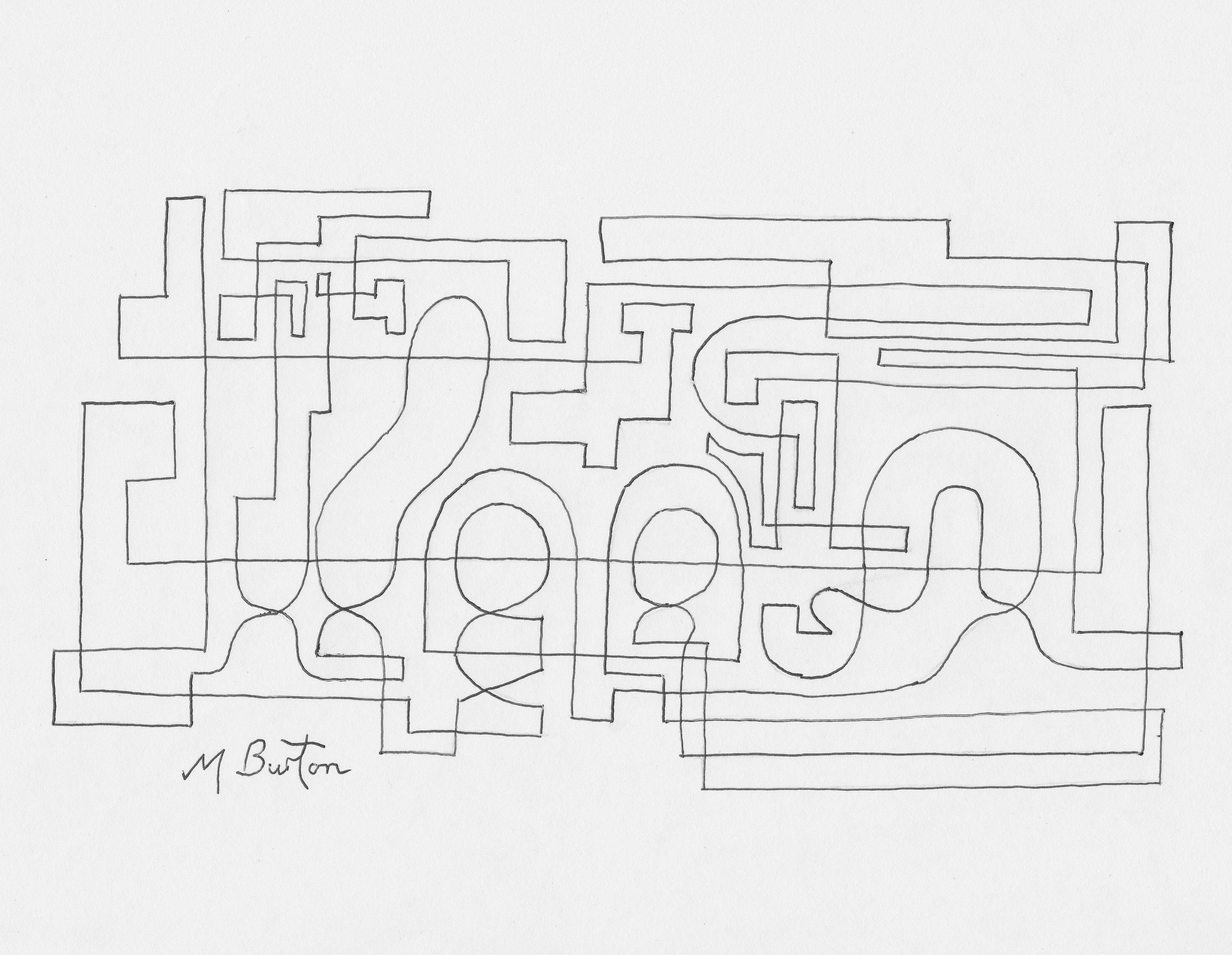
I did one more embedded image in 1970 before moving on to other things.  This time, instead of making the abstract continuous line from flowing curves with no straight lines, I decided to use mostly straight lines and right angles.

Abstract before Alternate Overdraw embedded steam engine appears.  Mick Burton, Continuous Line Drawing.

Abstract before Alternate Overdraw embedded steam engine appears. Mick Burton, Single Continuous Line Drawing.


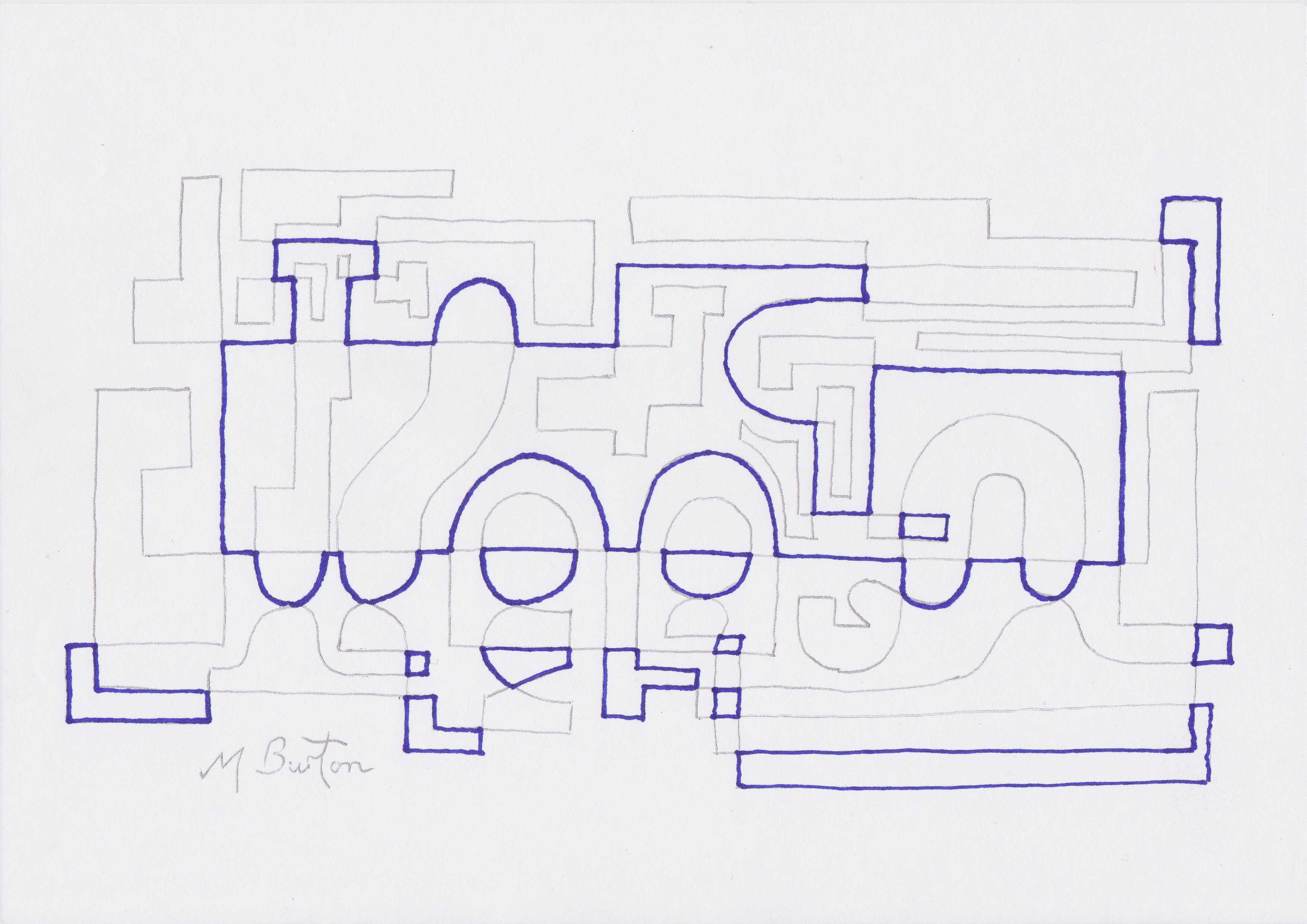
This time I  was concealing a steam engine and the Alternate Overdraw result is shown below.

Alternate Overdraw embedded steam engine appears.  Mick Burton, Continuous Line Drawing.

Alternate Overdraw embedded steam engine appears. Mick Burton, Single Continuous Line Drawing.


As always with my various styles, I wonder who else may be using them  and whether they were in use long ago.

Colour Sequence on Continuous Line Drawing

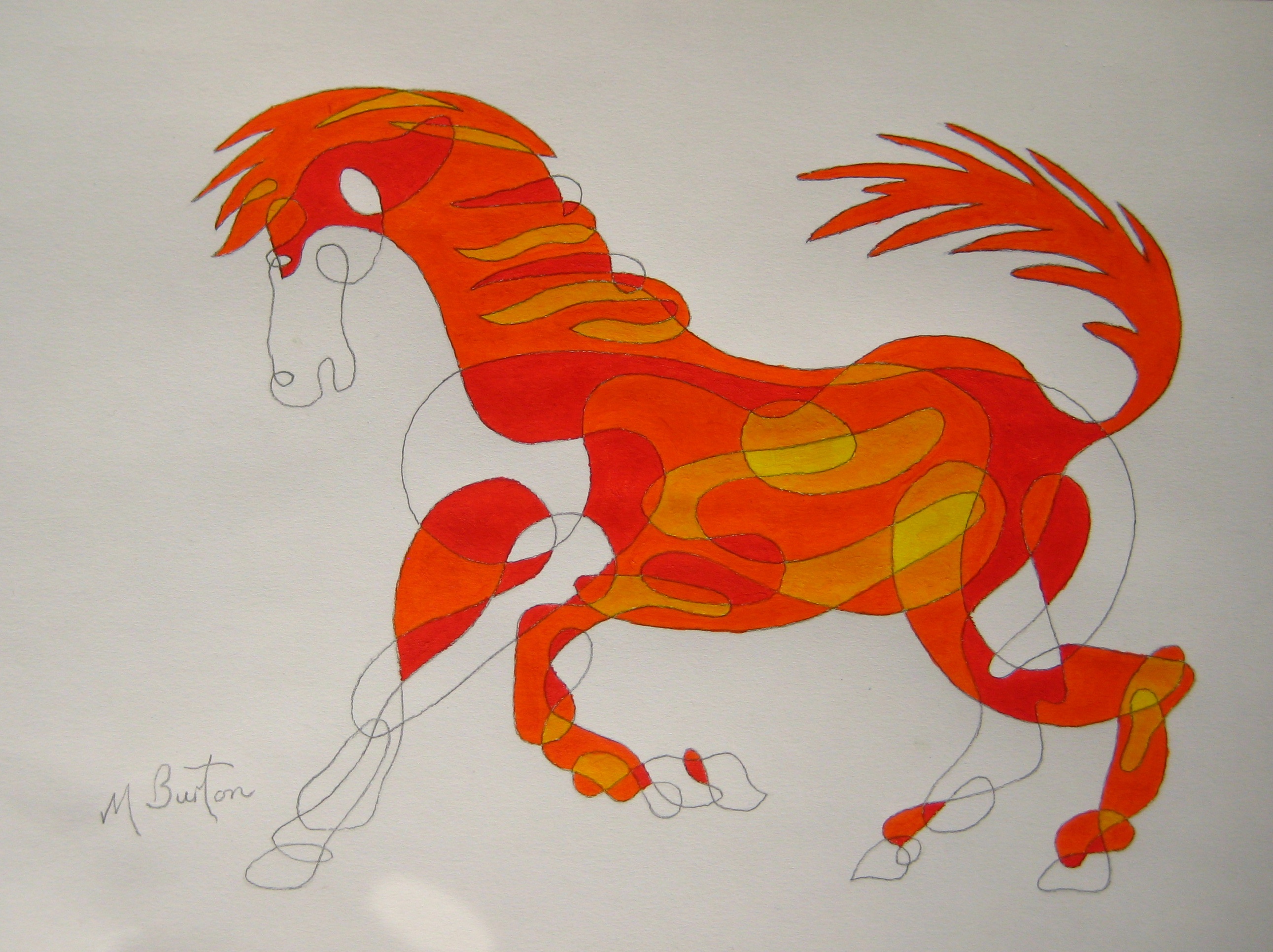
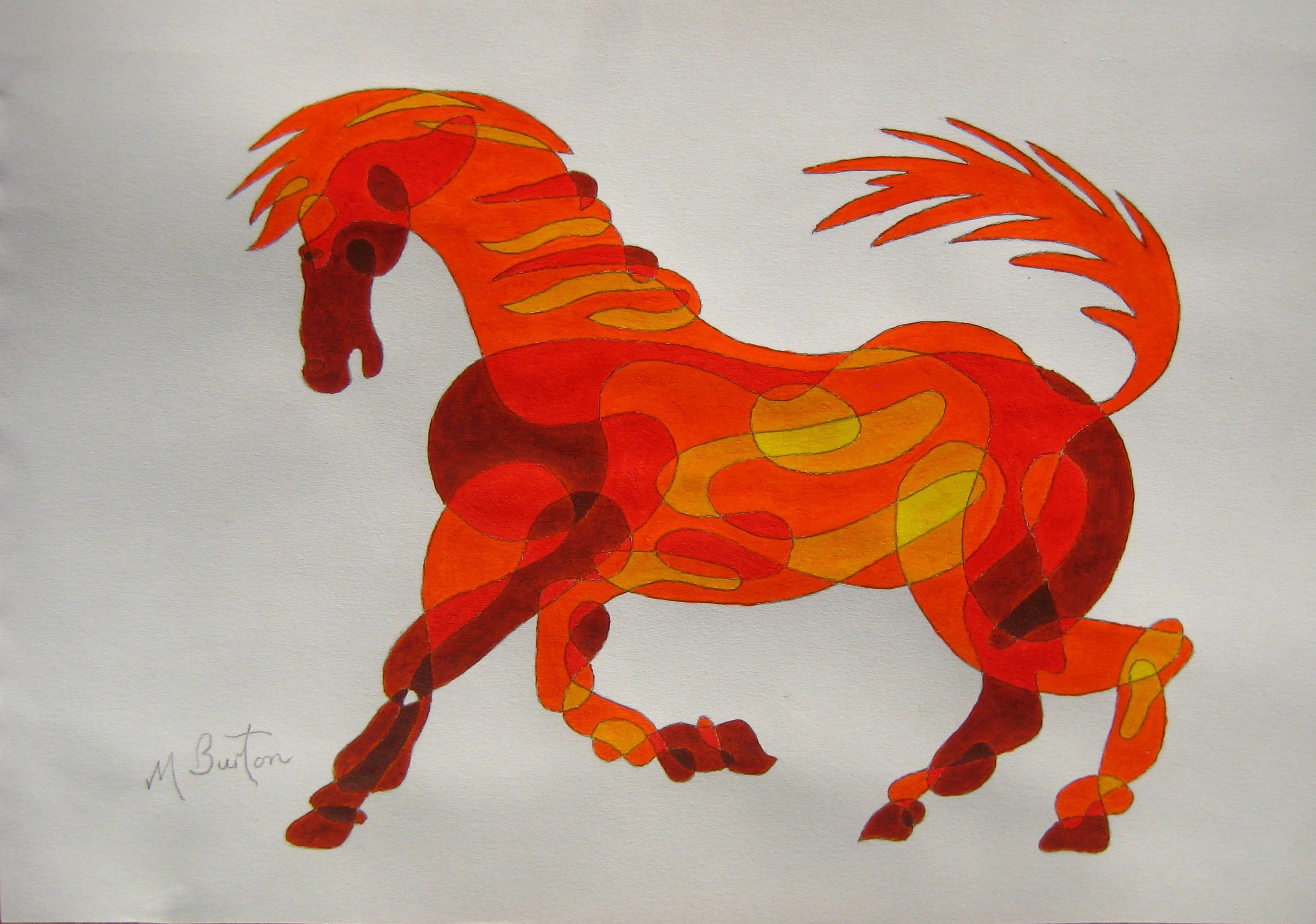
Fig 1. Completed Colour Sequence on Continuous Line Drawing of horse. Mick Burton, Continuous Line Blog.

Fig 1. Completed Colour Sequence on Single Continuous Line Drawing of horse. Mick Burton, Continuous Line Blog.

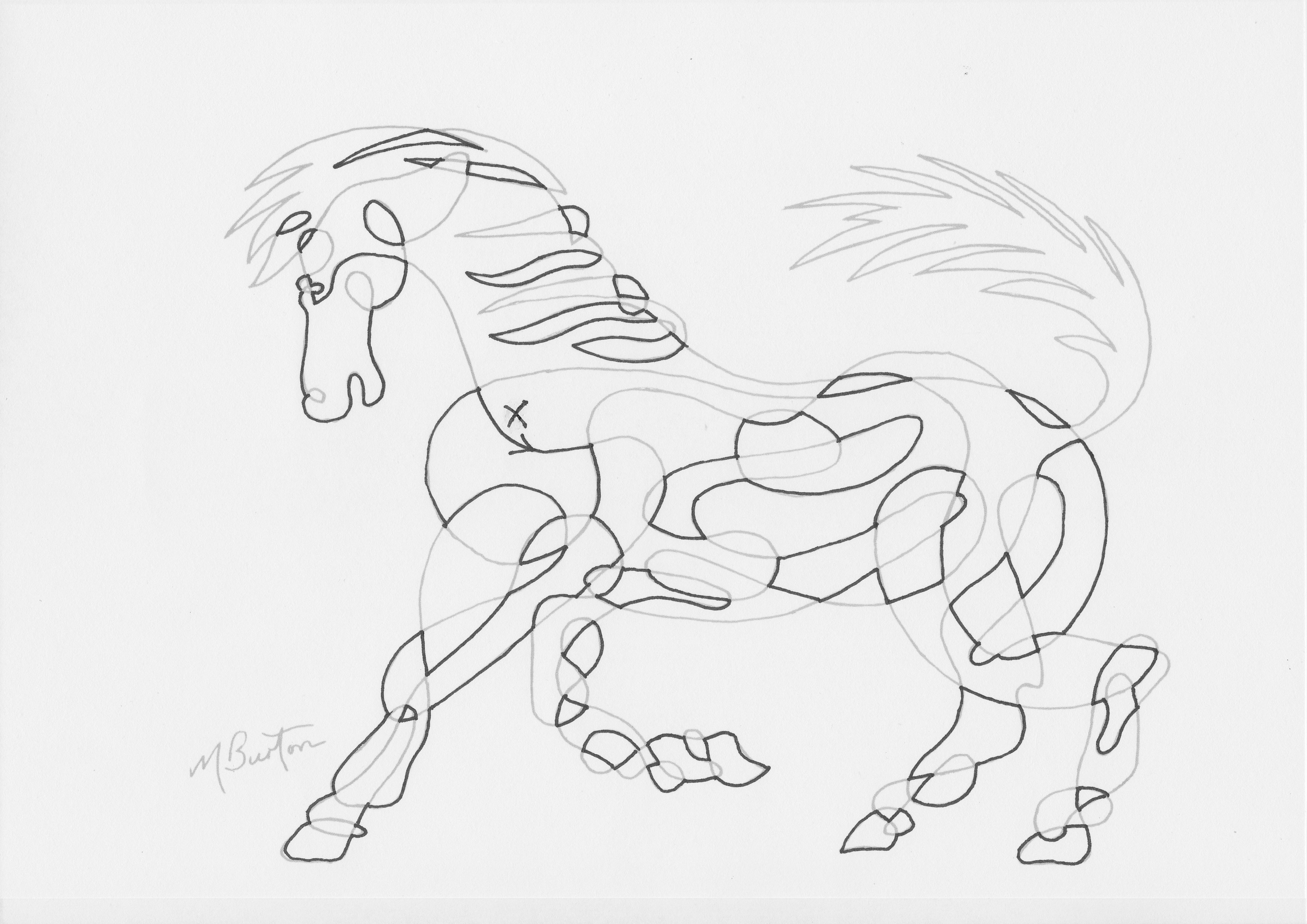
How do I apply Colour Sequence to my Continuous Line Drawings, which I first developed in the late 1960,s ?  In my last blog post, about Alternate Overdraw of My Continuous Lines, I pointed out that Colour Sequence was the next stage and so here we go.  I will now show the stages involved in completing the colouring of this Horse.
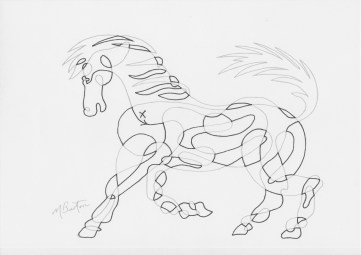
Other Alternate Overdraw on Continuous Line of horse.

Fig 2. Alternate Overdraw on Single Continuous Line Drawing of the Horse, as the first stage of Colour Sequence. Mick Burton, Continuous Line Blog.

From the two Alternate Overdraw examples in the previous post, I have chosen Fig 2 commencing at point “X” for this example (either “A” or “X” would result in the same colour sequence).

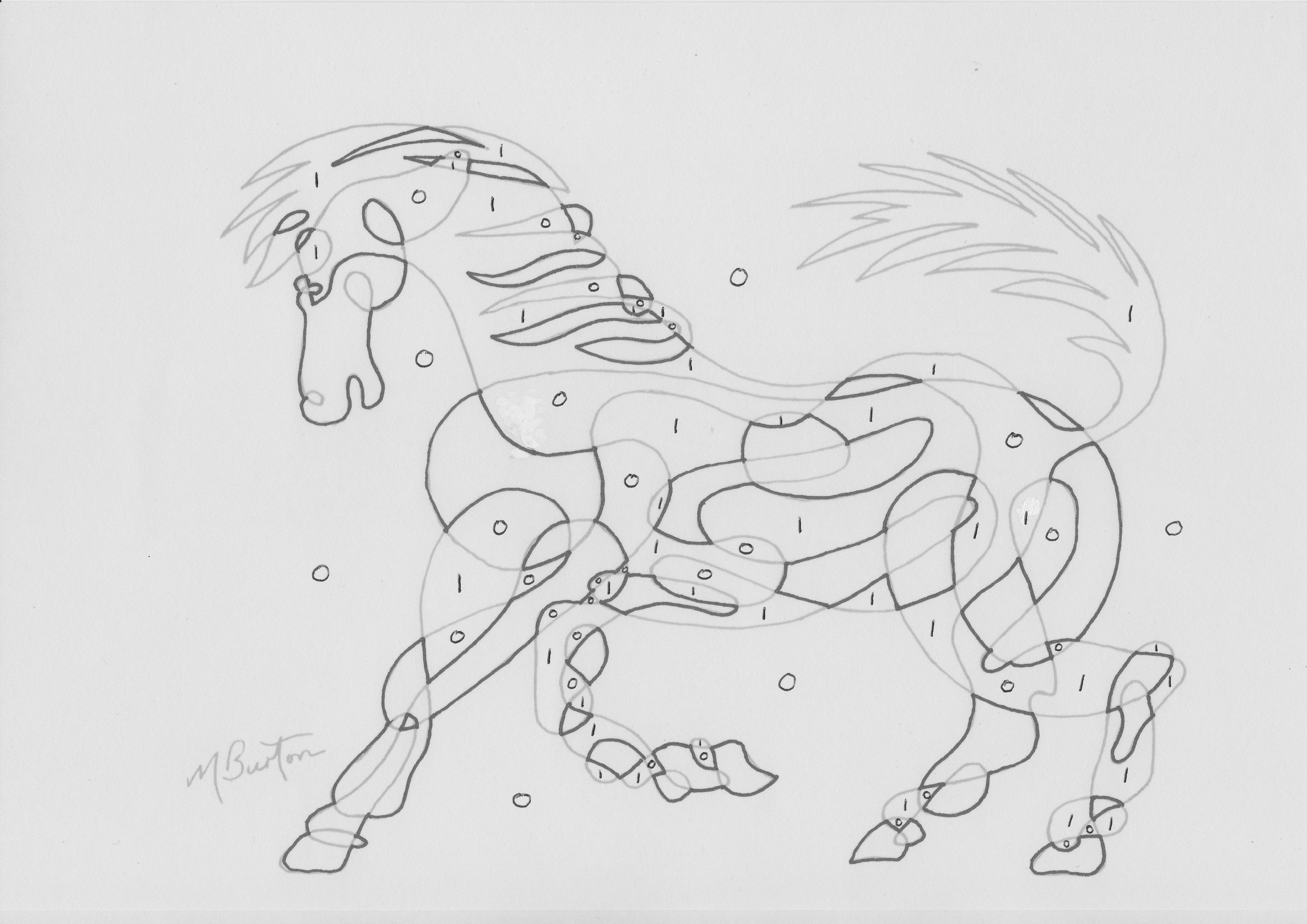
We are going to number all areas of the drawing, commencing with the background which will be numbered “0”.  In this example the background will remain uncoloured but “0” will also occur within the drawing and have a colour. 
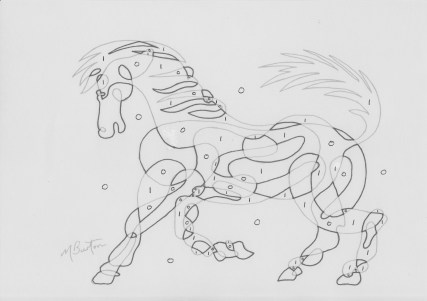
Fig 3. Initial numbering (0 and 1) of channels between Alternate Overdraws on the Continuous Line Horse.

Fig 3. Initial numbering (0 and 1) of channels between Alternate Overdraws on the Continuous Line Horse.

You will notice that between all the closed lines, formed by the Alternate Overdraws, there are channels of areas.  These can be completely numbered alternately by only two numbers, which in this case are 0 and 1.  So, starting with 0 on the background, work through all these linked channels, see Fig 3.  This also sets the direction of the number sequence throughout the drawing.
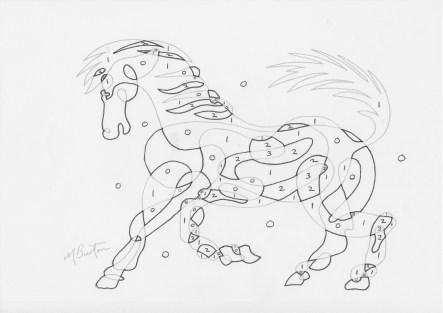
 

Fig 4. Colour Sequence numbers 2 and 3 on the Continuous Line Horse.

Fig 4. Colour Sequence numbers 2 and 3 on the Continuous Line Horse.


The numbering progresses both upwards through positive numbers and downwards through negative numbers.  We will start with the positive direction and allocate the next pair of numbers, 2 and 3.  By moving from an 0 area into a 1 area, and on through its Alternate Overdraw border, we will enter an un-allocated area we can mark 2.  Now deal with all the other areas in this new channel, marking alternate areas 3 and 2, to complete this allocation.  After this we need to check for any further Alternate Overdraw channel, or channels, at this level adjacent to 1 areas and then allocate 2 and 3 to them also, see Fig 4.

We then need to check for any further Alternate Overdraw channels enclosed within any of the 2 and 3 channels.  If we found one we would allocate 4 and 5 to the new channel or channels.  In this case there is no higher level channel. 

Fig 5. Colour Sequence numbers (-)1 and (-)2 on the Continuous Line Horse. Mick Burton, Continuous Line Blog.

Fig 5. Colour Sequence numbers (-)1 and (-)2 on the Single Continuous Line Horse. Mick Burton, Continuous Line Blog.

Having  completed the numbering of areas in the positive direction, we now go into the negative in Fig 5.  By looking at an area 1 and moving through a 0 area with an Alternate Overdraw border we can cross through that into a (-)1 and (-)2 channel.  Mark the initial one (-)1 and then allocate alternately through the channel with (-)2 and (-)1.  After completing that channel, look for other un-allocated channels adjacent to 0 areas and allocate (-)1 and (-)2 to them.  Now look for further channels in the negative direction enclosed within a (-)1 and (-)2 channel.  There is one such, a single area (enclosed by its own Overdraw) in the front leg of the horse, which I have left blank in Fig 5 , which will be (-)3.
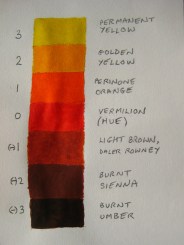
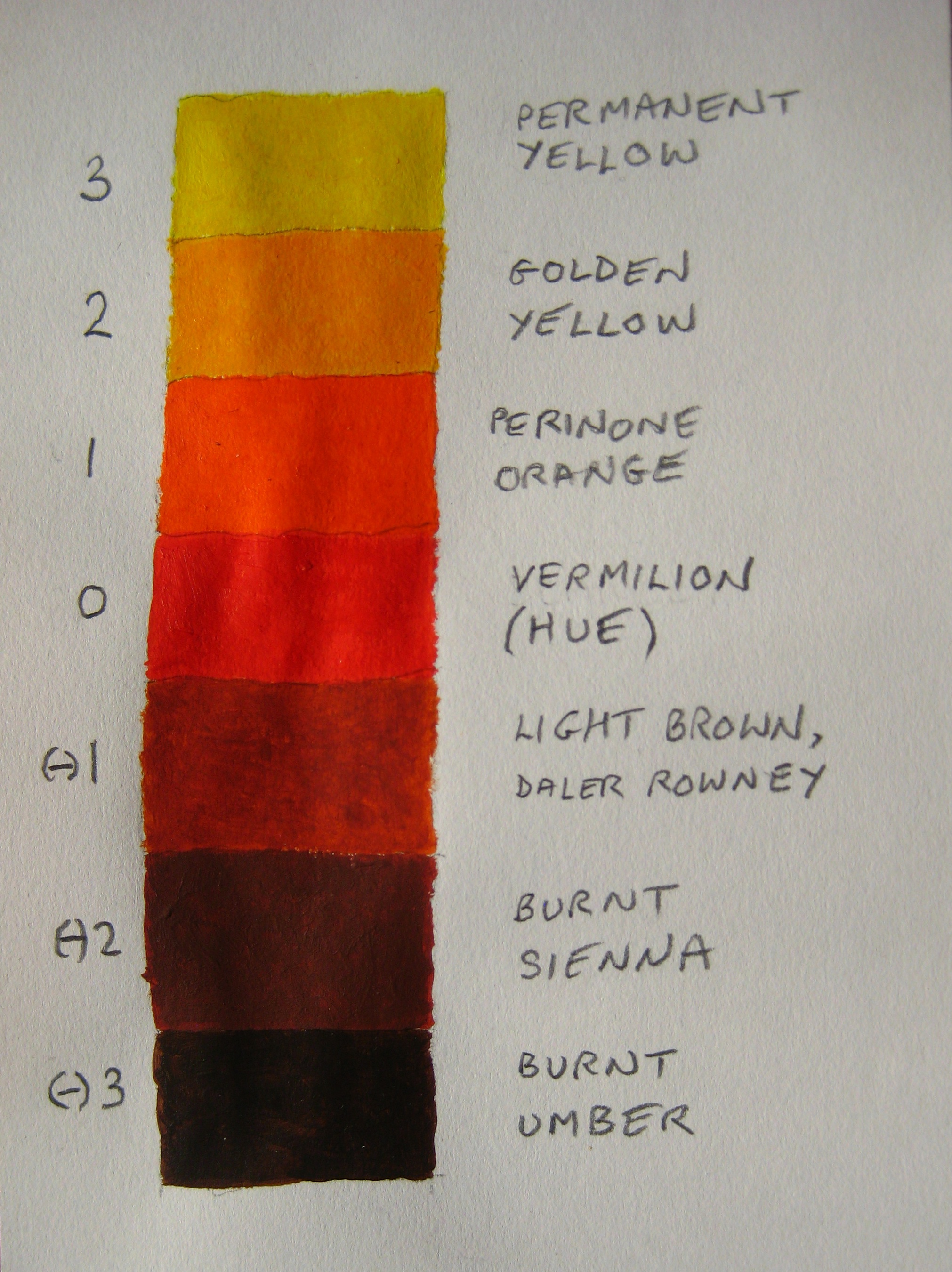
Fig 6. Colour Sequence colour chart for Continuous Line Horse. Mick Burton, Continuous Line Blog.

Fig 6. Colour Sequence colour chart for Continuous Line Horse. Mick Burton, Continuous Line Blog.

I was inspired by Rainbows in deciding on the sort of Colour Sequences I wanted to use for my Continuous Lines.  For shorter sequences, I settled for “partial rainbows” involving two prime colours only with a progression of colour mix and tones from light to dark.  For the Elephant I used yellows, greens and blues and for the Horse it was yellows, orange, red and browns in Fig 6.

I have carefully selected colours which have a stepped progression, both in colour and tone, and where possible I apply them from the tube (poster colour in the late 1960’s or acrylic now) to achieve an even and solid result.  I avoid mixing if I can, to retain the pure consistency of colour application across the painting, but sometimes it is necessary.
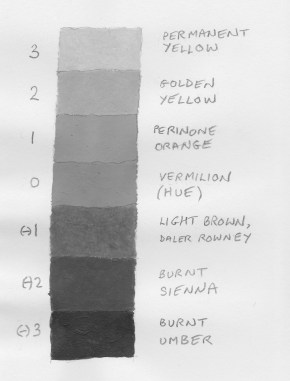
 

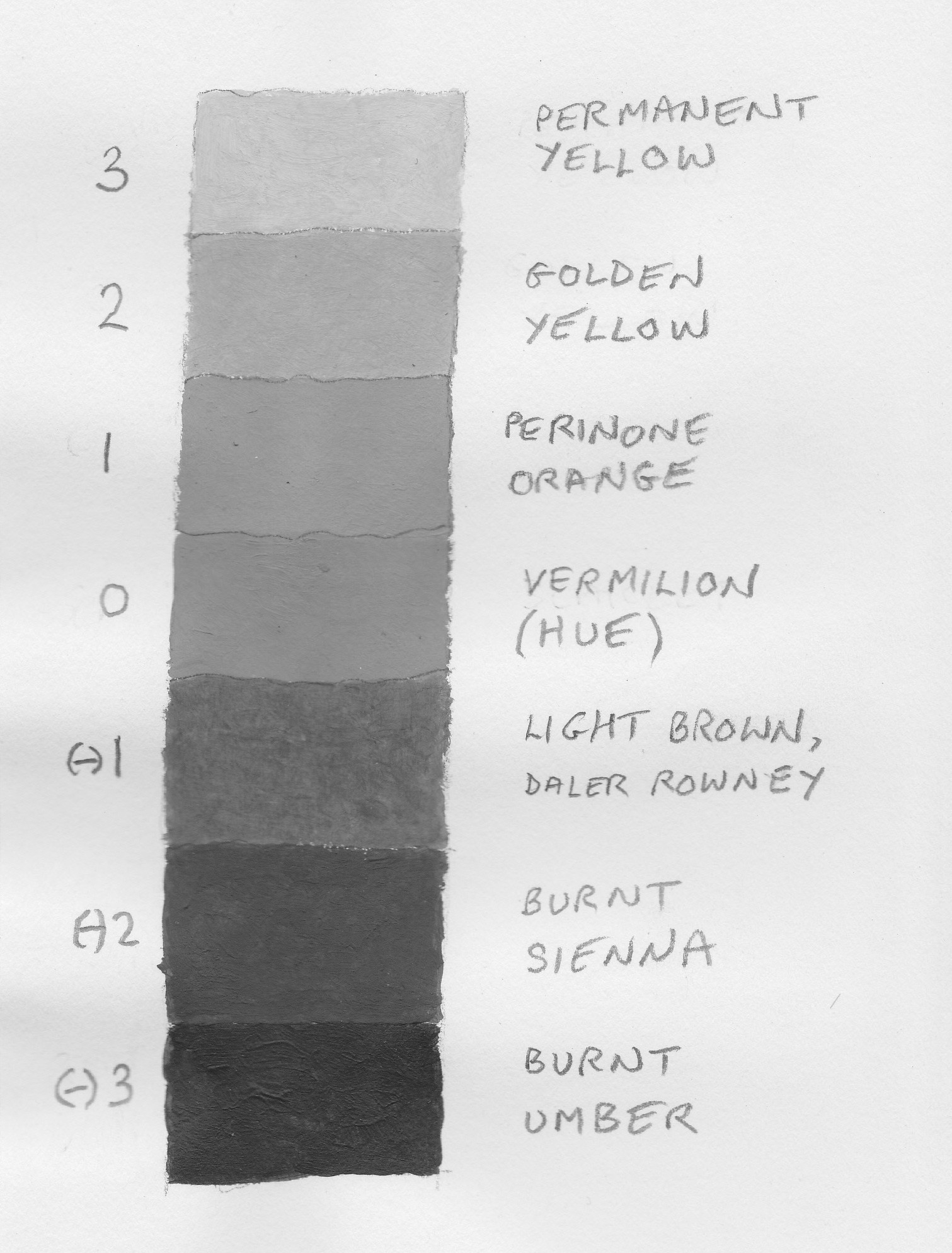
Fig 7. Black and white photocopy of Colour Chart for Continuous Line Horse.

Fig 7. Black and white photocopy of Colour Chart for Continuous Line Horse.


To assess the accuracy of the progression steps of my Colour Sequence chart, I do a black and white (or grayscale) photocopy of my chart to check that the steps still work in monochrome, see Fig 7.

Having produced the Colour Sequence chart, we need to decide the direction of the colours matched to the numbers, ie. Light to dark in an upward or a downward direction.  Generally I see whether a scale would mostly coincide with where a natural highlight would be, or have more darks towards the lower parts in a drawing to infer shadow.  Usually it is fairly obvious, but you can always start again with the other direction of colours.  Note that my style may take advantage of natural hints of highlight or shadow on a subject, but generally these aspects (along with perspective) are absent.

I remember that when doing equations at school, which produced two answers (+ or (-) ), was a puzzle to me which no one could explain.  I understand the concept of a practical outcome from having two answers a bit better now.
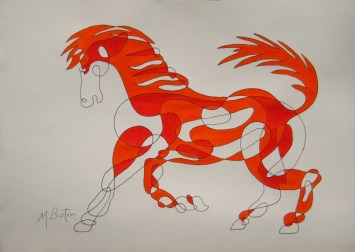
Fig 8. Initial Colour Sequence pair of colours on Continuous Line Horse. Mick Burton, Continuous Line Blog.

Fig 8. Initial Colour Sequence pair of colours on Continuous Line Horse. Mick Burton, Continuous Line Blog.

Once we have decided on the colour match with the numbers, the initial two colours can be painted in, ie.  Vermillion = 0 and Orange = 1, see Fig 8.
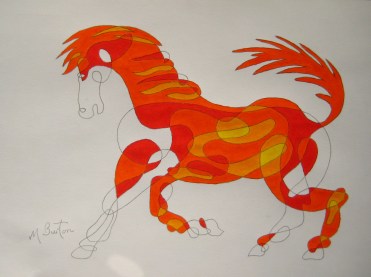


Fig 9. Second Colour Sequence pair of colours on Continuous Line Horse.

Fig 9. Second Colour Sequence pair of colours on Continuous Line Horse.


We can then match numbers 2 and 3 in areas to the colours required in the next channels up, or simply apply Golden Yellow to areas across the overdraw from Orange and then its alternate colour Permanent Yellow, in Fig 9.
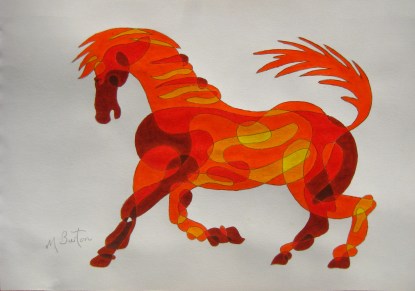


Fig 10. Third Colour Sequence pair of colours, in the negative direction, on the Continuous Line Horse. Mick Burton, Continuous Line Blog.

Fig 10. Third Colour Sequence pair of colours, in the negative direction, on the Single Continuous Line  Drawing of Horse. Mick Burton, Continuous Line Blog.

Now we can match numbers (-)1 and (-)2 in the negative direction, or simply apply Light Brown to areas across the Overdraws from Vermillion.  When these Light Brown and Burnt Sienna channels have been completed the last channel colour is (-)3 which is Burnt Umber.  In Fig 10 I have left this final area blank  (on the front left leg of the Horse).

So you have seen my Colour Sequence method, using Alternate Overdraw, for Continuous Line Drawings.  Sorry if it has been a long explanation (particularly if you grasped it quickly or had already come across parts of it), but I have tried to pitch it as helpfully as I can, based on my demonstration sessions.    
A couple a years after I started Colour Sequence I came across the Winding Number Theory.  There is a connection and I did pick up one or two ideas from it.  I will talk about this in a later post, but as always I am not a trained mathematician and so I will keep talking in pictures. 

 I hope that you will give it a try and I am sure you will enjoy the ride, as I have for so long.

If you display or publish your results, it would be great if you could specifically acknowledge me and my ideas.