Category Archives: Abstract

Change a four sided continuous structure into a single surface Mobius torus, or Mobioid.

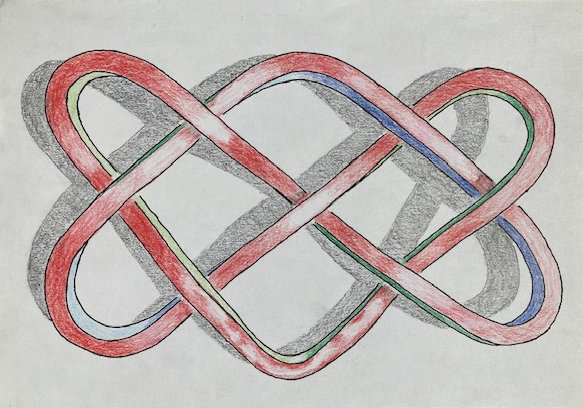
Drawing of Doug Eglen continuous metal sculpture with sides in four colours. Mick Burton, continuous line artist.

In my last post, on 3 June 2025, I said that I would like to draw Doug Eglen’s 3/8″ square forged metal sculpture. 

Continuous Lines in forged metal, by Doug Eglen.

Here it is, but I have used separate colours for each of the four sides.  You can only see Red, Green and Blue because the metal remains flat overall and you cannot see the Black I allocated for the underside.

I have tried to reflect the 3D quality of the sculpture, with its Celtic over and under style, highlights and shadow.

When I first saw the structure, I wanted to understand what would happen if I applied twists to the sculpture.  I thought that there should be one or more types of twist which would turn the culture from being four sided with four surfaces into four sided with one surface.  I knew that the Mobius Strip has two sides before the half twist and one continuous surface afterwards and thought that the single surface should also be possible for Doug’s structure.

Another thing that I wanted do was to try and clarify my idea that his structure reflected the shapes of two Boomerangs.  I wondered what twists I would need to do this.

The poker which I made at the age of 12 at school appeared to have a half twist but it is difficult to visualise how this changed the position of the sides.
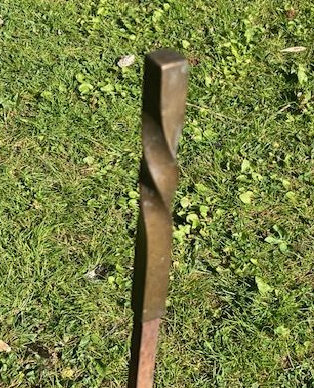
Brass handle with half twist on my poker, made at school when I was 12. Mick Burton, continuous line artist.

I had to use a pencil to draw along one surface to confirm that it changed the top side into the bottom side.  This meant that I could use two half twists near the centre of a new drawing of the sculpture to produce two boomerangs which had individual colours.
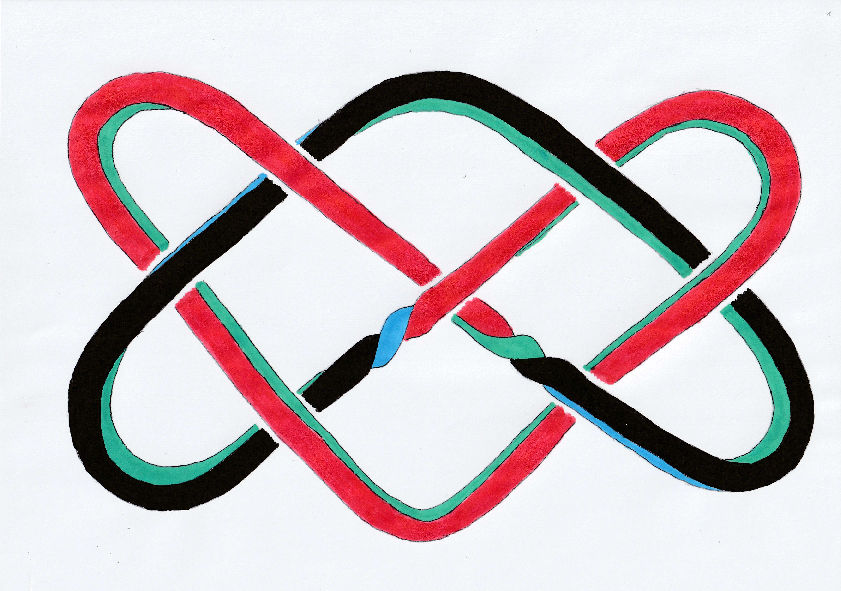
Using two twists to produce Black and Red Boomerangs on drawing of Doug Eglen’s metal sculpture. Mick Burton, continuous line artist.

Black has now appeared at the top for half the time, so we have four colours on view.  Another outcome is that the two sides, which are Green and Blue, swapped from one side to the other at the twists which has resulted in blue almost disappearing.  This is due to the close photographic angle by Doug showing most of the insides of each boomerang shape and I coloured them almost equally Green and Blue in my first drawing.  Green stayed the same within the Red boomerang here and Blue changed to Green in the new Black one.

I have mentioned the Mobius effect.  The Boomerang drawing has not produced a change in the number of surfaces but just altered their positions. Sides still equal surfaces.  This is because I have used two half twists.  If I had only used one half twist then the number of surfaces overall would become two surfaces, one colour for top and bottom and another for both sides.

It seemed to me that employing one quarter twist would produce a Mobius single surface throughout, as each time a surface comes round again it deflects a quarter and on the fourth approach it is back on top. Maybe a three quarter twist would also achieve this, but I found this more difficult to visualise.  First approach deflects to side 4, Second to side 3, Third to side 2 and fourth to side 1 again.

Anyway, I have drawn simply a single quarter twist as an addition to Doug’s sculpture.
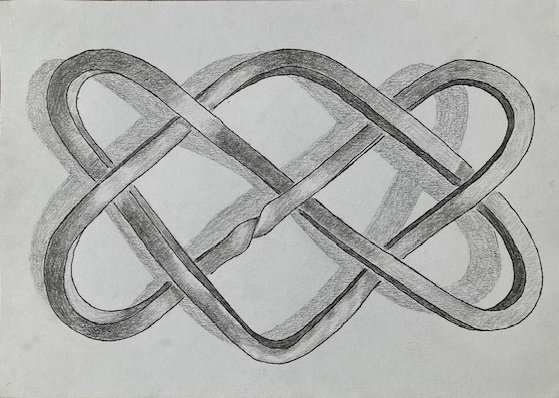
Drawing of Doug Eglen continuous metal sculpture, but with added quarter twist. Mick Burton, continuous line artist.

I have started with black and the result is All Black.  This drawing depicts a 4 sided metal continuous sculpture which has only one surface.  It is a complete Mobius result.  Visually, you can see that it is a quarter twist and our knowledge of the general sculpture helps us to realise that there is in fact one surface.

Yes, a Boomerang drawing and an “All Black” drawing suggest that I have Australian and New Zealand interests.  My mother, maiden name Brenda Mace, was born in a pub in Bedale, North Yorkshire.  Nearly 100 years earlier six brothers were born in the same pub and four of them went to gold fields in both Australia and then New Zealand in the early 1860’s.  They were cricketers as well and Christopher Mace played for Victoria against the first team to visit from England and two years later John and Harry joined with him, in Otago New Zealand, against the first English team to play there.

Back to the drawings.  I looked on the Internet for images of general structures which included a quarter twist and failed to find any.  There were examples of the pure circular twist, including 4 sided, but these are difficult to visualise as there is no obvious start point. 
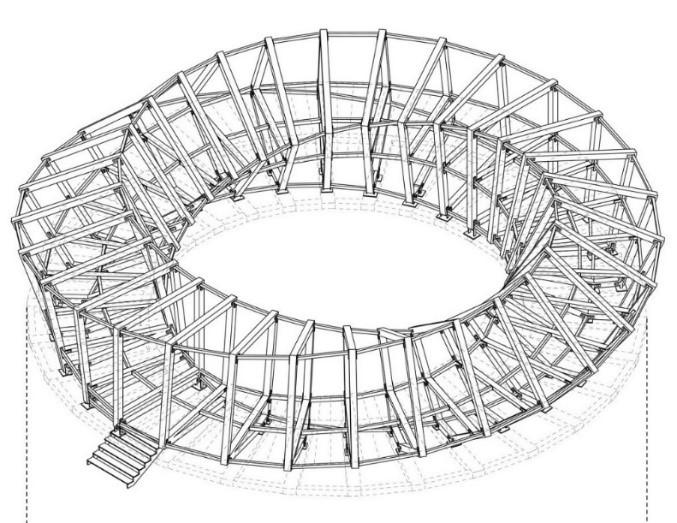
Mobius Strip Structure of Rectangle Geometric Shape. Issuu website.

This pure circular twist is more understandable than most and the Issuu website shows how they built one which you can walk round in.  I am not sure if this includes walking upside down at one stage!

https://issuu.com/vsvu/docs/prof_is_1000/s/16586493

I feel that a twist anchored into an actual general structure, which has some straight and flat sections, is important.  It is easier to identify the type of twist and how the effect of the twist radiates through the whole structure in a more meaningful way.

Some other reference sites mention continuous surfaces, with more than the single edge and surface of a Mobius Strip, as Morbioids.  They compare their structure with the Torus (when it has parallel lines drawn around it which can be regarded as equivalent to edges which can produce the Mobius effect).

There are specific explanations of degree of twist, the number of sides, leading to the number of surfaces.  These confirm my assumptions about a quarter (90 degree) twist, or three quarter (270 degree) twist resulting in a single surface for the square structure.  A half (180 degree) twist has two surfaces.  Others explain 5 or 6 sides and there is a formula for n surfaces according to twist and sides.

A useful link that works is headed “Name for a 3 sided Mobius Strip?”  https://reddit.com/r/topology/comments/1bfdu7m/

SamwiseGanges    said that he was going to call them Mobius prisms.  When he referred to square Mobius prisms, he confirmed my assumptions about the effect of their twists.

AceThe Aro   said that Dr. Cye Waldman called them Mobioid’s in 2017 and you can click onto his moving images.  You can also click on Ace’s own slideshow which runs through all the different twist and number of sides possibilities.

I would like to refer to my drawing of Doug Eglen’s structure, with a quarter twist, as an “Anchored mobius torus”, or “Anchored Mobioid”.

Doug may consider loosening the join on his double boomerang ironwork and resetting it with a quarter (90 degree) twist.  That would produce a real single surface anchored Mobioid.  
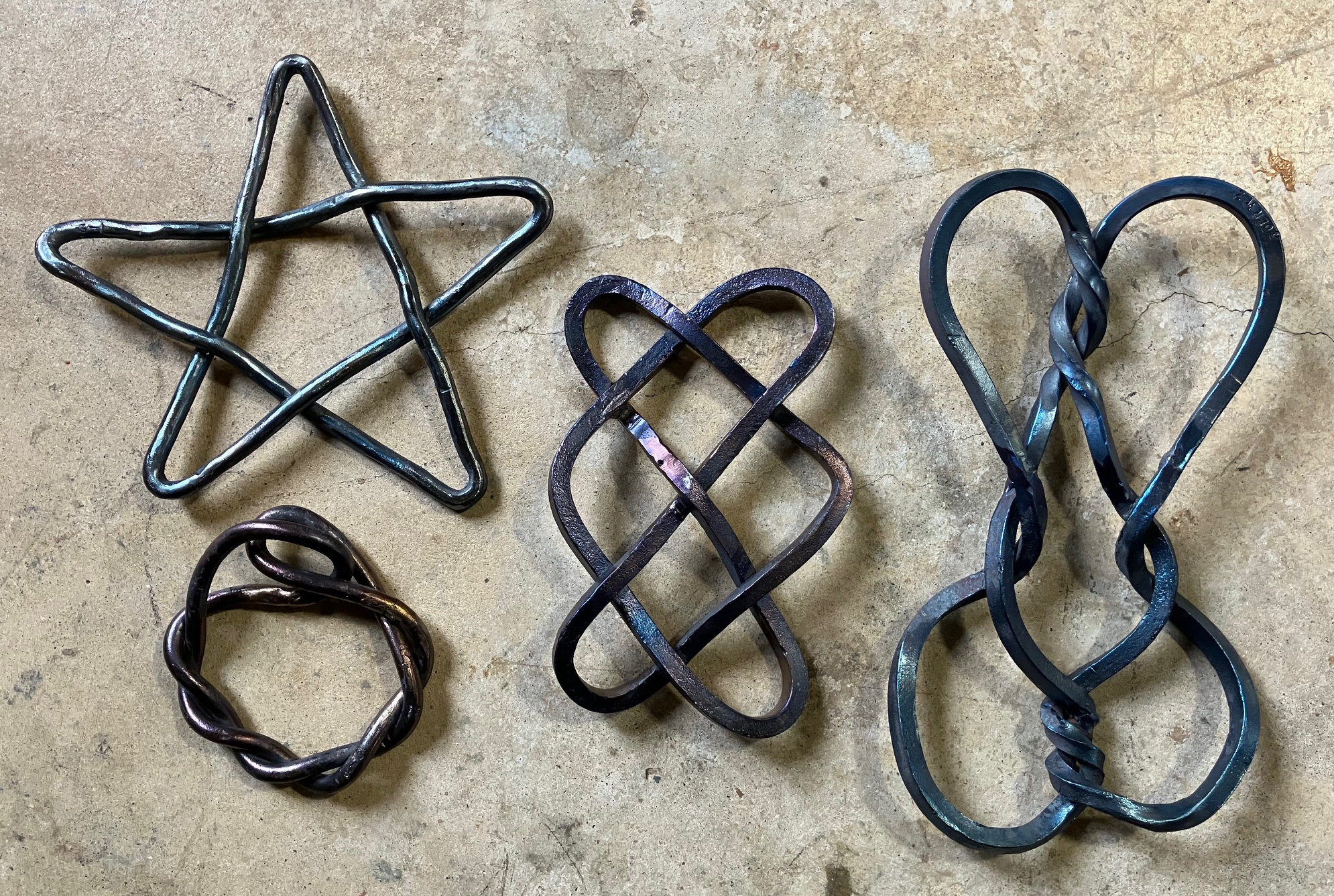


Continuous Lines in forged metal, by Doug Eglen.

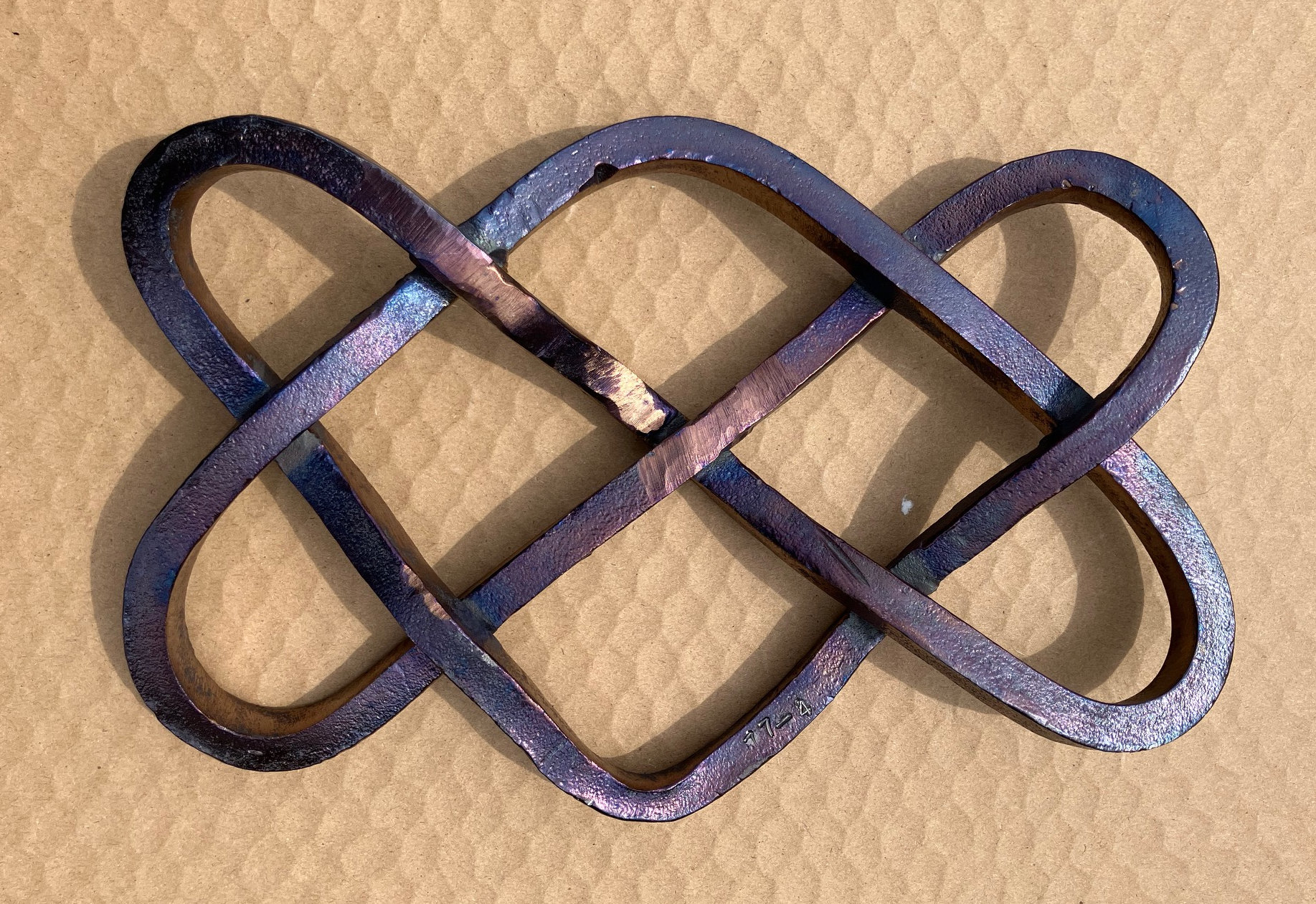
Continuous Line knots in tempered metal forged by Doug Eglen. Photo by Doug sent to Mick Burton, April 2025.

Doug Eglen contacted me in March 2025 to say that he had recently started having an interest in knots and unknots and came across my painting of Haken’s Gordian knot, which you can see in my earlier posts of 9 May 2018 and 5 June 2015

Continuous Line Artist view of Haken’s Gordian Knot.

How do you construct Haken’s Gordian Knot?

He asked for my permission to paint his own version of the Gordian knot, based upon my painting.  He intended to exhibit his painting, along with the new metal knots which he was producing in his forge.  Doug has an exhibit case at Purdue University, Indiana, in the Math department library.  I agreed, and answered his questions about assumptions he had made about the construction of my painting. 

Doug later sent me a copy of his painting.  This is impressive, as are his metal knots, and you can see them on his website   

https://http://www.deglen.org/math-art

I particularly liked Doug’s photo of his 3/8″ square metal, in what I would call a sort of “double boomerang” shape without any twists.

Doug Eglen square 3/8″ metal without twists in a continuous line, copied to Mick Burton.

The alternate over and under style, like Celtic knotwork, produces great highlight graduations as well as suggestions of colour that Doug achieves with his firing treatments. I like the dark shade of the sides of the metal compared with the shadow of the piece.  I would like to draw this.

At school, when I was 12, I produced a metal poker with brass handle which has a half twist.  I have had no further experience of metal work.

Brass handle with half twist on my poker, made at school when I was 12. Mick Burton, continuous line artist.

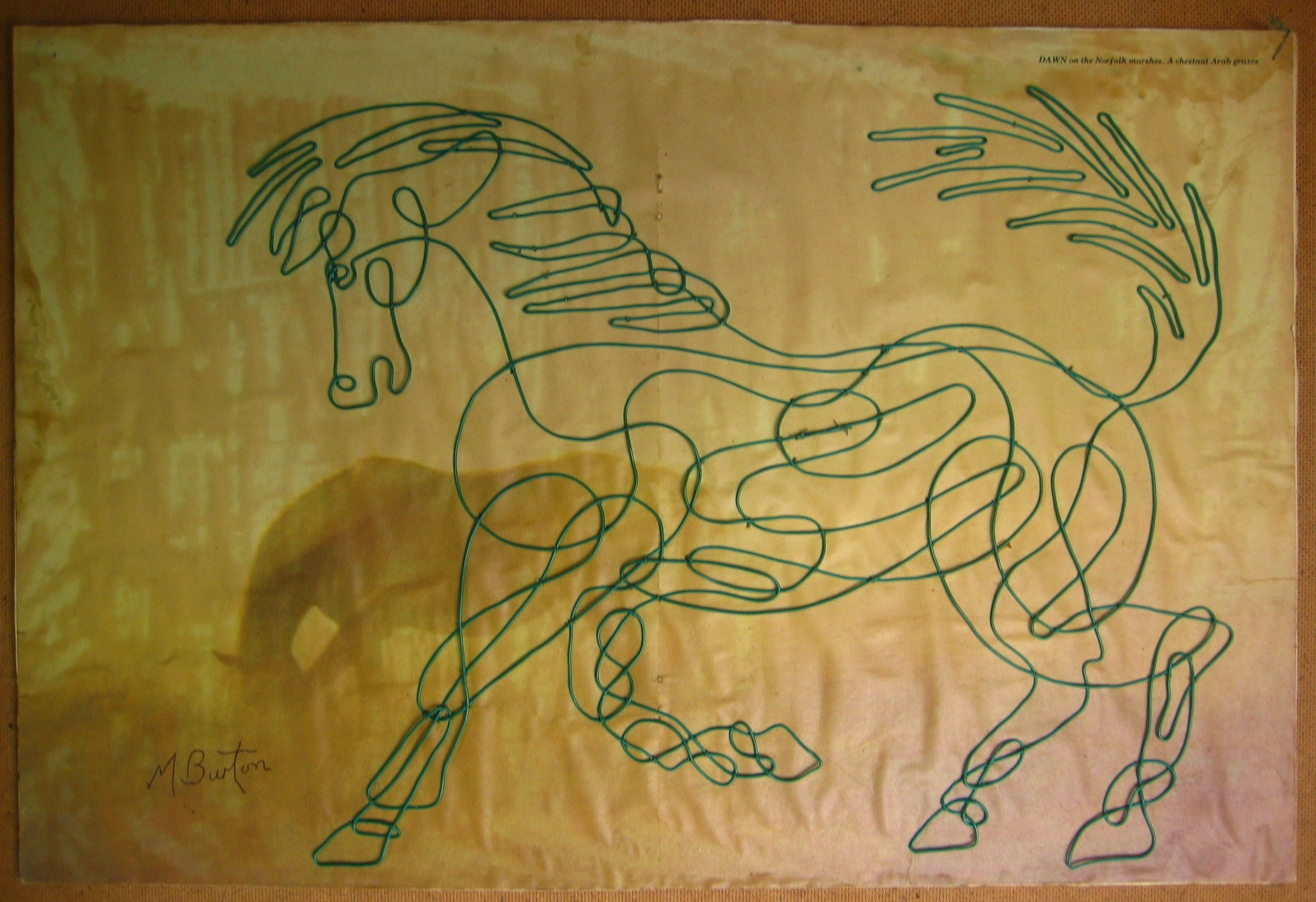
I did do some wire bending to produce a single continuous line wire horse in 1967.  At first I placed it underneath a piece of clear glass covering the dining table, to hold it down.  Then I secured it to a wooden board through a centre page magazine photo of a horse grazing in a meadow.

Continuous line Horse in a length of garden wire done in 1967. Mick Burton.

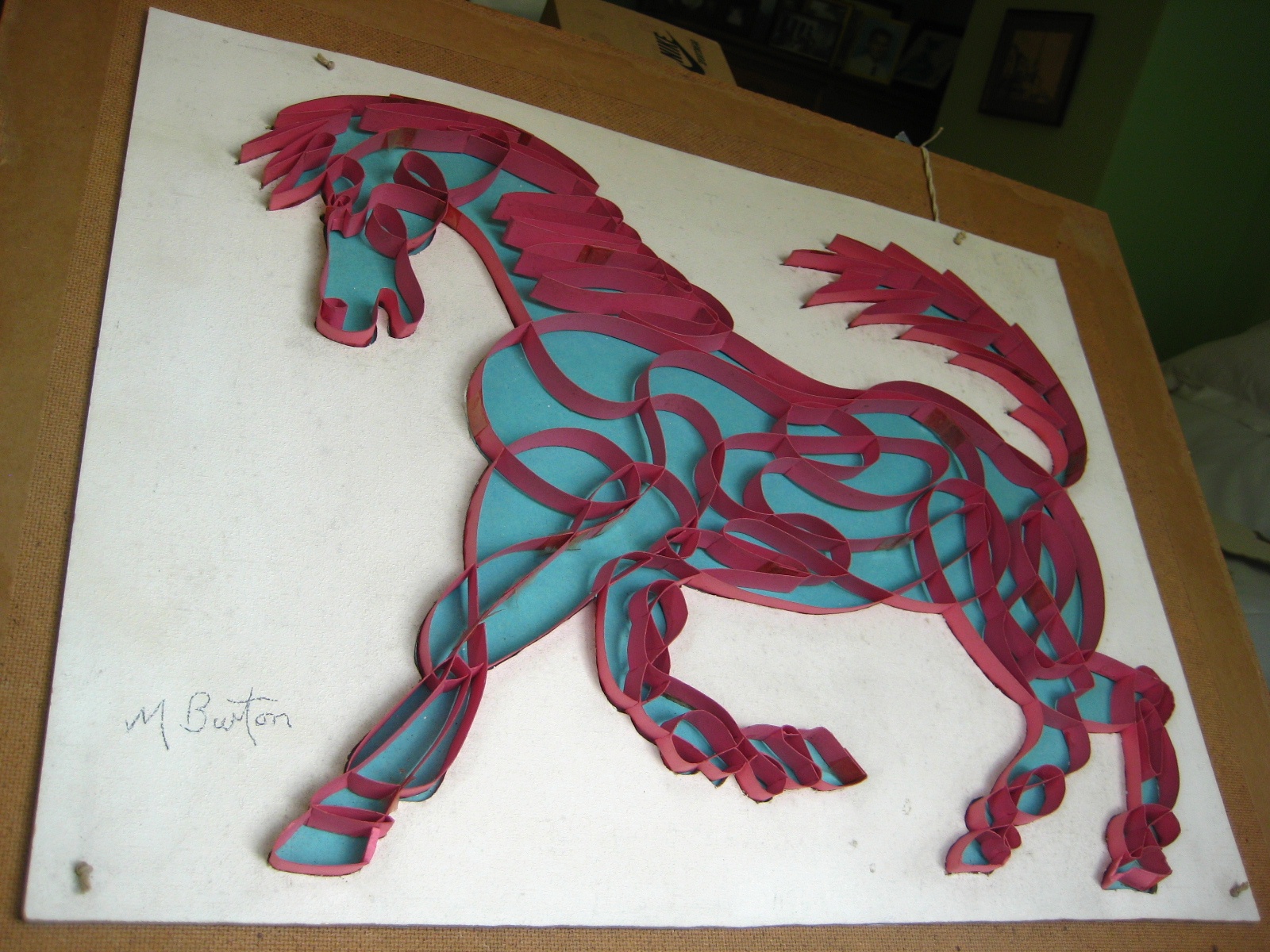
Next, I went sculptural and used cardboard strips to take the Horse a stage further in 1970 when I lived in Nottingham.

Continuous line Horse using strips of cardboard 1970. Mick Burton.

I showed it to someone at work who’s Dad owned a company which produced steel castings. He said he would ask his Dad about the possibilities of doing a metal horse.  The answer was a “Yes”, but it would cost me £3,000 !  I now know someone who’s cousin does 3D printing, so maybe I can get a more reasonable quote now.

Of course, this is all “small beer” compared to Doug Eglen’s metal workings.

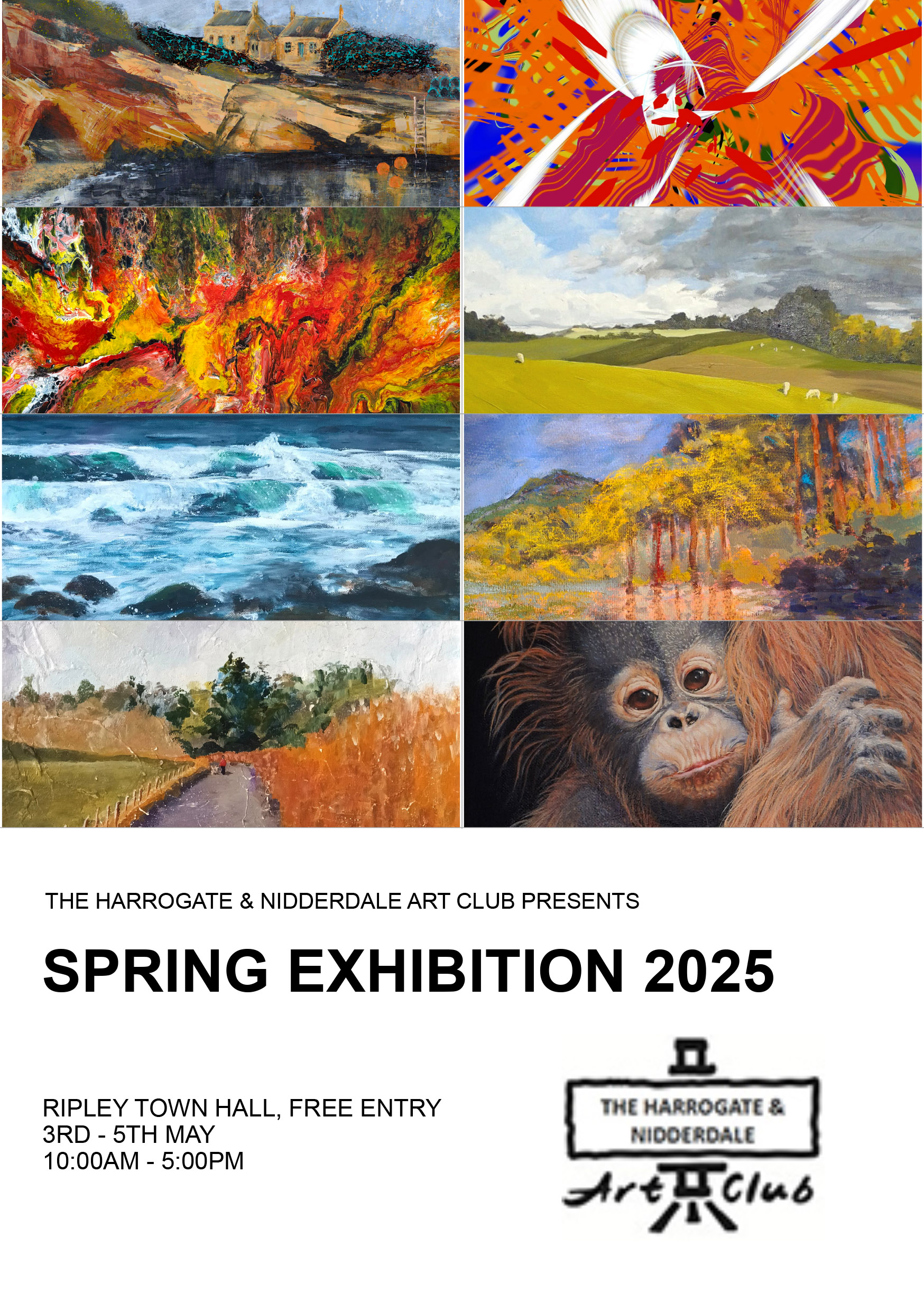
Harrogate and Nidderdale Art Club, Spring Exhibition 2025 at Ripley Town Hall.

Harrogate and Nidderdale Art Club, Spring Exhibition 2025. At Ripley Town Hall.

The Harrogate and Nidderdale Art Club, Spring Exhibition, will be held on 3rd to 5th May 2025 at Ripley Town Hall.  As usual, there will be a wide range of quality paintings, prints and cards by members of the club at this splendid venue.

My pictures will include the completed coloured version of my single continuous line Phormium which I covered in my earlier post of 27 November 2024.  I call it “Phormium in Snow”.  There were also fox tracks passing the phormium, down and back up the garden, which I thought of including.

Phormium in Snow. Mick Burton, continuous line artist.

Another update from that post is that the bees have re-occupied the hole in the lawn. 

There is often a bee arriving and another leaving at the same time.  It is not a quick process!  The one landing may circle around and land a foot away and wander around before working its way through the grass into the hole.  The leaver will crawl out and wander around before flying off at low level.   Of course, when I mow the lawn I have to be careful that they are not coming or going when I go over their area.

And now here is something completely different.

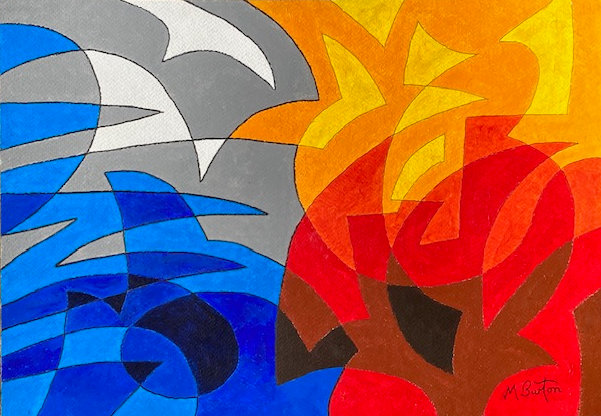
Tsunami Tackles Wildfire. Mick Burton, continuous line artist.

Another new picture is my “Tsunami Tackles Wildfire”.  It combines two Climate Change topics, pitting two extreme situations against each other.        

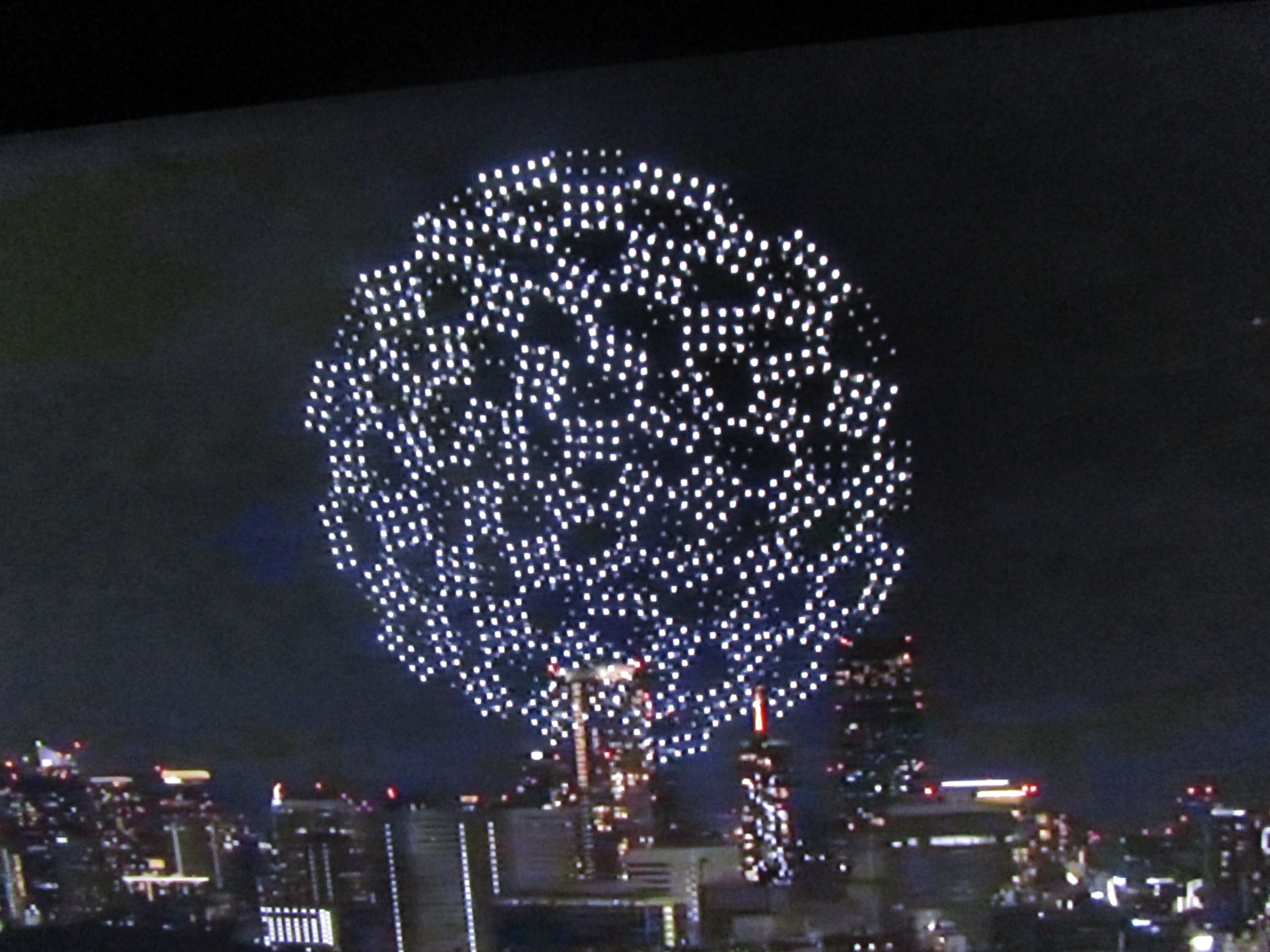
Spherical Continuous Line Abstract with Colour Sequence.

I started the picture during an Abstract workshop arranged by club Chairman Steve Walmsley.  I told him what the title might be.  I also said that, as President Trump was making all sorts of announcements to change the World, I could call the picture “Trump calls in Tsunami to tackle California Wildfire and if that fails he has Icebergs moored off Greenland he can have towed round.”

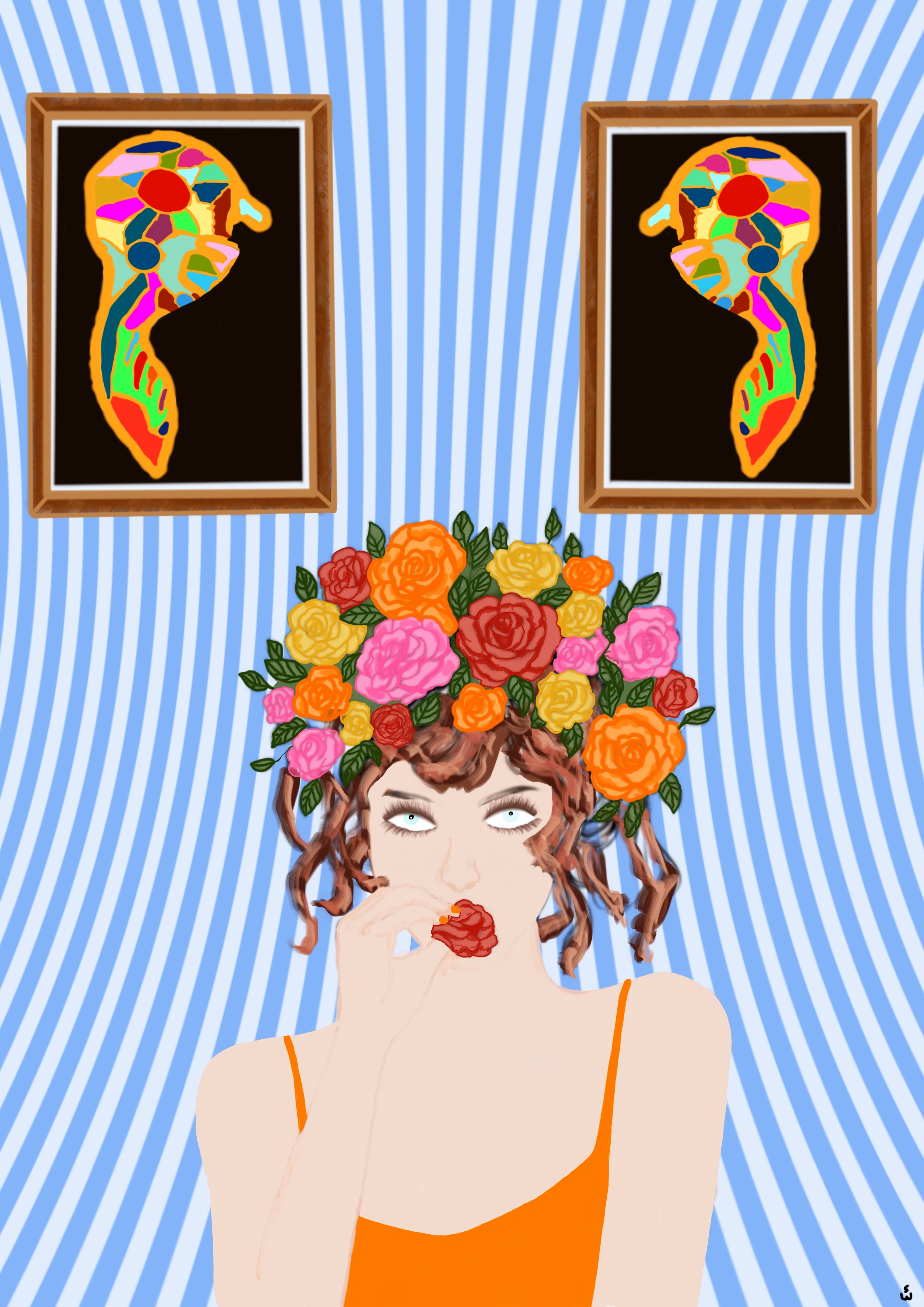
Steve Walmsley Surrealist Portrait of Mick Burton, Continuous Line Artist.

Flower Girl With Her Two Small Portraits Of Renowned Yorkshire Artist Mick Burton. By Steve Walmsley, Surrealist Artist.

Steve Walmsley sent me this image, which he created in response to my continuous line Portrait of him which I featured in my Post of December 2023.

My first reaction was that this Lady appears to be looking forward to devouring two pork chops.  Of course I realised that they were really portraits of me.  I think that it is a terrific composition and am pleased to be involved.
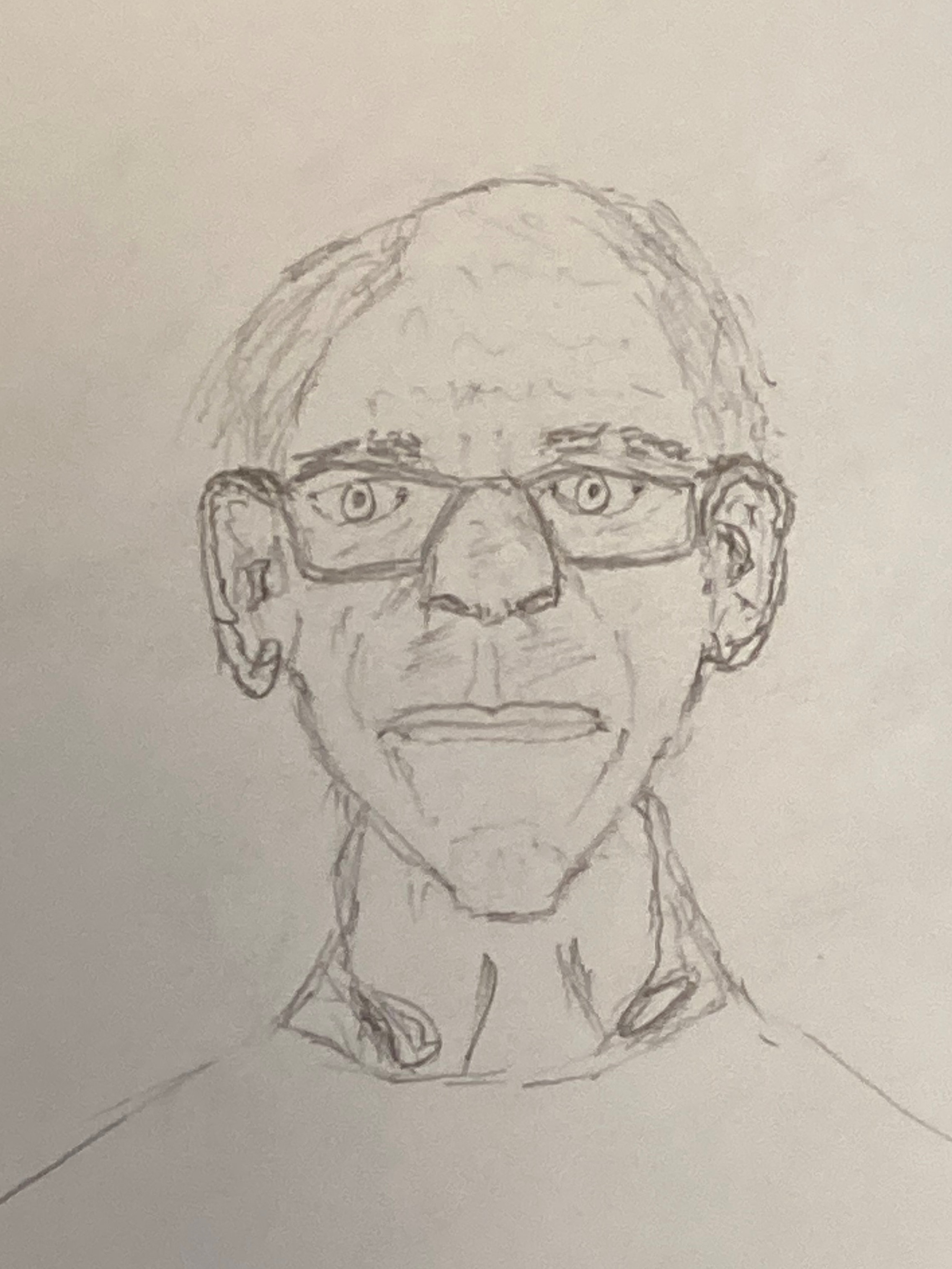
As I said in the previous Post, we sketched each other at Harrogate and Nidderdale Art Club and my sketch led of one of my Continuous Line Drawings of him and then a Colour Sequence version.  These are all shown in my previous post.  At that time, I did not include my photograph of Steve’s sketch portrait of me.
Now that he has responded, it is time to produce his sketch of me as a reference.

Portrait sketch of Mick Burton by Steve Walmsley, Surrealist Artist, May 2023.

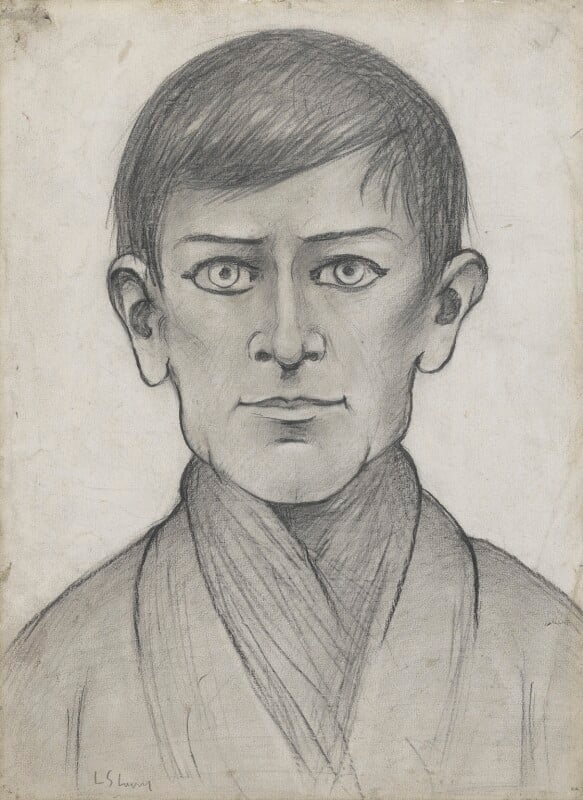
This sketch does not relate too closely to Steve’s creation, but it does remind me of “front on” sketches done by L.S Lowry.  Here is one that is in the National Portrait Gallery.

Portrait by L. S. Lowry. National Portrait Gallery, NPG 5951.

Steve’s latest Surrealist Art can be seen on his website       

https://steven-walmsley.pixels.com/art/surrealism   . 

Phormium New Zealand Flax continuous line drawing.

Phormium, New Zealand Flax. Mick Burton, continuous line artist.

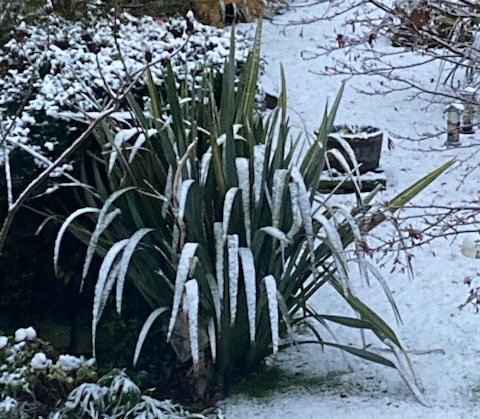
We have just had snow from Storm Burt and it weighed down some of the sword-like leaves of our sturdy Phormium.  Here is the photo below.

Phormium, after snow weighed down the leaves. Photo Mick Burton, continuous line artist..

I considered that the mixture of curved drooping leaves and straight upright leaves would make a good contrasting straight and curved overlapping continuous line. 

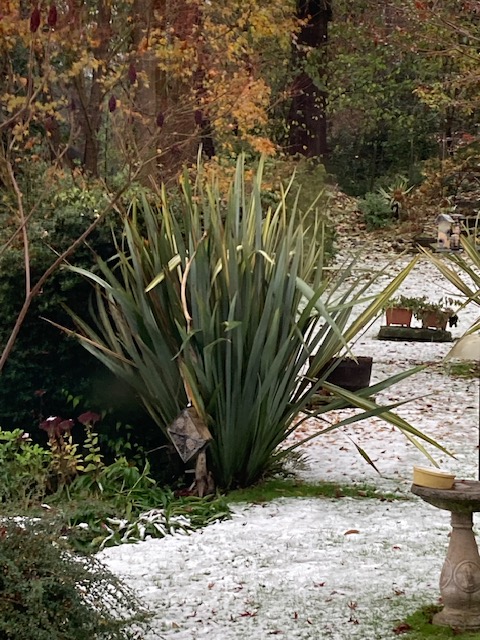
As soon as the snow went, the leaves sprang back upright again.  The leaves are pretty rigid and I prune them with a hack saw.

After the snow melted the sword-like leaves returned to straight up. Photo Mick Burton, continuous line artist.

Captain Cook and Joseph Banks recorded the plant in New Zealand in 1770.  The Museum of New Zealand states that “Russia, the main supplier of sailcloth and rope for the Royal Navy, had restricted sales to England and Cook considered the New Zealand flax as and alternative for making these vital supplies.”

We had good fox tracks in the snow this time.  In one direction it was a single line of spaced prints and in the other it was pairs of prints spaced out.

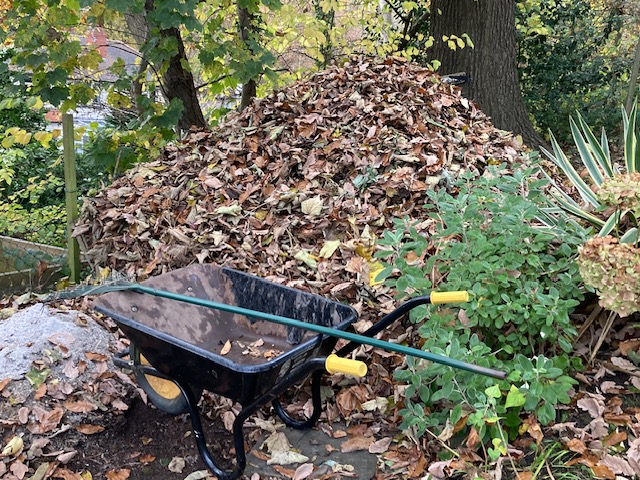
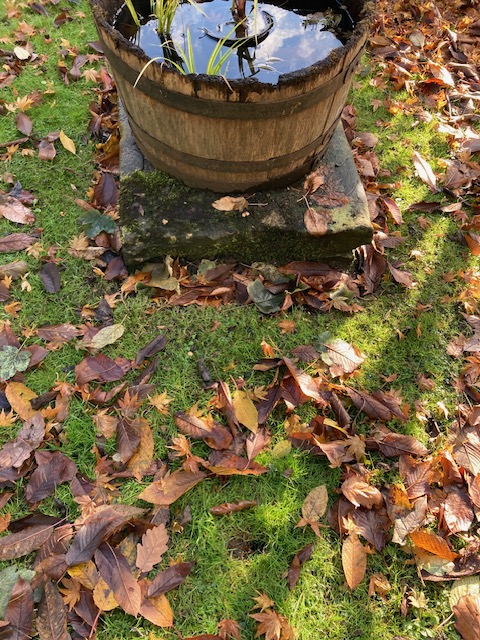
Before the snow came, I had raked up all the leaves and produced our biggest pile yet, for the first stage of producing soil from leaf mould.  It is far bigger than the pen I built for leaves.  Of course, some are blown in from Gledhow Valley Woods.

Largest leaf pile to date. Photo Mick Burton, continuous line artist.

As the leaf pile has spilled across the slab path up the garden I was interested to see what the Fox did when using the path – would it go round?  Nope, it staggered over the right hand side of the pile.

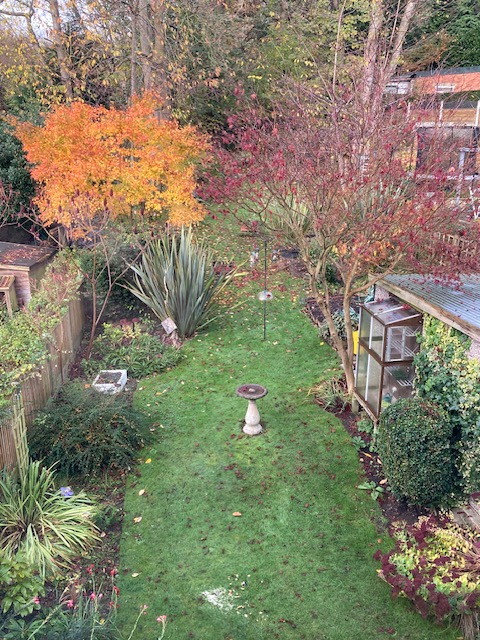
One strange thing every year is the the Red leaved Acer drops its leaves before all the other trees and the Bronze leaved Acer is usually the last.

Red leaved Acer next to the garage drops leaves long before the bronze leaved one on the left. Photo Mick Burton, continuous line artist.

In the lawn, under the leaves I found that the Bumble Bee hole was still there.  The hole is near the bottom of the photo below.  On the internet it says that the holes are in use for a few months and then not used again, as the queen builds a new one next year.

Bumble Bee hole in the lawn. Photo Mick Burton, continuous line artist.

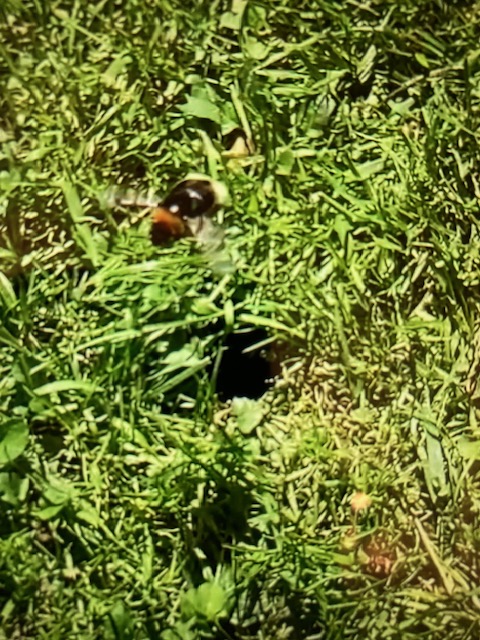
When I first spotted the hole in the lawn in late May there was a Bee just emerging from it.  The black patch at the very bottom of the photo is the shadow of the bee.

Bumble bee leaving the nest hole in the lawn. Photo Mick Burton, continuous line artist.

I first found out about Bees nesting in the ground when I was digging the tiers in the bank at the top of the garden. I became aware that an increasing number of bees were circling around me.  It was just couple of Bumble Bees at first then all sorts of sizes of bees, some appearing to be similar to hive bees, flying around me.  I realised that I must have disturbed their nest and so I stopped the digging for the day.  The next day I came to look and there was a new hole in the bank and bees coming out, so I just abandoned my digging for the summer.


Alien Creatures on Train Tracks Puzzle Continuous Line.

Alien Creature continuous line from Train Tracks Puzzle.    Puzzle Madness, Large, 1.5.2022.  Mick Burton.

This is an update from my post of 24 December 2020 when I explained how I had started Train Tracks Puzzles during Covid lockdowns.    Red Alert, Continuous Line Detected on Train Tracks Puzzle.

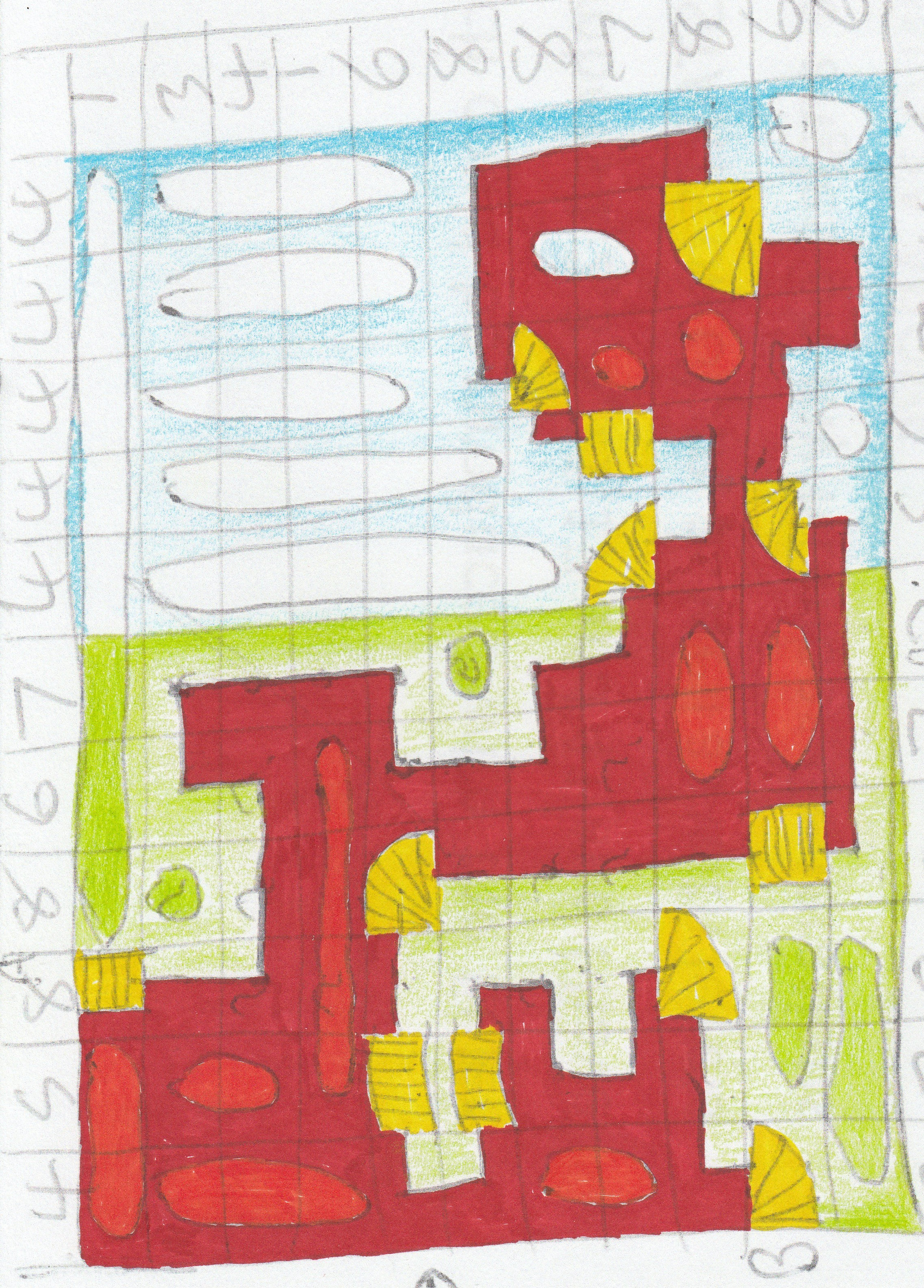
When I try to solve a Train Tracks Puzzle, I draw out the grid freehand and copy in the cross references of number of tracks in vertical or horizontal rows as well as the given pieces of track.  A big part of the process is marking the squares, which will not have track pieces, with a circle or cloud shape.  I draw in the track I have decided upon with a line between given pieces of track.

Most people will complete the puzzle on their phone or laptop from start to finish, but I just like drawing things, rather than hitting wrong buttons on keypads most of the time.  Here is my initial drawing.

Initial drawing of Train Tracks Puzzle 1.5.2022. Mick Burton, continuous line artist.

I coloured all “given pieces of track” yellow and the interior of the Alien red in Sharpie pen and did lighter background with coloured pencils, leaving the cloud shapes white.

Here is another Alien from two days later.

Green Alien based upon Train Tracks Puzzle.    Large 3.5.2022 Puzzle Madness.   Mick Burton, continuous line artist.

I mentioned in my post of 24.12.2020 that I was at position 272 out of the 863 people listed.  Also that I had scored 17.925 points compared to the top rated Stirlingkincaid with 2,766,965. This was nearly twice the points of anyone else and I wondered if he ever slept.

I got to about position 130 and for a time just tried to keep treading water at that level.  The number of participants had more than doubled since I started.  Here is the summary a few months ago, at about the time I ceased to do the puzzles.  You can find the Train Tracks puzzles on     https://puzzlemadness.co.uk      .

All time Train Tracks table on Puzzle Madness in June 2022. Top three all over 4 million points and Mick Burton on 240 thousand.

GA had drawn level with Stirlingkincaid on 4,221,000 but both trailed Stevo by 665.  Fourth place Antique was only on 2,708,990.  Do any of them ever sleep?

I have kept quite a lot of my initial drawings and may do some more Aliens.


Winding Number Man, continuous line drawing.

Winding Number Man. Continuous line drawing with colour sequence. Mick Burton.

In 1972, at the same time as I was experimenting with winding number lines such as in Petrol Polluted Puddle (see my post of 24.11.2014),       Winding Number Theory and Continuous Line Drawing

I drew Winding Number Man, which involved looping around in the same direction from start to finish.

Winding Number Man. Continuous line with alternate overdraw. Mick Burton.

If I had done this in a concentrated area, like the close spiral I used in Petrol Polluted Puddle, I would have had a long single series of overlapping colours.  However, as I progressed around the head, body, legs and arms of the man I avoided too many overlaps.  As I gained new overlaps, previous ones fell away.

The longest sequence of colours is six, whereas with PPP the real sequence is 19.  I could not cope with one sequence of colours that long, with only slight changes between each one, so I used a repeat rainbow sequence which provided the puddle effect I wanted.

The shorter single sequence of colours on the Winding Line Man gives him the form and density I required.

All along I had in mind something similar to the Michelin Man who advertised the tyres.  Here is a recent representation.

Michelin Man logo. Creative Review.

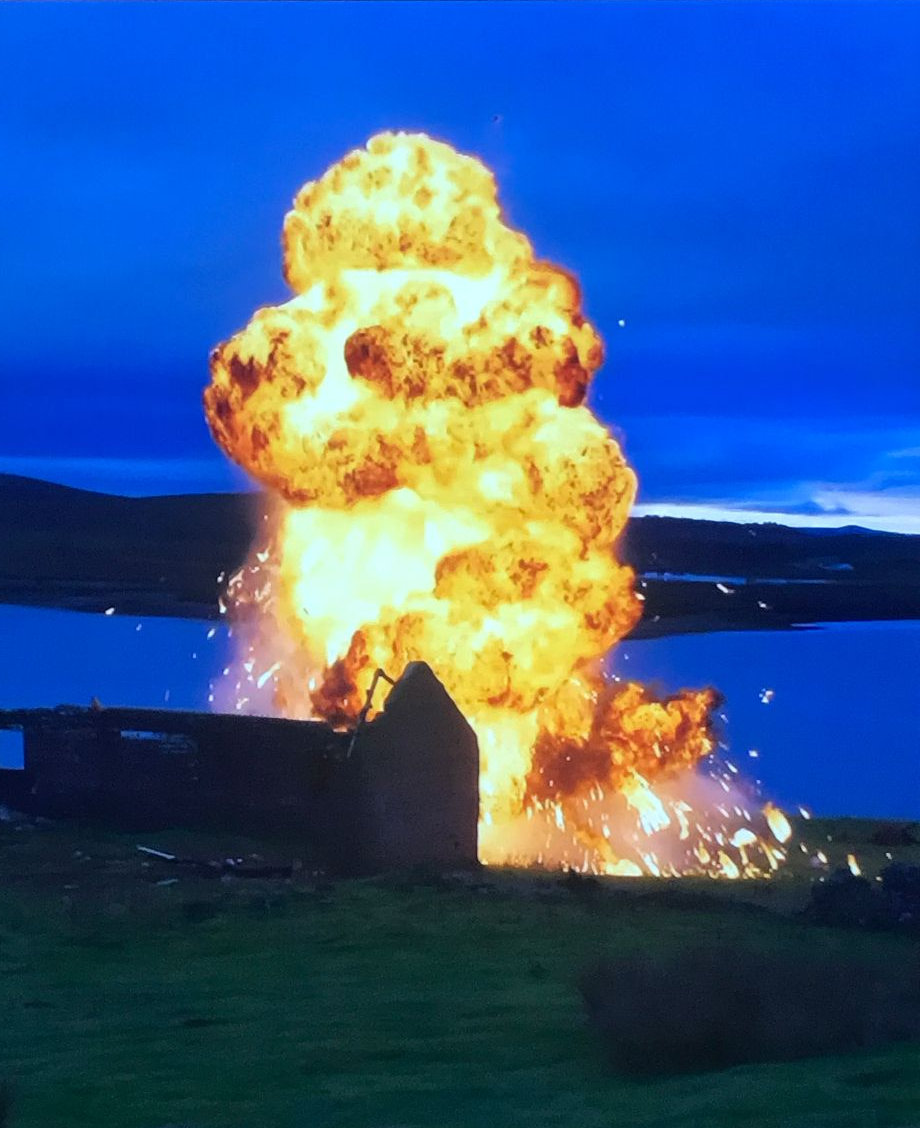
Strangely, I was remined to get on with this blog when watching the new Shetland TV series, where Detective Sergeant  “Tosh” McIntosh was trapped inside a caravan which was about to explode.  I paused the TV in the middle of the explosion and the freeze frame flame looked a bit like the Michelin Man.

Shetland explosion looks like the Michelin Man. End of Episode 3, Series 7.

Watch Episode 4 to see what happened to Tosh.

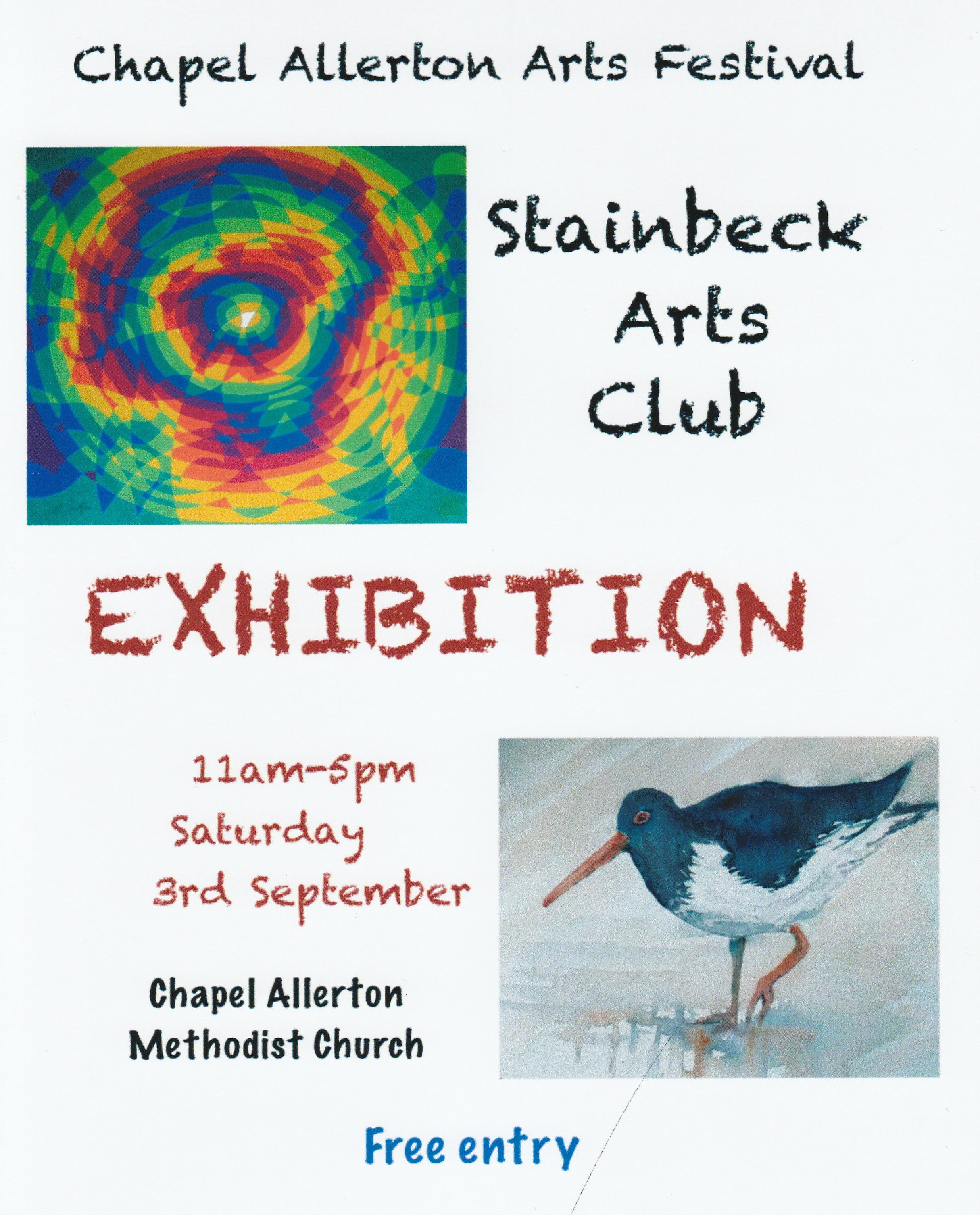
Stainbeck Arts Club Annual Exhibition at Chapel Allerton Arts Festival.

Stainbeck Arts Club Annual Exhibition at Chapel Allerton Arts Festival.

The Stainbeck Arts Club has its first Annual Exhibition following the end of Covid on Saturday 3rd September 2022.  As usual it is in the Chapel Allerton Methodist Church and alongside the activities of the Chapel Allerton Arts Festival.  Entry is free and a fine range of paintings and cards will be on view.

If you are interested in joining the club, our meetings are on the second and fourth Tuesdays each month from 2pm to 4pm.  Just ask for details at the exhibition.  You can come along to see what we doing before deciding to join. 

Have a look at our Website       https://stainbeckarts.co.uk 


Another Artist in the Burton Family

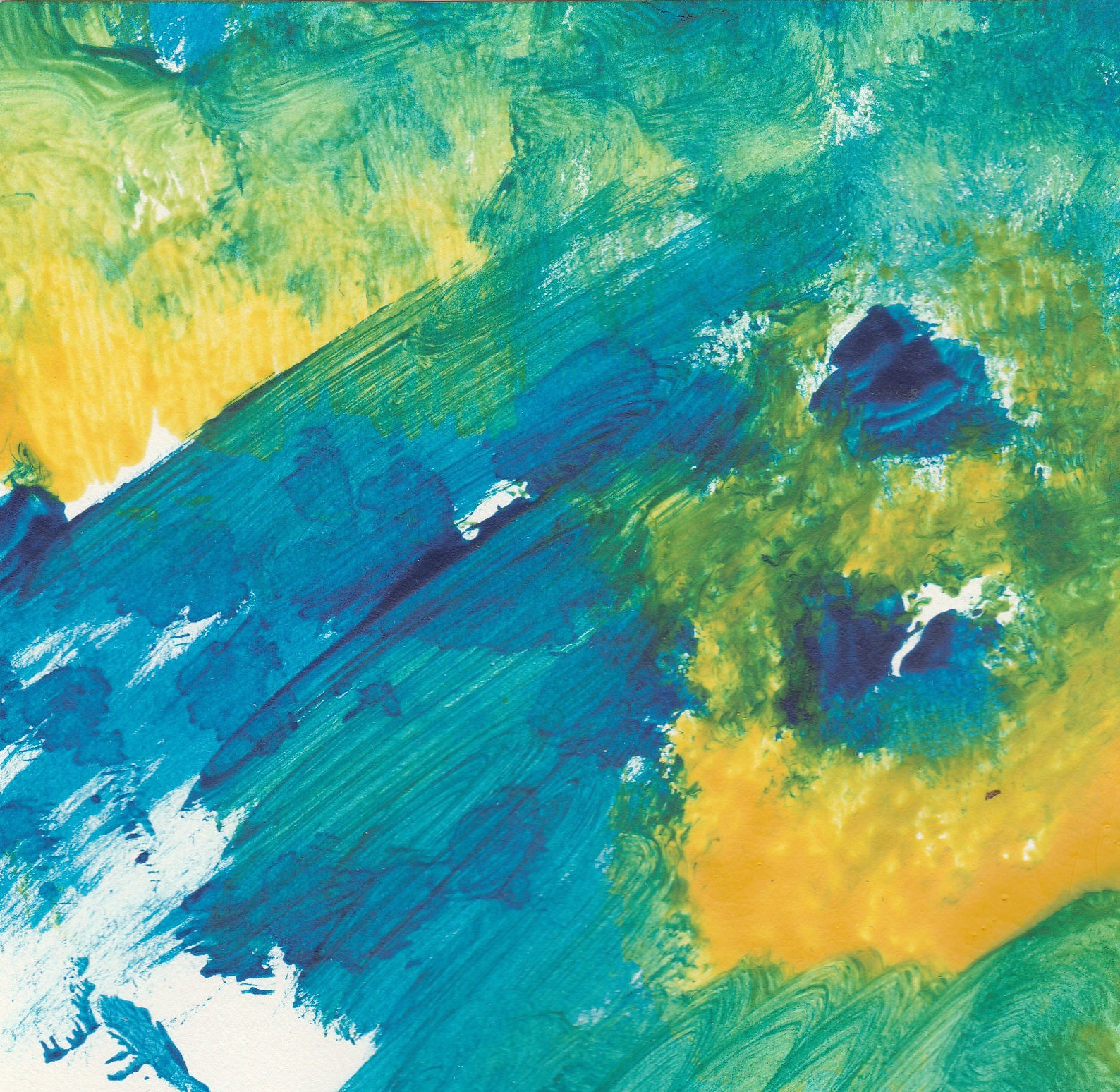
Fathers’ Day card, from my daughter Kate, painted by my grandson Lucas.      Mick Burton, continuous line artist.

This action painting, by my grandson Lucas, reminded me of a fast rushing stream.

My daughter Kate is a professional artist and film maker (see my post of 2 February 2016 – “BB” by Kate Burton, Glasgow film maker, at London Short Film Festival),

“BB” by Kate Burton, Glasgow filmmaker, at London Short Film Festival.

Three year old Lucas receives plenty of encouragement to make pictures.

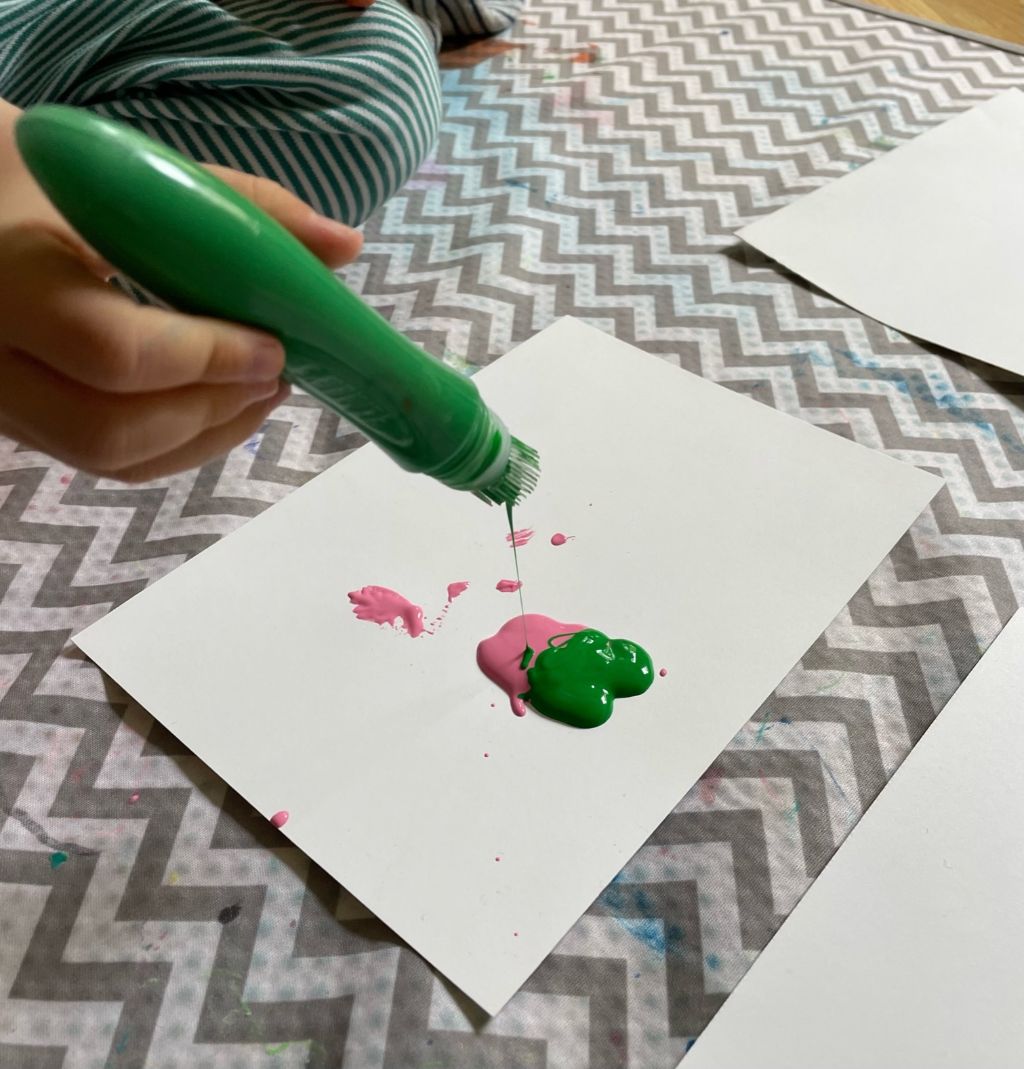
Lucas also squeezes paint tubes directly onto a piece of card to create mixes of paint, before Kate provides another piece of card to squash the paint.  There is a sort of ink blot “butterfly” copy effect.

Lucas squeezes paint directly from the tube.        Mick Burton, continuous line artist.

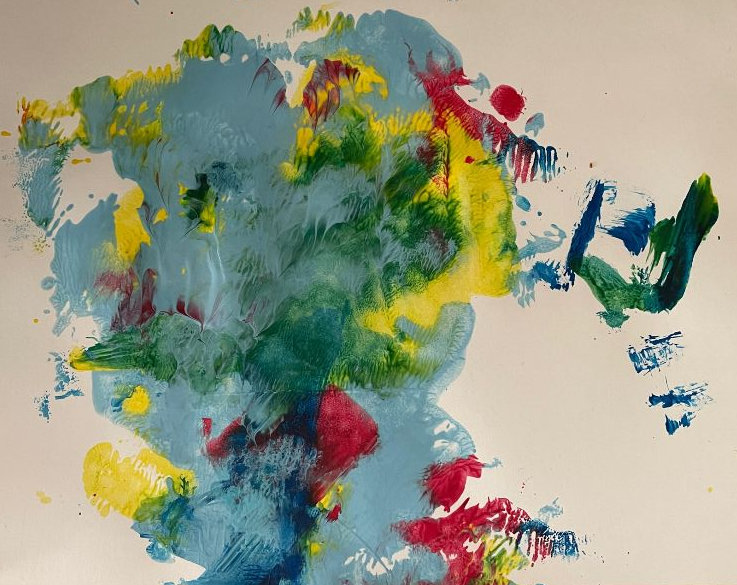
Here are some results, along with “Grandad” type observations.

Lucas watery landscape.         Mick Burton, continuous line artist.

This result made me think of a sort of Chinese or Japanese landscape painting.  Here is a modern version for comparison.

Autumn Mountains at Dawn, by Zhang Daqian.      En.wahooart.com.

The next picture has the appearance of a flying elephant, and I have done a few continuous line elephants in my time.  

Lucas’s flying elephant.    Mick Burton, continuous line artist.

Lucas’s flying elephant.  Naturally, he has a squash copy flying the other way.  See below Dumbo, the most famous flying elephant.

Dumbo the Elephant, from Tim Burton’s remake of Dumbo Takes Flight.

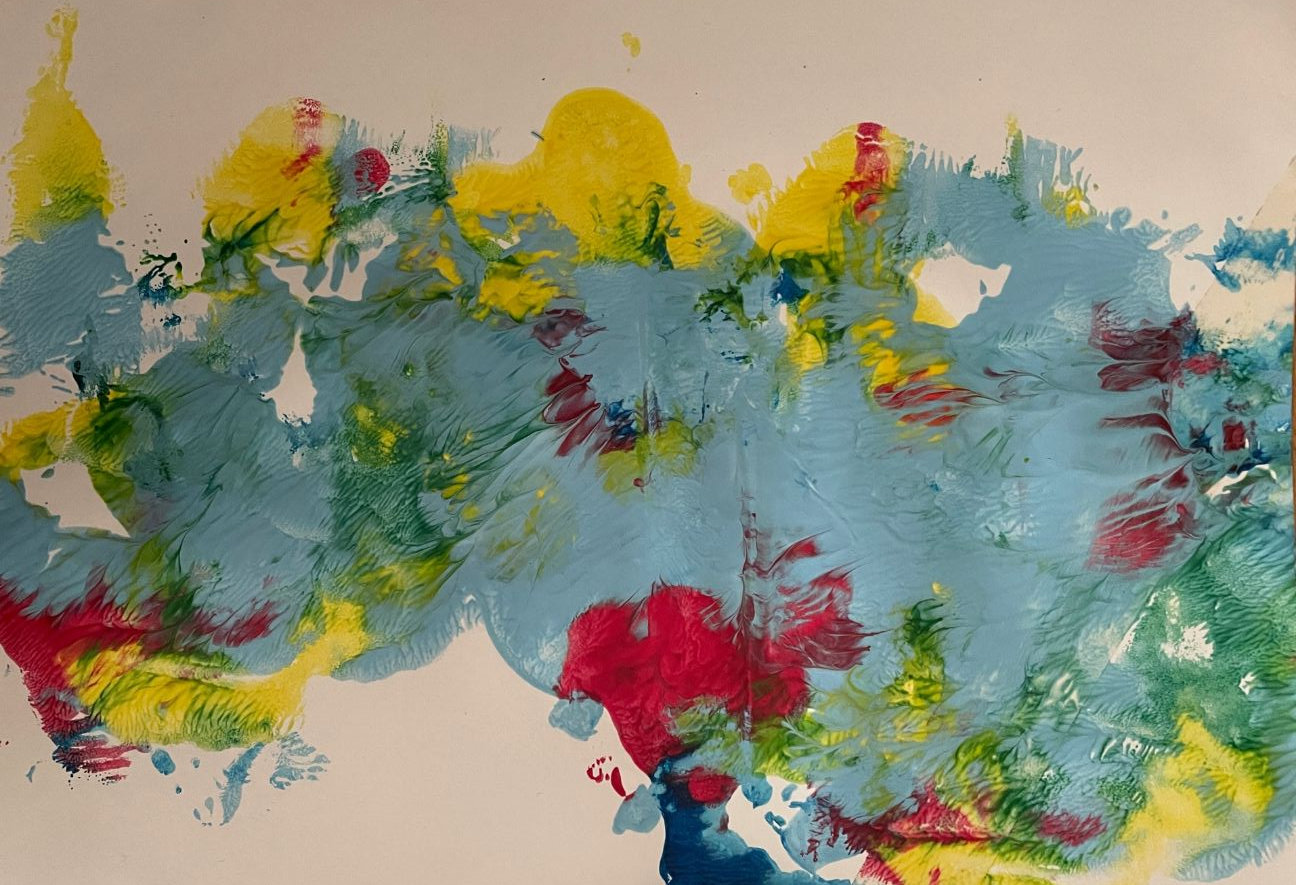
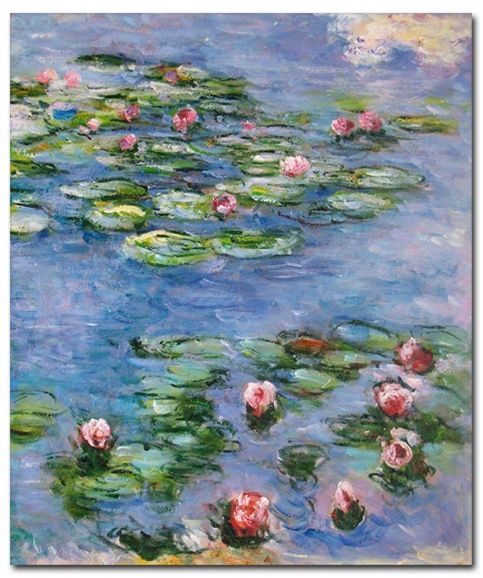
Another Lucas watery image reminded me of a Monet.

Lucas – garden pond squash painting.    Mick Burton, continuous line artist.

Here is one of Monet’s many paintings of water lilies.

Water Lilies Giverny – by Claude Monet.

One day I may tell you about a picture Kate painted when she was four.