Author Archives: mickburton2

Unknown's avatar

About mickburton2

I am an Artist in Leeds, fascinated by Continuous Line Drawings. I first developed my style and ideas in the 1960's and early 1970's.

Colour Sequence Allocation on Escher Islamic Mosaic Continuous Lines, STAGE 3.

Now that we have applied my Alternate Overdraw to the Continuous Lines in the Escher Islamic design, I can show how I allocate colours.  We can then compare the result with the colours on the original Islamic design painted by Escher in 1922.

My basic method of allocating colours is covered in my Post on 27 September 2014 entitled “Colour Sequence on Continuous Line Drawing”.

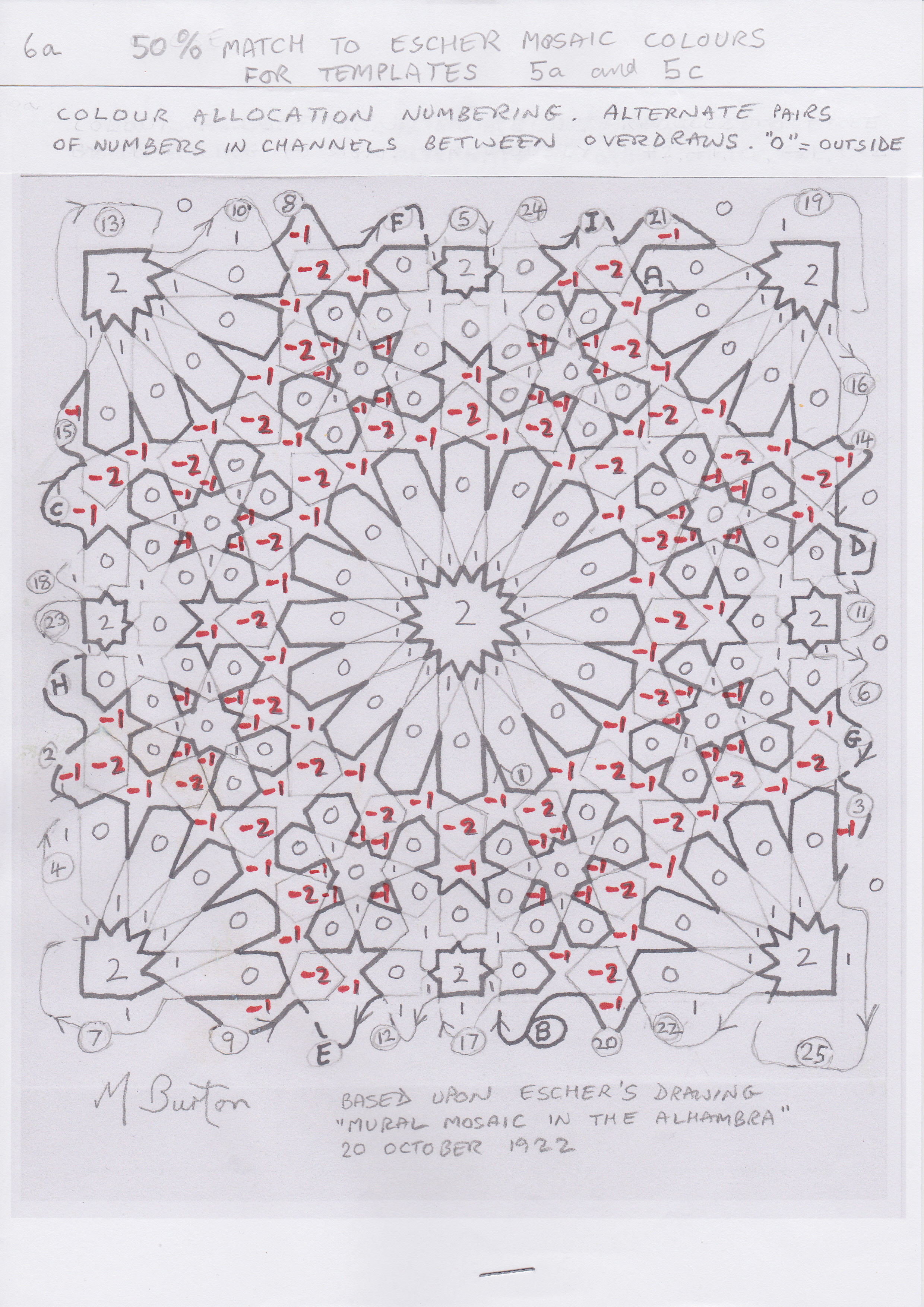
I will start with that same basic process where colour “0” is the outside of the drawing and this is alternated with “1” in its channel or channels.  When we cross through an overdraw from a “1” area we allocate “2” to this adjacent area on the other side and then alternate this with “3” (if there are any) in that channel.  In the negative direction, if we go from a “0” area through an overdraw we will allocate “(-)1” and alternate with “(-)2” in that channel.

Five colour number allocation on continuous lines for Escher Mosaic. Mick Burton study.

Five colour number allocation on continuous lines for Escher Mosaic. Mick Burton study.

There are no areas coloured “3” and so we have 5 colours allocated, compared to only 4 colours used in the original Mosaic.

At this stage things did not look promising.  Trying to equate the 4 original colours in the Mosaic to my 5 numbers produced a best set of matches of 156 out of 313 (I won’t go into much detail here) which is just under 50%.

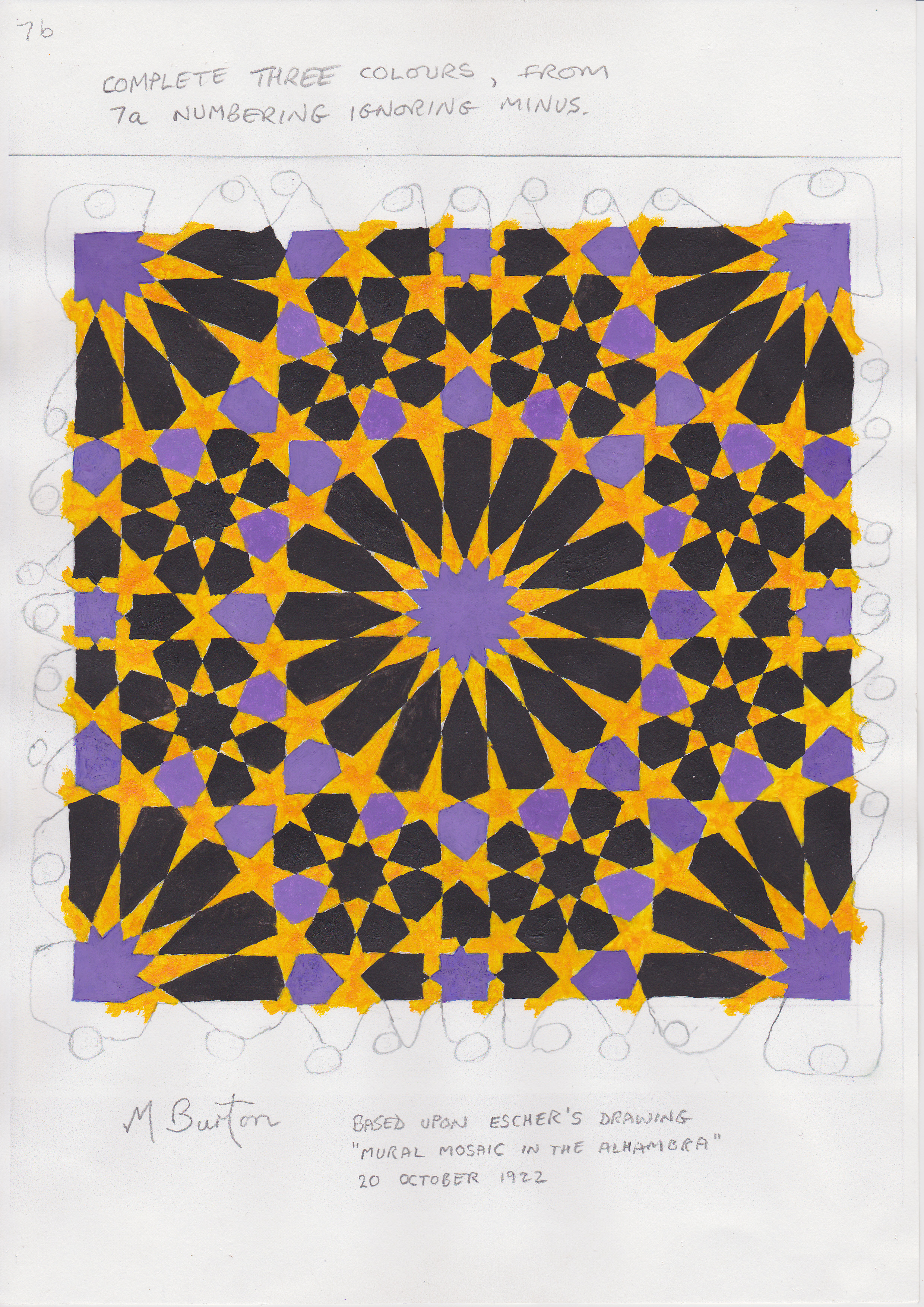
One thing that I did observe was that YELLOW matched “1” on 76 occasions and “(-)1” on 88 occasions.  This reminded me that I occasionally allocate colours positively by ignoring (-) signs.  When switched to simply using “0”, “1” and “2” I had 3 numbers to compare with the 4 original colours on the mosaic.  This now produced a best match of 241 colours out of 313 which gives 77% and was much more respectable.  Here is the 3 colour allocation.

Colour sequence allocation of 3 colours to continuous lines on Escher Mosaic. Mick Burton study.

Colour sequence allocation of 3 colours to continuous lines on Escher Mosaic. Mick Burton study.

Of course the fourth colour GREEN used in the mosaic does not appear at all in mine.

As with a lot of art, including craft, there may be processes (or even rules) which get you a long way in a design but you have to know when, and how, to break away from them.  I may be a bit rigid with my Continuous Lines but my studies of Picasso and Dali doing them demonstrates that nothing is certain.

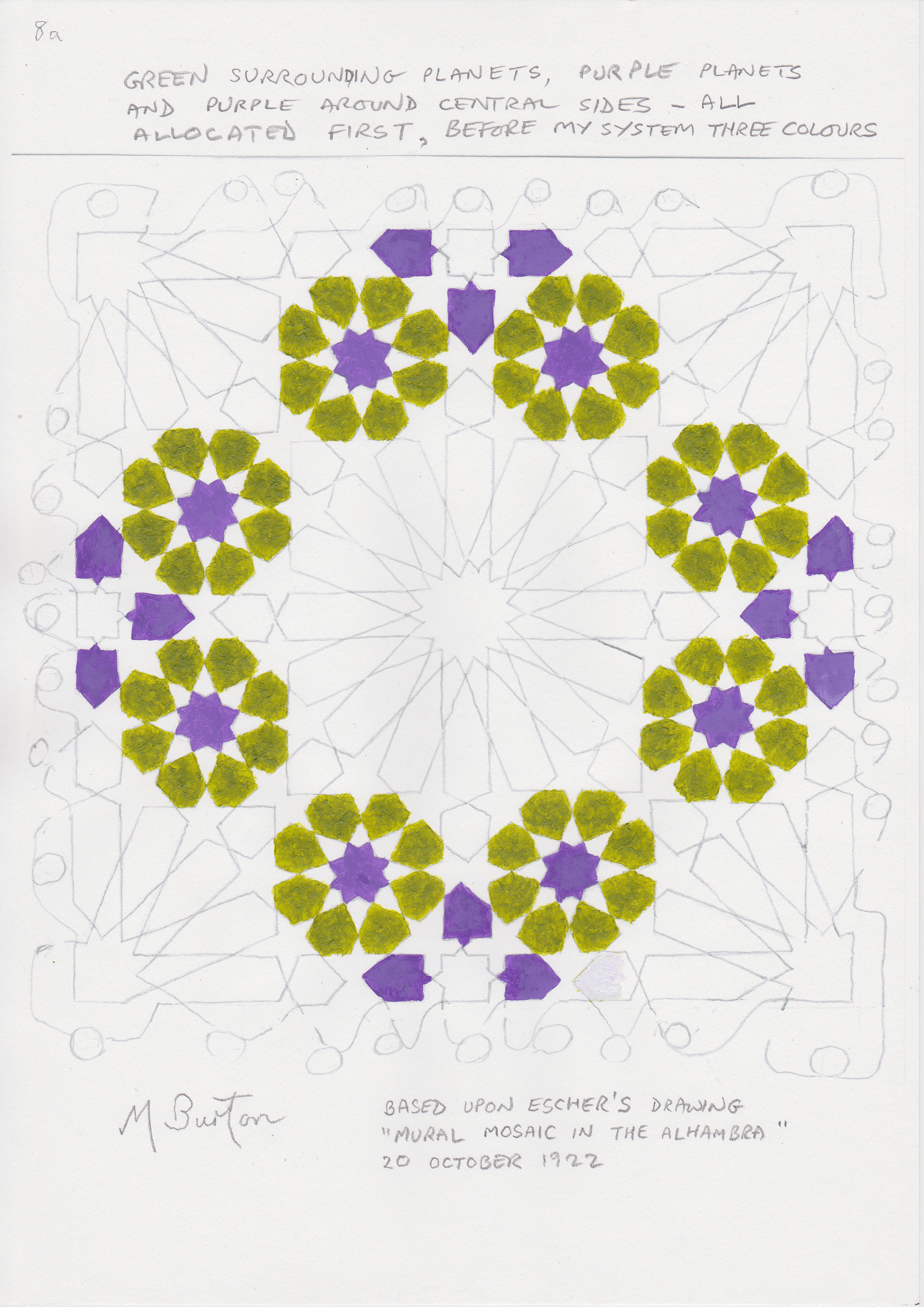
This Islamic artist, who I regard as very special, probably used a method equivalent to mine to allocate most of his colours but probably made the following over riding decisions to finish the colouring off –

a.   GREEN was allocated to the 8 areas surrounding each of the 8 planets, and nowhere else.

b.  Each of the 8 planets was coloured PURPLE, instead of black, to mirror its use for the centres of the Suns.

c.  Each Purple junction block at the middle of each side has three directional areas surrounding it which are coloured PURPLE instead of black.  I originally considered these to be decorative.

Allocation of all green colours and changes of black to purple on Escher Mosaic. Mick Burton study.

Allocation of all green colours and changes of black to purple on Escher Mosaic. Mick Burton study.

If the above decisions were made first, then the remaining allocations would be made totally on my 3 colour allocation.  That is 229 areas remaining where my allocation matches 100% with the original Escher Mosaic colours.

229 colour sequence areas matching original Escher Mosaic colouring. Mick Burton study.

229 colour sequence areas matching original Escher Mosaic colouring. Mick Burton study.

So there we are. I hope you have found my attempt to explain how this Escher Islamic Mosaic contains two continuous lines, which I believe was deliberate by the artist, and how most colours matched a colour sequence directly linked to the continuous lines.

The basic elements in the design largely match the template produced by my Alternate Overdraw method and, after specific allocation decisions were made by the artist, there was a total match of all other colours allocated by my method using the template.  Whether of not the artist used a similar method to myself, there is a direct link between the colour sequence and the two continuous lines.

In my searches through other forms of art, on the look out for continuous lines, I have not found any other example of art which contained both continuous lines and a related colour sequence, or signs of possible use of Alternate Overdraw with its Template.

There is a modern mathematical theory called “The Winding Number Theory” which could allocate colours in an equivalent way to my initial 5 colours, but it is not as much fun.

I will do a FURTHER POST (STAGE 4) on how the artist could have used Alternate Overdraw to help him to connect up the loose ends on the borders when actually constructing his continuous lines.

Mick Burton Continuous Line Blog.
Alternate Overdraw Applied to Escher Islamic Mosaic Continuous Lines, STAGE 2.

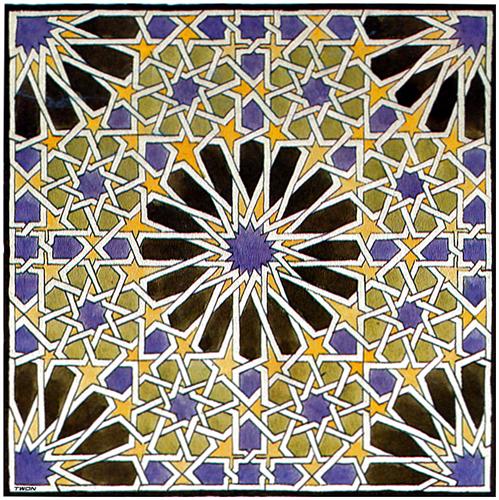
Escher painting 1922 of Islamic Mosaic tile at the Alhambra. WikiArt. Continuous line study by Mick Burton.

Escher painting 1922 of Islamic Mosaic tile at the Alhambra. WikiArt. Continuous line study by Mick Burton.

Before applying my Alternate Overdraw, which I use to allocate colours to Continuous Lines, I will give you my analysis of the colours in the original Mosaic and what I feel were the artist’s ideas behind the design.

Eric Broug states, in his YouTube demonstration “How Grids and Patterns Work Together” that this is a 16 point star surrounded by 8 point stars.  Geometrically you can produce stars with many different numbers of points.  Having done many planetary paintings myself, I feel that the original artist has realised that in this case we have a central Sun and 8 planets surrounding it which can represent our solar system (we can ignore Pluto as a planet as it only featured as such for a part of the last century).  The colours the artist uses reflect many aspects of this planetary situation –

a.  YELLOW is used as the colour for the flaming surfaces of the central Sun and the corner Suns.  All other yellow areas have star like shapes and represent distant stars peppering the background.

b.  PURPLE is used for the centres of the Suns and the 8 Planets.  Purple is also used for the lines of areas along the sides, vertically and horizontally from the centres of the sides and diagonally (the lines of purple areas may simply be decorative).

c.  BLACK is used for the “fan blade” shapes emanating from the Suns.  In my planetary paintings I often use black for the background outside a drawing and for the gaps through the  drawing .  The artist here could be using the same idea, so that the blades are in fact deep space seen beyond the Suns.

d.  GREEN is used to surround each Planet and I interpret this as representing life on each Planet, not just ours.

The process for completing an Alternate Overdraw is covered in my Post dated 10 September, 2014  (9/10/2014)  entitled “Alternate Overdraw on Continuous Line Drawing”.

In the previous post, STAGE 1, I showed that there are two continuous lines in the Mosaic.  I apply my Alternate Overdraw to produce a template for me to work with to allocate a colour sequence.  I have to bear in mind that there are 2 Overdraw results and 1 colour sequence for a single continuous line and 4 Overdraw results and 2 colour sequences for two continuous lines.

My experience tells me that the Alternate Overdraw, which will produce a Template best representing this Planetary composition, will have –

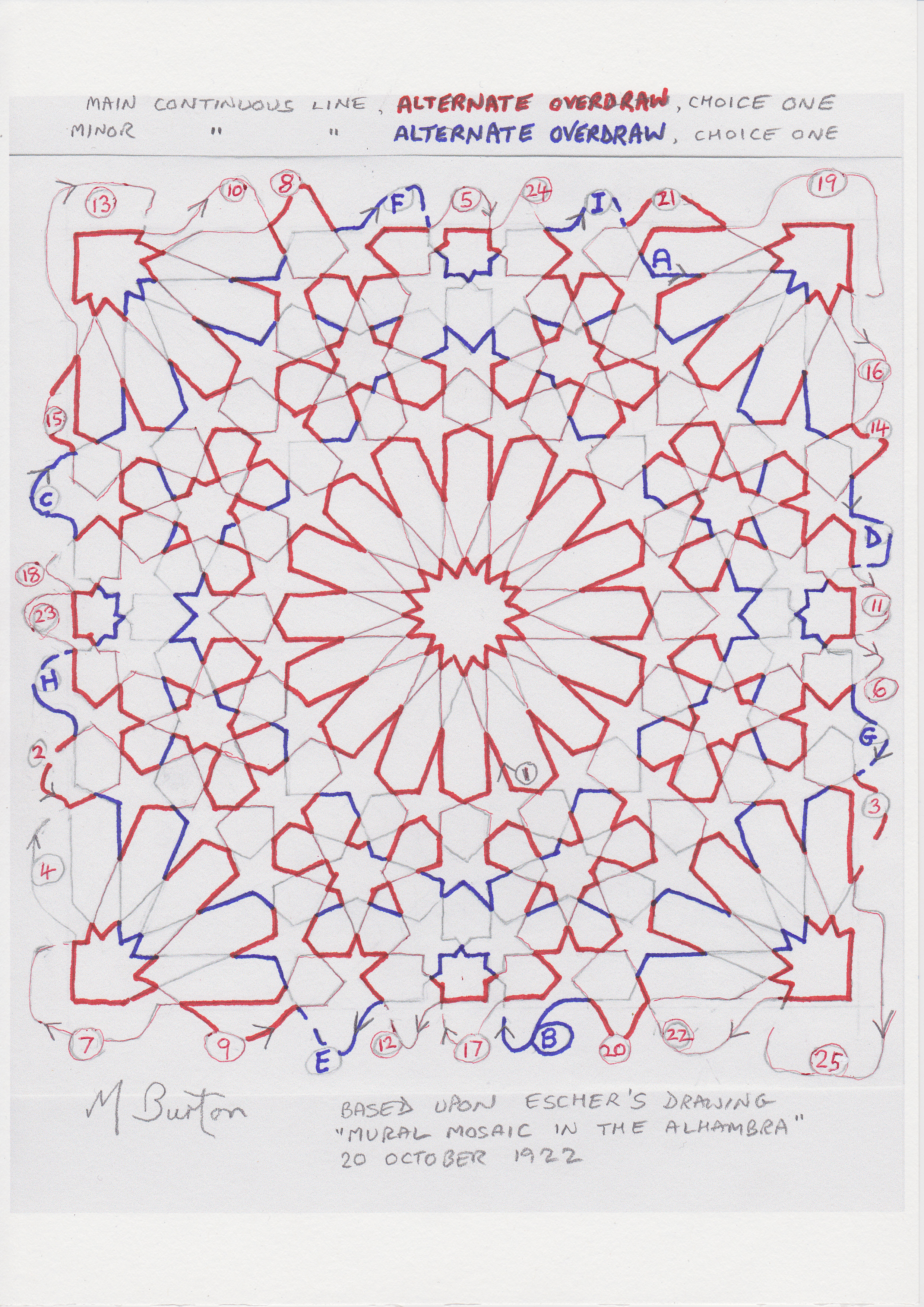
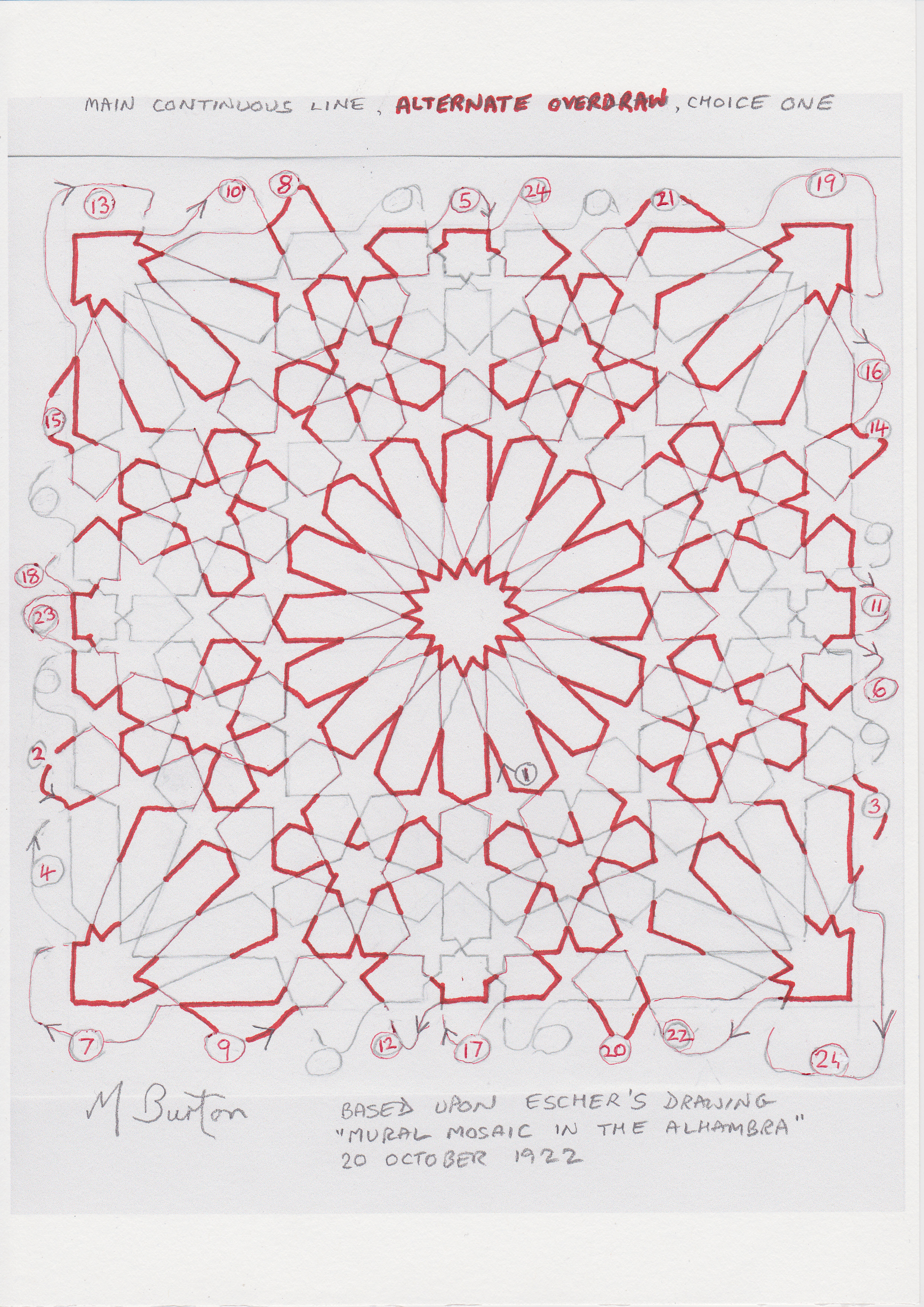
a.  An Overdraw for the Main continuous line commencing by overdrawing (in Red) a side of a fan blade of the central Sun, and

b.  An Overdraw for the Minor continuous line commencing by overdrawing (in Blue) a side of a fan blade on a corner Sun.

Main continuous line, Alternate Overdraw, choice 1. Mick Burton, Escher Mosaic study.

Main continuous line, Alternate Overdraw, choice 1. Mick Burton, Escher Mosaic study.

Minor Continuous Line, Alternate Overdraw in Blue, Choice 1. Mick Burton Escher Mosaic study.

Minor Continuous Line, Alternate Overdraw in Blue, Choice 1. Mick Burton Escher Mosaic study.

The aim  of the Alternate Overdraw is to create channels within the design where two colours can be allocated alternately within each channel and that adjacent channels have different pairs of colours.  An overall sequence of colours then follows across channel boundaries.

My experience told me, at this stage, that my colour sequence was likely to match the original Mosaic in and around the five Suns, but less so elsewhere.

I will show my attempts at allocating corresponding colours in the NEXT POST.  I will also explain why I feel that the original artist may have used the Alternate Overdraw or an equivalent method.

Mick Burton Continuous Line Blog.
Continuous Lines in Escher Islamic Mosaic painting, STAGE 1.

Escher painting 1922 of Islamic Mosaic tile at the Alhambra. WikiArt. Continuous line study by Mick Burton.

Escher painting 1922 of Islamic Mosaic tile at the Alhambra. WikiArt. Continuous line study by Mick Burton.

I look for continuous lines in all forms of art.  I first saw this design in my daughter Kate’s book “Escher, The Complete Graphic Work”, by J.L. Locher.   We are both long term admirers of this artist.  Escher did this detailed painting  in 1922 when in Granada at the Alhambra, and its quality really hit me.  It was of an Islamic mural Mosaic tile,  which was made up of those geometric lines which are often seen in Islamic art, and I assessed it for continuous lines.  

I could see that the overall symmetrical  pattern and I saw that Escher had painted the design BORDER, which seemed to indicate what happened to the lines after they hit the sides of the square.  I then worked out, from the Border Pattern, that the lines were fed back in the same routes on all four sides of the square.  From the point of view of finding a single continuous line, in my experience, such overall symmetry of the structure meant that it was very unlikely that there was only one line. 

Here is the basic structure which I arrived at, which shows the “wiring” connections indicated by the border.  Let’s see how many continuous lines there are.

Escher Islamic Tile. Basic line structure, with border connections. Mick Burton continuous line study.

Escher Islamic Tile. Basic line structure, with border connections. Mick Burton continuous line study.

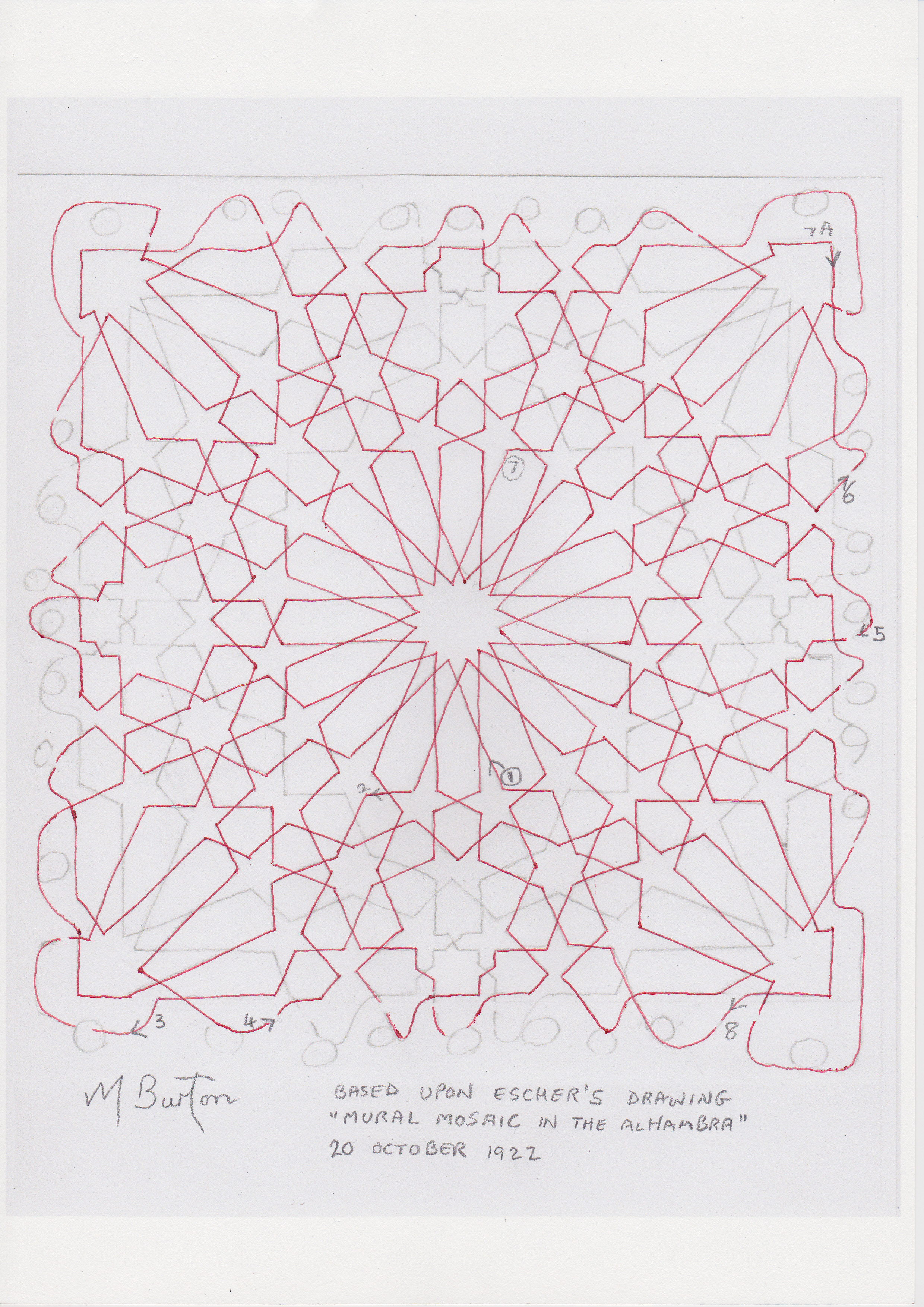
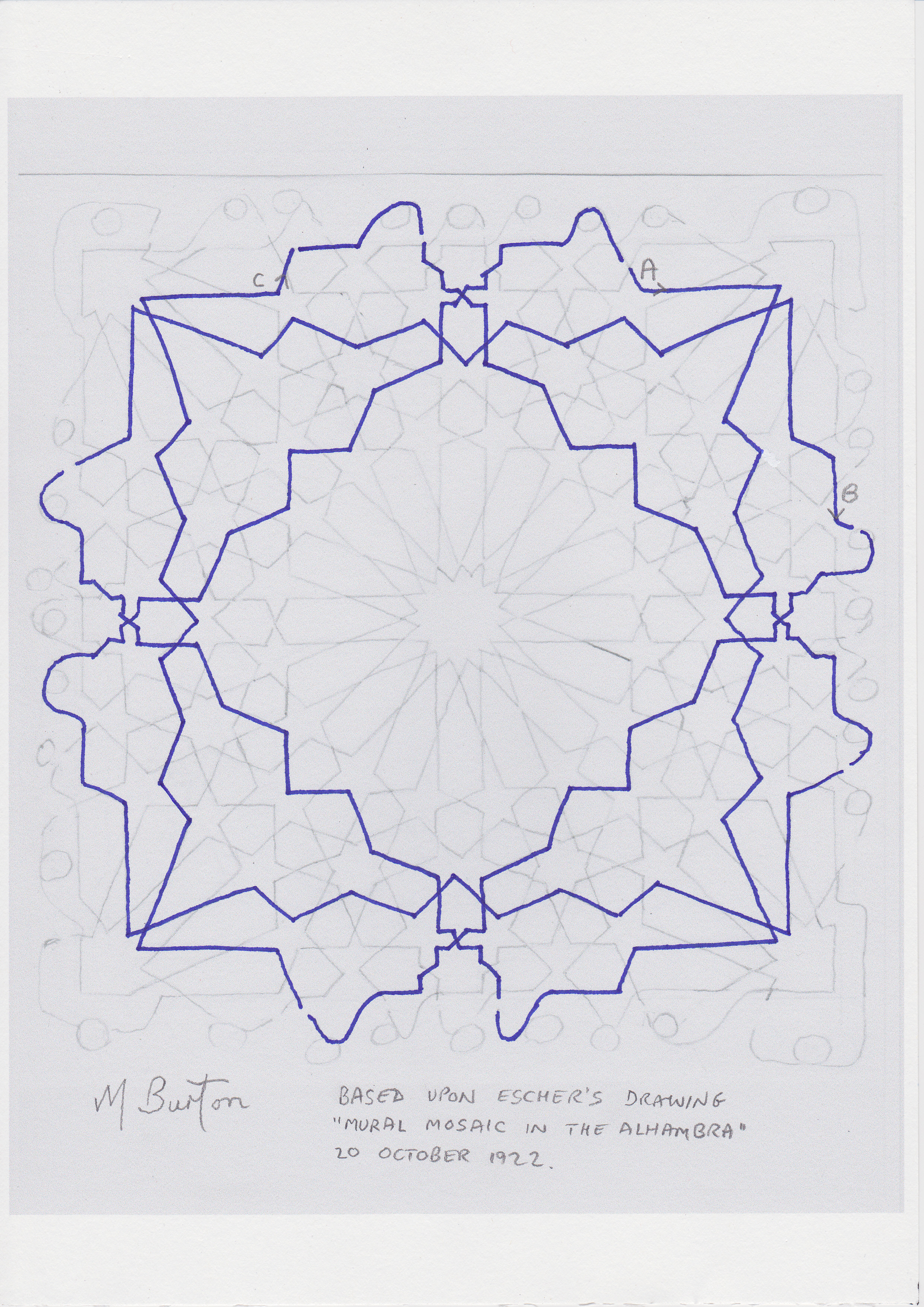
When I traced over the lines I found that there were in fact two continuous lines making up the whole design.  Here are the two results, a Main continuous line (in red) and a Minor one (blue).

Main continuous line, one of two. Escher Islamic tile design. Mick Burton continuous line study.

Main continuous line, one of two. Escher Islamic tile design. Mick Burton continuous line study.

Minor continuous line, 2nd of two. Escher Islamic tile design. Mick Burton continuous line study.

Minor continuous line, 2nd of two. Escher Islamic tile design. Mick Burton continuous line study.


By experimenting with border changes, a bit like swapping wiring connections, I did come up with a single continuous line, but the borders were no longer symmetrical.  It seems likely that the artist realised that two continuous lines was the best he could hope for whilst retaining overall symmetry.   In a LATER POST I will show how a border can be “tweaked” by a slight alteration to make one continuous line in the mural mosaic, and how this answer is achieved.  I will also show how the artist is likely to have worked out how to achieve two continuous lines by connecting up the correct loose ends.

I now needed to know  “How important continuous lines were, within this design, to the artist?”   It could be that Continuous Lines were incidental to other aims, or they may have been of prime importance.

In my NEXT POST I will apply my Alternate Overdraw technique to produce a Template of closed lines, which I use to decide upon the colours to allocate.   I will also suggest what the artist’s ideas were for the design and his colour selection.  In a FURTHER POST you will see how my colour allocation compares with the original colours and to what extent I feel that my ideas were the same or similar to those used by the artist.

All this has been done without any reference to the construction of the original line structure.  I have taken the completed structure as a starting point to apply my ideas.  I did not research in any detail on Islamic line construction, until after my whole study was completed.

I have recently found YouTube demonstrations by Eric Broug entitled “How to Draw a Mamluk Quran Page” and “How Grids and Patterns Work Together”, which gave me a good insight into pattern construction and include an explanation of a larger tile containing this Escher Mosaic design as a section.  This is a fascinating process used by the Islamic artists over 500 years ago.  Otherwise, I have not found any reference to borders, colouring, or specific meaning of this design.

Possibly my ideas will generate a new view on aspects of the creation of this and other Islamic designs. 

Mick Burton, Continuous Line Blog. Continue reading
Continuous Line Drawings at “British Wildlife” Exhibition, Martin Mere.

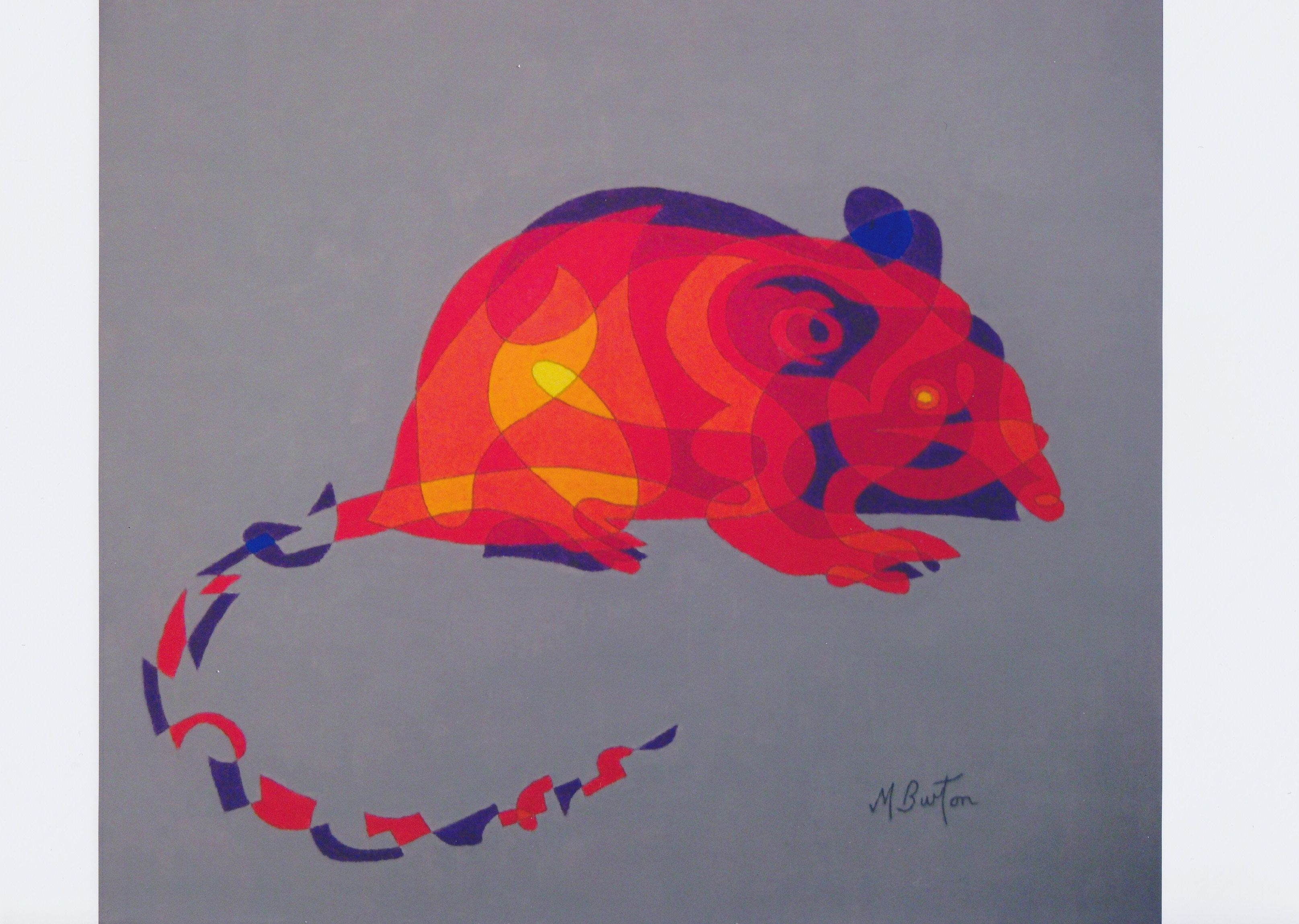
"Mouseman Mouse" based upon Robert Thompson carved mouse.  Association of Animal Artists  "British Wildlife" Exhibition, Martin Mere, February & March 2015.  Mick Burton, Continuous Line Drawings.

“Mouseman Mouse” single continuous line drawing based upon Robert Thompson carved mouse. Association of Animal Artists
“British Wildlife” Exhibition, Martin Mere, February & March 2015. Mick Burton, Continuous Line Artist.

This is my second year taking part in the Association of Animal Artists exhibition at Martin Mere Wetlands Centre, Lancashire.  “British Wildlife” runs until 29 March 2015.  My chosen wildlife submissions are “Mouseman Mouse and “Gledhow Foxes Sunbathing”.

My grandad George Burton was born in Kilburn, North Yorkshire, and when I was young my Dad took me to the Church in Kilburn and pointed out the carved mice which appeared on the church furniture.  They were carved by Robert Thompson, who was at school with Grandad, and his family still run the furniture business in Kilburn which is now world famous.

As time went on I found out so many things about Robert “Mouseman” Thompson and his mouse trademark.  It seemed natural that I should do a  mouse in my continuous line drawing style and colour sequence.

Robert "Mouseman" Thompson's trademark carving on the Altar rail in Kilburn Parish Church, North Yorkshire.  Picture by Dave Sumpner at English Wikipedia.

Robert “Mouseman” Thompson’s trademark carving on the Altar rail in Kilburn Parish Church, North Yorkshire. Picture by Dave Sumpner at English Wikipedia.

Dad told me that Grandad and Robert were drinking companions in the late 1890’s and he passed on some stories of those times.

A man went to the pub in Kilburn with his groceries every day before setting off home.  He always went home over the “beck” footbridge, which had vertical rails with strappings through them.  The man habitually stopped half way across, sat on the straps and lit his pipe.  Grandad and others loosened the straps one day and the man later fell into the water.  There was a lot of “fuss” about that.

Another regular at the pub always parked his horse and trap outside and, of course, regardless of how much he had had to drink the horse could find its way home.  One night he came out of the pub and boarded the trap, not realising that the horse had been turned around between the shafts.  He drove off backwards to crash into the church wall.

I attended a talk by one of the Thompson family over 40 years ago in Leeds Central Library and spoke to him later.  He said that each wood carver had his own style of mouse.  Old Robert’s mouse had become very simple, like a wedge of cheese, and they called it “grand prix” mouse.

"Gledhow Foxes Sunbathing".  Association of Animal Artists "British Wildlife" exhibition, February & March 2015.  Mick Burton, Continuous line drawing.

“Gledhow Foxes Sunbathing”. Association of Animal Artists “British Wildlife” exhibition, February & March 2015. Mick Burton, Single Continuous line drawing.

I saw a fox cub at the east end of Gledhow Valley Woods when walking the Airedales over 30 years ago.  Since moving here foxes have regularly been in the garden in the day time.  Last summer they took up sun bathing at the top of the lawn virtually every day for a period.  This usually included a prolonged period of scratching.

When we were completing the patio, with the help of Helen, Janet and Richard, a fox came and sat at the top of the garden and watched.  He had the demeanour of an “overseer” or a General overlooking a battle.  On another day there were two of them sitting up there and they reminded me of the “King and Queen” sculpture by Henry Moore which I saw up on the hill at Yorkshire Sculpture Park in 1987.

Poster for Henry Moore exhibition at Yorkshire Sculpture Park, 1987.

Poster for Henry Moore exhibition at Yorkshire Sculpture Park, 1987.


Continuous line blog by Mick Burton.

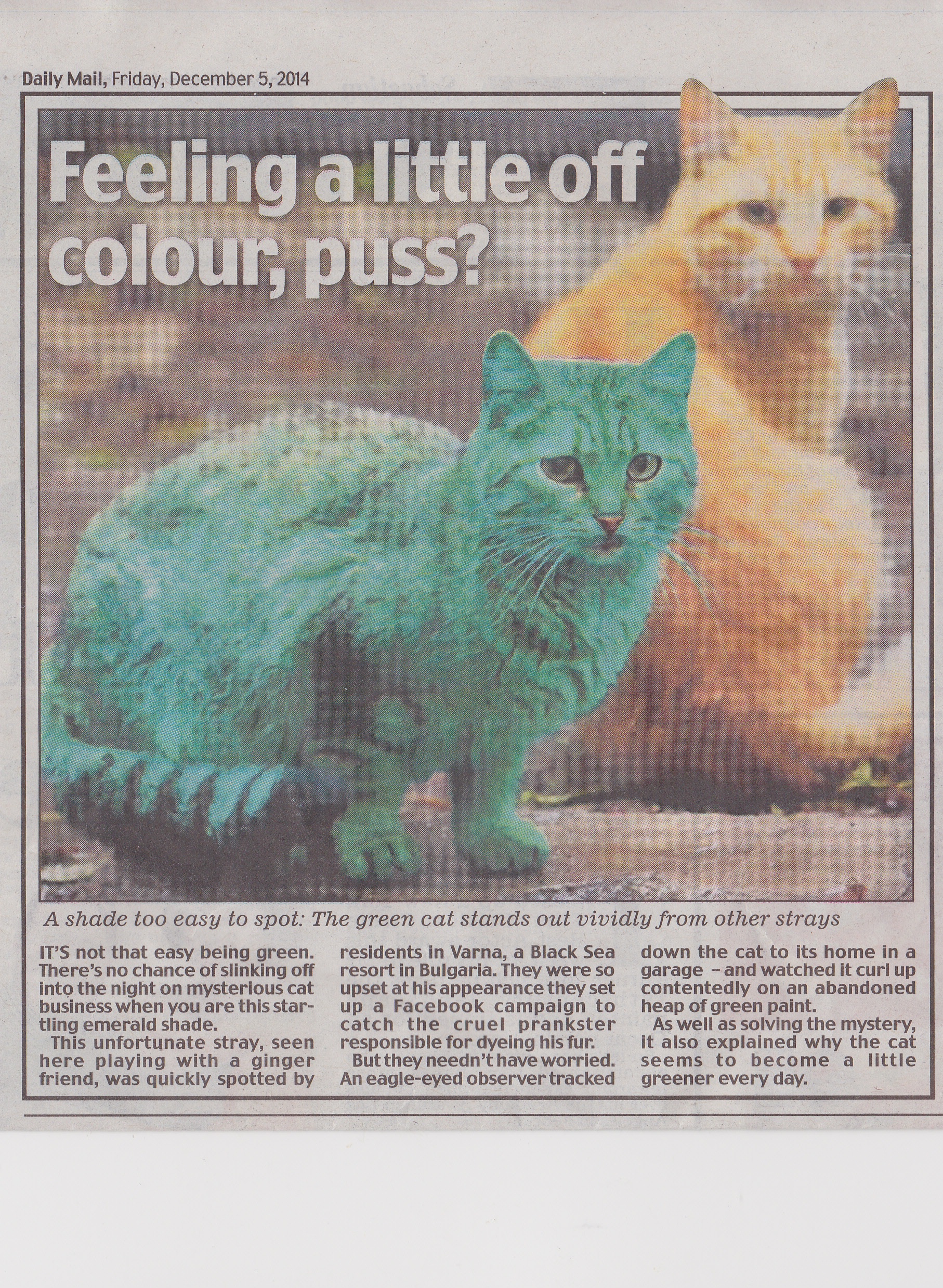
Show me a real Green Cat.


Cat who slept on a heap of old green paint. Daily Mail, December 5, 2014.  Mick Burton, continuous line drawing.

Cat who slept on a heap of old green paint. Daily Mail, December 5, 2014. Mick Burton, continuous line drawing.

I always thought that Green was a natural colour for a cat done with my continuous line drawing, but I never realised that one would appear. Here we are, in the Daily Mail report on a cat who is actually green and wandering around quite happily. It turns out that the cat slept in a garage on an abandoned heap of green paint.

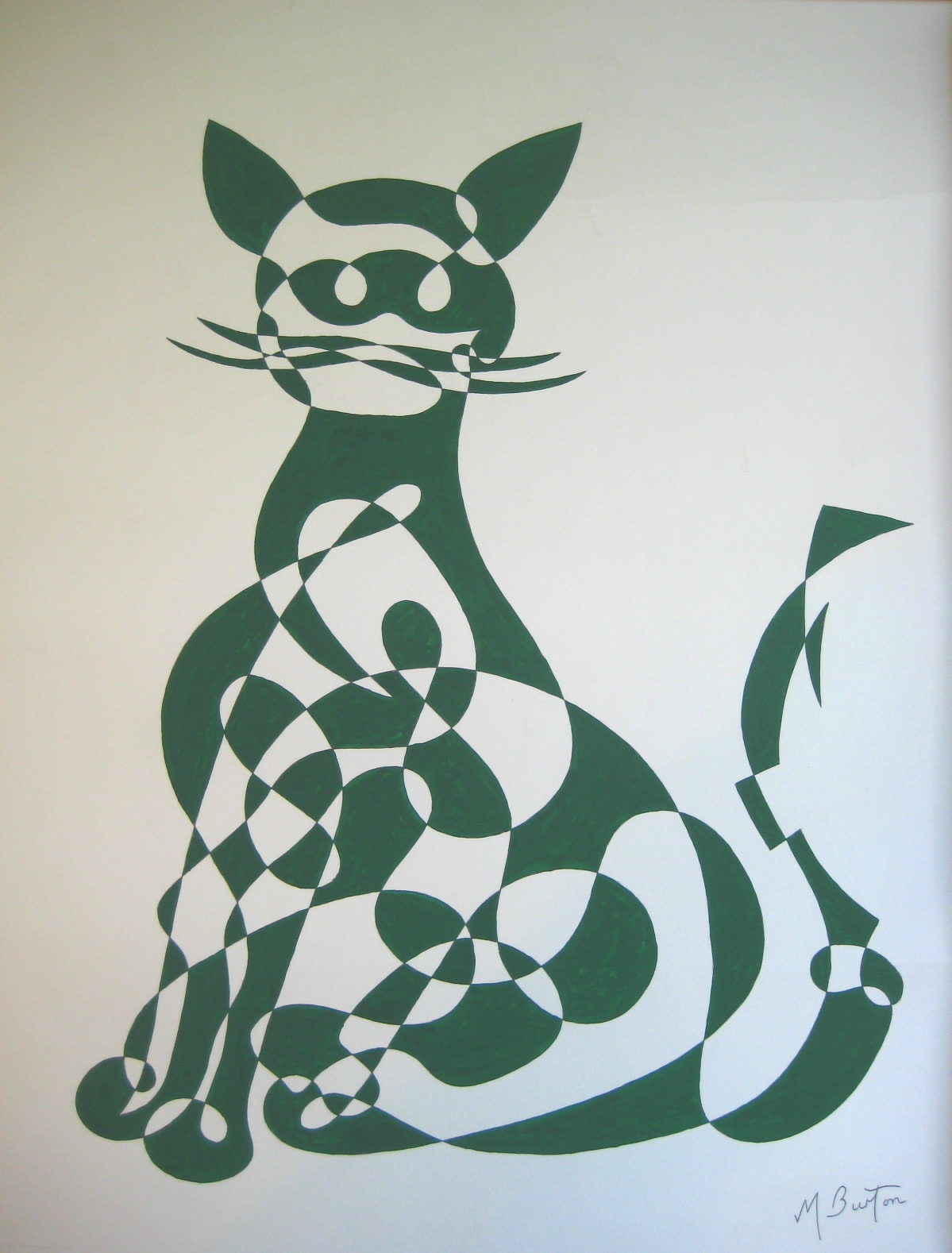
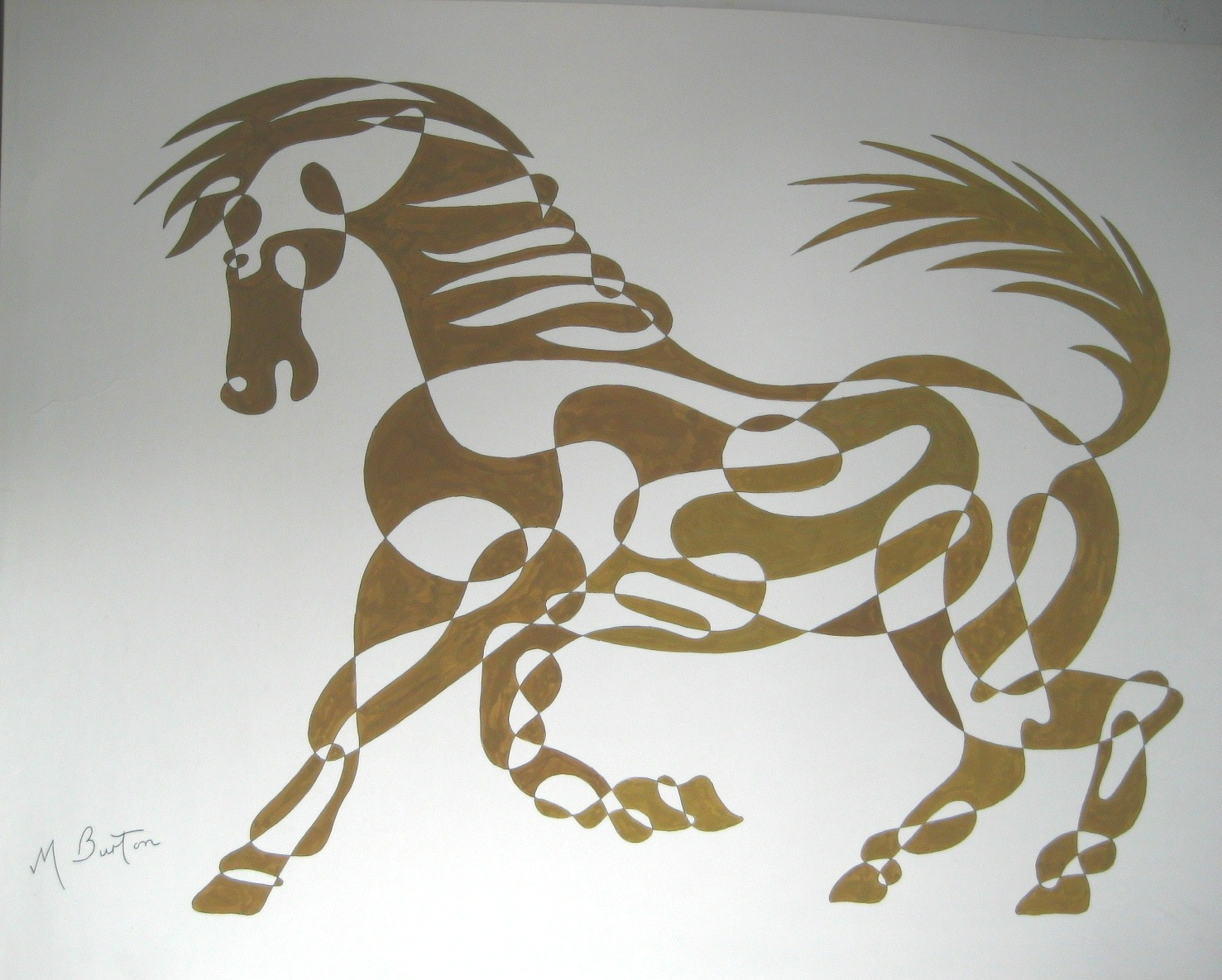
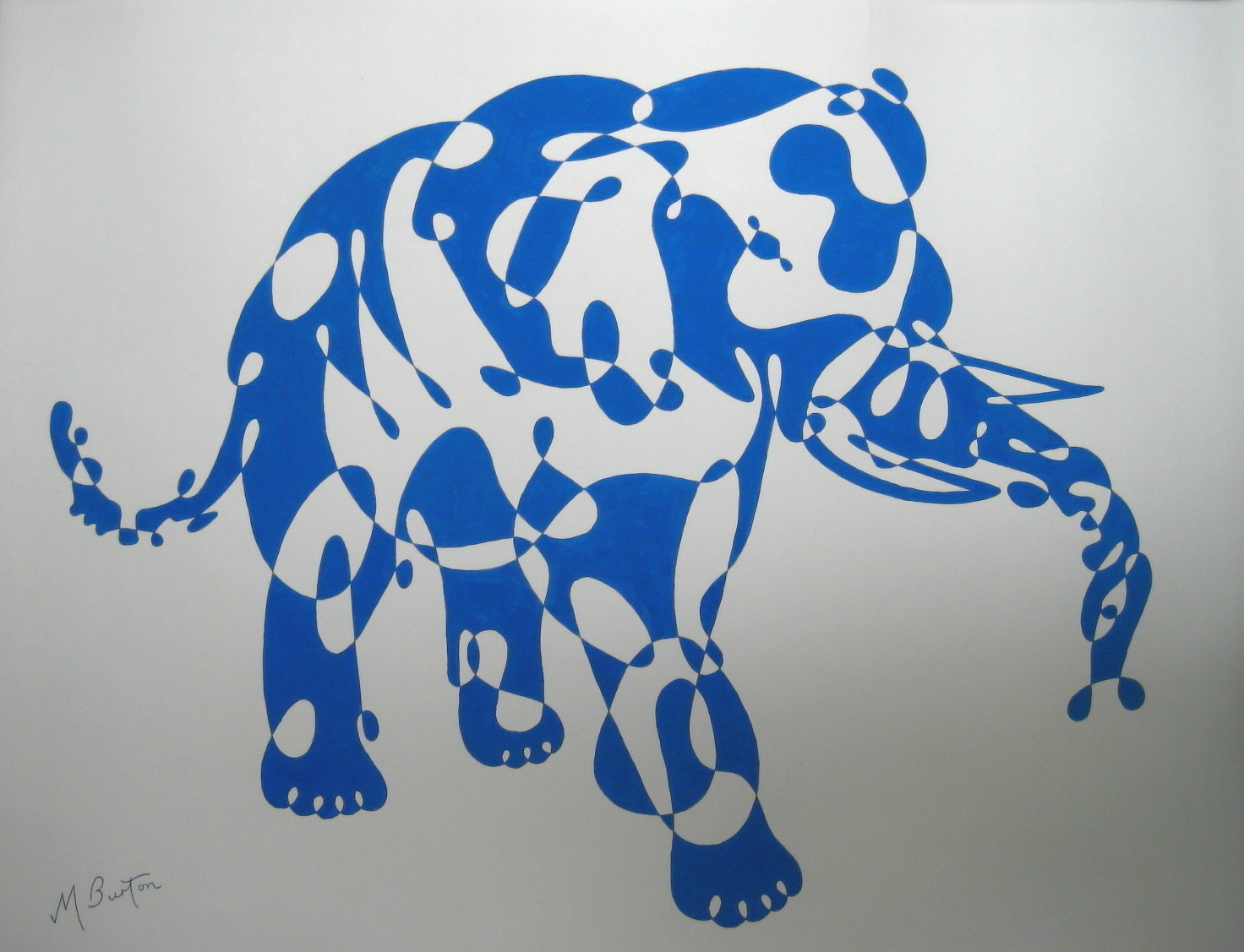
My original Green Cat was created in 1969 as one of four animals sold to J Arthur Dixon Ltd., a greetings card company that was based on the Isle of Wight.  They produced sets of Notelets with them on, sold in little cardboard boxes.  Here are the four designs.

Green Cat, continuous line drawing and alternate shading, by Mick Burton.  Notelet design for J Arthur Dixon Ltd, Isle of Wight, 1969.

Green Cat, single continuous line drawing and alternate shading, by Mick Burton. Notelet design for J Arthur Dixon Ltd, Isle of Wight, 1969.

Golden Horse, continuous line drawing and alternate shading, by Mick Burton.  Notelet design for J Arthur Dixon Ltd, Isle of Wight, 1969.

Golden Horse, single continuous line drawing and alternate shading, by Mick Burton. Notelet design for J Arthur Dixon Ltd, Isle of Wight, 1969.

Blue Elephant, continuous line drawing and alternate shading, by Mick Burton.  Notelet design for J Arthur Dixon Ltd, Isle of Wight, 1969.

Blue Elephant, single continuous line drawing and alternate shading, by Mick Burton. Notelet design for J Arthur Dixon Ltd, Isle of Wight, 1969.

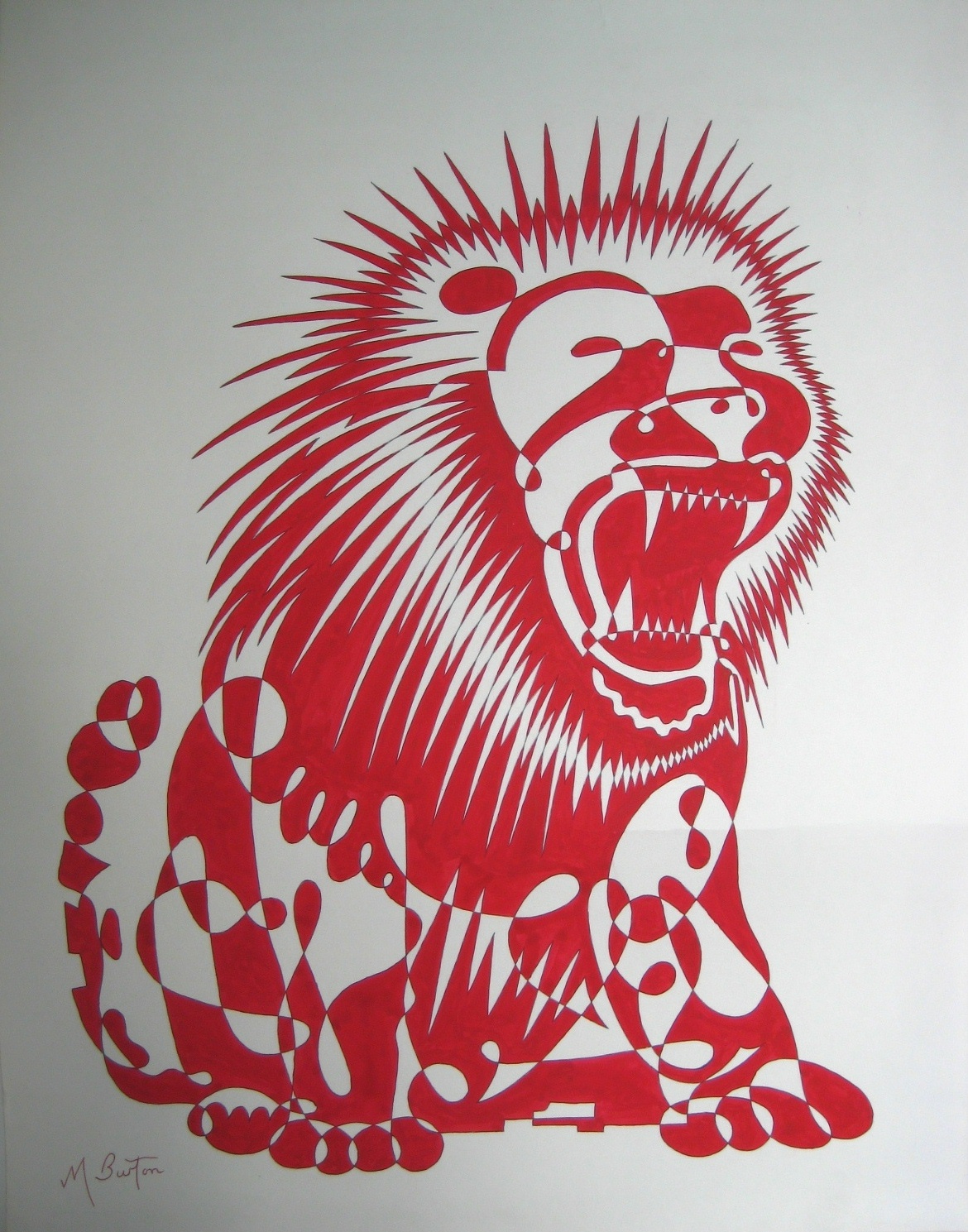
Red Lion, continuous line drawing and alternate shading, by Mick Burton.  Notelet design for J Arthur Dixon Ltd, Isle of Wight, 1969.

Red Lion, single continuous line drawing and alternate shading, by Mick Burton. Notelet design for J Arthur Dixon Ltd, Isle of Wight, 1969.


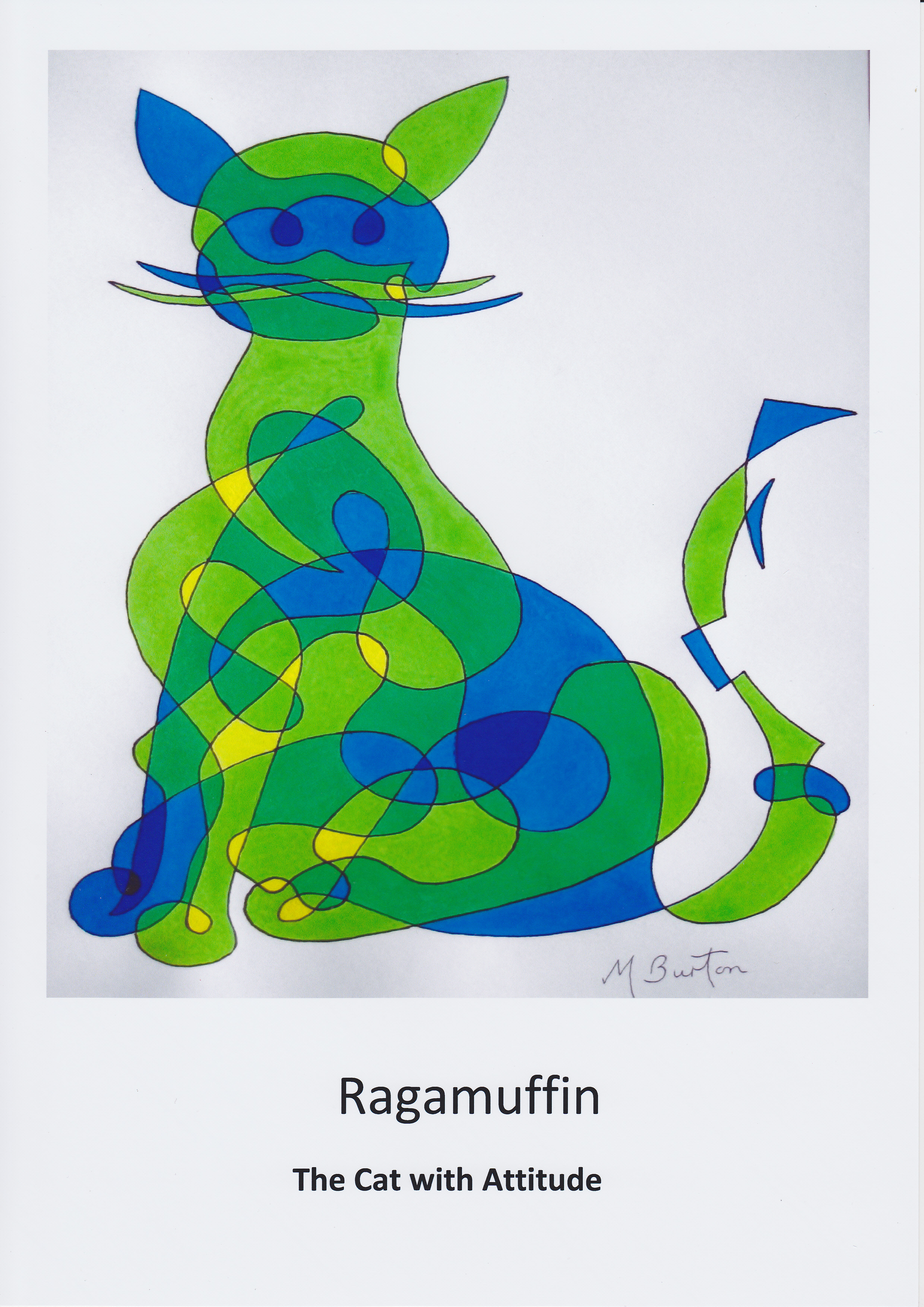
I continued the Green theme for a cat when I started producing my own greetings cards in 2013. This time I used colour sequence from yellow, through greens to blues.

The narrative on the card is about a cat that we had who used to get into all sorts of scrapes. His real name was Sandy and he looked a bit like the cat in the background in the Daily Mail photo above.</strong

Ragamuffin, green cat, continuous line drawing with colour sequence.  Greetings Card (front)  by Mick Burton.

Ragamuffin, green cat, single continuous line drawing with colour sequence. Greetings Card (front)
by Mick Burton.

Ragamuffin, continuous line drawing with alternate shading.  Rear of Greeting Card by Mick Burton.

Ragamuffin, single continuous line drawing with alternate shading. Rear of Greeting Card by Mick Burton.

>

Identikit and Key Features for Continuous Line Drawing


Identikit image of suspect for the murder of Elsie Batten, London, March 1961.

Identikit image of suspect for the murder of Elsie Batten, London, March 1961.

Edwin Bush, recognised and arrested as a result of the Identikit image for the murder of Elsie Batten.

Edwin Bush, recognised and arrested as a result of the Identikit image for the murder of Elsie Batten.

I use Key Features as part of my Continuous Line Drawing of Animals and People. Faces have always been of interest to me and when young I loved to do caricatures of people. I was in the police for a time and of course identification in its many forms was also fascinating.
In 1960 I left Harrogate Secondary Technical School and became a Police Cadet with the West Riding Police at the Wakefield Headquarters. My first post was in the Prosecutions Department, opening the mail (which required signing the Official Secrets Act) and making the tea. One of the officers preparing cases for Quarter Sessions and the Assizes was Inspector George Oldfield, who nearly 20 years later was Assistant Chief Constable Crime and in charge of the Yorkshire Ripper investigation.
My next posting in early 1971 was in “Modus Operandi” the Criminal Records Office for the North of England. Each criminal’s record sheet had at least one photograph of him attached, and in one case there were eight or nine photos ranging from a man’s early teens up to his seventies. Of course he had changed vastly over this time, but I noticed that his ears were identical in all the photos.
One day there was a bit of commotion in the large office with detectives collected in a corner arguing and laughing. I went to see what it was all about and they were looking a two images of suspects for a robbery. They explained to me that the images were produced by selecting parts of a face printed on cellophane sheets and placing them on top of each other to build up a face based on witness descriptions. It was called an Identikit set and was new in this country after being started in the USA. There were accompanying descriptions of a large man and a small man. The joke was that it was Laurel and Hardy. It was not given much chance of being successful by some of the crowd. A detective walking past peeped at what we were looking at and said, “Oh, I know them, but I think they are in prison”. Everyone laughed. Five minutes later he returned and said that he had looked up the two records and they had come out of prison a week before. They were not out for long!
I then found out about a recent case of murder in London which had been solved by the use of the Identikit. It was following the murder of Elsie Batten, an antique shop owner in London in March 1961. The detective investigating had two witness descriptions and produced two images on his new Identikit set. A constable saw a man resembling one of the images and arrested him. It was Edwin Bush, who admitted to the murder. He was executed at Pentonville Prison in July 1961. The image and a photo of Bush are shown above.
A few months later I was working at Horsforth Police station, near Leeds, when a detective I had worked with in the Records Office came in and said that he was going round all the police stations handing out Identikit sets and explaining how they should be used. So I had a go and it was great fun. Then the Inspector came in and he chatted to the detective for 20 minutes and said that he was not convinced that the Identikit would be much good. I had been watching as the detective had surreptitiously created an image of the Inspector whilst they were talking, and it was spot on, to everyone’s amusement!

.
Of course Identikit was not directly successful in all cases. In the late 1970’s The Yorkshire Ripper committed at least 13 murders and there were several Identikit images available to assist George Oldfield as he tried to solve them with his large team of officers. There were many complications and George was side tracked by the tape recordings from a man with a Geordie accent who said that he was the killer (most of my Geordie friends were interviewed). When Peter Sutcliffe was captured in Sheffield it was realised that several of the Identikit images were good likenesses to him.

Winding Number Theory and Continuous Line Drawing


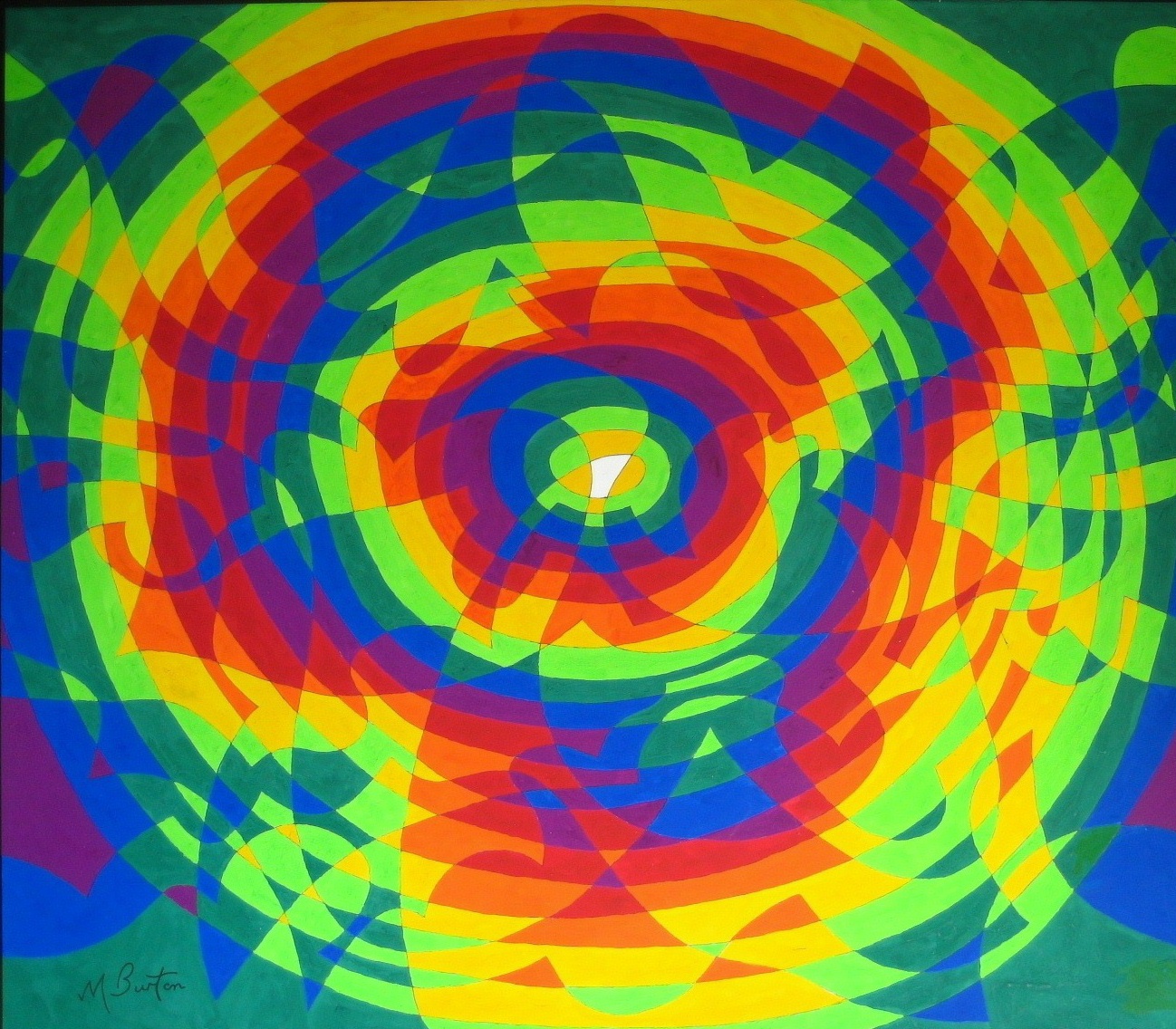
Whirlpool in Space, or Petrol Poluted Puddle. Spherical continuous line with repeat colour sequence with Rainbow colours. Mick Burton, Continuous Line, 1971.

Whirlpool in Space, or Petrol polluted Puddle. Spherical single continuous line drawing with repeat colour sequence with Rainbow colours. Mick Burton, Continuous Line, 1971.

This painting was one of two pictures hung at the Chelsea Painters Open Exhibition, held at the Chenil Galleries, Chelsea,1971.  I walked along the Kings Road looking for the gallery (I had submitted through and agency) and it was great to see the Whirlpool first in a window by the entrance.

The design was triggered by a browse through mathematics books in the library and coming across Winding Number Theory.  This used a continuous line and every time the line was drawn winding in a counter-clockwise direction a level was added and if you wound back in a clockwise direction a level was taken off.

So far, in my colour sequence numbering based upon Alternate Overdraw, I had not had a sequence of colours greater than about nine.  If I used the Winding Number method and continued to wind around counter-clockwise many times I could have a long colour sequence.  I went a bit mad with the Whirlpool, which was done on a spherical basis (allowing drawing out of one side of the paper and back in at the opposite side), and has a sequence of 20.

I did not simply go from light to dark over the whole 20 (the steps in shade between each colour would have been too small), but oscillated up and down with a smaller range of colours similar to a rainbow.  I had seen the rainbow effect produced by sunlight on petrol spilt on a puddle.

Alternate overdraw with colour sequence numbers. Continuous Line, Mick Burton.

Alternate overdraw with colour sequence numbers. Continuous Line, Mick Burton.

To illustrate the difference between my Alternate Overdraw and the Winding Number, I start with the Alternate Overdraw in Red on the left.  As shown in earlier posts, each channel of areas between overdraws has two numbers alternately.  You move naturally up to a higher channel or down to a lower channel, through the red line and continue the numbering.

As before, you start with “0” on the outside and 0 can also appear within the drawing.


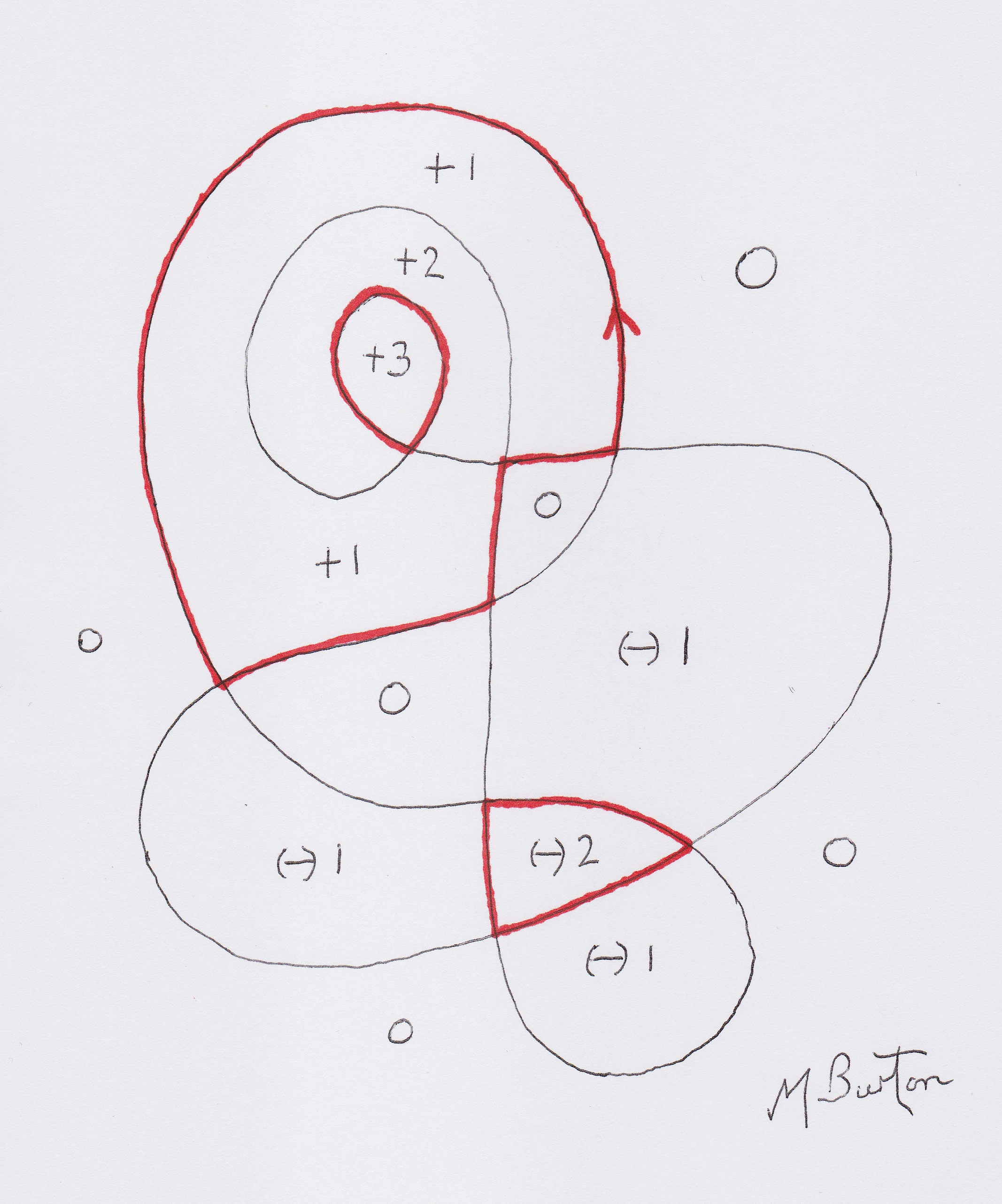
When we come to Winding Number allocation, we can use the same basic drawing with little arrows showing the direction it has been drawn.  It can be either direction of course, but I have chosen one which will match the result above.

Winding number allocation. Continuous Line, Mick Burton.

Winding number allocation. Continuous Line, Mick Burton.

Starting at “0” for the outside, if we cross to another area through a counter-clockwise border for that area, it will be a level higher.  If we cross through a clockwise line we reach a lower area.

Here the + areas are of course higher levels and the (-) areas are lower.

The numbering matches the Alternate Overdraw illustration above.


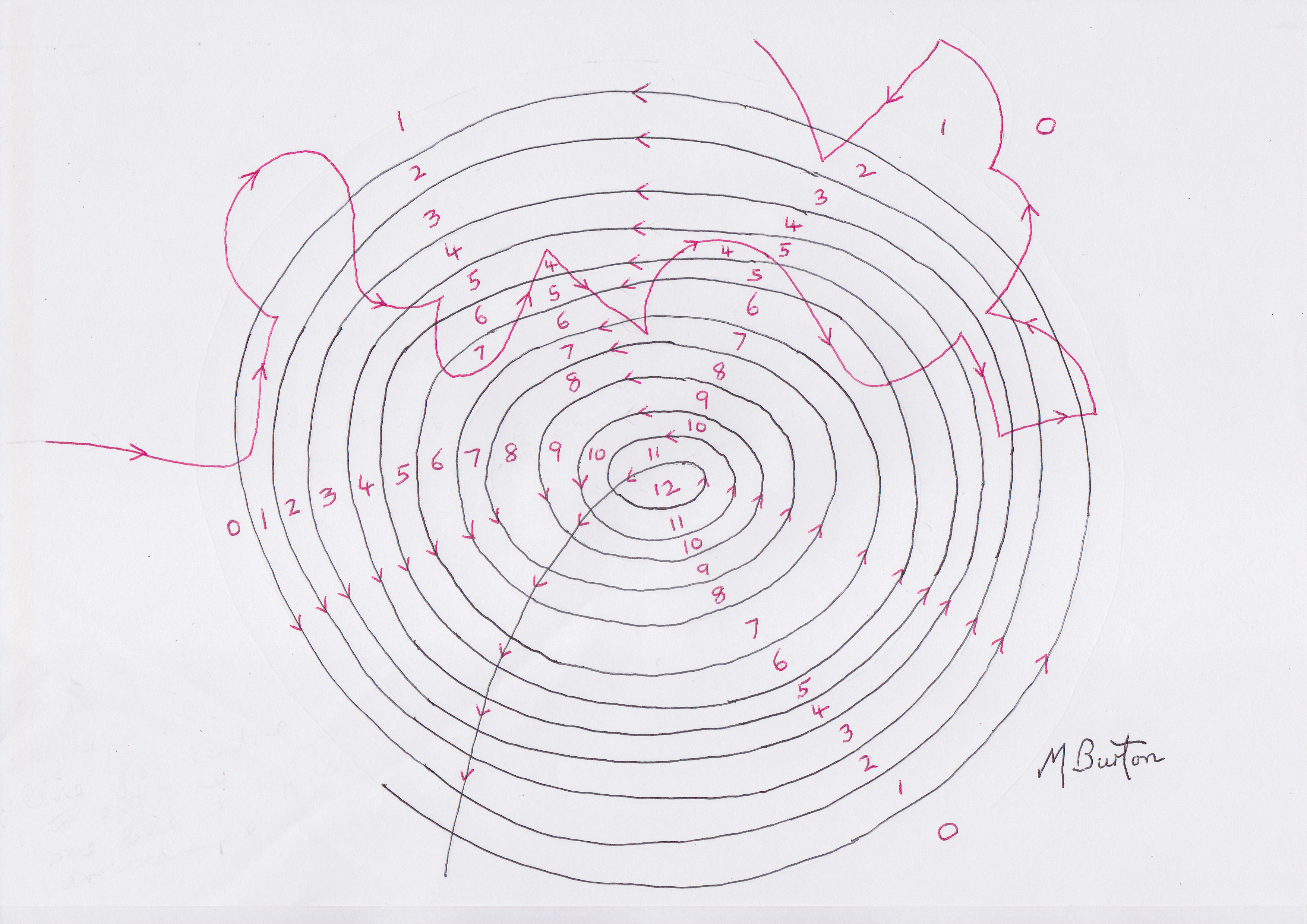
Now, just to show the initial thrust of the drawing for the Whirlpool, with many levels, the next illustration shows a line spiralling from the centre outwards and I have shown just 13 winds.

Part of initial Winding Number spiral for Whirlpool painting. Mick Burton, continuous line.

Part of initial Winding Number spiral for the Whirlpool in Space painting.    Mick Burton, single continuous line drawing.

Then I have drawn a line from the centre of the spiral directly back to the bottom of the picture as the first phase of breaking up the spiral so that lots more areas start to  appear.  The next such phase is a meandering line near the top of the picture. 

As I have said, this is a shorter version than the one usd for the main Whirlpool in Space picture above.

Next I have decided that the direction of  the line will be counter-clockwise starting from the bottom of the spiral, so that the levels go up towards the centre.  The numbers have then been added.

On the original painting, which is 24″ x 20″, I used alternate overdraw to allocate the colours.  This was because I was used to using that method and I think it is better for an artist anyway.  The Winding Number theory was simply the inspiration for producing a sequence of 20 or more.

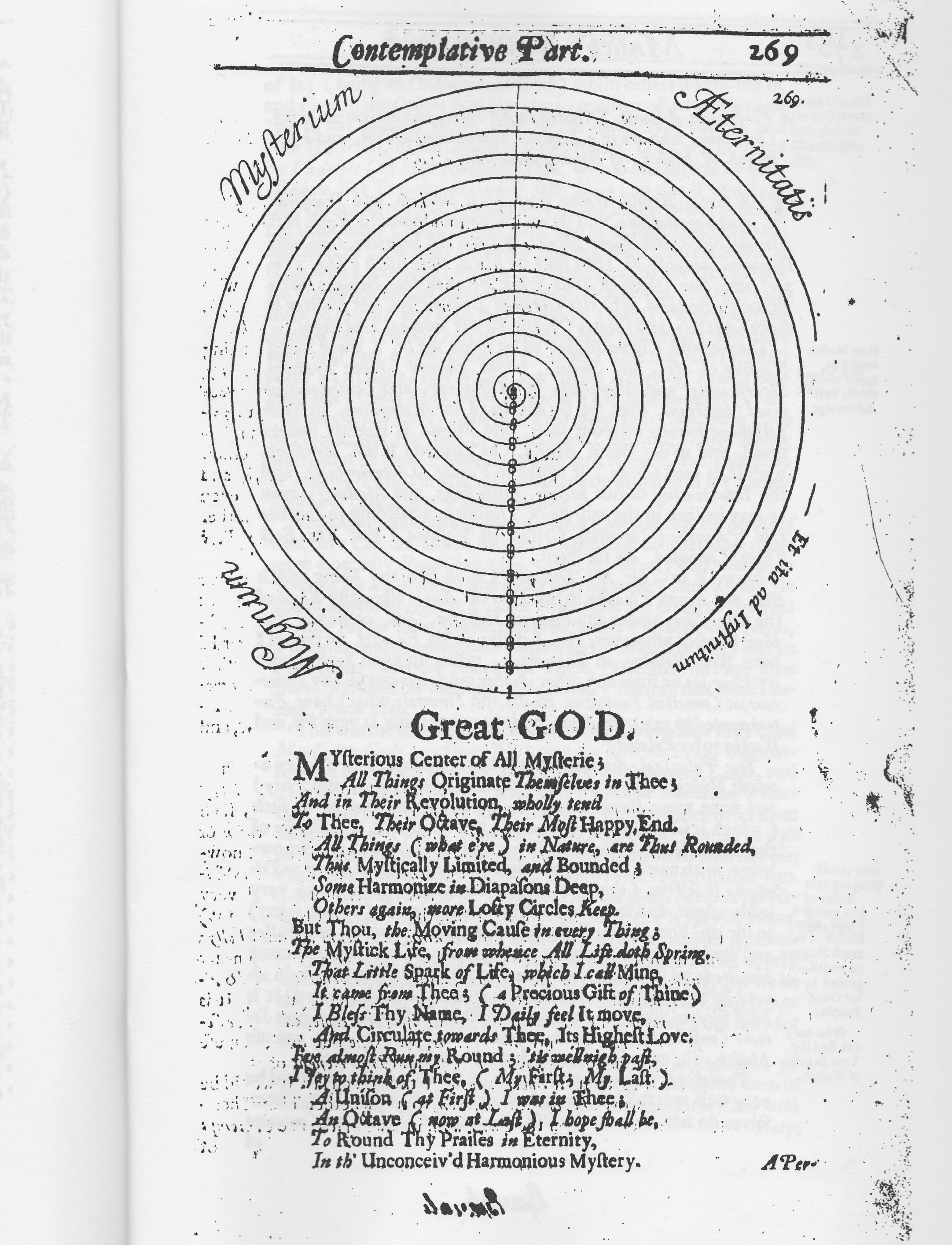
Now, to go off at a tangent, I am interested in other artists in the family who keep coming to light.  As part of my research into my mother’s family, the Mace’s from Bedale (from 1825) and much earlier from Cambridge, I have come across a book by Thomas Mace called “Musick’s Monument” published originally in 1676.  It was published again about six years ago.  Amongst his own illustrations within the book is this one of a spiral depicting his idea of God’s world.


“Mysterious Centre of All Mysterie…” in Musick’s Monument, by Thomas Mace, 1676. Continuous Line, Mick Burton.


Thomas was a famous composer of the 17th century, and craftsman who made lutes and viols, whose main job was a chorister at Trinity College, Cambridge.

To add to this “sort of” co-incidence, my Uncle Harry Mace from Bedale, North Yorkshire, was a joiner and builder.  When he retired he started to make old style instruments, such as viols, and sold them to a music shop in Leeds.  I am sure he did not know about Thomas of Cambridge.

Thomas was not too impressed with a relatively new instrument in his time, the violin.


Herons on Gledhow Valley Lake

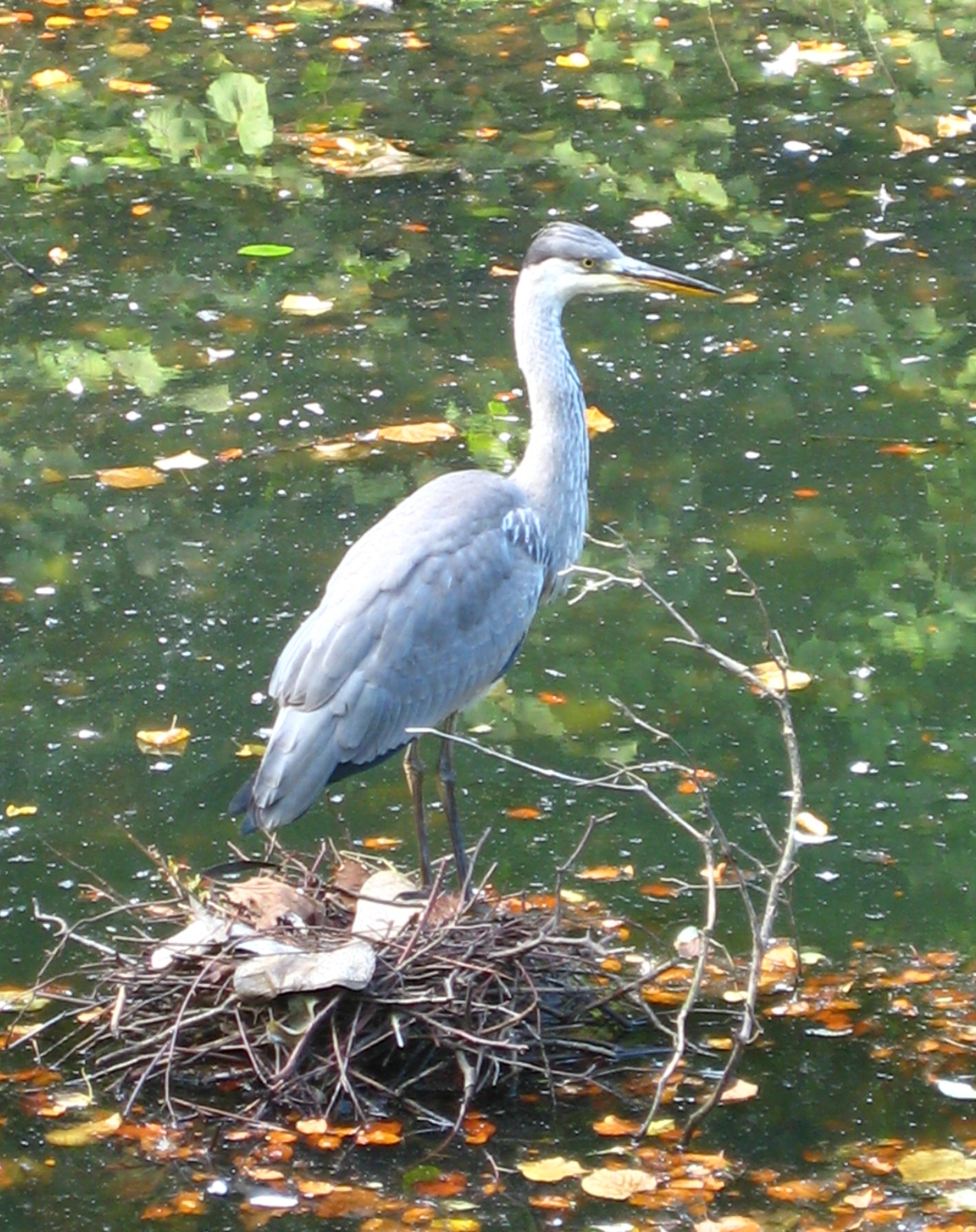
Young heron on Gledhow Valley Lake, Leeds, September 2014. Photo Mick Burton, continuous line artist.

Young heron on Gledhow Valley Lake, Leeds, September 2014. Photo Mick Burton, continuous line artist.

I am an artist who draws and paints quite a lot of animals and birds and it is great to live in a wooded valley which has a stream and a large lake and plenty of wildlife.

Our house is at the East end of the woods, which stretch for about  a mile.  There is a road running the length of the valley, which goes near to the edge of the lake.  Gledhow Beck feeds the lake from  the west  and a road from Chapel Allerton crosses the valley and stream and then winds up a steep south facing slope known locally as “Little Switzerland”.

I have lived in Gledhow Valley, at two different addresses, for nearly 40 years.

There have been swans on the lake for many years and of course ducks , moorhens and coots.  In recent years we have seen a heron, mainly on the other side well away from the main viewing stage.

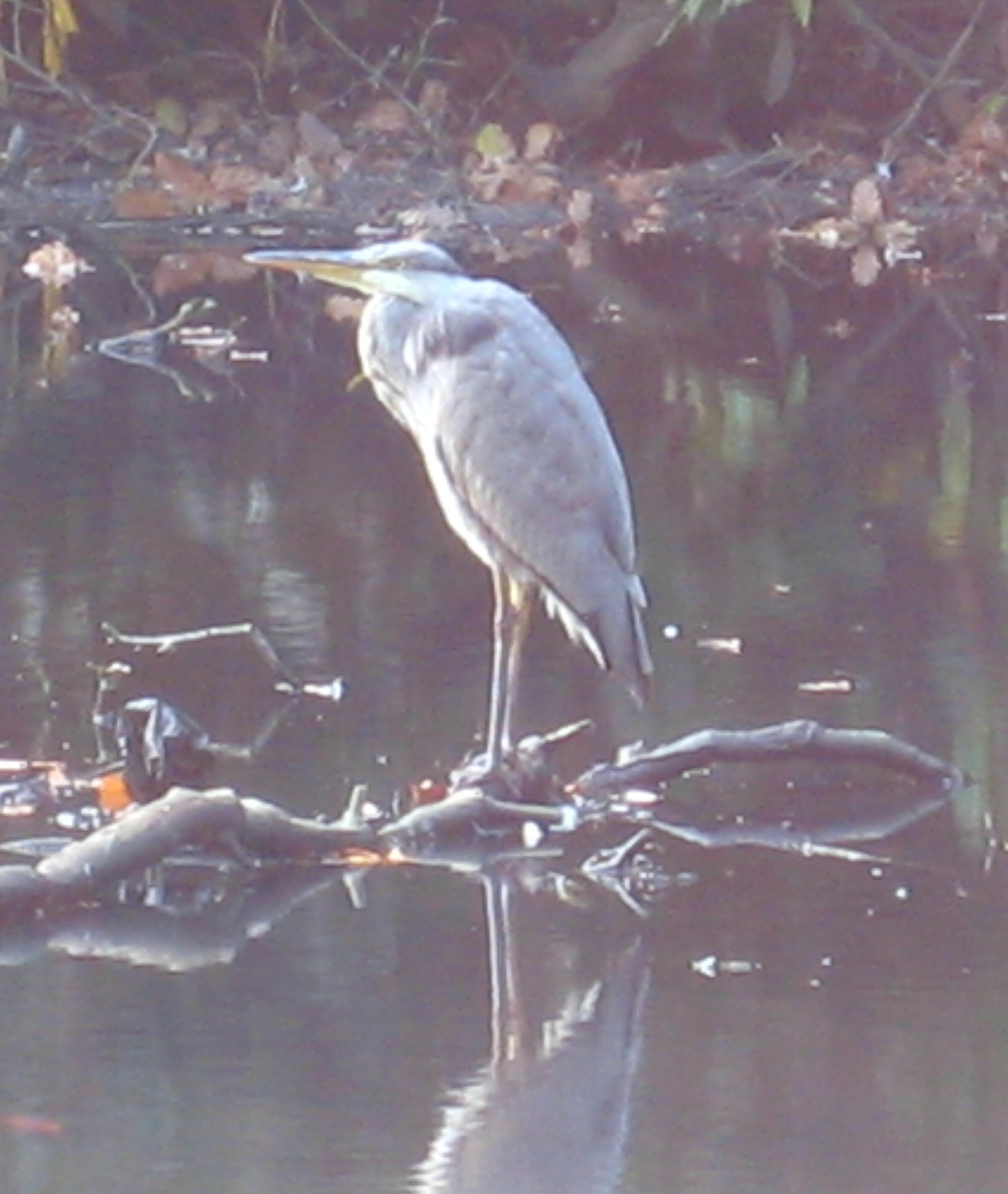
Older Heron, Gledhow Valley Woods, Leeds, September 2014.  Photo by Mick Burton, continuous line artist.

Older Heron, Gledhow Valley Woods, Leeds, September 2014. Photo by Mick Burton, continuous line artist.

In the last couple of months there have been two herons and I took the attached photos a month ago.  The older heron (see left) was still quite a distance away but the young one (see above) was more accommodating and I took quite a lot of photos from the dam on the East end of the lake.  My bird watcher friend Bernard says that the young heron will be about a year old.  It seemed to be catching small fish in its beak.

About a week previously Joan had spotted a Heron sitting up in a tree in the next garden to ours.  I was too slow to get the camera before the bird flew off, but it seemed to be looking down into the beck which runs past a neighbour’s garden.  This would probably have been the young heron.

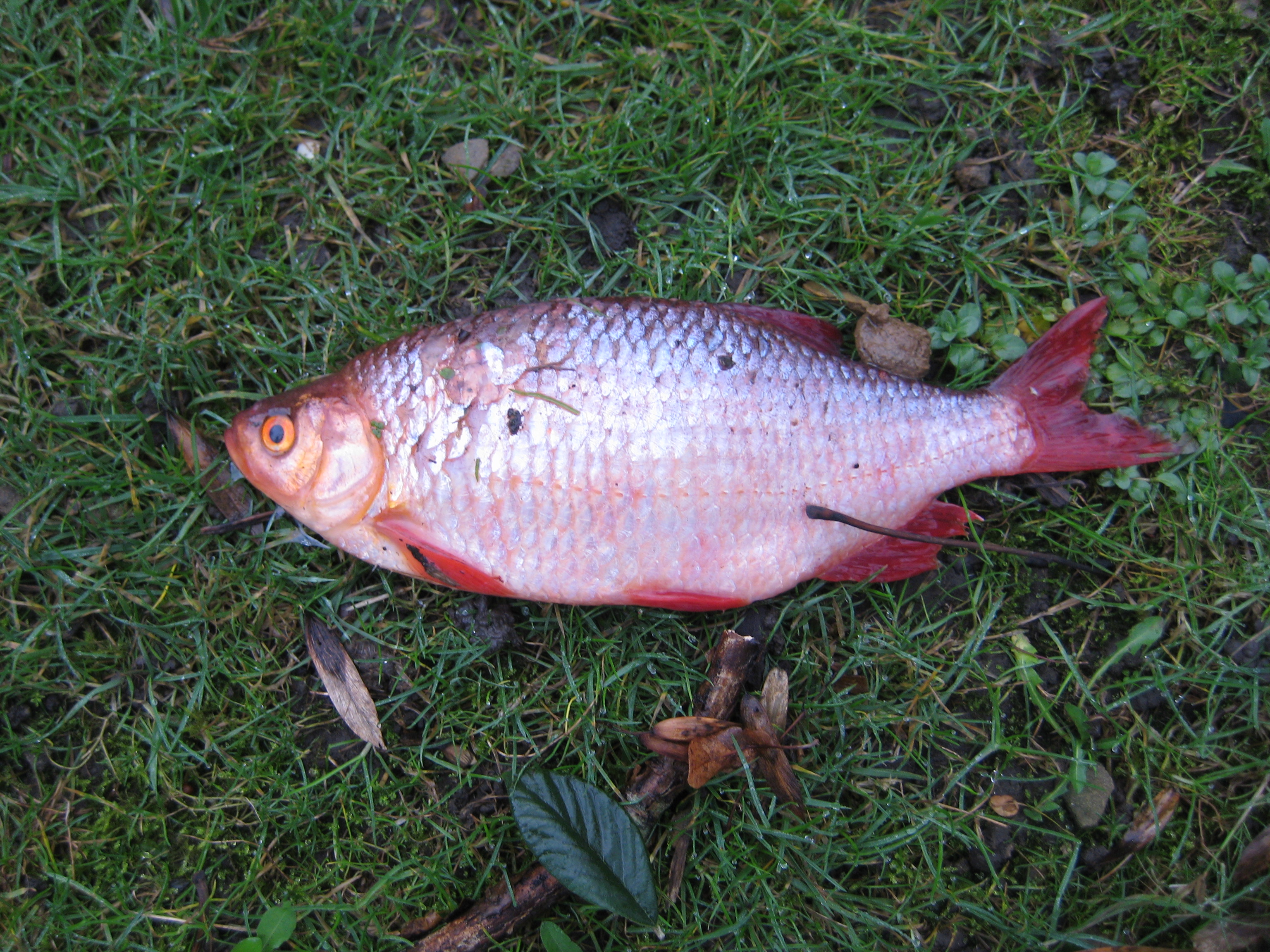
I then remembered an incident  earlier in the year, in January, when Joan found a fish on the back lawn.  It was 9″ long and I photographed it (see below).  We could not understand how it got there and our friend Jerry, who is a keen fisherman, said that it was either a Rudd or a Perch and it looked slightly damaged on its side.  Possibly a heron was passing by with the fish and dropped it !

Rudd or Perch fish, 9

Rudd or Perch fish, 9″ long, found on lawn. Maybe dropped by heron. Photo by Mick Burton, continuous line artist.

The photo shows a largish animal dropping above the tail, which could be from a Fox (we see one most days in the garden – even two at once last week) maybe claiming title to the fish.  We left the fish there and it disappeared.

Our enjoyment of the valley is greatly helped by the Friends of Gledhow Valley Woods who once a month organise volunteers (including Joan, and occasionally me) to collect litter and do all sorts of development work and repairs on paths, seats, signs, etc.  They hold an Annual Fair and an Open Day of the Well House, or Gipton Spar Bath House, which was built in 1671.

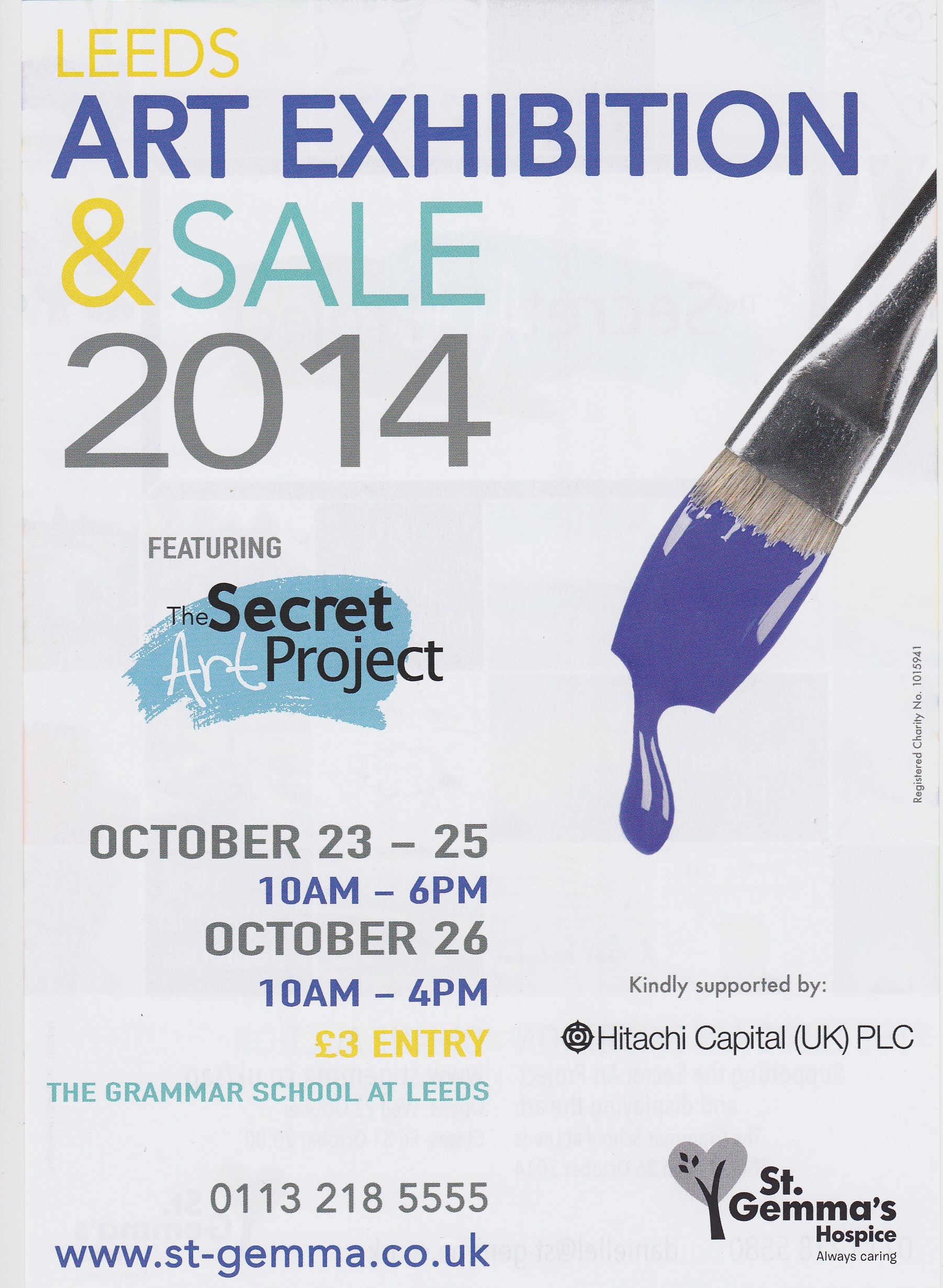
Continuous line drawing at St Gemma’s Leeds Art Exhibition 2014

St Gemma's Leeds Art Exhibition.  Mick Burton continuous line.

St Gemma’s Leeds Art Exhibition. Mick Burton continuous line.

I have entered seven paintings in St Gemma’s Leeds Art Exhibition, which starts on Thursday 23 October 2014 at Leeds Grammar School.  There are over 800 pictures for sale.  I felt I had to put this in my continuous line blog.

I have entered in the previous 2 years since I started painting again and managed to sell work each time.  Its well worth a visit.  And its in aid of St Gemma’s Hospice.

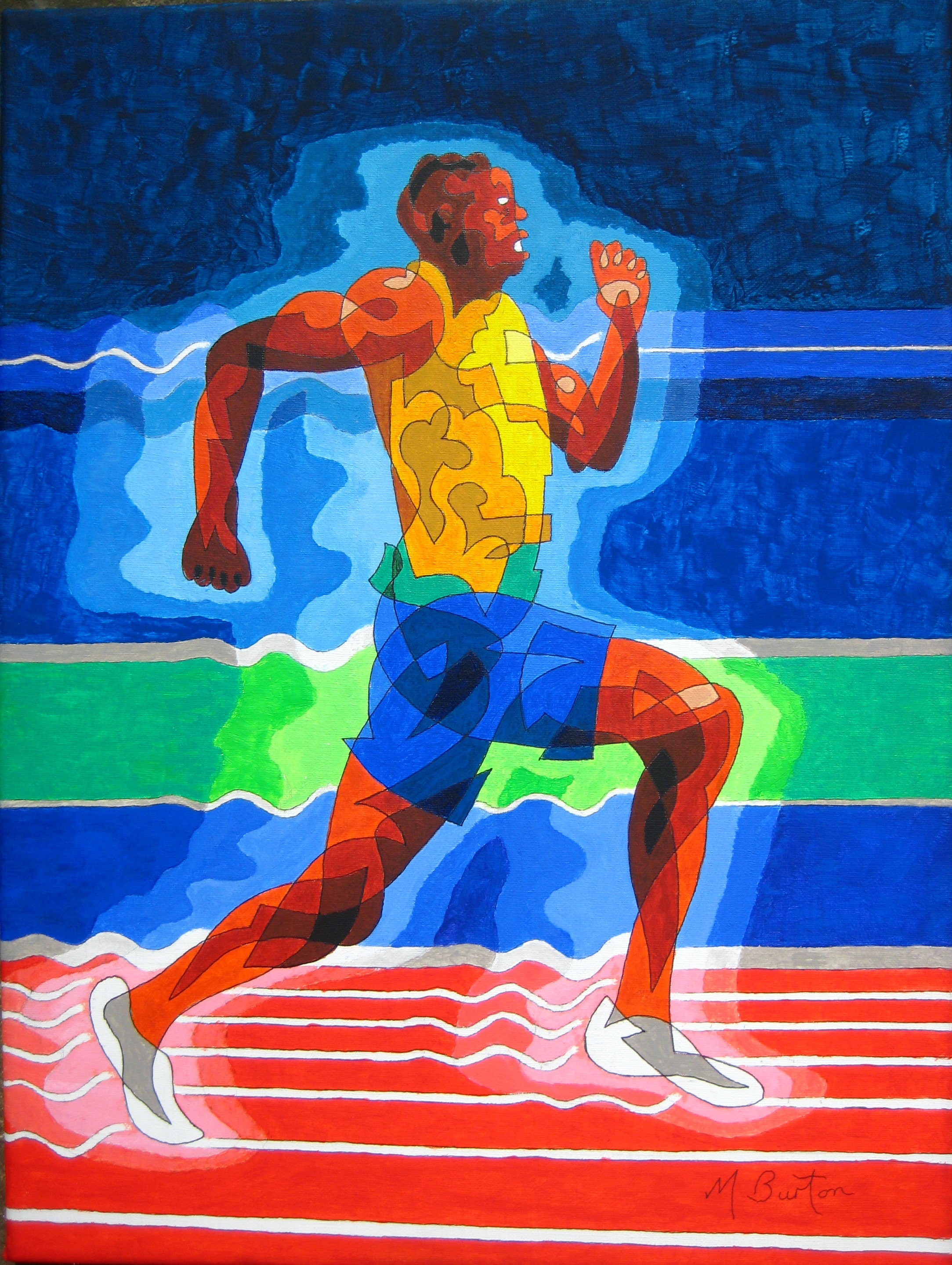
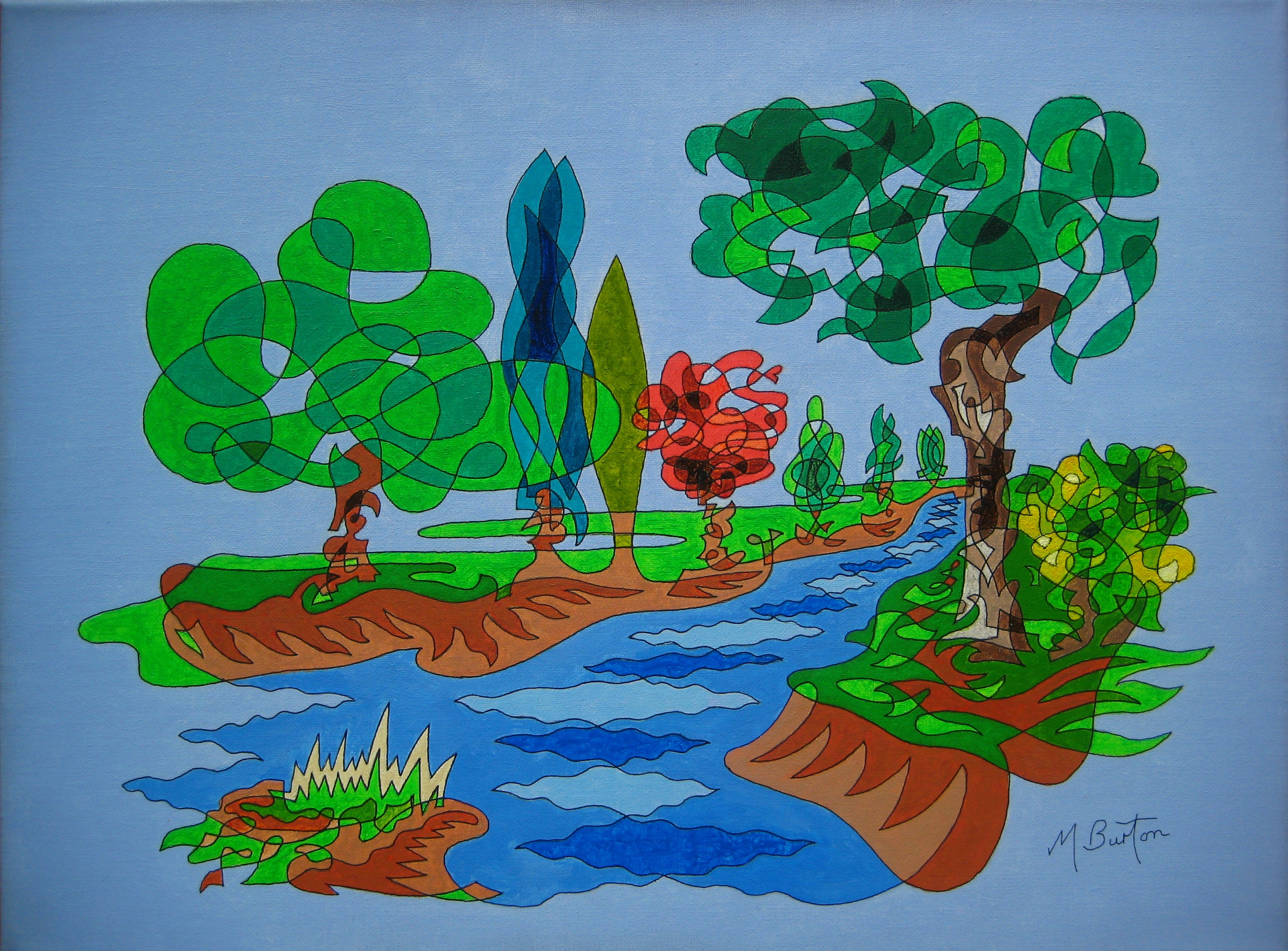
Here are three of my paintings as a taster.  All are in acrylic on canvas.


Usain Bolt continuous line drawing.  Several colour sequences.  100 metre Olympic final at night.  Mick Burton, 2013.

Usain Bolt single continuous line drawing. Several colour sequences. 100 metre Olympic final at night. Mick Burton, 2013.

I have been a big fan of Usain Bolt and wanted to use my style to try to capture the dynamic speed and flowing movement of this great athlete.

As the race took place under floodlights, I have used a shimmering effect against the dark background.


Skelldale is totally drawn with one continuous line and various colour sequences have been used. Mick Burton, 2013.

Skelldale is totally drawn with one continuous line and various colour sequences have been used. Mick Burton, single continuous line artist 2013.

I was brought up in Ripon, a North Yorkshire small market town.  There are three rivers which virtually surround the place – the Laver, the Skell and the Ure  in order of increasing size.

I lived near to the Skell, and we sometimes would walk along it upstream to Fountains Abbey.  One of the local myths was that there was an ancient  tunnel from Ripon Cathedral to Fountains Abbey and we would discuss where the route might be.

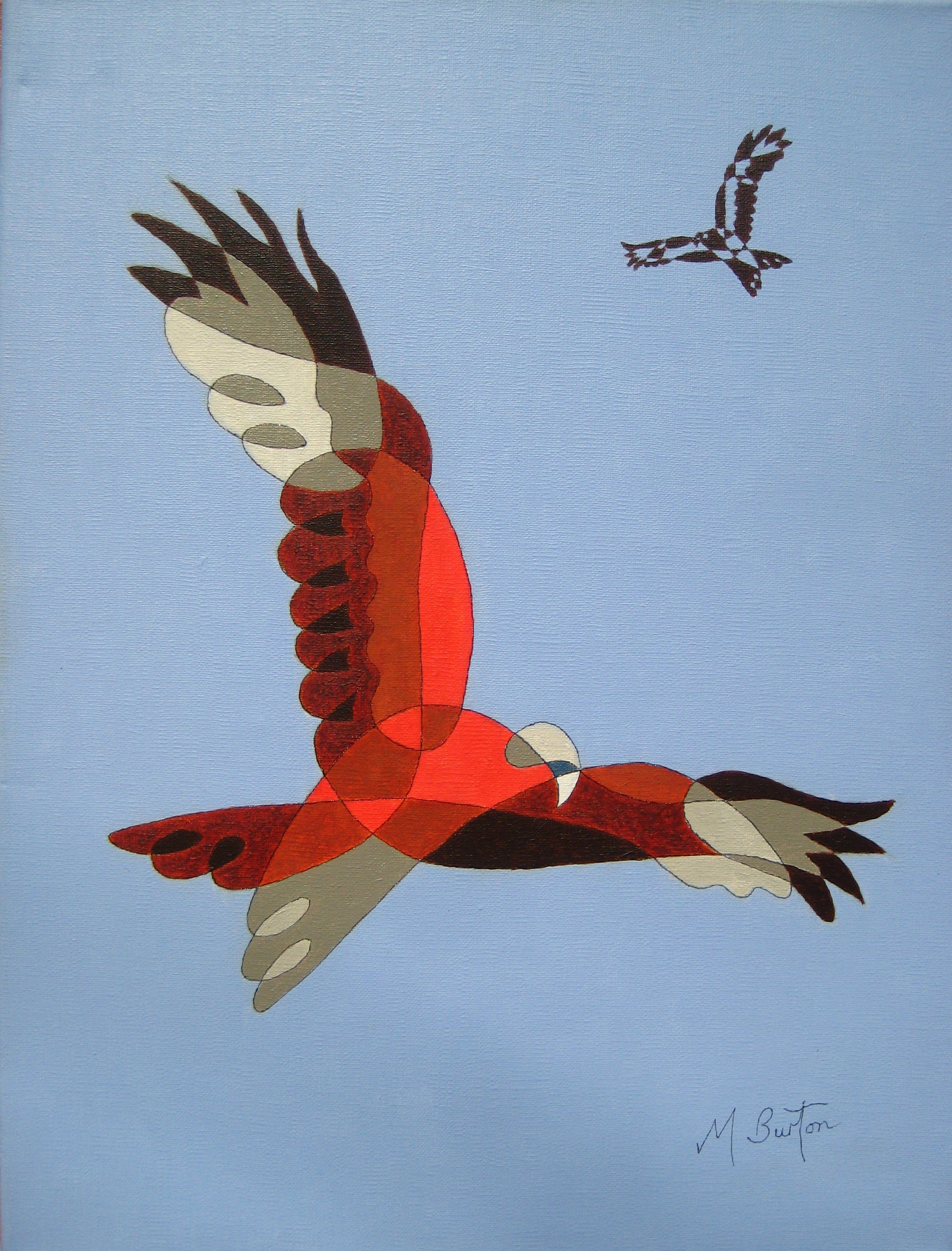
Red Kites at Harewood, continuous line and colour sequence. Mick Burton, 2013.

Red Kites at Harewood, single continuous line drawing and colour sequence. Mick Burton, 2013.

Yesterday, on the bus back from Harrogate to Leeds, we approached Harewood Bank and saw the herd of deer in the park and above there were six red kites circling.  I have never seen that many at once. 

Since they were re-introduced near Harewood they have spread many miles and sometimes float above our house in Gledhow Valley in Leeds.

I had to try to capture this amazing bird with my continuous line and colour sequence.


Continuous Line Drawing Alternate Overdraw embedded image.


Abstract before Alternate Overdraw  embedded Dog appears.  Mick Burton, Continuous Line.
Abstract before Alternate Overdraw embedded Dog appears. Mick Burton, Single Continuous Line Drawing.


Here is an abstract Continuous Line Drawing which conceals an image of a dog.  Possibly you can see some clues as to where the outline of the dog is.  The idea is to carry out an Alternate Overdraw along the line throughout the picture which will produce the image of the dog.  Start the overdraw with the arc marked with chevrons.

After I developed Alternate Overdraw in 1970, which enabled me to allocate my colour sequence to continuous line drawings, other possibilities started to occur to me.  The first was that you could hide an image of an animal within what looked like a totally abstract continuous line drawing.

See below how the dog finally appears.  In fact it looks a bit like Ben, who we have been looking after this week.

Alternate Overdraw embedded dog appears.  Mick Burton, Continuous Line Drawing.

Alternate Overdraw embedded dog appears. Mick Burton, Single Continuous Line Drawing.

The start of the process was to sketch a simple dog outline and then , knowing that the outline had to include many crossing lines, I broke the outline down into short lines or arcs which were at an angle to each other.

Next, I needed to run lines through the dog, from various directions, which used these arcs.  For it to work, there had to be an odd number of arcs in each line which went across the dog, between each two outer arcs.  This was so that, after completion, when you drew an alternate overdraw across the dog, both arcs on the outline were overdrawn.  This would result in all the arcs around the outline being overdrawn, thus forming one loop of overdraw. 

Within the body of the dog, several overdraw loops were also formed.  Similarly in the background a number of overdrawn loops and inner loops resulted. 

Of course, trial and error is involved in connecting up all the loose ends (of the lines running through the dog) to achieve a single continuous line through the whole drawing.

Finally, having completed a continuous line, I needed to check that there were no obvious sections which would indicate that an animal was in there. 

I did one more embedded image in 1970 before moving on to other things.  This time, instead of making the abstract continuous line from flowing curves with no straight lines, I decided to use mostly straight lines and right angles.

Abstract before Alternate Overdraw embedded steam engine appears.  Mick Burton, Continuous Line Drawing.

Abstract before Alternate Overdraw embedded steam engine appears. Mick Burton, Single Continuous Line Drawing.


This time I  was concealing a steam engine and the Alternate Overdraw result is shown below.

Alternate Overdraw embedded steam engine appears.  Mick Burton, Continuous Line Drawing.

Alternate Overdraw embedded steam engine appears. Mick Burton, Single Continuous Line Drawing.


As always with my various styles, I wonder who else may be using them  and whether they were in use long ago.