Tag Archives: Mick Burton continuous line artist

Phormium New Zealand Flax continuous line drawing.

Phormium, New Zealand Flax. Mick Burton, continuous line artist.

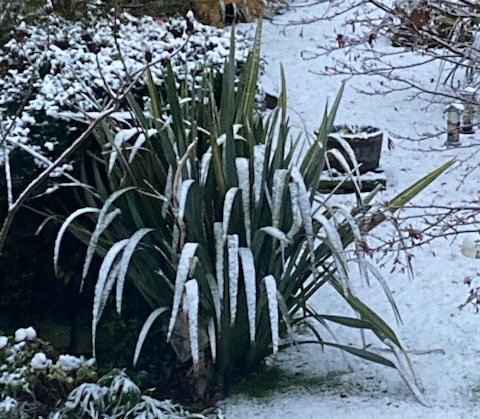
We have just had snow from Storm Burt and it weighed down some of the sword-like leaves of our sturdy Phormium.  Here is the photo below.

Phormium, after snow weighed down the leaves. Photo Mick Burton, continuous line artist..

I considered that the mixture of curved drooping leaves and straight upright leaves would make a good contrasting straight and curved overlapping continuous line. 

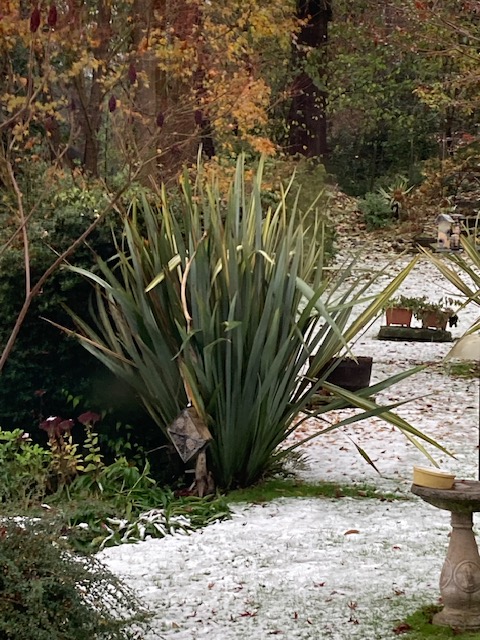
As soon as the snow went, the leaves sprang back upright again.  The leaves are pretty rigid and I prune them with a hack saw.

After the snow melted the sword-like leaves returned to straight up. Photo Mick Burton, continuous line artist.

Captain Cook and Joseph Banks recorded the plant in New Zealand in 1770.  The Museum of New Zealand states that “Russia, the main supplier of sailcloth and rope for the Royal Navy, had restricted sales to England and Cook considered the New Zealand flax as and alternative for making these vital supplies.”

We had good fox tracks in the snow this time.  In one direction it was a single line of spaced prints and in the other it was pairs of prints spaced out.

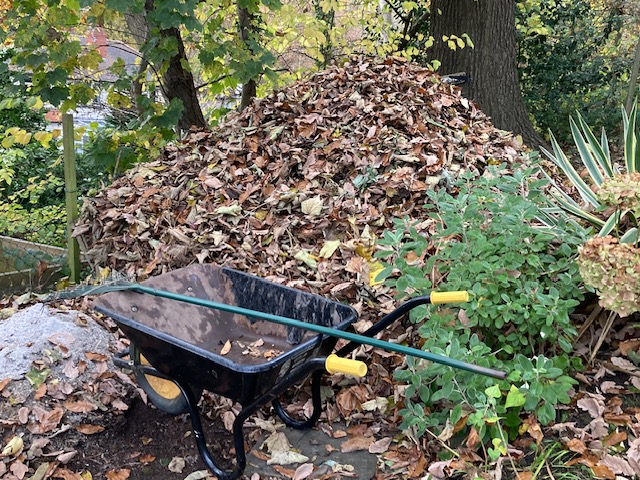
Before the snow came, I had raked up all the leaves and produced our biggest pile yet, for the first stage of producing soil from leaf mould.  It is far bigger than the pen I built for leaves.  Of course, some are blown in from Gledhow Valley Woods.

Largest leaf pile to date. Photo Mick Burton, continuous line artist.

As the leaf pile has spilled across the slab path up the garden I was interested to see what the Fox did when using the path – would it go round?  Nope, it staggered over the right hand side of the pile.

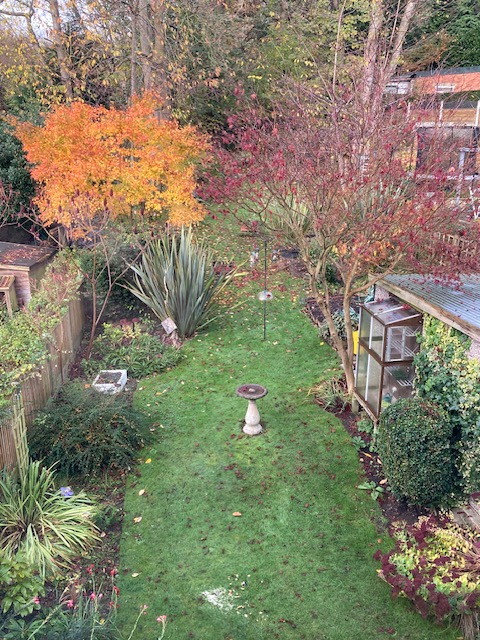
One strange thing every year is the the Red leaved Acer drops its leaves before all the other trees and the Bronze leaved Acer is usually the last.

Red leaved Acer next to the garage drops leaves long before the bronze leaved one on the left. Photo Mick Burton, continuous line artist.

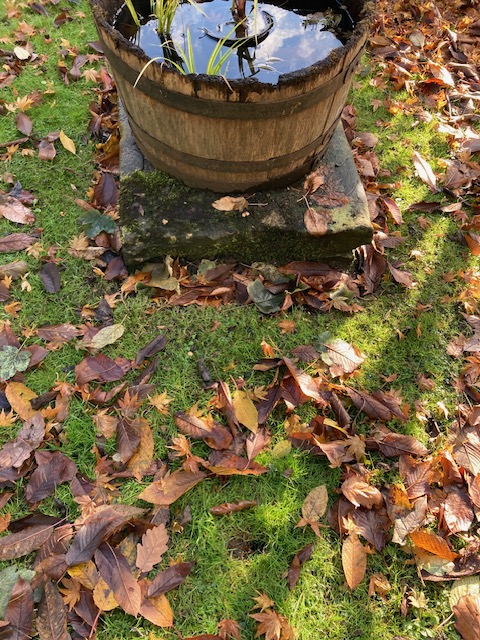
In the lawn, under the leaves I found that the Bumble Bee hole was still there.  The hole is near the bottom of the photo below.  On the internet it says that the holes are in use for a few months and then not used again, as the queen builds a new one next year.

Bumble Bee hole in the lawn. Photo Mick Burton, continuous line artist.

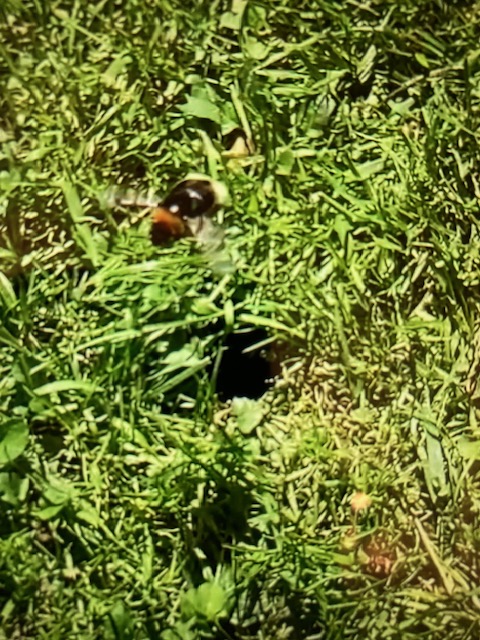
When I first spotted the hole in the lawn in late May there was a Bee just emerging from it.  The black patch at the very bottom of the photo is the shadow of the bee.

Bumble bee leaving the nest hole in the lawn. Photo Mick Burton, continuous line artist.

I first found out about Bees nesting in the ground when I was digging the tiers in the bank at the top of the garden. I became aware that an increasing number of bees were circling around me.  It was just couple of Bumble Bees at first then all sorts of sizes of bees, some appearing to be similar to hive bees, flying around me.  I realised that I must have disturbed their nest and so I stopped the digging for the day.  The next day I came to look and there was a new hole in the bank and bees coming out, so I just abandoned my digging for the summer.


Continuous Line Portrait with Colour Sequence.

Continuous Line Portrait “Colourful Musician” by Mick Burton.

This is the second Colour Sequence portrait that I have completed, the first being of “Barry” 10 years ago which had a shorter range of colours.

As usual, I have worked out the natural range of levels running through the drawing and I can choose which end of the range to allocate Red and then Blue at the other end of this 6 colour sequence.  You may ask why the end of the sequence is in an eye coloured Red in some of my pictures of Animals (eg. Hen and Iguana).  The answer is that when I draw continuous line eyes there is a final loop (or even a loop within a loop), which can extend the range of colours if it is already at the end of the existing range (orange in this case).

Normally, only one eye is visible from a side-on view of most of my animals.  I do not then have the situation where the other eye can be at the other end of the colour range.  In the “Colourful Musician” I have ended up with totally different coloured eyes.  Fortunately, the portrait is of a Surrealist painter who is happy with this outcome.

I do not mind either, because continuous line drawing produces its own three dimensional appearance naturally.  Conventional Artists may regard my drawings as very technical, but I can argue that they use perspective and shadows in their art, which I regard as technical, and I get by without using either.  The head in this painting has a natural rounded appearance and the “Blue” eye side implies shadow.

Sometimes I have had to alter the lines to ensure that both eyes are the same colour, which I did with Nessie the cockapoo painting.

The “Colourful Musician” painting only came about after we had one of those sketch a fellow member sessions at Harrogate and Nidderdale Art Club, this one being run by Chairman Steve Walmsley who also announced that I would sketch him.

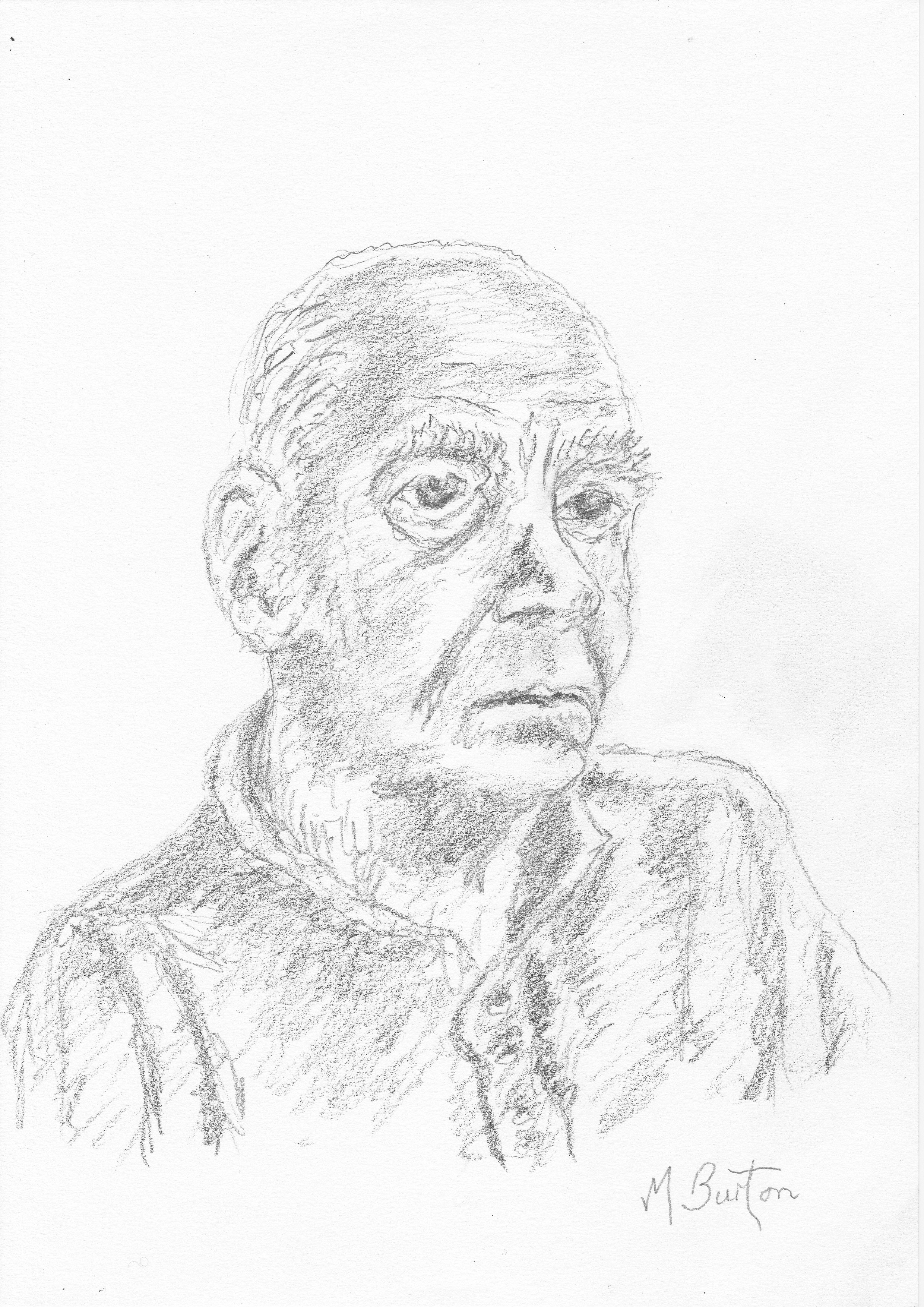
Sketch of Steve at Harrogate and Nidderdale Art Club. Mick Burton, continuous line artist.

Someone asked if I would do more work on my sketch and I said that it may turn into a Continuous Line Drawing.  Steve said “If you do, then I want all your colours”.  So I took a photo of him for added reference.

Steve Walmsley, Chairman of Harrogate and Nidderdale Art Club. Mick Burton, continuous line artist.

I produced a Single Continuous Line portrait using Over and Under lines before I went onto the colour version above.

“Surrealist Artist” Continuous Line Drawing by Mick
Burton.

Steve has his own unique approach to colour in his pictures, which are increasingly Digital Art.  You can view his full range of Surrealism, Abstractions, Landscapes, Portraits and Digital Art on his website www.steven-walmsley.pixels.com.

I particularly like the following pictures he has created.  The first one is acrylic and the rest are all digital art.

“Self Portrait with Sax” by Steve Walmsley, Surrealist Artist.


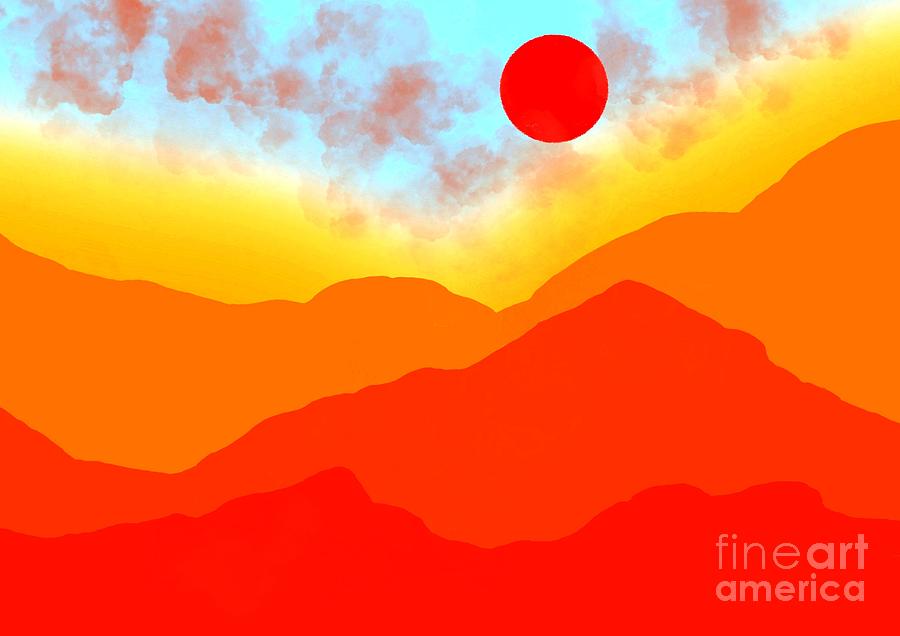
“Desert” by Steve Walmsley, Surrealist Artist.


“Neanderthal” by Steve Walmsley, Surrealist Artist.


“The Cruel Sea” by Steve Walmsley, Surrealist Artist.


“Reflections” by Steve Walmsley, Surrealist Artist.


“The Waterwheel” by Steve Walmsley, Surrealist Artist.

“That’s our Water on the Gold Coast”.

“That’s our Water on the Goldcoast”. Reaction by Terry when shown “Climate Change Down Under”, a continuous line drawing by Mick Burton.

Our friends Cathy and Terry, who live in Queensland, Australia, were over here recently.  I showed them a photo of my painting “Climate Change Down Under” which I featured in a recent post         Climate Change Hits Australia, continuous line drawing.

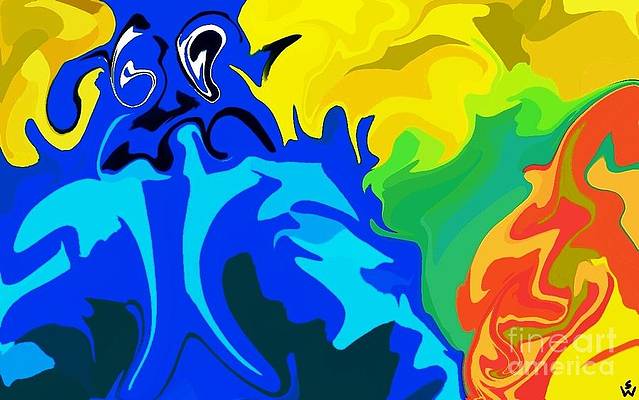
I show it again below.  Terry immediately said “That’s our Water!”.

Climate Change hits Australia. Continuous line drawing. Mick Burton.

When I painted it I simply wanted to include a shape depicting Water in blue, in contrast to the Fire in red and the Sunshine in yellow on the land behind.  We knew that Cathy and Terry lived on the Gold Coast and overlooked some moorings, but I did not realise that their waterways were so similar to my painting.

Here is a broader view of their wonderful part of the Gold Coast, which is near Brisbane in Queensland.  Their “water” is at the bottom of the map.

Runaway Bay, on the Gold Coast, showing Cathy and Terry’s “water” at the bottom. Mick Burton, continuous line artist.

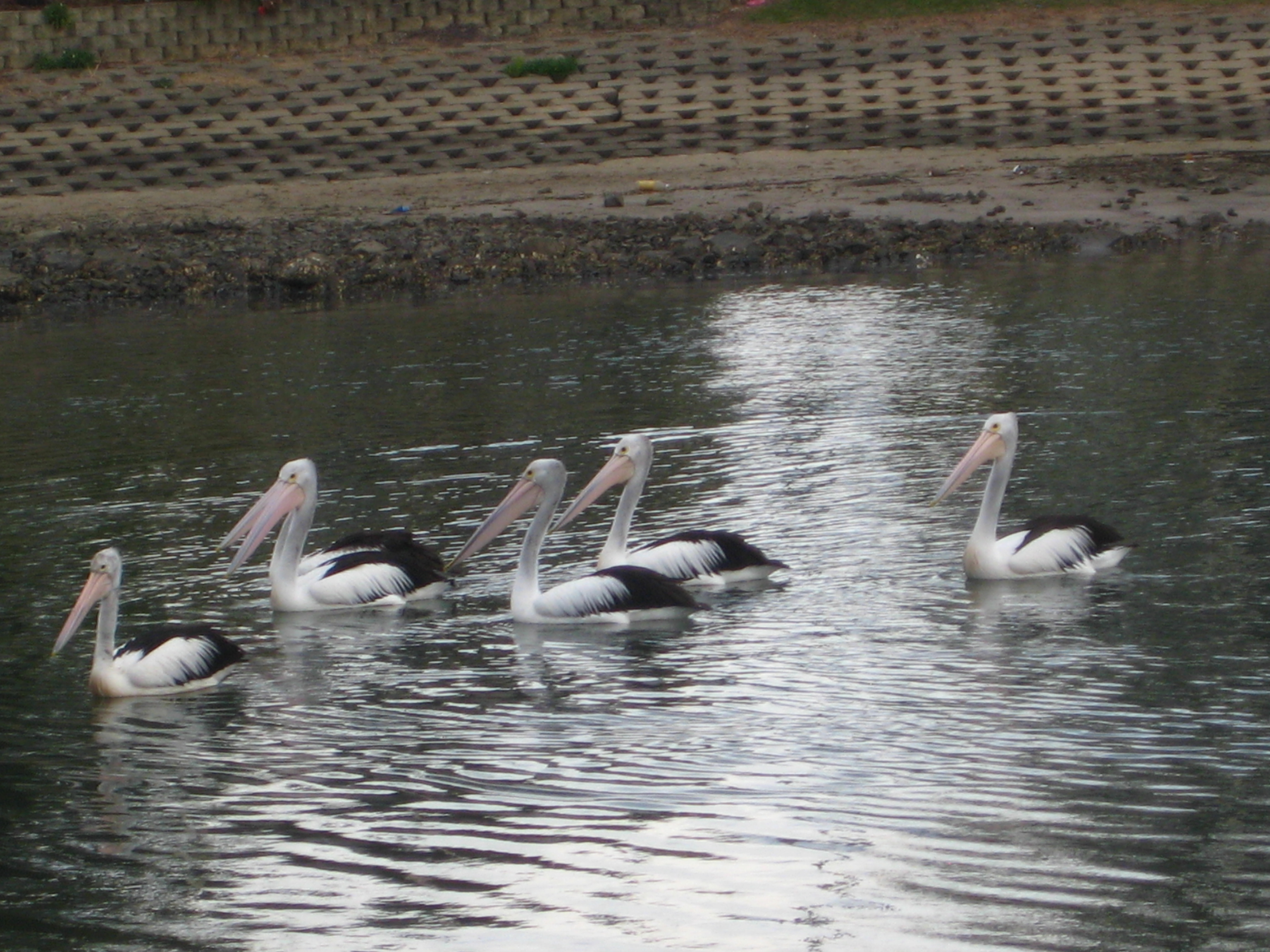
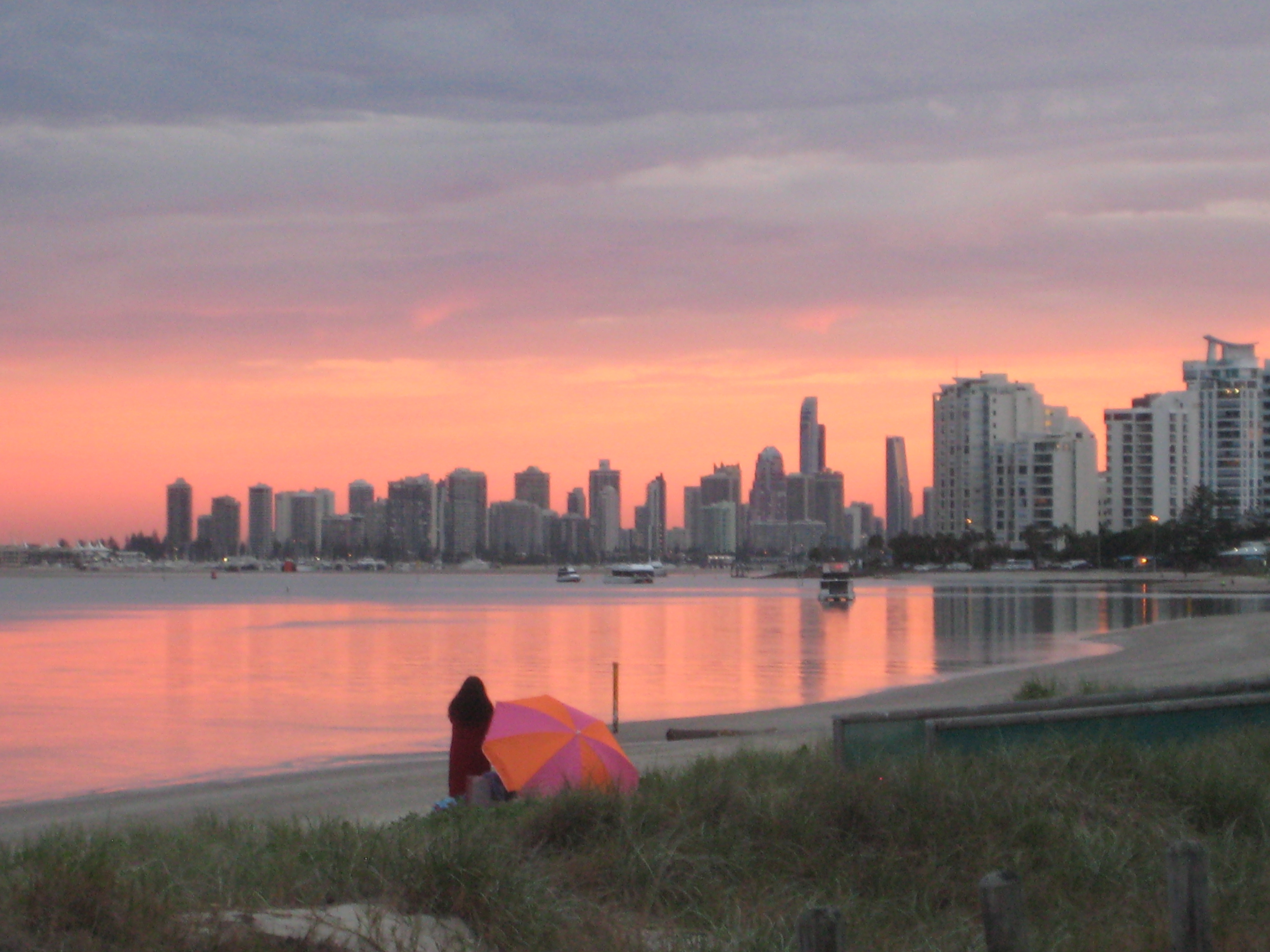
When Joan and I visited Cathy and Terry in May 2013, they lived inland as I mentioned in the post of October 2022.  Cathy dropped us off in the Gold Coast for the day and here are a few photos.

Gold Coast, Queensland. May 2013. Mick Burton, continuous line artist.

Pelicans near the beach, Gold Coast, Queensland. May 2013. Mick Burton, continuous line artist.

Sunset on the Gold Coast, Queensland. May 2013 at about 4.30pm. Mick Burton, continuous line artist.

Climate Change Hits Australia, continuous line drawing.

Climate Change hits Australia. Continuous line drawing. Mick Burton.

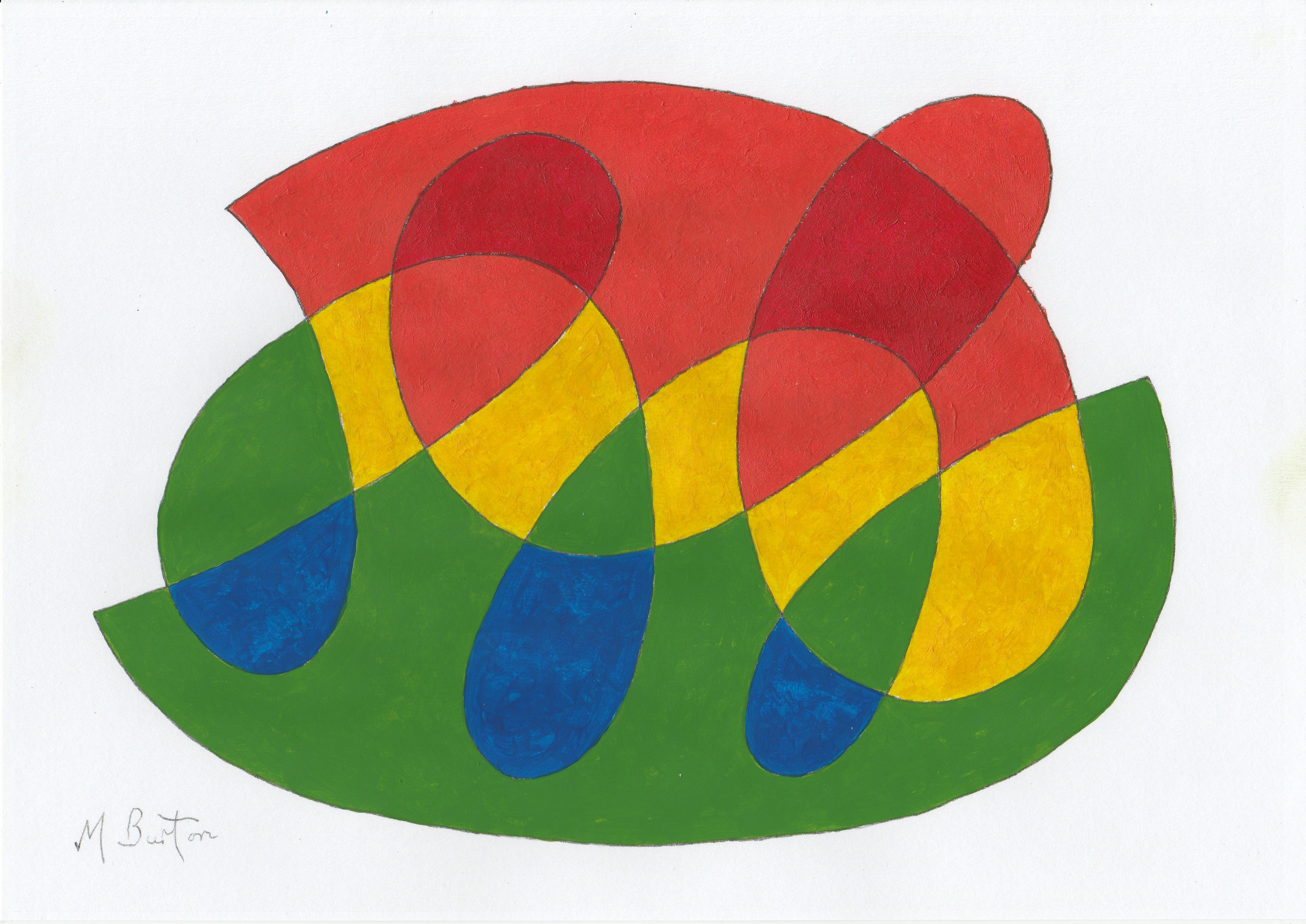
I have been looking at using the Primary Colours in a way which uses the colour mix when they overlap.  I wanted to produce a result as effective as that achieved in my “Knight’s Tour Fragments” abstract shown below.

“Knight’s Tour Fragments”, acrylic on canvas. Exhibited at Harrogate and Nidderdale Art Club Exhibition in November 2016. Mick Burton, continuous line artist.

Here I produced a similar effect to overlapping pieces of coloured glass.

This time I decided to give each Primary Colour a distinctive shape which seemed to reflect the nature of the colour itself.  Red often represents Fire and so I decided to use straight lines and pointed angles to contain it.  Blue is a quieter colour often representing water and so I decided upon curves and flowing fingers to contain it.  Yellow can represent the sun and I thought of the outline of Australia, which includes the “sunshine state” of Queensland.

Joan and myself visited some friends of hers in Queensland in 2013.  They lived inland from Brisbane in a large wooden house that they built, which had a couple of wallabies resident in the garden.  They moved to live on the Gold Coast a few years ago, but heard from old neighbours in early 2020 that a bush fire had nearly destroyed their old house.  The street had been evacuated and the fire was apparently heading for the house but veered off in another direction just in time.  The increased number of fires are attributed to Global Warming.

Earlier this month we saw on the news that floods in Sydney were amongst the worst since records began in the 1850’s.

With all these things coming together, I decided upon Primary Colours and Australia as part of a Continuous Line workshop I did a couple of weeks ago at Harrogate and Nidderdale Art Club.

For the picture at the top of this post, I superimposed the straight line Red fire line and the curvy Blue water line on top of the sunny Yellow Australia.  This produced semi-primes Orange, Green and Violet areas and where all three Primes overlapped we have a sort of muddy Brown.

I like to think that the outline of a subject can be used to direct continuous lines into the interior which create an image representing the subject.  After completing a single continuous line over a map of Australia I realised that there was something like a kangaroo in there which I have marked in red.  Also, if you push things a little, there may be a Black Swan over Western Australia.

Kangaroo and maybe Black Swan images from single continuous line of Australia. Mick Burton.

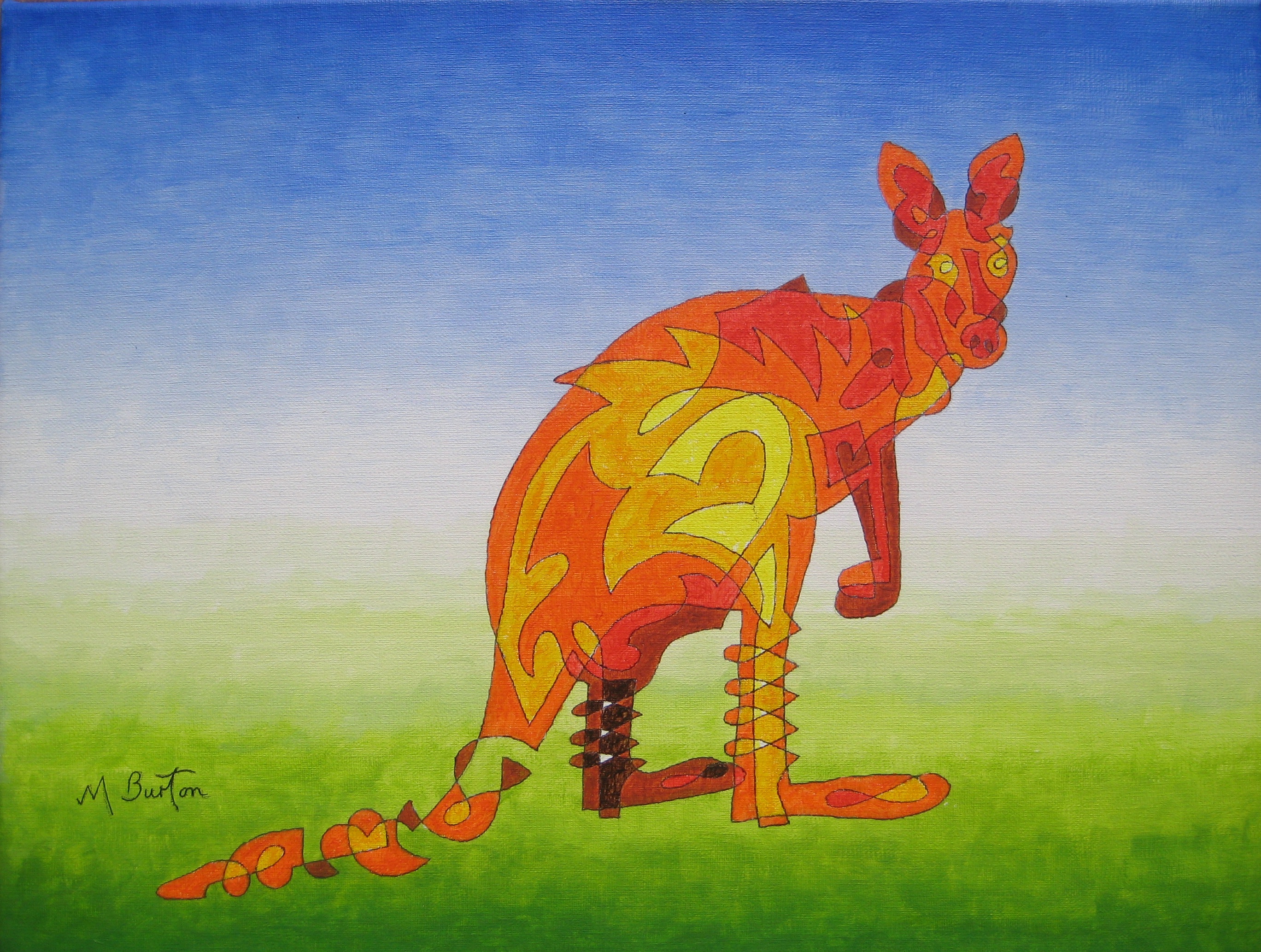
The friends we visited have my Wallaby painting in their house on the Gold Coast.

Wallaby, or Kangaroo. Single continuous line drawing and colour sequence. Massive distance background added. Mick Burton, 2013.

Other Primary Colour things we did I will cover in a later post.


Alien Creatures on Train Tracks Puzzle Continuous Line.

Alien Creature continuous line from Train Tracks Puzzle.    Puzzle Madness, Large, 1.5.2022.  Mick Burton.

This is an update from my post of 24 December 2020 when I explained how I had started Train Tracks Puzzles during Covid lockdowns.    Red Alert, Continuous Line Detected on Train Tracks Puzzle.

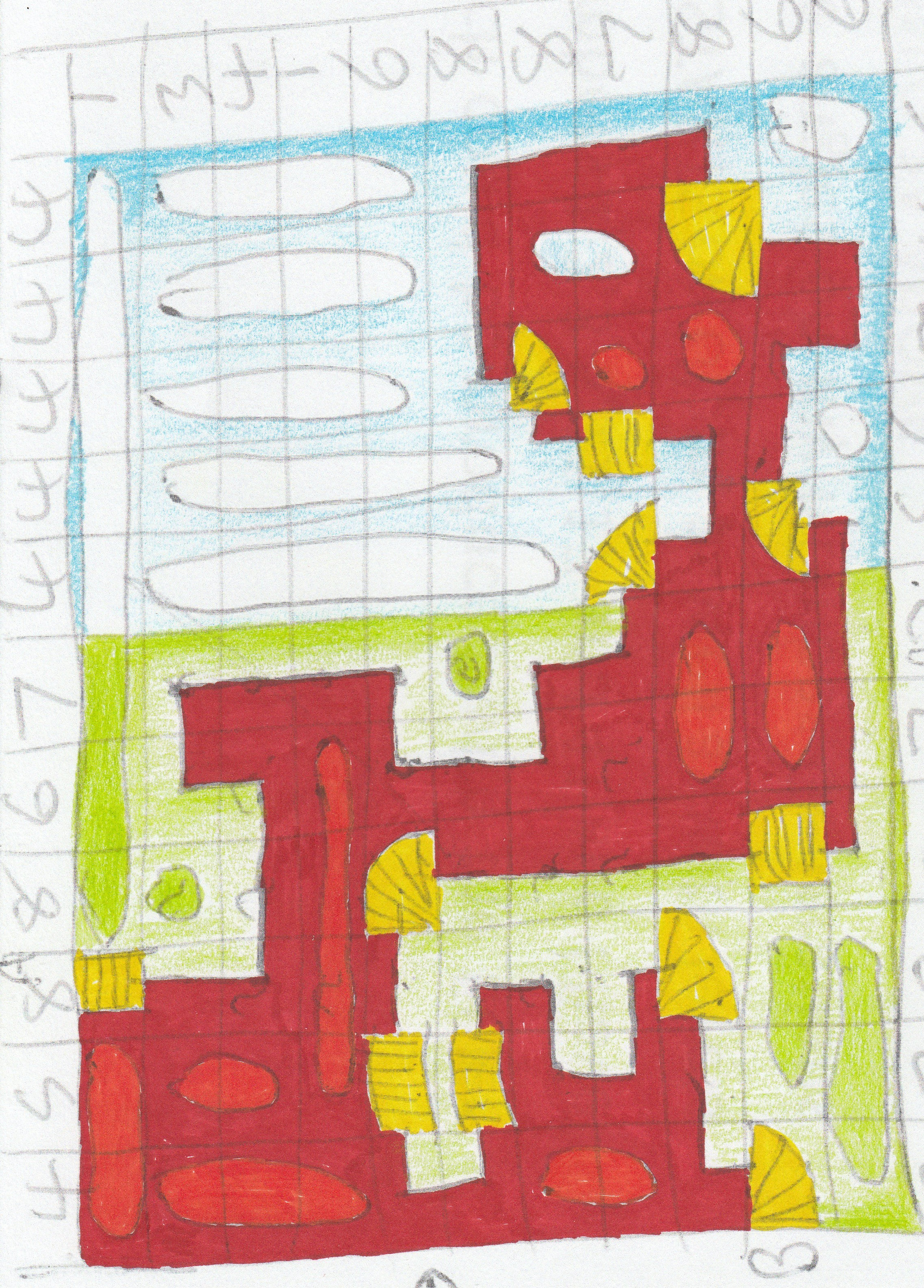
When I try to solve a Train Tracks Puzzle, I draw out the grid freehand and copy in the cross references of number of tracks in vertical or horizontal rows as well as the given pieces of track.  A big part of the process is marking the squares, which will not have track pieces, with a circle or cloud shape.  I draw in the track I have decided upon with a line between given pieces of track.

Most people will complete the puzzle on their phone or laptop from start to finish, but I just like drawing things, rather than hitting wrong buttons on keypads most of the time.  Here is my initial drawing.

Initial drawing of Train Tracks Puzzle 1.5.2022. Mick Burton, continuous line artist.

I coloured all “given pieces of track” yellow and the interior of the Alien red in Sharpie pen and did lighter background with coloured pencils, leaving the cloud shapes white.

Here is another Alien from two days later.

Green Alien based upon Train Tracks Puzzle.    Large 3.5.2022 Puzzle Madness.   Mick Burton, continuous line artist.

I mentioned in my post of 24.12.2020 that I was at position 272 out of the 863 people listed.  Also that I had scored 17.925 points compared to the top rated Stirlingkincaid with 2,766,965. This was nearly twice the points of anyone else and I wondered if he ever slept.

I got to about position 130 and for a time just tried to keep treading water at that level.  The number of participants had more than doubled since I started.  Here is the summary a few months ago, at about the time I ceased to do the puzzles.  You can find the Train Tracks puzzles on     https://puzzlemadness.co.uk      .

All time Train Tracks table on Puzzle Madness in June 2022. Top three all over 4 million points and Mick Burton on 240 thousand.

GA had drawn level with Stirlingkincaid on 4,221,000 but both trailed Stevo by 665.  Fourth place Antique was only on 2,708,990.  Do any of them ever sleep?

I have kept quite a lot of my initial drawings and may do some more Aliens.


Winding Number Man, continuous line drawing.

Winding Number Man. Continuous line drawing with colour sequence. Mick Burton.

In 1972, at the same time as I was experimenting with winding number lines such as in Petrol Polluted Puddle (see my post of 24.11.2014),       Winding Number Theory and Continuous Line Drawing

I drew Winding Number Man, which involved looping around in the same direction from start to finish.

Winding Number Man. Continuous line with alternate overdraw. Mick Burton.

If I had done this in a concentrated area, like the close spiral I used in Petrol Polluted Puddle, I would have had a long single series of overlapping colours.  However, as I progressed around the head, body, legs and arms of the man I avoided too many overlaps.  As I gained new overlaps, previous ones fell away.

The longest sequence of colours is six, whereas with PPP the real sequence is 19.  I could not cope with one sequence of colours that long, with only slight changes between each one, so I used a repeat rainbow sequence which provided the puddle effect I wanted.

The shorter single sequence of colours on the Winding Line Man gives him the form and density I required.

All along I had in mind something similar to the Michelin Man who advertised the tyres.  Here is a recent representation.

Michelin Man logo. Creative Review.

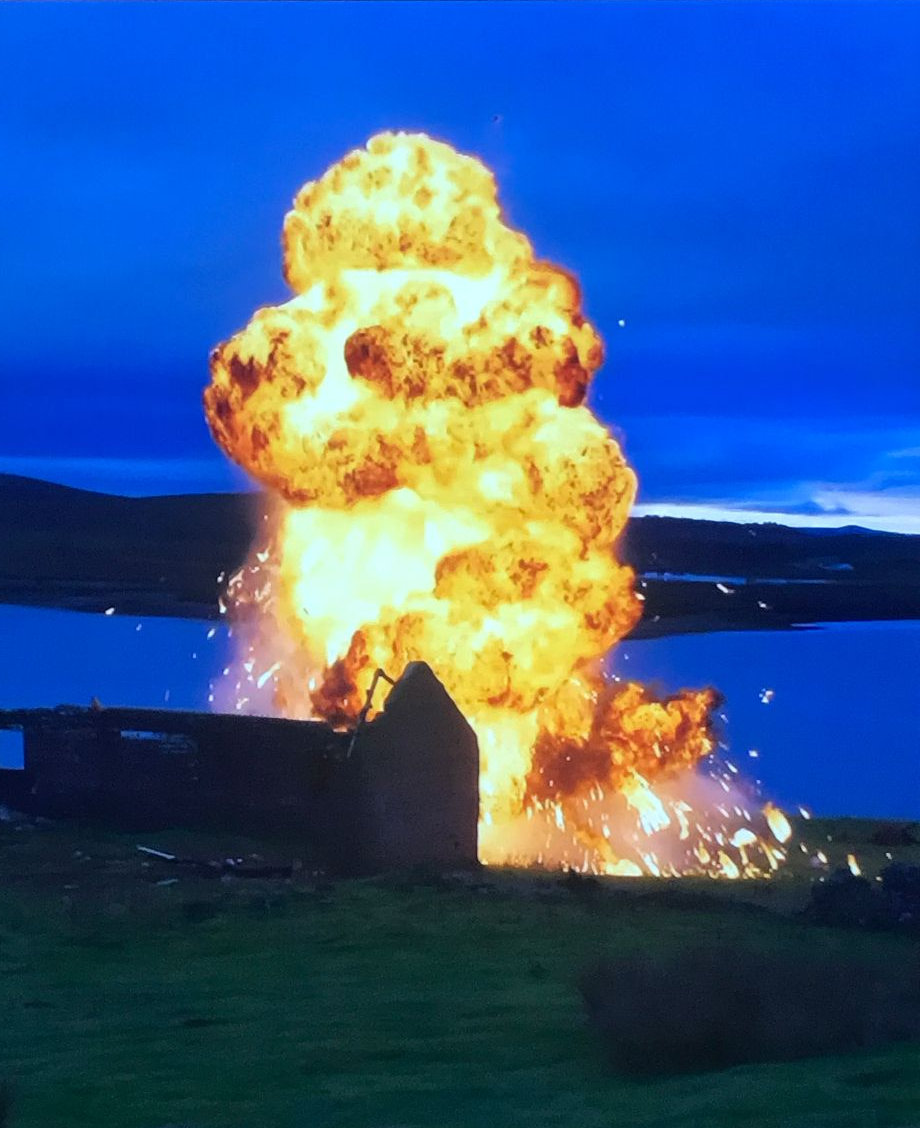
Strangely, I was remined to get on with this blog when watching the new Shetland TV series, where Detective Sergeant  “Tosh” McIntosh was trapped inside a caravan which was about to explode.  I paused the TV in the middle of the explosion and the freeze frame flame looked a bit like the Michelin Man.

Shetland explosion looks like the Michelin Man. End of Episode 3, Series 7.

Watch Episode 4 to see what happened to Tosh.

Nidd Art Trail 2022

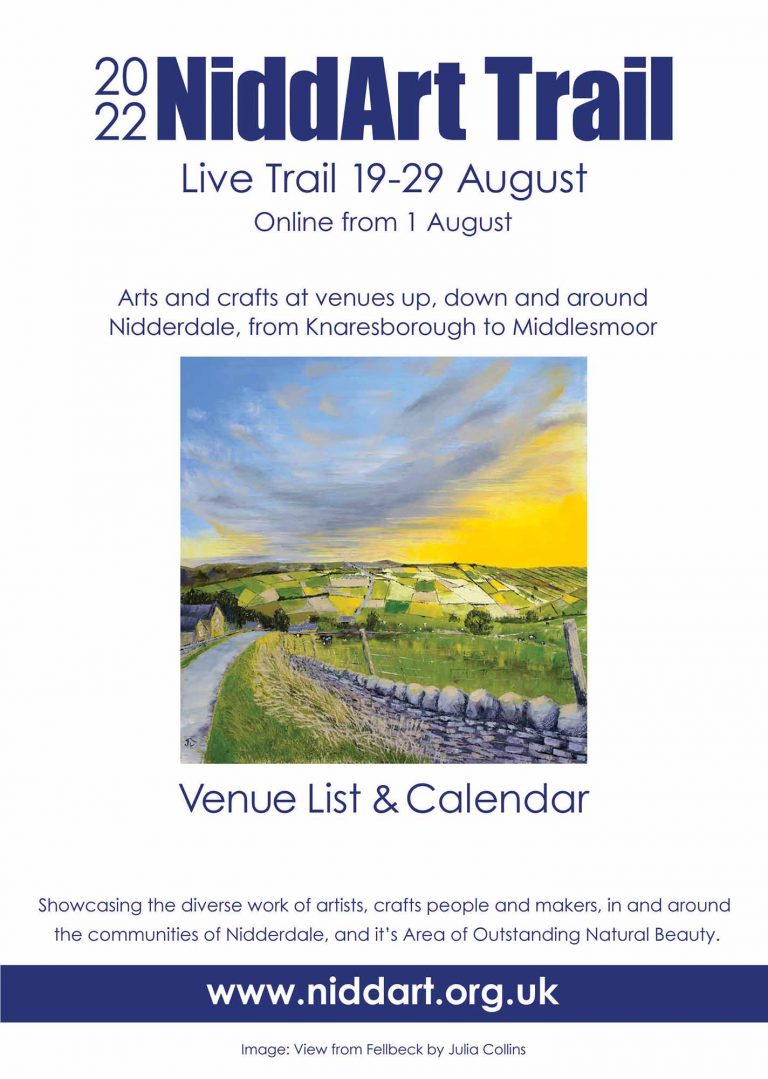
Nidd Art Trail 2022. Live Trail from 19-29 August 2022. Online from 1 August 2022, including Mick Burton, continuous line artist.

After visiting Pateley Bridge Art Club in May 2022, to carry out a workshop on my Continuous Line Drawing,    Pateley Bridge Art Club Continuous Line Drawings

I was invited to take part in the Online section of the Nidd Art Trail 2022.  

As I am not involved in any of the venues along the art trail, I have included several pictures which have direct association with various places in Yorkshire such as Ripon, Ripley, Knaresborough, Kilburn, Otley and my home in Gledhow Valley in Leeds.

The Website is very impressive.  Go into “The artists, craftspeople and makers …” tab and there are over 60 feature works of art or venues.  Just click on any one to see more individual pictures etc and information about the artists.

There is also illustrated information about the venues along the art trail.


Continuous Line Artist view of Haken’s Gordian Knot in “Unknot Hall of Fame”.

Peter Prevos, has included me in his “Unknot Hall of Fame”, within an article on his website about “The Art and Magic of the Trivial Knot”, which also explains many technical aspects of the trivial knot and how magicians have incorporated those ideas. There are designs, in the Hall of Fame, by Goeritz, Thistlewaite, Ochiai and Haken as well as art by Vanuatu and myself and reference to James Sienna. Have a look on – https://horizonofreason.com/science/unknot-gallery/

I had already done my painting when I saw a post on Mathoverflow website “Are there any very hard unknots?” by mathematician Timothy Gowers – https://mathoverflow.net/questions/53471/are-there-any=very-hard-unknots

I responded with posts on my website on in June 2015 and a later update in May 2018.

Noboru Ito, mathematician now at the of University of Tokyo, contacted me in February 2016 about his near completed book “Knot Projections” and my article is referenced in the Preface. “It was very helpful”.

Tomasz Mrowka, mathematician at the Massachusetts Institute of Technology, asked in November 2017 for a copy of my painting, as “it’s really quite striking and would love to hang it in my office”.

David Eppstein, computer scientist and mathematician at university of California, Irvine, featured my painting on his website in November 2018 “Mick Burton, an artist known for drawings that use a single continuous line to create the impression of complex and naturalistic shapes, looks at knot theory, self-overlapping curves, and the visualization of Seifert surfaces.” I had to look in Noboru Ito’s book to check out Seifert surfaces !

In essence my painting of Haken’s Gordian Knot is another example of me finding a well known structure which I can apply my continuous line knowledge and experience to. The way that nature can work in these structures often surprises me.

This is separate to my ongoing art work of producing single continuous lines and colouring based upon interesting subjects – which can be animals, landscapes, portraits, still life and abstracts.

Other examples of looking at structures have been –

Four colour theory maps, where my overdraw method could divide a map up into two streams of alternate colours, hence the four colours. I corresponded with mathematicians Robin Wilson and Fred Holroyd in the mid 1970’s. See my post in August 2015 on Skydiver patterns and my Four Colour Theory.

The artist Escher’s favourite tile at the Alhambra in Spain, which I realised had two continuous lines running through it. I saw that the artist could have made in into a single line with two small alterations. See my posts of April 2015.

Knights moves on a chess board starting and finishing at the same square and landing once on all the other squares. See my 1974 picture in the Gallery 1965-1974.

I am always on the look out for new structures which are suitable.

Colour Sequence Application to Continuous Line Drawings by Mick Burton – demonstration continued.

img_5140 - copy

Clyde the Elephant, single continuous line with colour sequence by Mick Burton.

This is the continuation post covering my demonstration and workshop at Harrogate and Nidderdale Art Club on 6 December 2018.

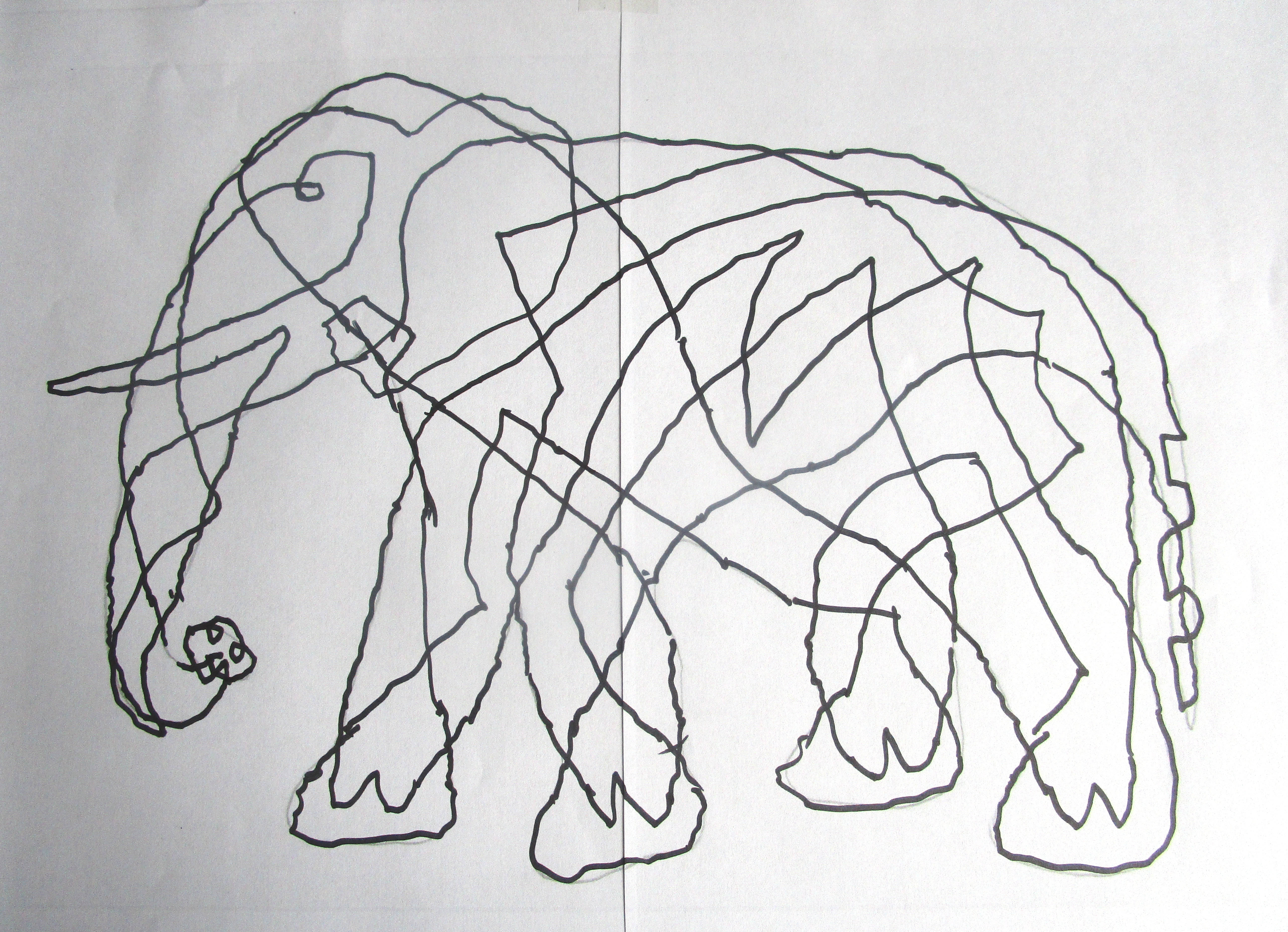
Here is a reminder of my marker pen attempt at a continuous line elephant.
IMG_4950

Demonstration of a Single Continuous Line Elephant, initial drawing, at Harrogate and Nidderdale Art Club by Mick Burton, on 6 December 2018.

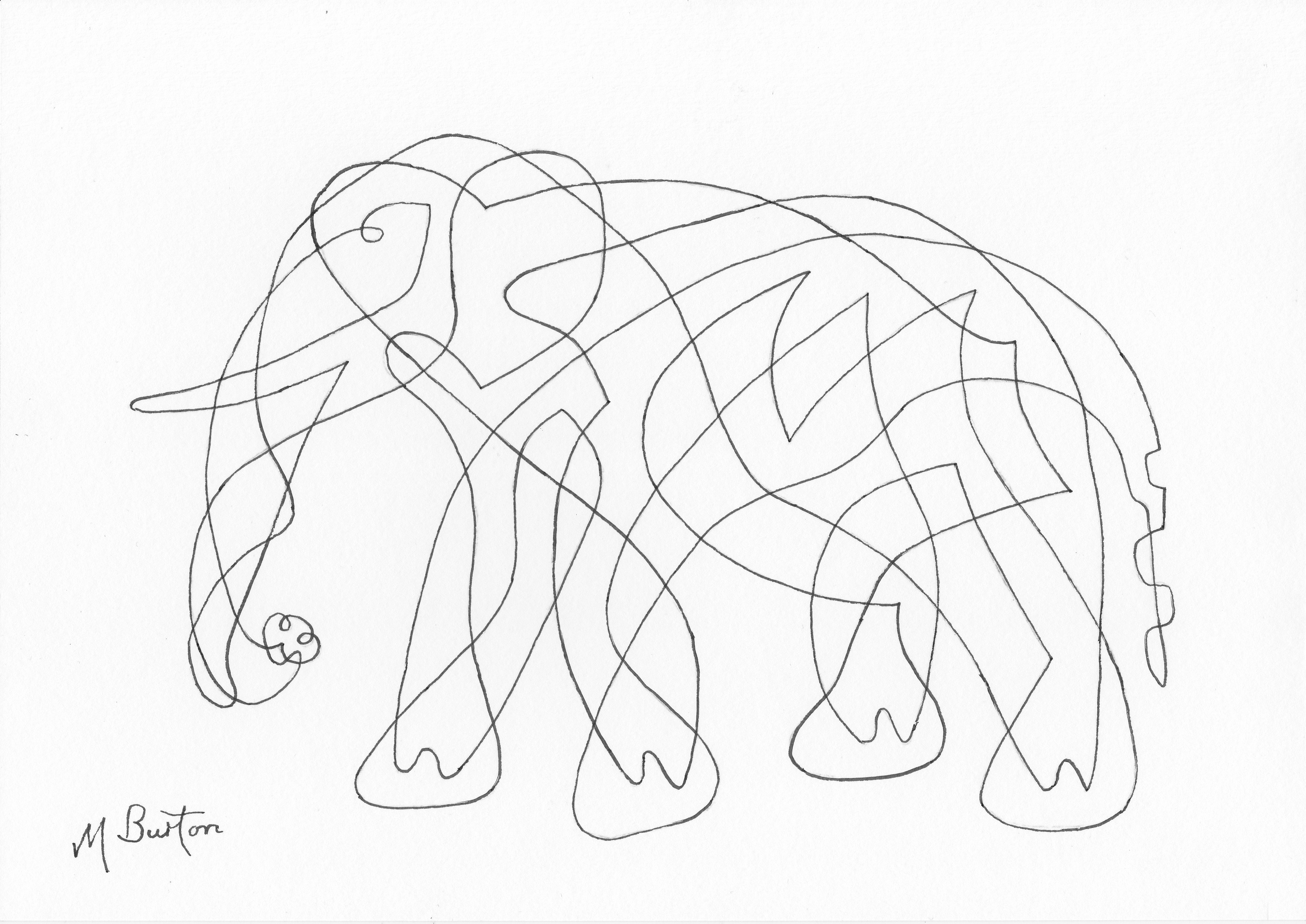
At home later I followed the line/s around and found that there was more than one line and I needed to do one or two diversions to correct that.  As the pattern at the front of the neck has a sort of square which I needed to get rid of I used that region to also turn the drawing into a single line throughout.  With a bit of general smoothing of arcs all round I arrived at the following revised elephant.
img_20190108_0002

Revised single continuous line elephant.    Mick Burton, Leeds Artist.

The next stage was to apply my Colour Sequence to the lines, which I completed in the last few days.  The result is shown at the top of this post.

To explain the process I use, and how it works, I will briefly go through the illustrations which I used later on in the Demonstration at Harrogate and Nidderdale Art Club.

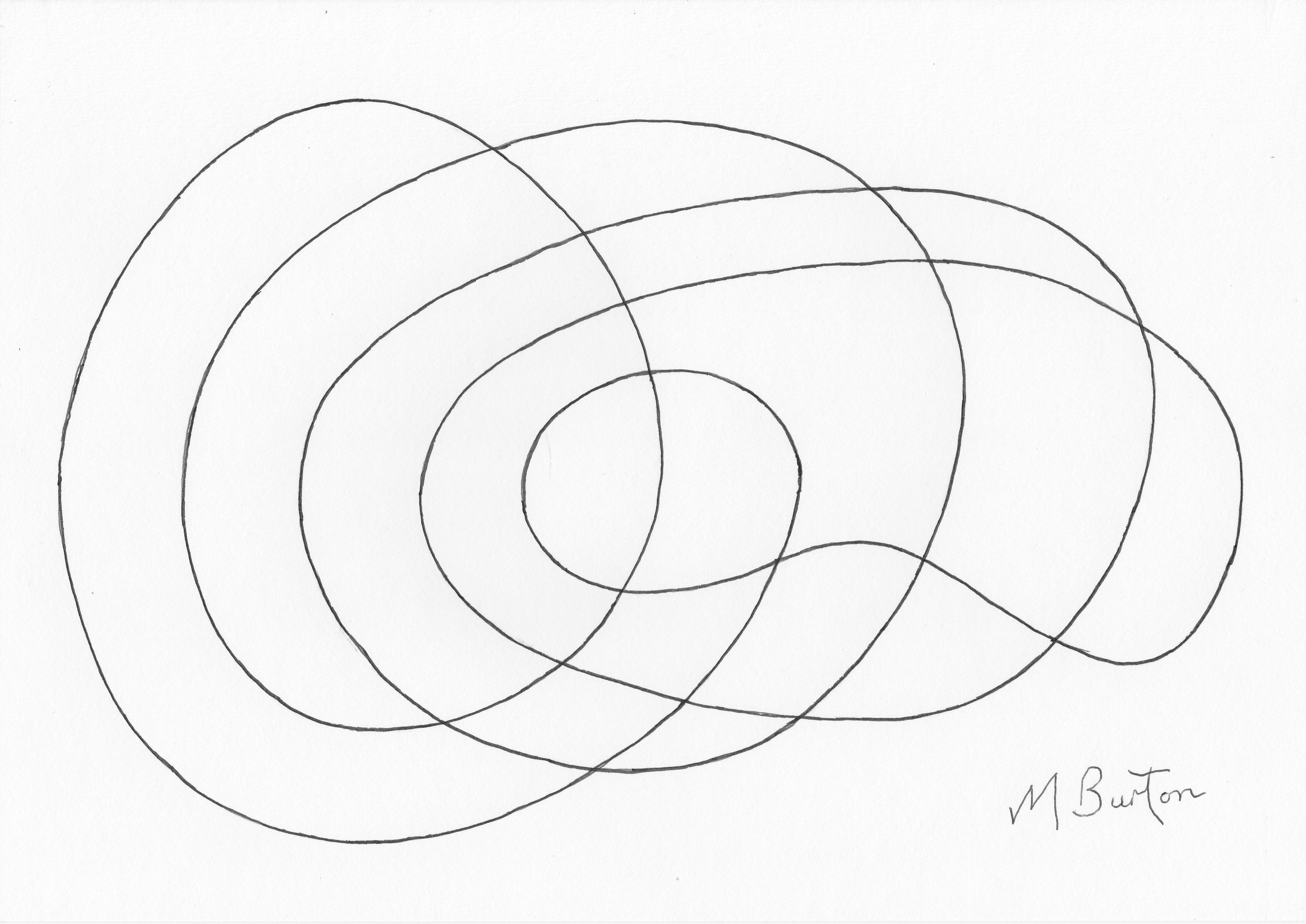
We start by drawing a winding line in an anticlockwise direction.
anticlock 1 line

Stage 1. Single line drawn anticlockwise.   Mick Burton explains colour sequence.

Then, starting on an outside section of line, overdraw in red alternate sections of line.  This results in three different continuous line sections bounded by a red line.

anticlock 2 alt overdraw

Stage 2. Overdraw in red missing alternate sections.   Mick Burton explains colour sequence.

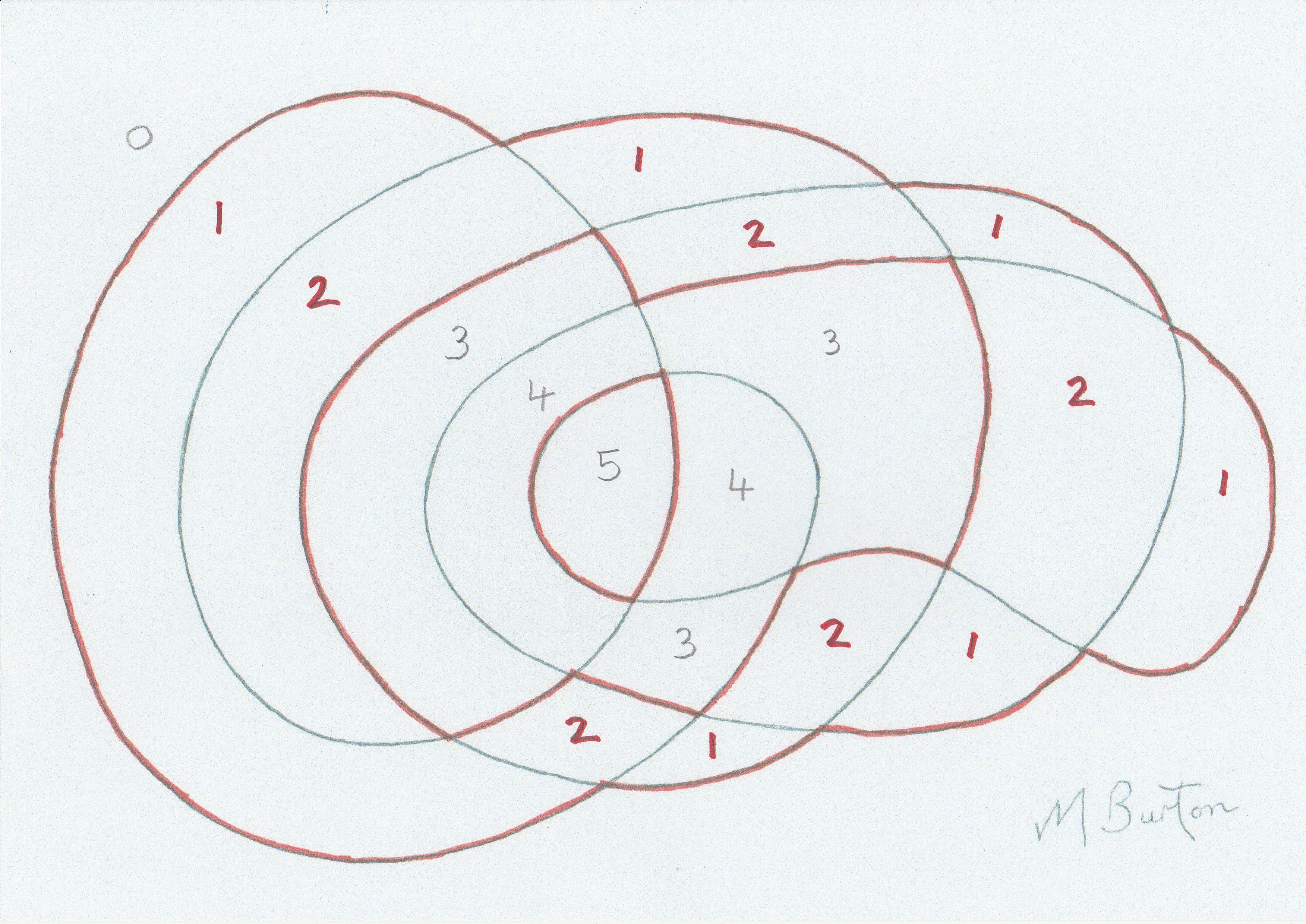
We can now number all the areas to indicate where the colours in the sequence go.  Call the outside 0 and number through the sections to 5 in the middle.  You will see that each channel between red lines has alternately numbered areas.
anticlock 3 number alloc

Stage 3. Number the areas in sequence from the outside (being 0) to the middle (being 5). Mick Burton explains colour sequence.

I have already decided on a sequence of colours to use, running from light tones to darker and from yellow to red.  First apply yellow and gold alternately throughout the outer corridor.
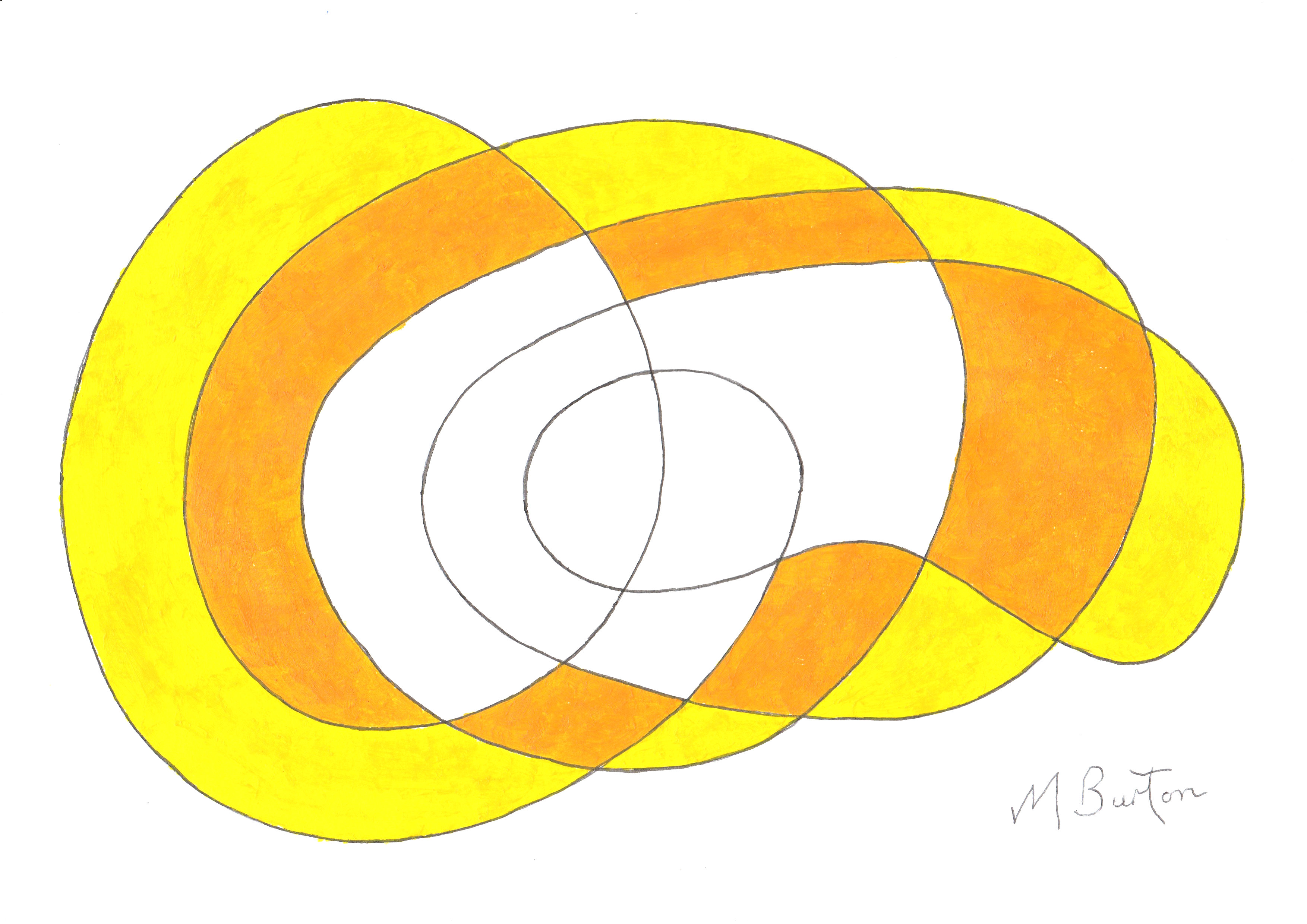
anticlock 4 first alt colours - copy

Stage 4. Paint alternate colours within the outer corridor. Mick Burton explains Colour Sequence.

Paint in the next two colours from the sequence – orange (which looks reddish here) and red – alternately in the inner corridor.  You can see how the colours are lining up in natural sequence of tone and colour.
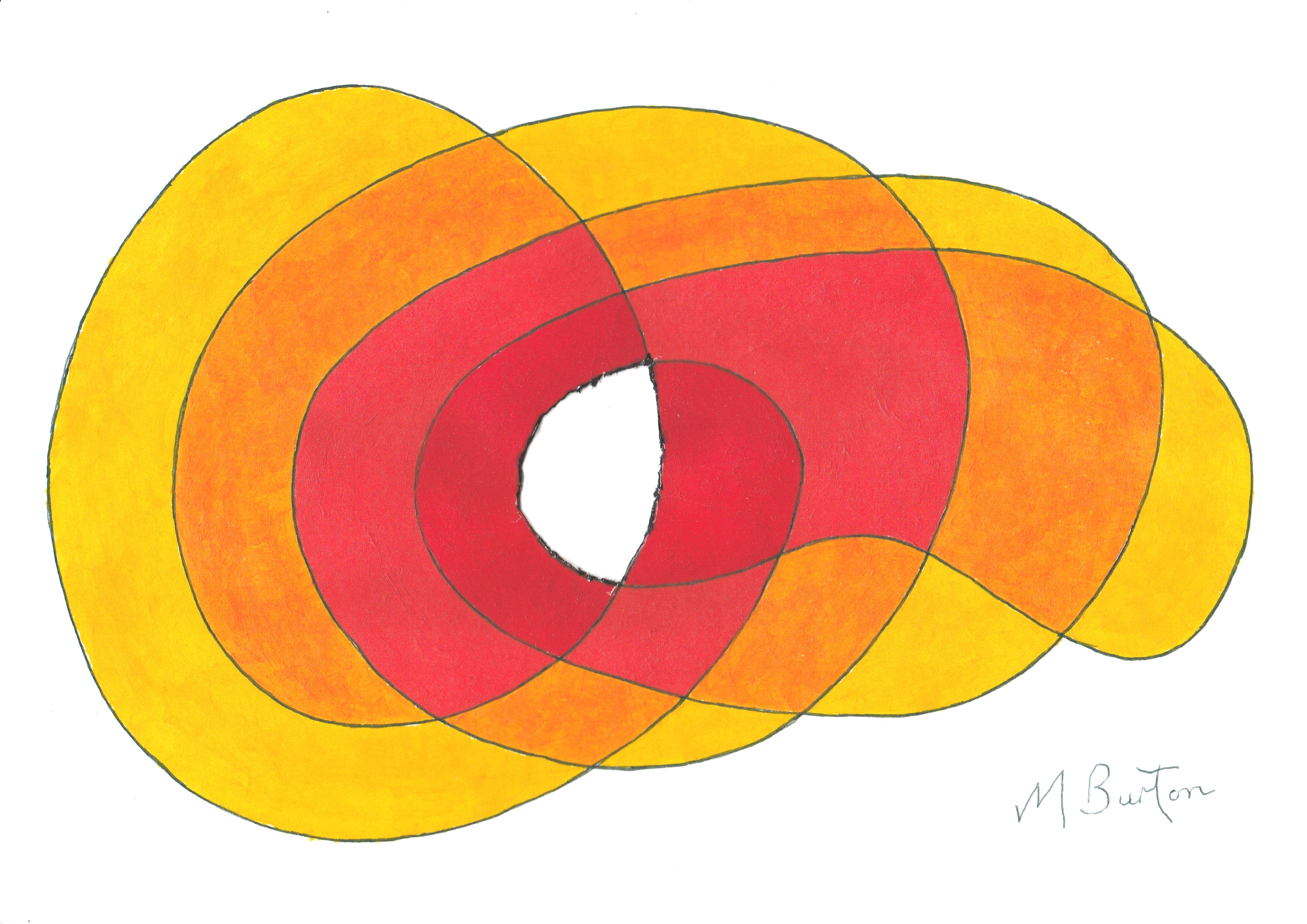
anticlock 5 second alt colours - copy

Stage 5. Paint second set of alternate colours (orange, which looks reddish here, and red) in the next corridor.   Mick Burton explains colour sequence.

Lastly, for our anticlockwise line we paint the central area (which has its own red line surrounding it).  The result is a simple set of sequences running from the outside to the middle.

anticlock 6 full colours

Stage 6. The last colour in the sequence (dark red) is added in the centre. Mick Burton explains colour sequence.

As you will have realised, each loop going over earlier parts of the drawing adds a level, like overlapping shadows or leaves on a tree looking darker as they overlap.  The direction of darker tones of colour in the sequence reflects this.

In more complex drawings, however, the sequences of colours can change direction.  To show this we need to have a different single continuous line.

Start drawing your line with two loops from the lower left in an anticlockwise direction as before.  When you reach the upper left change to doing three loops in a clockwise direction and then go back to the start by a line running underneath.
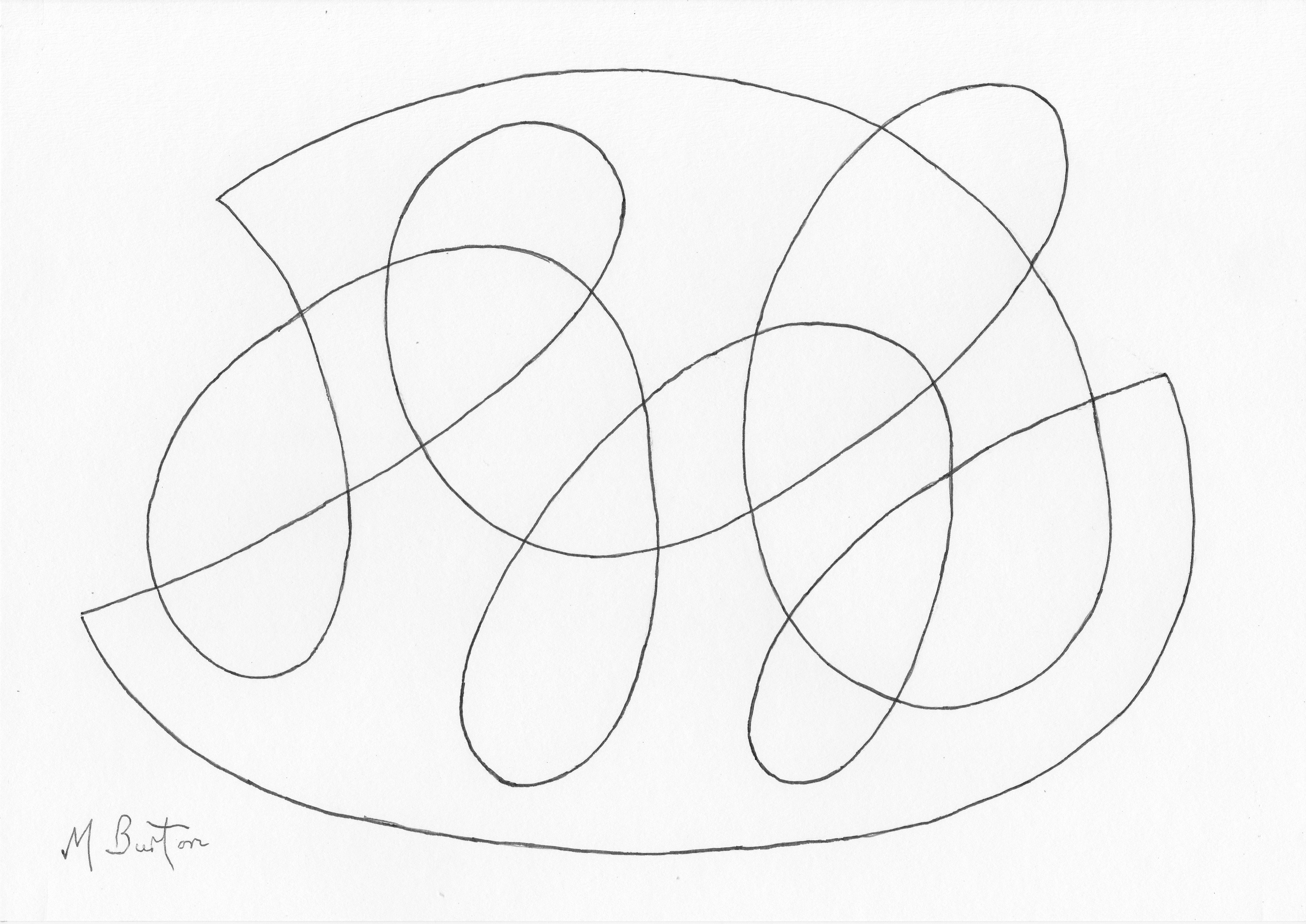
clock 1 line

Stage 7. Start drawing your line from the lower left in an anticlockwise direction doing loops and when you reach the higher left change to clockwise loops running back to the right. Then finish clockwise running underneath to the start. Mick Burton explains colour sequence.

Here is confirmation of the directions of the line, anticlockwise and clockwise, and how they change and run back over earlier lines.  We now have a more complex drawing for colouring.

clock 2 directions of line

Stage 8. Here is the completed single line with the directions shown – red for anticlockwise and blue for clockwise. Mick Burton explains colour sequence.

By applying alternate overdraw in red we split the drawing into corridors which look a bit more complicated than the simple anticlockwise drawing we did earlier.

clock 3 alt overdraw

Stage 9. Alternate overdraw in red splits the new drawing up into corridors for colouring. Mick Burton explains colour sequence.

When we number the areas, starting at 0 on the outside as before, we have plus numbers at the top of the drawing but minus numbers appear in the lower corridor.  When we follow the natural sequence of numbers downwards from 2 through 1 and 0 we hit -1 and -2.

clock 4 number alloc

Stage 10. Numbering from 0 on the outside as before we get minus numbers as well as plus. Mick Burton explains colour sequence.

After I had been doing my colour sequence for a few years I found out that mathematicians call this mix of anti and clock directions Winding Number Theory.  When you continue with loops in an anticlockwise direction you are adding levels of overlap and when you change to clockwise you start reducing levels.

We can now apply alternate colours yellow and red to the upper channel.

clock 5 first alt colours

Stage 11. First set of alternate colours in the upper channel on the complex drawing. Mick Burton explains colour sequence.

Then we can complete the positive colour direction.
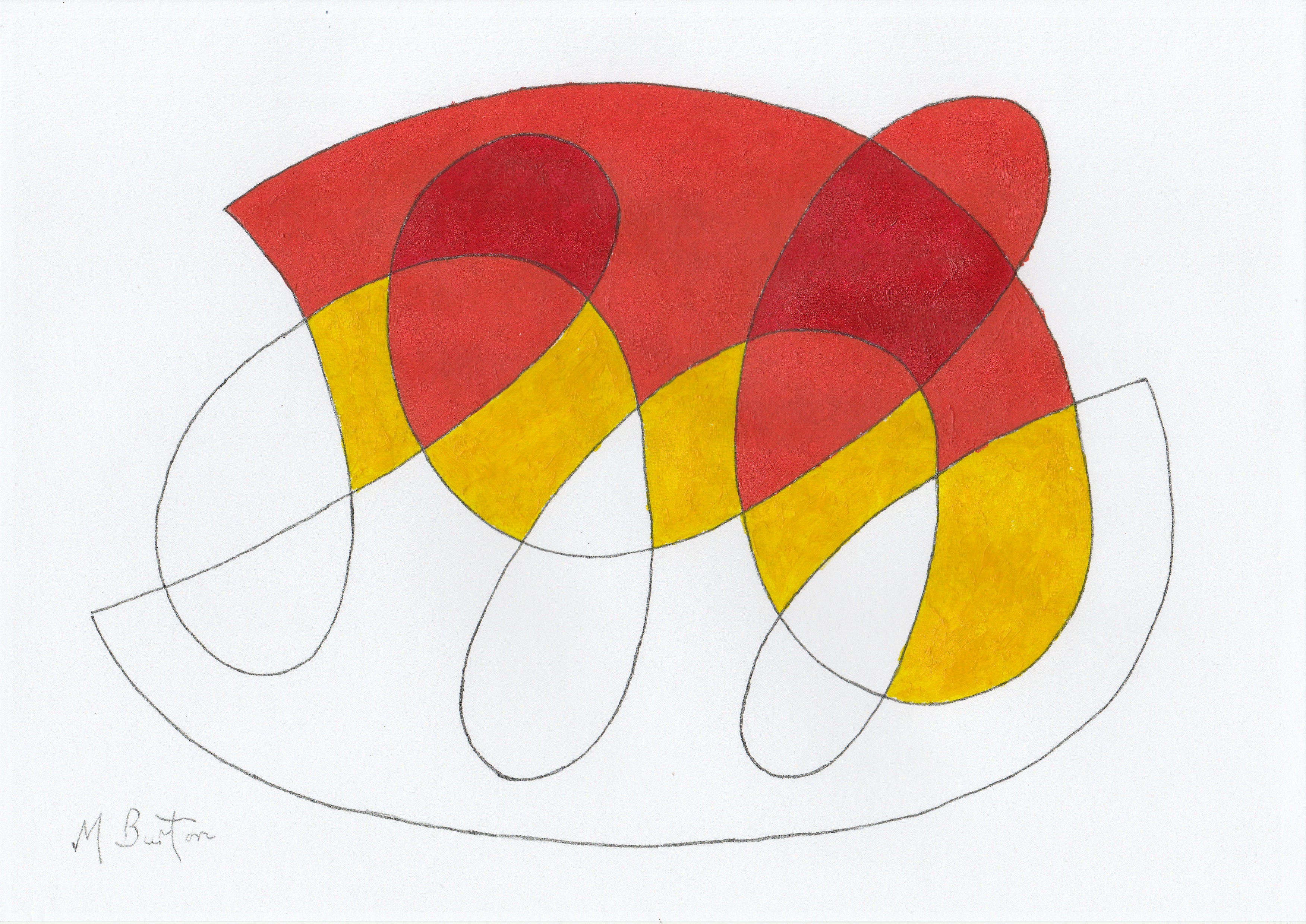
clock 6 last upward colour

Stage 12.  Completing the plus direction colours by adding dark red.   Mick Burton, continuous line artist.

Now looking at the lower colours, in the clockwise section of the drawing we add the final two colours alternately.
clock 7 downward colours

Stage 13.  Complete colour sequence on single continuous line drawn in both anticlockwise and clockwise directions. Mick Burton, Leeds artist.

So that is the basis of how I do my colour sequence.  

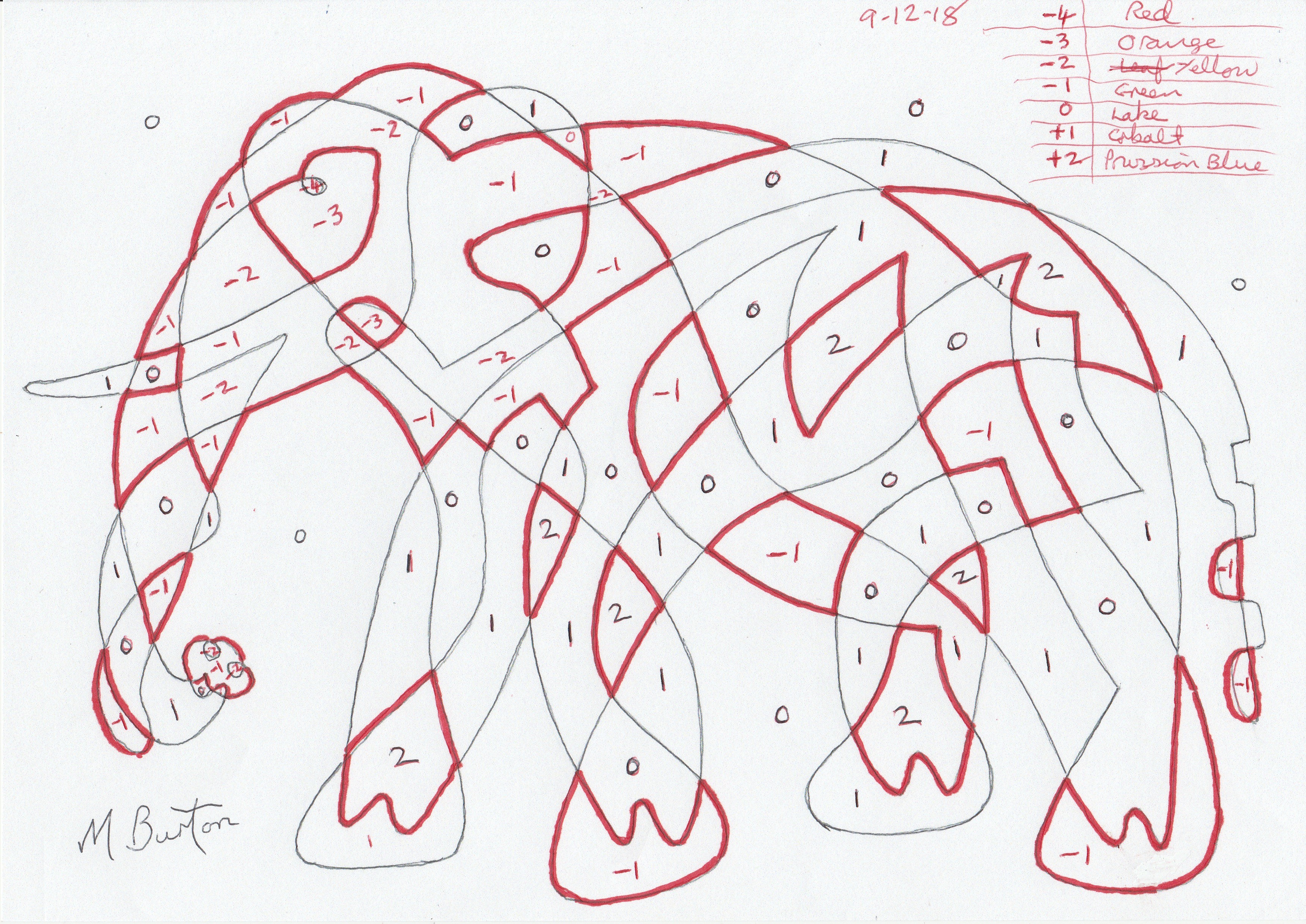
For my elephant, it is more complicated and I show below my sketch after doing the alternate overdraws to create the corridors of alternate colours and then numbered the colours throughout.
img_20190108_0001

Single continuous line elephant showing alternate overdrawn lines in red and colour numbering. The key to the colour sequence and numbering is shown. Mick Burton, continuous line artist.

I have shown the key to the colour sequence and numbering in the top right corner.  The colours can be employed in the opposite direction, of course, but with all my drawings the choice of which direction of sequence to adopt is not too difficult.  The darker colours fall lower down or on the main body of the animal and the more delicate red, orange and yellow mostly on the face. 

I only use red once, and that is on the eye.  This really reflects the greater detail on a face which extends the colour range.  Several of my colour sequence animals have the eye coloured by an end of range colour only used once in the drawing, eg. Iguana, Harriet the Hen and Olympic Lion.

The completed elephant, at the top of the post, has a story behind it.  I did the initial drawing in my demonstration to Harrogate and Nidderdale Art Club on 6 December 2018, which is the day my first grandson, Lucas, was born in Glasgow, son of Kate and Mark. 

I have decided to call the elephant Clyde after the famous Glasgow river.  Lucas can have a picture on his wall which is exactly as old as he is.