Author Archives: mickburton2

Unknown's avatar

About mickburton2

I am an Artist in Leeds, fascinated by Continuous Line Drawings. I first developed my style and ideas in the 1960's and early 1970's.

Change a four sided continuous structure into a single surface Mobius torus, or Mobioid.

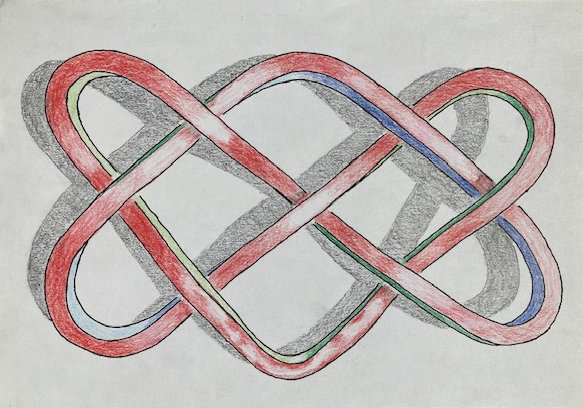
Drawing of Doug Eglen continuous metal sculpture with sides in four colours. Mick Burton, continuous line artist.

In my last post, on 3 June 2025, I said that I would like to draw Doug Eglen’s 3/8″ square forged metal sculpture. 

Continuous Lines in forged metal, by Doug Eglen.

Here it is, but I have used separate colours for each of the four sides.  You can only see Red, Green and Blue because the metal remains flat overall and you cannot see the Black I allocated for the underside.

I have tried to reflect the 3D quality of the sculpture, with its Celtic over and under style, highlights and shadow.

When I first saw the structure, I wanted to understand what would happen if I applied twists to the sculpture.  I thought that there should be one or more types of twist which would turn the culture from being four sided with four surfaces into four sided with one surface.  I knew that the Mobius Strip has two sides before the half twist and one continuous surface afterwards and thought that the single surface should also be possible for Doug’s structure.

Another thing that I wanted do was to try and clarify my idea that his structure reflected the shapes of two Boomerangs.  I wondered what twists I would need to do this.

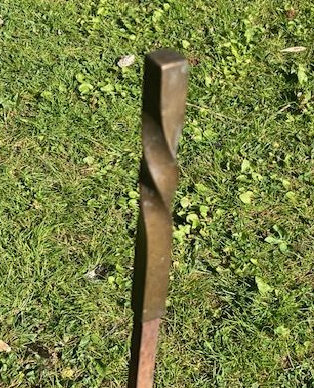
The poker which I made at the age of 12 at school appeared to have a half twist but it is difficult to visualise how this changed the position of the sides.

Brass handle with half twist on my poker, made at school when I was 12. Mick Burton, continuous line artist.

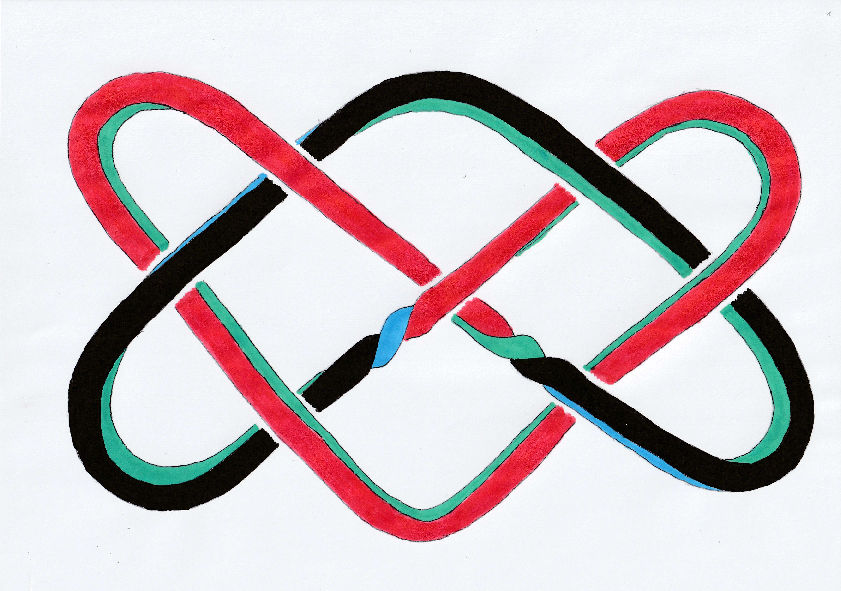
I had to use a pencil to draw along one surface to confirm that it changed the top side into the bottom side.  This meant that I could use two half twists near the centre of a new drawing of the sculpture to produce two boomerangs which had individual colours.

Using two twists to produce Black and Red Boomerangs on drawing of Doug Eglen’s metal sculpture. Mick Burton, continuous line artist.

Black has now appeared at the top for half the time, so we have four colours on view.  Another outcome is that the two sides, which are Green and Blue, swapped from one side to the other at the twists which has resulted in blue almost disappearing.  This is due to the close photographic angle by Doug showing most of the insides of each boomerang shape and I coloured them almost equally Green and Blue in my first drawing.  Green stayed the same within the Red boomerang here and Blue changed to Green in the new Black one.

I have mentioned the Mobius effect.  The Boomerang drawing has not produced a change in the number of surfaces but just altered their positions. Sides still equal surfaces.  This is because I have used two half twists.  If I had only used one half twist then the number of surfaces overall would become two surfaces, one colour for top and bottom and another for both sides.

It seemed to me that employing one quarter twist would produce a Mobius single surface throughout, as each time a surface comes round again it deflects a quarter and on the fourth approach it is back on top. Maybe a three quarter twist would also achieve this, but I found this more difficult to visualise.  First approach deflects to side 4, Second to side 3, Third to side 2 and fourth to side 1 again.

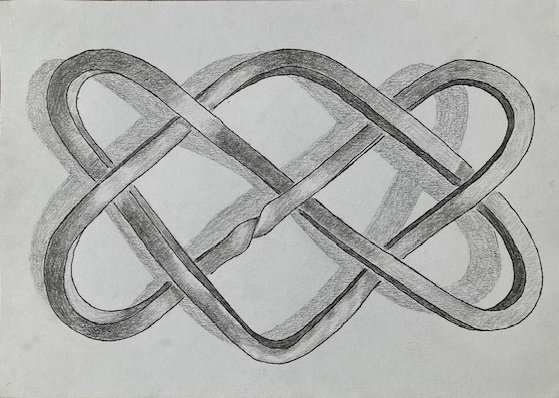
Anyway, I have drawn simply a single quarter twist as an addition to Doug’s sculpture.

Drawing of Doug Eglen continuous metal sculpture, but with added quarter twist. Mick Burton, continuous line artist.

I have started with black and the result is All Black.  This drawing depicts a 4 sided metal continuous sculpture which has only one surface.  It is a complete Mobius result.  Visually, you can see that it is a quarter twist and our knowledge of the general sculpture helps us to realise that there is in fact one surface.

Yes, a Boomerang drawing and an “All Black” drawing suggest that I have Australian and New Zealand interests.  My mother, maiden name Brenda Mace, was born in a pub in Bedale, North Yorkshire.  Nearly 100 years earlier six brothers were born in the same pub and four of them went to gold fields in both Australia and then New Zealand in the early 1860’s.  They were cricketers as well and Christopher Mace played for Victoria against the first team to visit from England and two years later John and Harry joined with him, in Otago New Zealand, against the first English team to play there.

Back to the drawings.  I looked on the Internet for images of general structures which included a quarter twist and failed to find any.  There were examples of the pure circular twist, including 4 sided, but these are difficult to visualise as there is no obvious start point. 

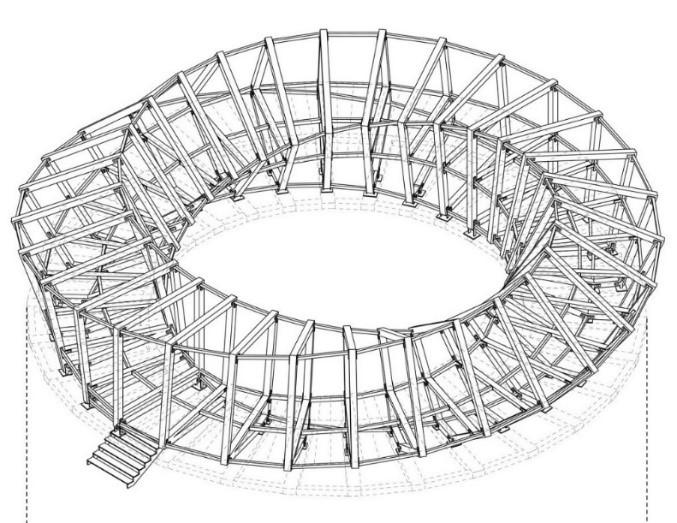
Mobius Strip Structure of Rectangle Geometric Shape. Issuu website.

This pure circular twist is more understandable than most and the Issuu website shows how they built one which you can walk round in.  I am not sure if this includes walking upside down at one stage!

https://issuu.com/vsvu/docs/prof_is_1000/s/16586493

I feel that a twist anchored into an actual general structure, which has some straight and flat sections, is important.  It is easier to identify the type of twist and how the effect of the twist radiates through the whole structure in a more meaningful way.

Some other reference sites mention continuous surfaces, with more than the single edge and surface of a Mobius Strip, as Morbioids.  They compare their structure with the Torus (when it has parallel lines drawn around it which can be regarded as equivalent to edges which can produce the Mobius effect).

There are specific explanations of degree of twist, the number of sides, leading to the number of surfaces.  These confirm my assumptions about a quarter (90 degree) twist, or three quarter (270 degree) twist resulting in a single surface for the square structure.  A half (180 degree) twist has two surfaces.  Others explain 5 or 6 sides and there is a formula for n surfaces according to twist and sides.

A useful link that works is headed “Name for a 3 sided Mobius Strip?”  https://reddit.com/r/topology/comments/1bfdu7m/

SamwiseGanges    said that he was going to call them Mobius prisms.  When he referred to square Mobius prisms, he confirmed my assumptions about the effect of their twists.

AceThe Aro   said that Dr. Cye Waldman called them Mobioid’s in 2017 and you can click onto his moving images.  You can also click on Ace’s own slideshow which runs through all the different twist and number of sides possibilities.

I would like to refer to my drawing of Doug Eglen’s structure, with a quarter twist, as an “Anchored mobius torus”, or “Anchored Mobioid”.

Doug may consider loosening the join on his double boomerang ironwork and resetting it with a quarter (90 degree) twist.  That would produce a real single surface anchored Mobioid.  


Continuous Lines in forged metal, by Doug Eglen.

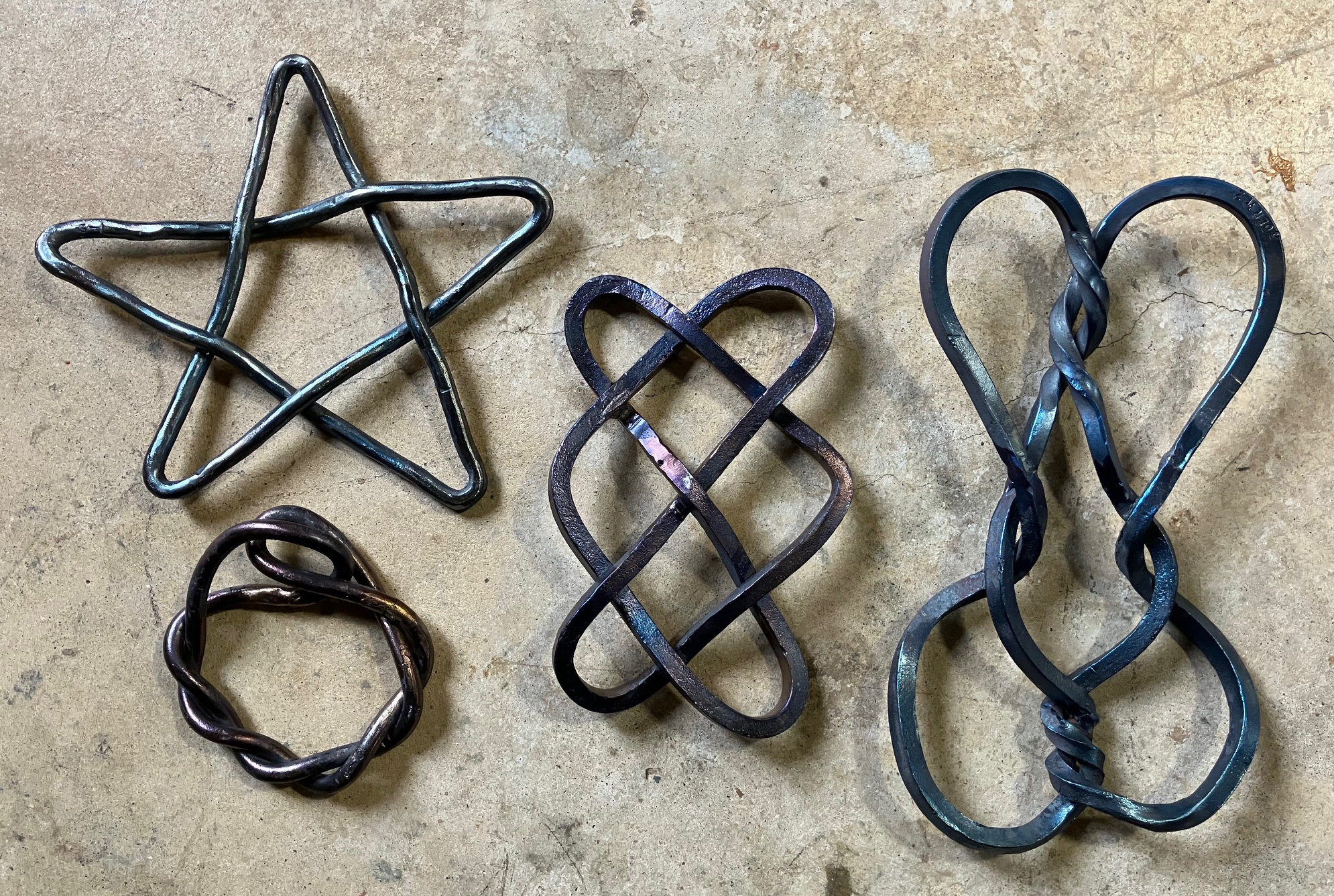
Continuous Line knots in tempered metal forged by Doug Eglen. Photo by Doug sent to Mick Burton, April 2025.

Doug Eglen contacted me in March 2025 to say that he had recently started having an interest in knots and unknots and came across my painting of Haken’s Gordian knot, which you can see in my earlier posts of 9 May 2018 and 5 June 2015

Continuous Line Artist view of Haken’s Gordian Knot.

How do you construct Haken’s Gordian Knot?

He asked for my permission to paint his own version of the Gordian knot, based upon my painting.  He intended to exhibit his painting, along with the new metal knots which he was producing in his forge.  Doug has an exhibit case at Purdue University, Indiana, in the Math department library.  I agreed, and answered his questions about assumptions he had made about the construction of my painting. 

Doug later sent me a copy of his painting.  This is impressive, as are his metal knots, and you can see them on his website   

https://http://www.deglen.org/math-art

I particularly liked Doug’s photo of his 3/8″ square metal, in what I would call a sort of “double boomerang” shape without any twists.

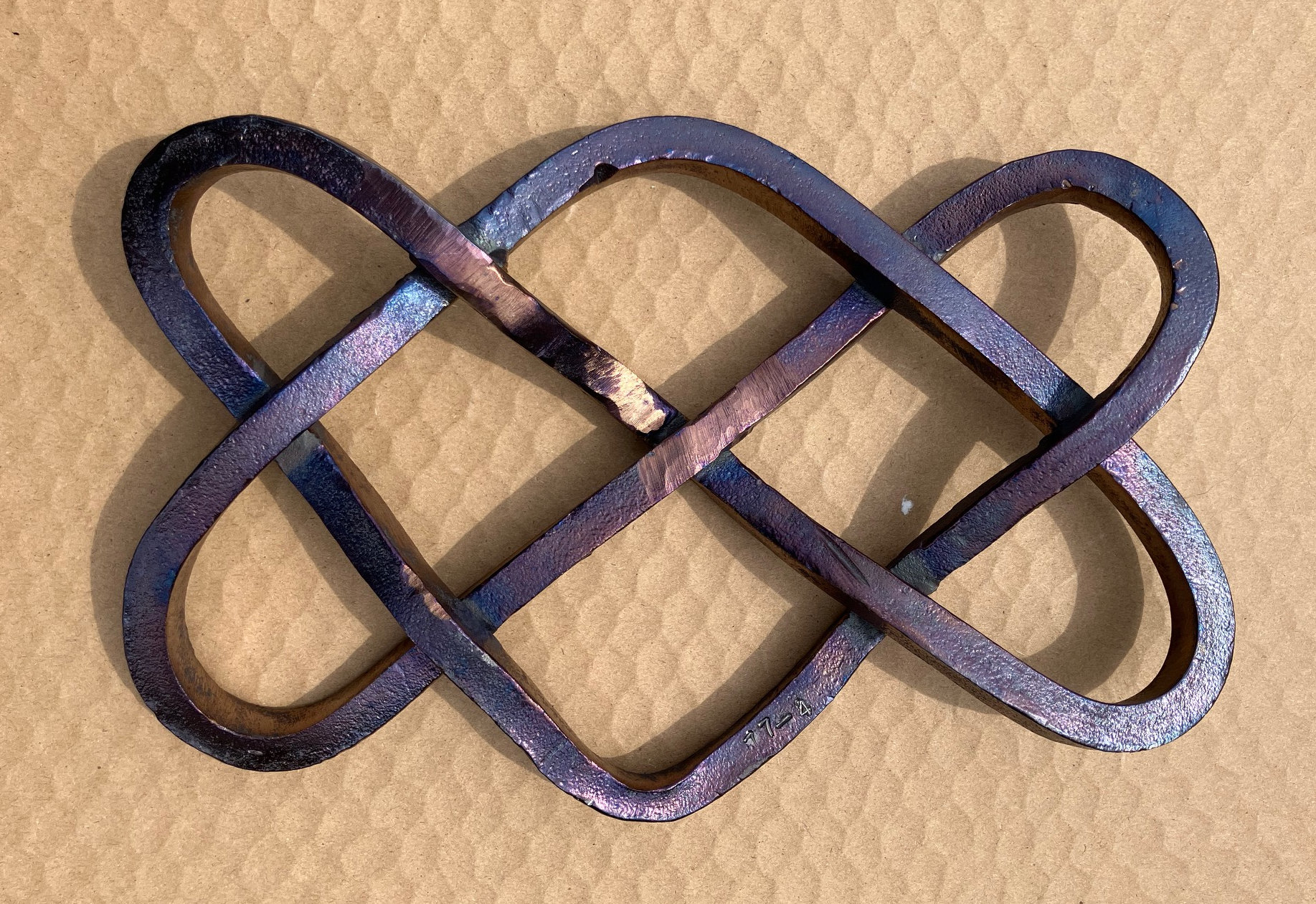
Doug Eglen square 3/8″ metal without twists in a continuous line, copied to Mick Burton.

The alternate over and under style, like Celtic knotwork, produces great highlight graduations as well as suggestions of colour that Doug achieves with his firing treatments. I like the dark shade of the sides of the metal compared with the shadow of the piece.  I would like to draw this.

At school, when I was 12, I produced a metal poker with brass handle which has a half twist.  I have had no further experience of metal work.

Brass handle with half twist on my poker, made at school when I was 12. Mick Burton, continuous line artist.

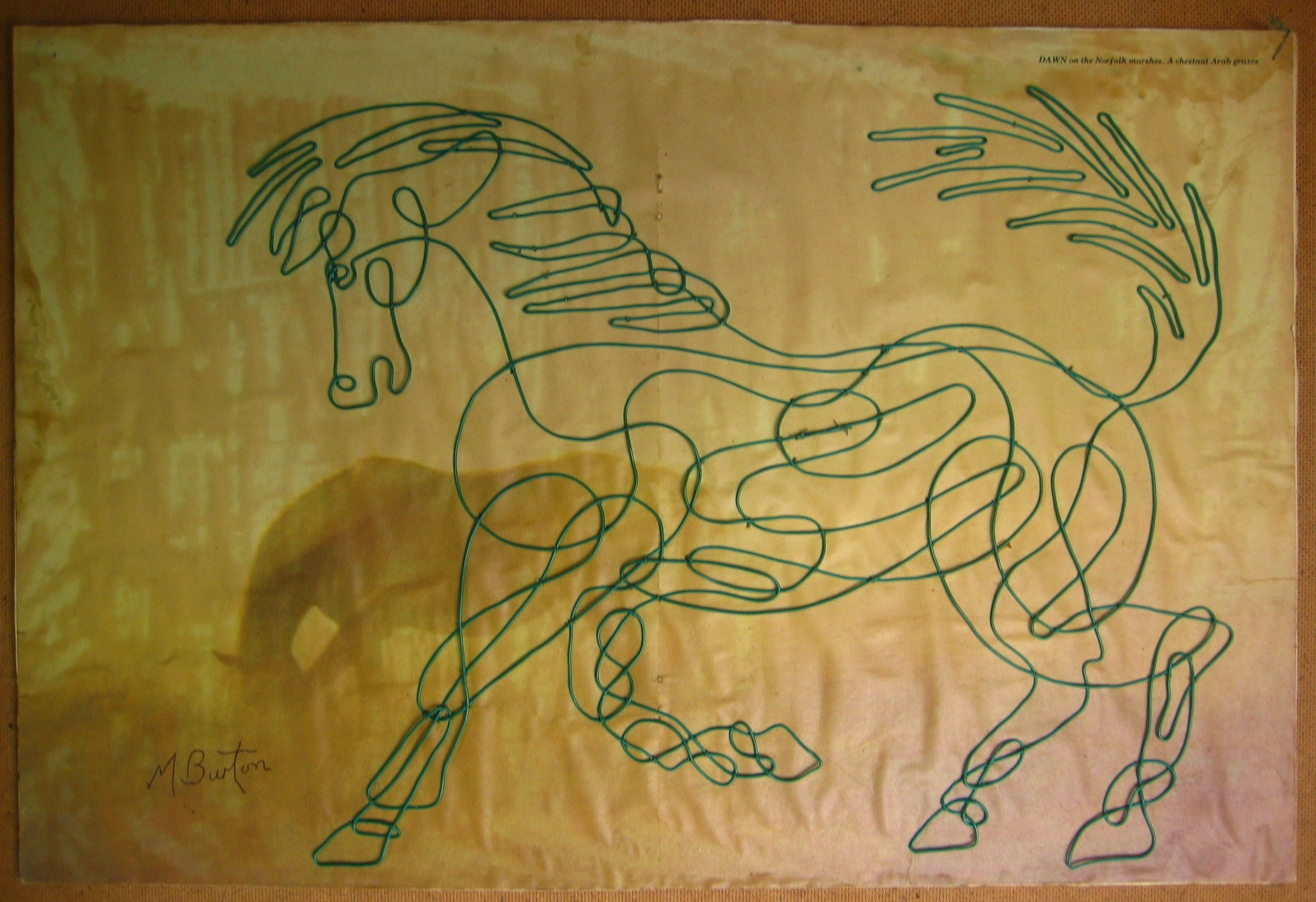
I did do some wire bending to produce a single continuous line wire horse in 1967.  At first I placed it underneath a piece of clear glass covering the dining table, to hold it down.  Then I secured it to a wooden board through a centre page magazine photo of a horse grazing in a meadow.

Continuous line Horse in a length of garden wire done in 1967. Mick Burton.

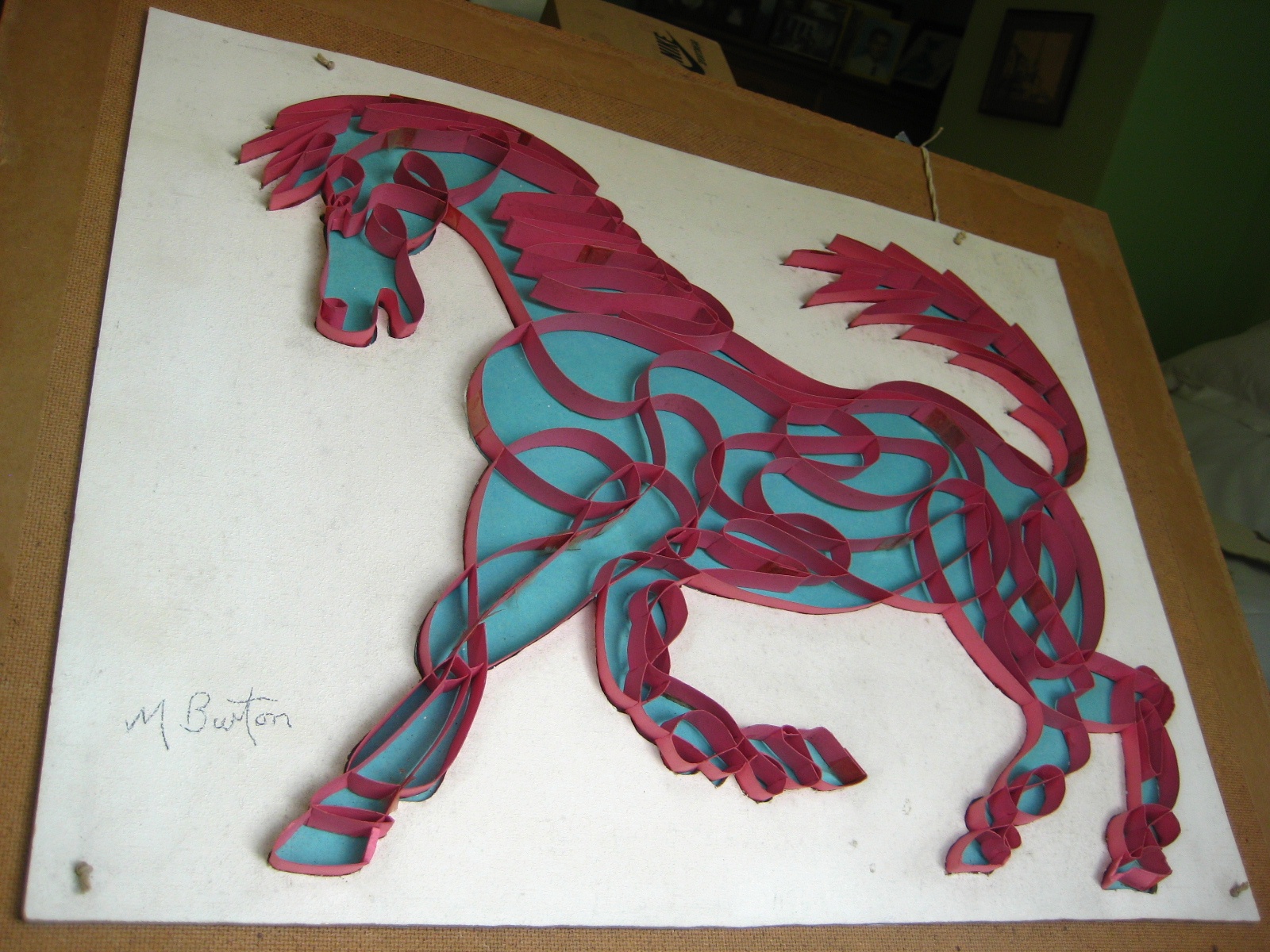
Next, I went sculptural and used cardboard strips to take the Horse a stage further in 1970 when I lived in Nottingham.

Continuous line Horse using strips of cardboard 1970. Mick Burton.

I showed it to someone at work who’s Dad owned a company which produced steel castings. He said he would ask his Dad about the possibilities of doing a metal horse.  The answer was a “Yes”, but it would cost me £3,000 !  I now know someone who’s cousin does 3D printing, so maybe I can get a more reasonable quote now.

Of course, this is all “small beer” compared to Doug Eglen’s metal workings.

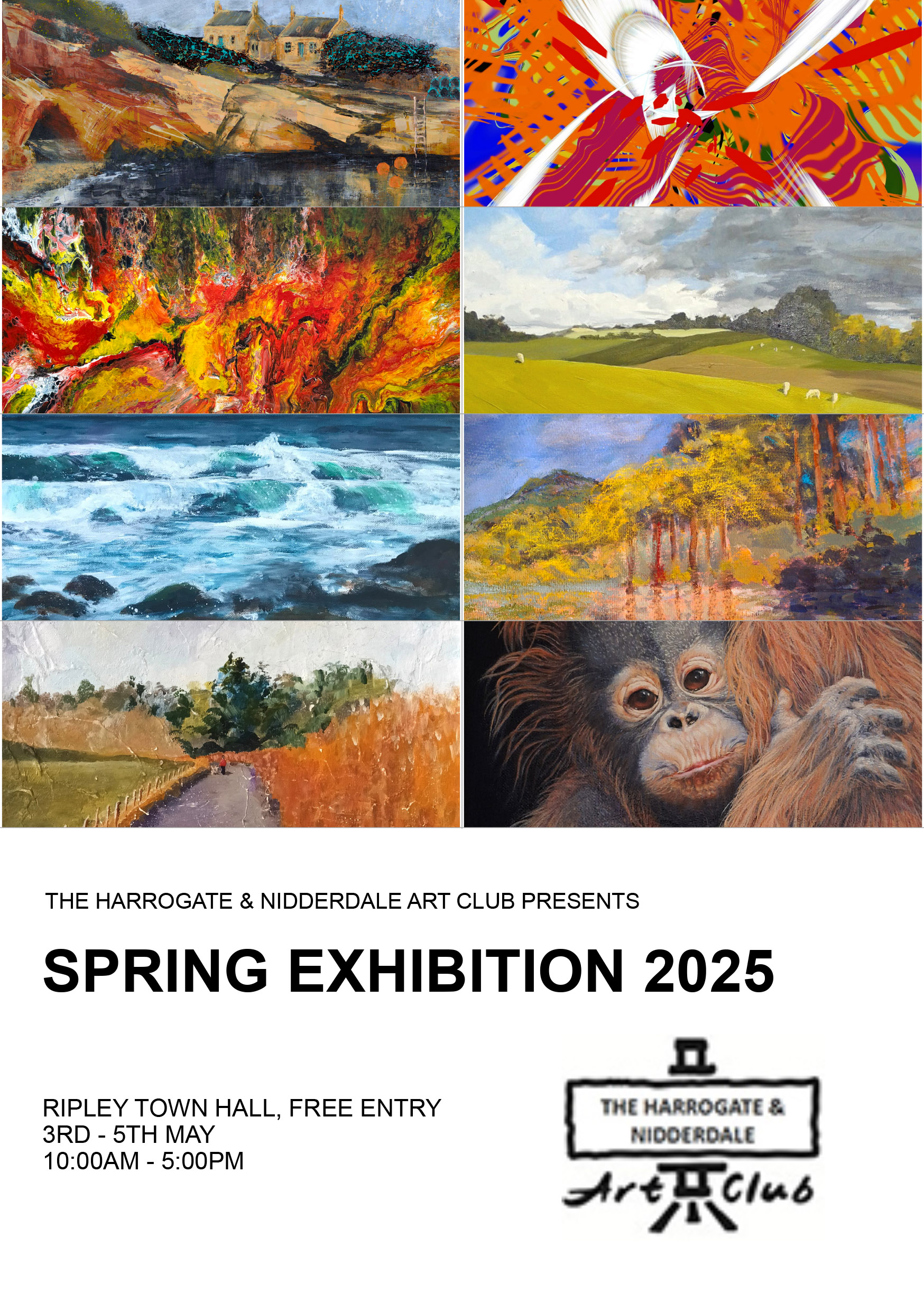
Harrogate and Nidderdale Art Club, Spring Exhibition 2025 at Ripley Town Hall.

Harrogate and Nidderdale Art Club, Spring Exhibition 2025. At Ripley Town Hall.

The Harrogate and Nidderdale Art Club, Spring Exhibition, will be held on 3rd to 5th May 2025 at Ripley Town Hall.  As usual, there will be a wide range of quality paintings, prints and cards by members of the club at this splendid venue.

My pictures will include the completed coloured version of my single continuous line Phormium which I covered in my earlier post of 27 November 2024.  I call it “Phormium in Snow”.  There were also fox tracks passing the phormium, down and back up the garden, which I thought of including.

Phormium in Snow. Mick Burton, continuous line artist.

Another update from that post is that the bees have re-occupied the hole in the lawn. 

There is often a bee arriving and another leaving at the same time.  It is not a quick process!  The one landing may circle around and land a foot away and wander around before working its way through the grass into the hole.  The leaver will crawl out and wander around before flying off at low level.   Of course, when I mow the lawn I have to be careful that they are not coming or going when I go over their area.

And now here is something completely different.

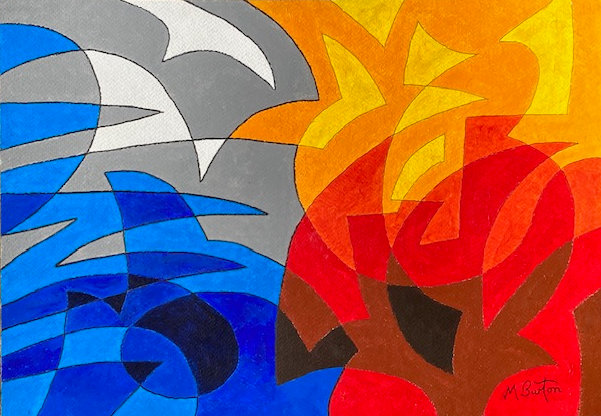
Tsunami Tackles Wildfire. Mick Burton, continuous line artist.

Another new picture is my “Tsunami Tackles Wildfire”.  It combines two Climate Change topics, pitting two extreme situations against each other.        

Spherical Continuous Line Abstract with Colour Sequence.

I started the picture during an Abstract workshop arranged by club Chairman Steve Walmsley.  I told him what the title might be.  I also said that, as President Trump was making all sorts of announcements to change the World, I could call the picture “Trump calls in Tsunami to tackle California Wildfire and if that fails he has Icebergs moored off Greenland he can have towed round.”

Steve Walmsley Surrealist Portrait of Mick Burton, Continuous Line Artist.

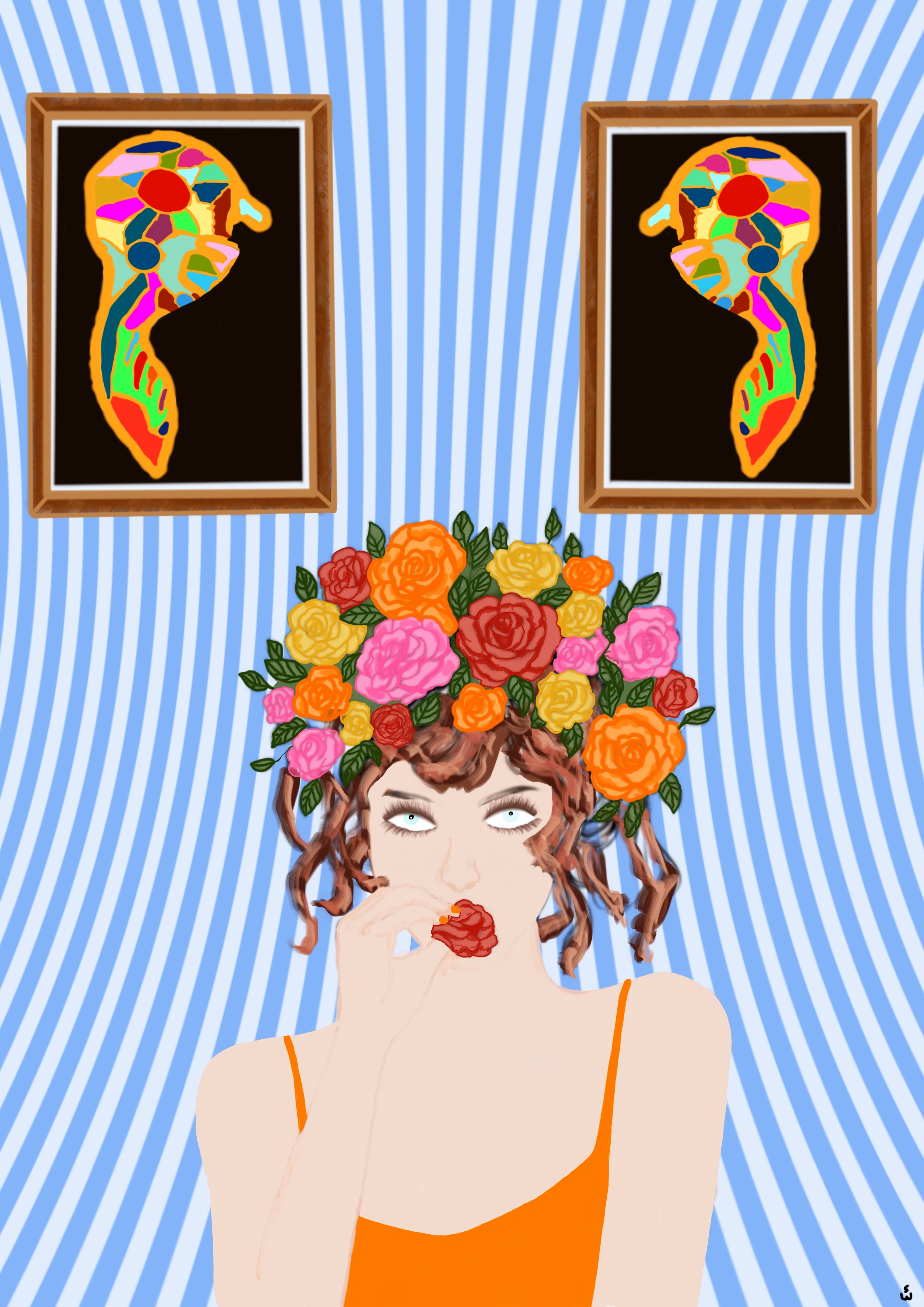
Flower Girl With Her Two Small Portraits Of Renowned Yorkshire Artist Mick Burton. By Steve Walmsley, Surrealist Artist.

Steve Walmsley sent me this image, which he created in response to my continuous line Portrait of him which I featured in my Post of December 2023.

My first reaction was that this Lady appears to be looking forward to devouring two pork chops.  Of course I realised that they were really portraits of me.  I think that it is a terrific composition and am pleased to be involved.

As I said in the previous Post, we sketched each other at Harrogate and Nidderdale Art Club and my sketch led of one of my Continuous Line Drawings of him and then a Colour Sequence version.  These are all shown in my previous post.  At that time, I did not include my photograph of Steve’s sketch portrait of me.

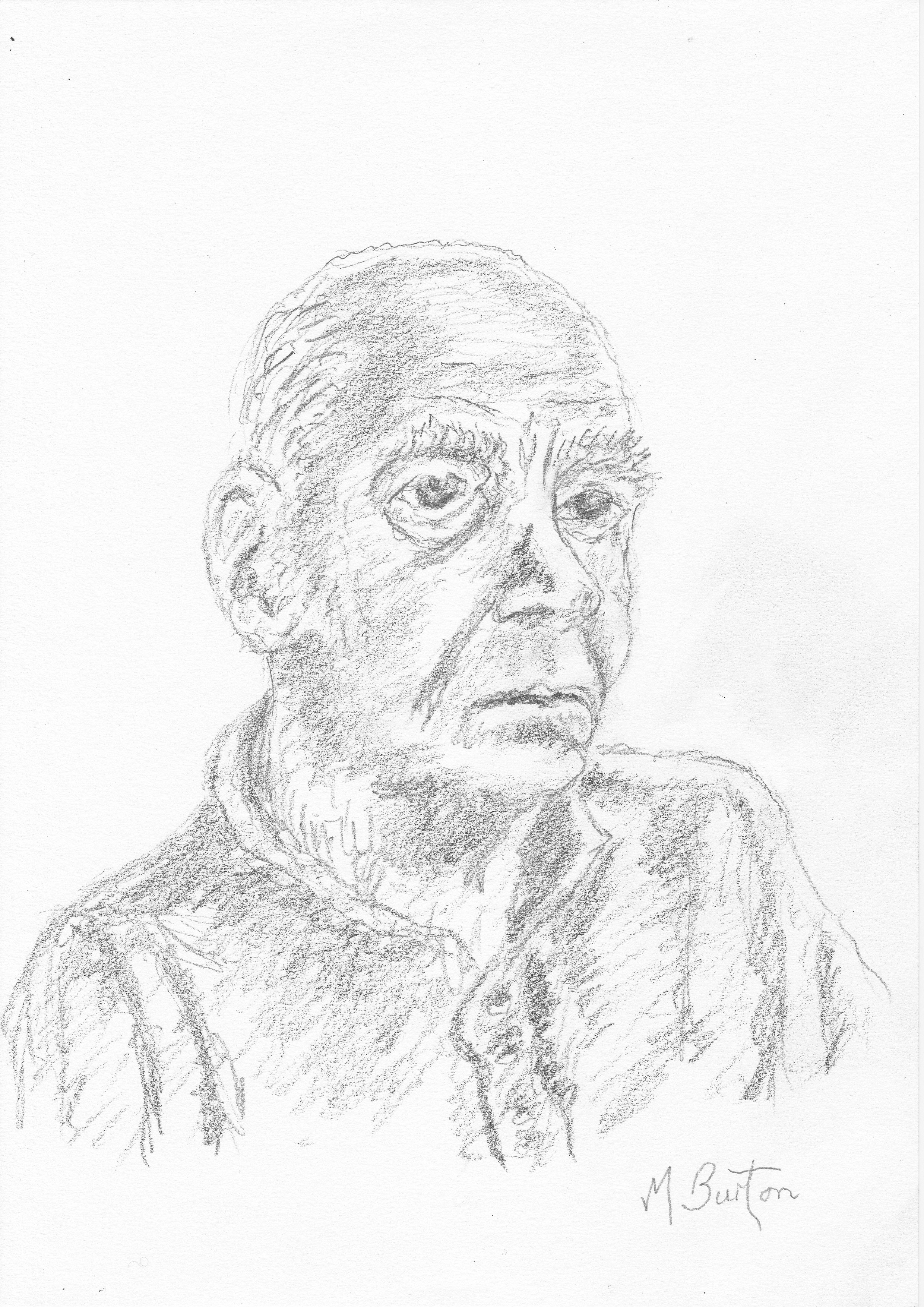
Now that he has responded, it is time to produce his sketch of me as a reference.

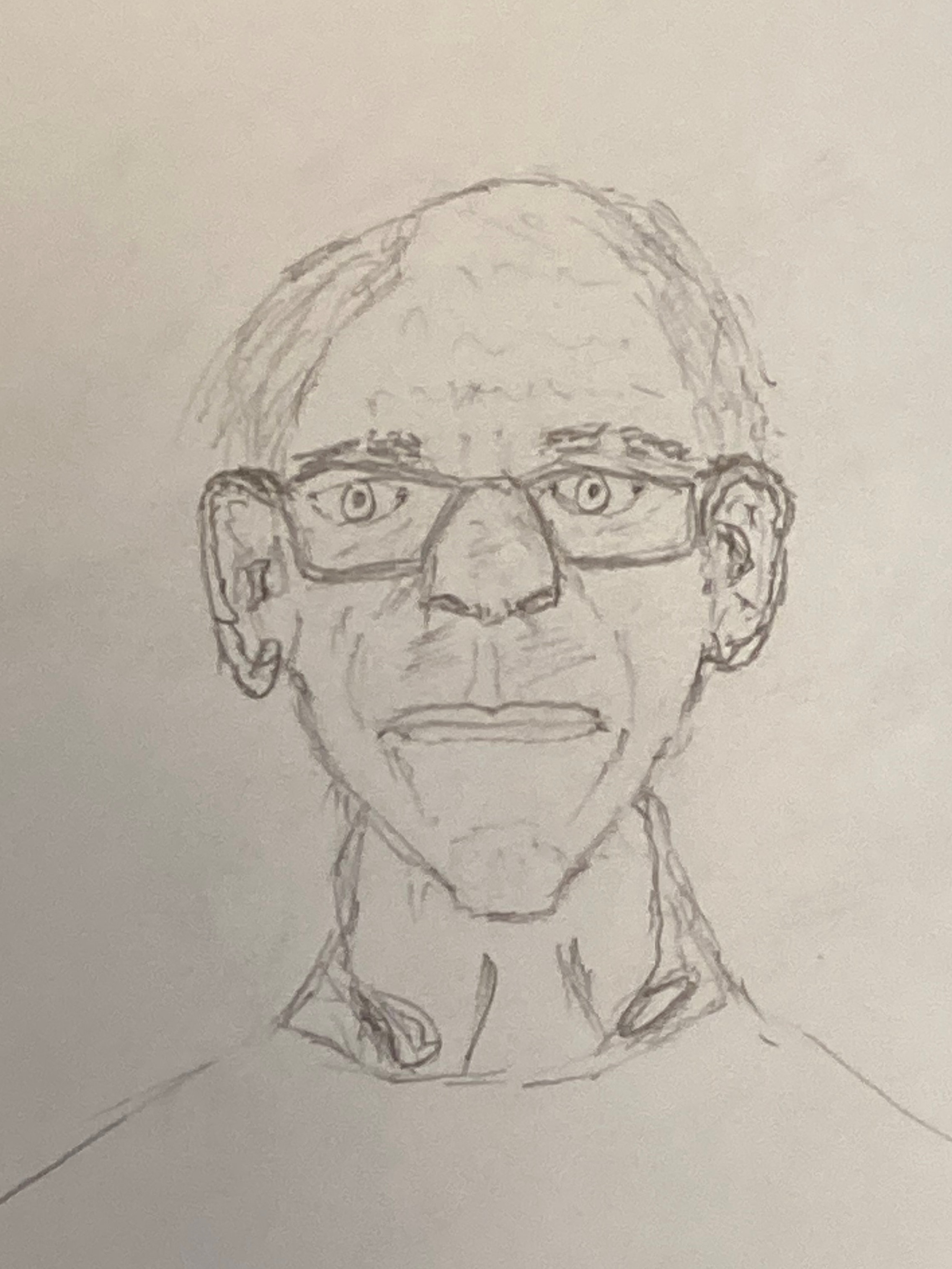
Portrait sketch of Mick Burton by Steve Walmsley, Surrealist Artist, May 2023.

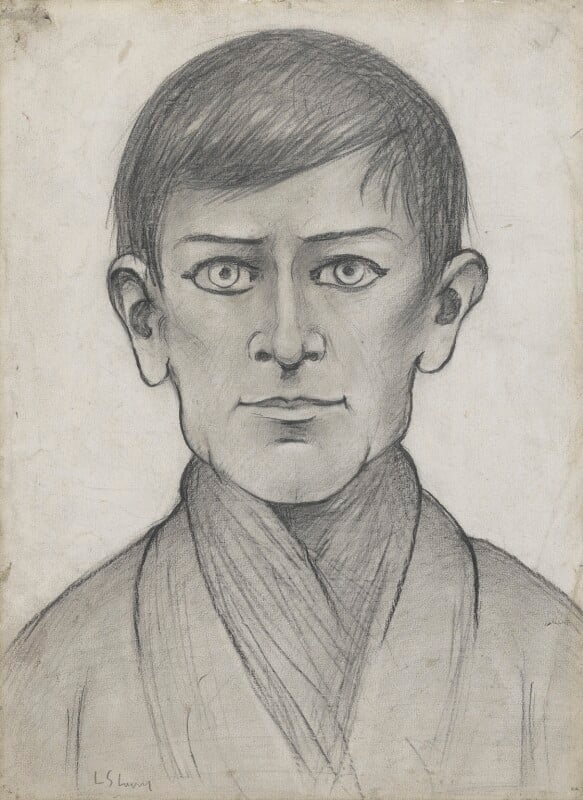
This sketch does not relate too closely to Steve’s creation, but it does remind me of “front on” sketches done by L.S Lowry.  Here is one that is in the National Portrait Gallery.

Portrait by L. S. Lowry. National Portrait Gallery, NPG 5951.

Steve’s latest Surrealist Art can be seen on his website       

https://steven-walmsley.pixels.com/art/surrealism   . 

Phormium New Zealand Flax continuous line drawing.

Phormium, New Zealand Flax. Mick Burton, continuous line artist.

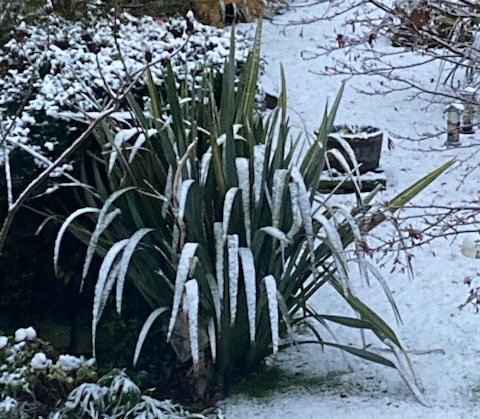
We have just had snow from Storm Burt and it weighed down some of the sword-like leaves of our sturdy Phormium.  Here is the photo below.

Phormium, after snow weighed down the leaves. Photo Mick Burton, continuous line artist..

I considered that the mixture of curved drooping leaves and straight upright leaves would make a good contrasting straight and curved overlapping continuous line. 

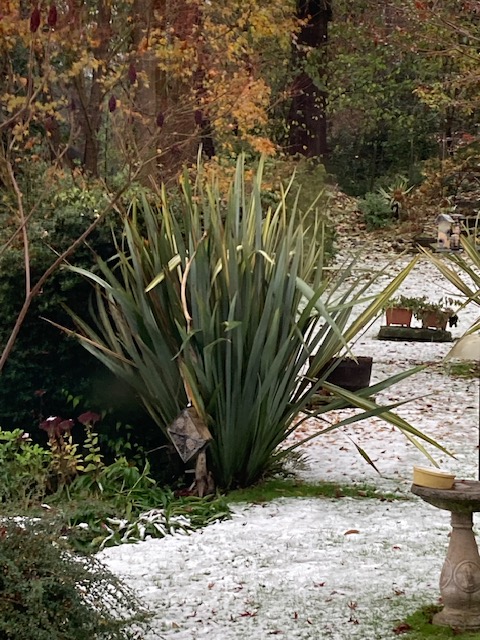
As soon as the snow went, the leaves sprang back upright again.  The leaves are pretty rigid and I prune them with a hack saw.

After the snow melted the sword-like leaves returned to straight up. Photo Mick Burton, continuous line artist.

Captain Cook and Joseph Banks recorded the plant in New Zealand in 1770.  The Museum of New Zealand states that “Russia, the main supplier of sailcloth and rope for the Royal Navy, had restricted sales to England and Cook considered the New Zealand flax as and alternative for making these vital supplies.”

We had good fox tracks in the snow this time.  In one direction it was a single line of spaced prints and in the other it was pairs of prints spaced out.

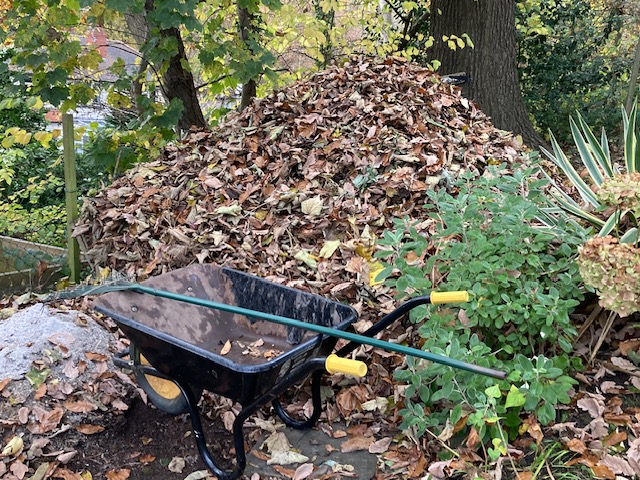
Before the snow came, I had raked up all the leaves and produced our biggest pile yet, for the first stage of producing soil from leaf mould.  It is far bigger than the pen I built for leaves.  Of course, some are blown in from Gledhow Valley Woods.

Largest leaf pile to date. Photo Mick Burton, continuous line artist.

As the leaf pile has spilled across the slab path up the garden I was interested to see what the Fox did when using the path – would it go round?  Nope, it staggered over the right hand side of the pile.

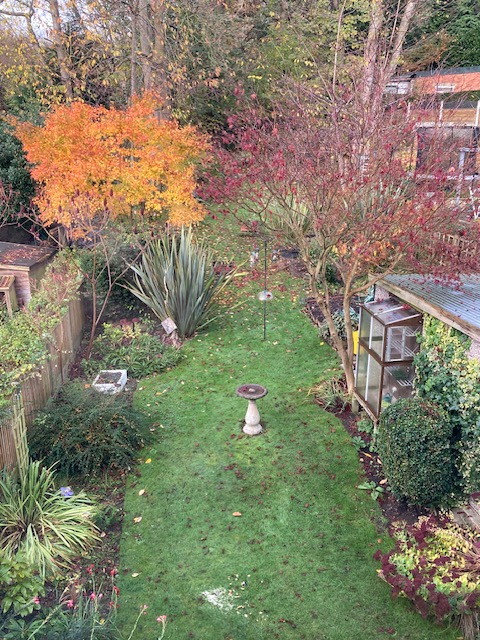
One strange thing every year is the the Red leaved Acer drops its leaves before all the other trees and the Bronze leaved Acer is usually the last.

Red leaved Acer next to the garage drops leaves long before the bronze leaved one on the left. Photo Mick Burton, continuous line artist.

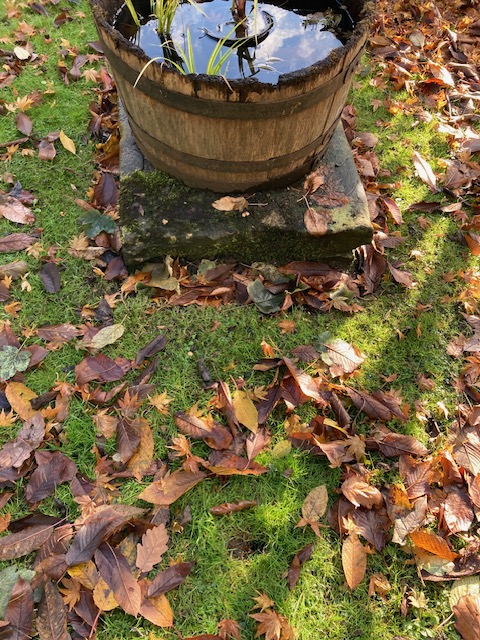
In the lawn, under the leaves I found that the Bumble Bee hole was still there.  The hole is near the bottom of the photo below.  On the internet it says that the holes are in use for a few months and then not used again, as the queen builds a new one next year.

Bumble Bee hole in the lawn. Photo Mick Burton, continuous line artist.

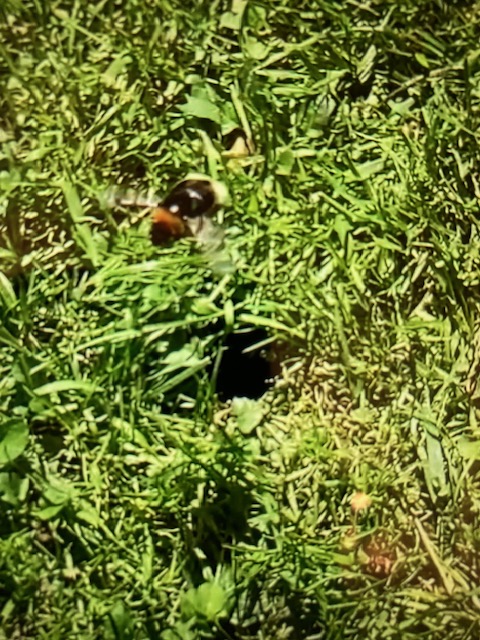
When I first spotted the hole in the lawn in late May there was a Bee just emerging from it.  The black patch at the very bottom of the photo is the shadow of the bee.

Bumble bee leaving the nest hole in the lawn. Photo Mick Burton, continuous line artist.

I first found out about Bees nesting in the ground when I was digging the tiers in the bank at the top of the garden. I became aware that an increasing number of bees were circling around me.  It was just couple of Bumble Bees at first then all sorts of sizes of bees, some appearing to be similar to hive bees, flying around me.  I realised that I must have disturbed their nest and so I stopped the digging for the day.  The next day I came to look and there was a new hole in the bank and bees coming out, so I just abandoned my digging for the summer.


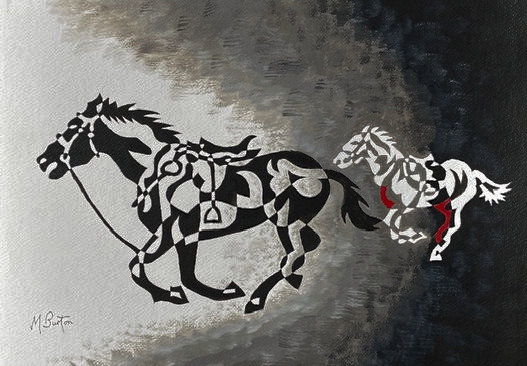
Terrified Army Horses Gallop through London.

Terrified Army Horses. Continuous line with colour. Mick Burton.

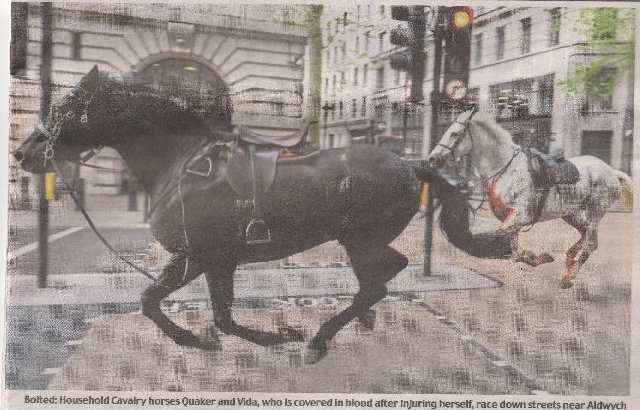
Seven Army horses and six riders were on an exercise in Kensington in April 2024, to help them get used to traffic and other noises in the City.  Near Hyde Park Corner at 8.30am the horses were frightened by a slab of concrete being dropped by Builders.  Four Army personnel were thrown from their horses and five horses dashed off into rush hour traffic.  Three soldiers had non-life threatening injuries.

There were collisions with vehicles which caused injuries to some of the horses and one horse hit a cyclist who was injured and taken to hospital.  Two horses were eventually apprehended almost six miles away at Limehouse by Police officers.  That evening, all horses were being cared for by vets.

I later read that it was two or three months before the horses were considered fully fit to patrol again.

The Daily Mail article included the following photograph, which I used as the basis for my continuous line drawing of two of the horses.

Daily Mail photograph 25.4.24. “Two panic-stricken horses, one of them bloodied, gallop across Central London.”  Photograph, Jordan Pettitt / PA Wire.

Whenever I have drawn horses before, I have used the general shape and structure of the animal to provide the design and I have never included a rider.  

Harrogate and Nidderdale Art Club – Autumn Exhibition 2023

Colour Sequence on Continuous Line Drawing

Of course there are no riders this time because they had been thrown off, but I decided that it was important to include the saddle, harnesses etc.

Regarding adding colour to the drawing, in the painting at the top of the post, I decided to use the fact the one horse was black and the other white.  Having a dark background to the right highlights the white horse.  The blood on the white horse produced the Black, White and Red combination I have used several times before. 

It occurred to me that the impression was like portraying “A bat out of Hell”, which could reflect how these poor horses felt.

Continuous line drawing of Terrified Horses in London. Mick Burton.

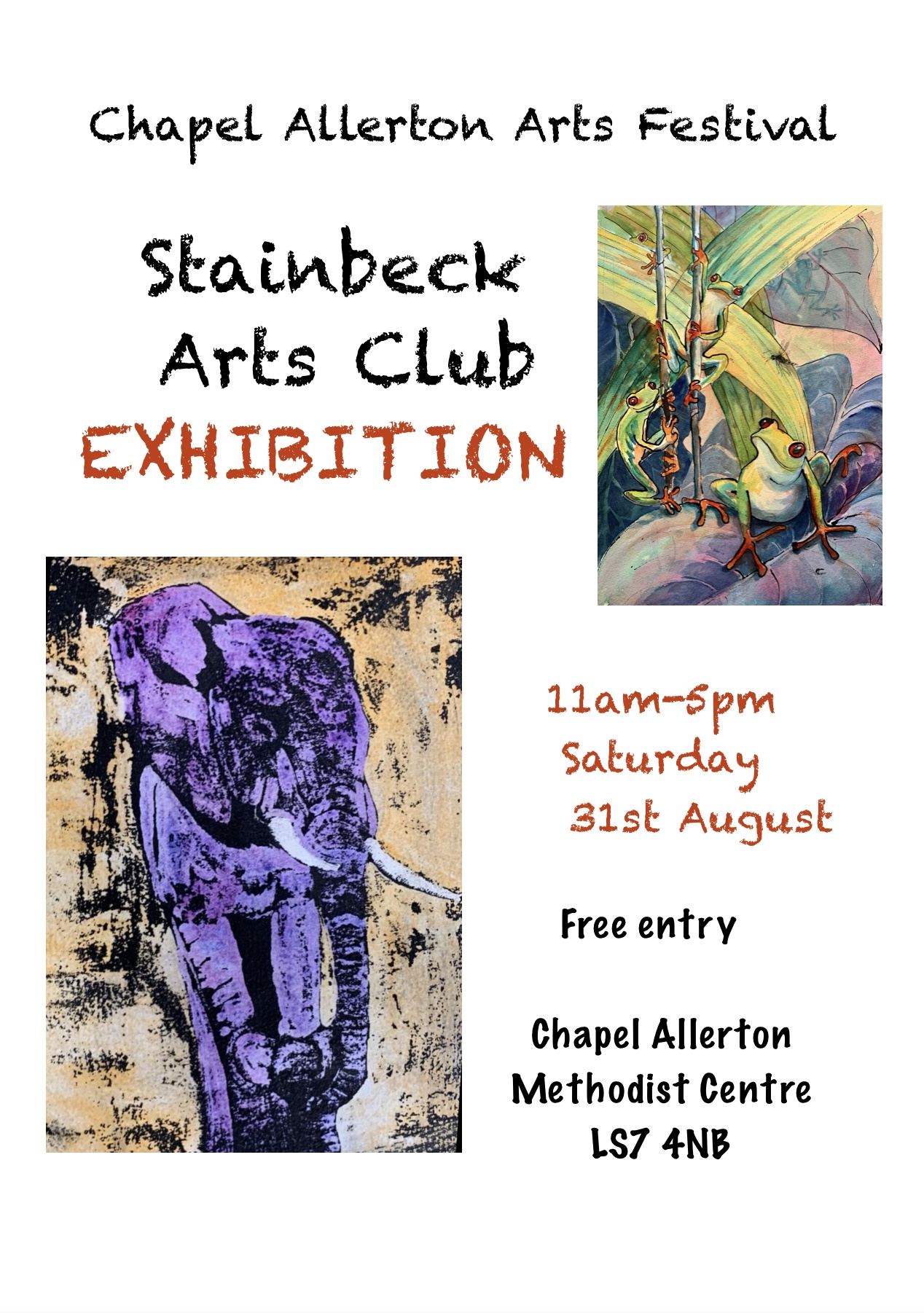
These two pictures are to be exhibited at the  Stainbeck Arts Club Annual Exhibition on Saturday 31 August 2024 at Chapel Allerton Methodist Centre, Leeds, LS7 4NB.  This is part of the Chapel Allerton Arts Festival.

Stainbeck Arts Club Exhibition, 31 August 2024, Chapel Allerton Arts Festival, Leeds.


Continuous Line Portrait with Colour Sequence.

Continuous Line Portrait “Colourful Musician” by Mick Burton.

This is the second Colour Sequence portrait that I have completed, the first being of “Barry” 10 years ago which had a shorter range of colours.

As usual, I have worked out the natural range of levels running through the drawing and I can choose which end of the range to allocate Red and then Blue at the other end of this 6 colour sequence.  You may ask why the end of the sequence is in an eye coloured Red in some of my pictures of Animals (eg. Hen and Iguana).  The answer is that when I draw continuous line eyes there is a final loop (or even a loop within a loop), which can extend the range of colours if it is already at the end of the existing range (orange in this case).

Normally, only one eye is visible from a side-on view of most of my animals.  I do not then have the situation where the other eye can be at the other end of the colour range.  In the “Colourful Musician” I have ended up with totally different coloured eyes.  Fortunately, the portrait is of a Surrealist painter who is happy with this outcome.

I do not mind either, because continuous line drawing produces its own three dimensional appearance naturally.  Conventional Artists may regard my drawings as very technical, but I can argue that they use perspective and shadows in their art, which I regard as technical, and I get by without using either.  The head in this painting has a natural rounded appearance and the “Blue” eye side implies shadow.

Sometimes I have had to alter the lines to ensure that both eyes are the same colour, which I did with Nessie the cockapoo painting.

The “Colourful Musician” painting only came about after we had one of those sketch a fellow member sessions at Harrogate and Nidderdale Art Club, this one being run by Chairman Steve Walmsley who also announced that I would sketch him.

Sketch of Steve at Harrogate and Nidderdale Art Club. Mick Burton, continuous line artist.

Someone asked if I would do more work on my sketch and I said that it may turn into a Continuous Line Drawing.  Steve said “If you do, then I want all your colours”.  So I took a photo of him for added reference.

Steve Walmsley, Chairman of Harrogate and Nidderdale Art Club. Mick Burton, continuous line artist.

I produced a Single Continuous Line portrait using Over and Under lines before I went onto the colour version above.

“Surrealist Artist” Continuous Line Drawing by Mick
Burton.

Steve has his own unique approach to colour in his pictures, which are increasingly Digital Art.  You can view his full range of Surrealism, Abstractions, Landscapes, Portraits and Digital Art on his website www.steven-walmsley.pixels.com.

I particularly like the following pictures he has created.  The first one is acrylic and the rest are all digital art.

“Self Portrait with Sax” by Steve Walmsley, Surrealist Artist.


“Desert” by Steve Walmsley, Surrealist Artist.


“Neanderthal” by Steve Walmsley, Surrealist Artist.


“The Cruel Sea” by Steve Walmsley, Surrealist Artist.


“Reflections” by Steve Walmsley, Surrealist Artist.


“The Waterwheel” by Steve Walmsley, Surrealist Artist.

Harrogate and Nidderdale Art Club – Autumn Exhibition 2023

Harrogate and Nidderdale Art Club – Autumn Exhibition 2023. Ripley Town Hall, 25-26 November 2023.

Harrogate and Nidderdale Art Club hold two exhibitions a year, Spring and Autumn.  The club has over 60 members and meets on Thursday evenings at Harrogate Grammar School during terms.  There are visiting demonstrators or talks at about half of meetings.

I will be exhibiting 7 pictures at the Autumn Exhibition, including two continuous line drawings of animals based upon photographs.

Daniel, Queen Elizabeth’s favourite Windsor Grey carriage horse, in 2017 when he retired to the Horse Trust.  Mick Burton, continuous line artist.

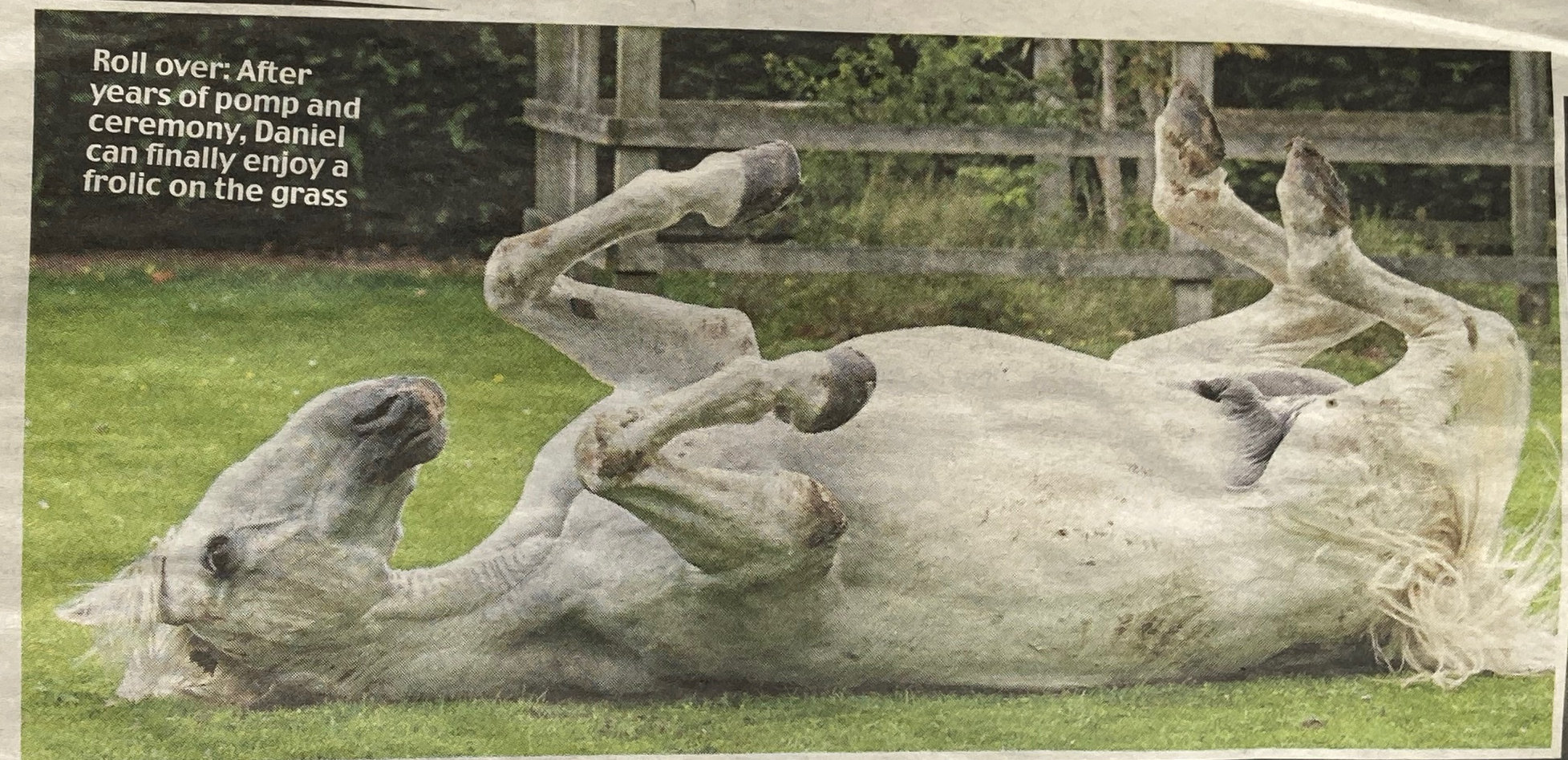
I have always liked shire horses and I based this continuous line drawing on a photograph in the Daily Mail article by Lucy Holden on 3 August 2017.  Danial, retired Royal carriage horse, is romping around in the paddock at Horse Trust.  I have added “fluffy feet”.

My main reason for producing this drawing is the memory of taking my kids to Bradford Industrial Museum and seeing the shire horses arrive back from a procession in full regalia around Bradford.  The staff suggested that we watch the horses when they were released into the paddock after a hard days work.  The horses immediately started dashing around, prancing and rolling on the ground and leaping up again.  We were shocked, surely these heavy animals would break something!

Here is a photograph of Daniel having a roll at the Horse Trust.

Daniel the Royal carriage horse having a roll in the Horse Trust paddock. Daily Mail, Lucy Holden article, 3 August 2017.

Daniel was Queen Elizabeth’s favourite carriage horse for 15 years up to his retirement in 2017 at the age of 22.  His face appeared on a Royal Mail stamp in 2014 and a life size bronze sculpture of him, and another of colleague Storm, appear to trot across the grass on the roundabout near the Long Walk in Windsor. Sculptor Robert Rattray, who was commissioned by residents to celebrate the Diamond Jubilee in 2012, said “Daniel is an old stalwart and rather cantankerous”.

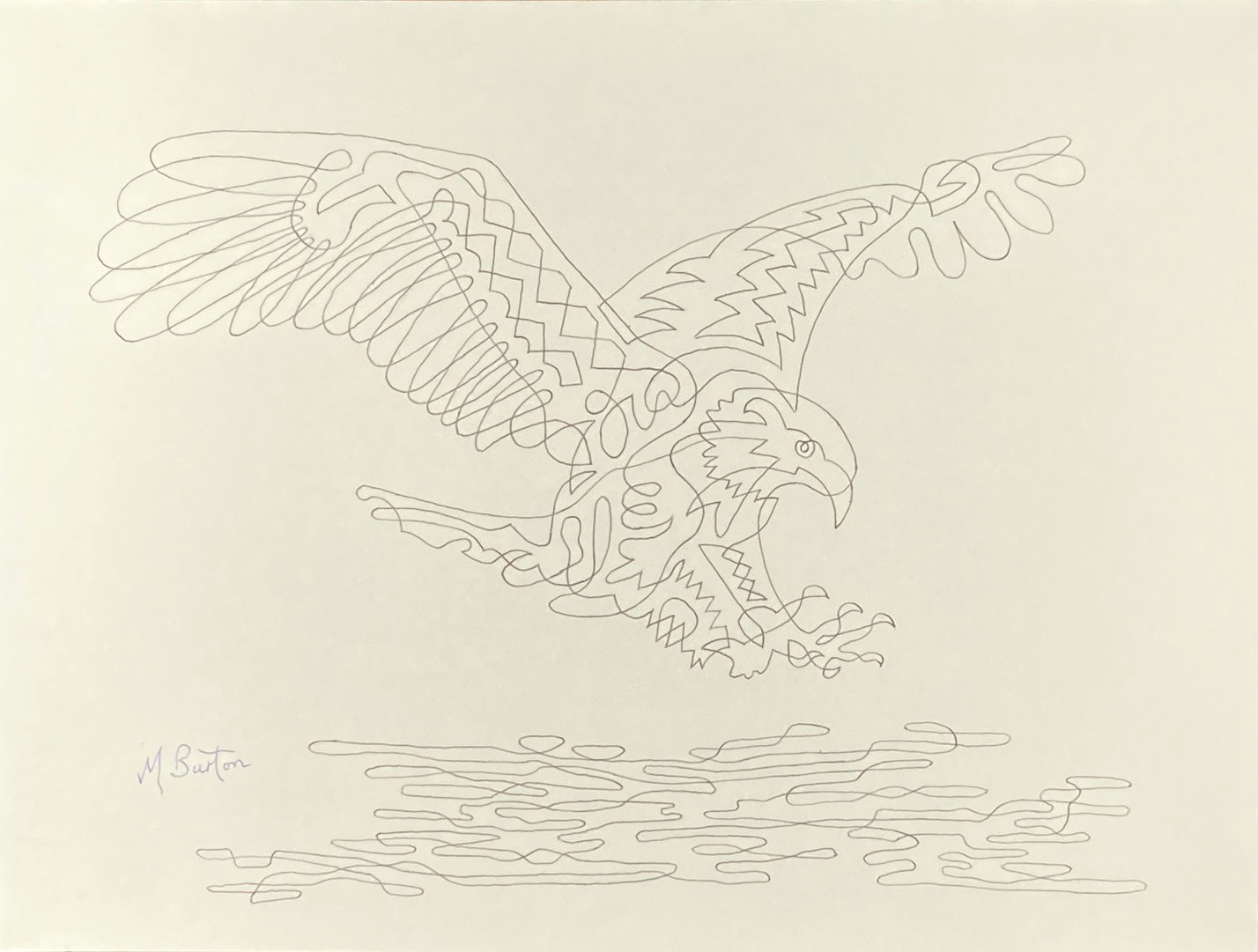
Bald Eagle, swooping down for a fish. Mick Burton, continuous line Artist.

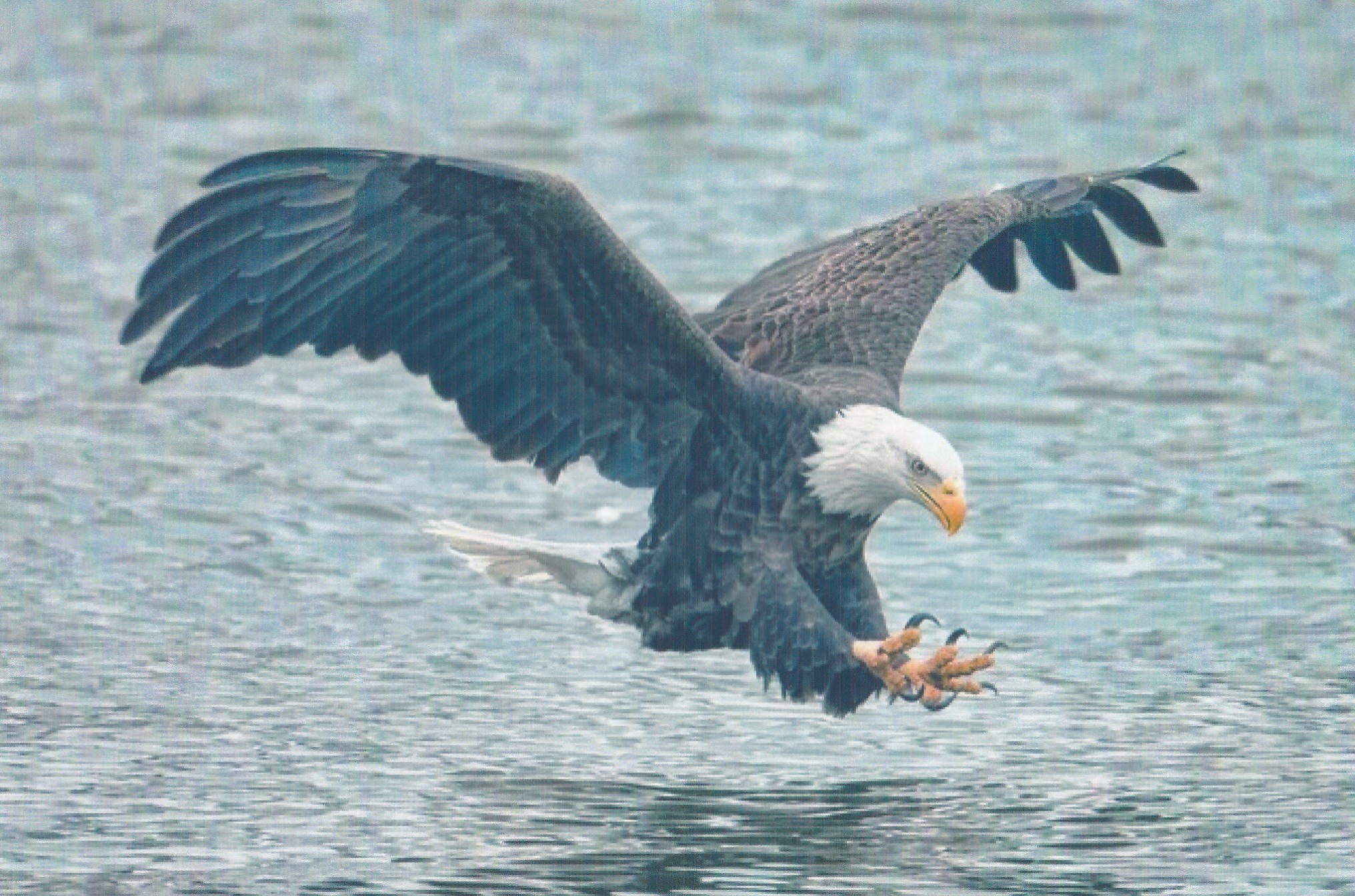
I based this continuous line drawing of a Bald Eagle on a Getty Image shown below.  I found that progressing overlapping loops worked well with the feathers.

Bald Eagle, Getty Image.

I also did a preliminary drawing in pen and colour pencil.

Bald Eagle in pen and coloured pencil. Mick Burton, continuous line artist.


Fluorescephant continuous line to Irrelephant Elephant in 50 years

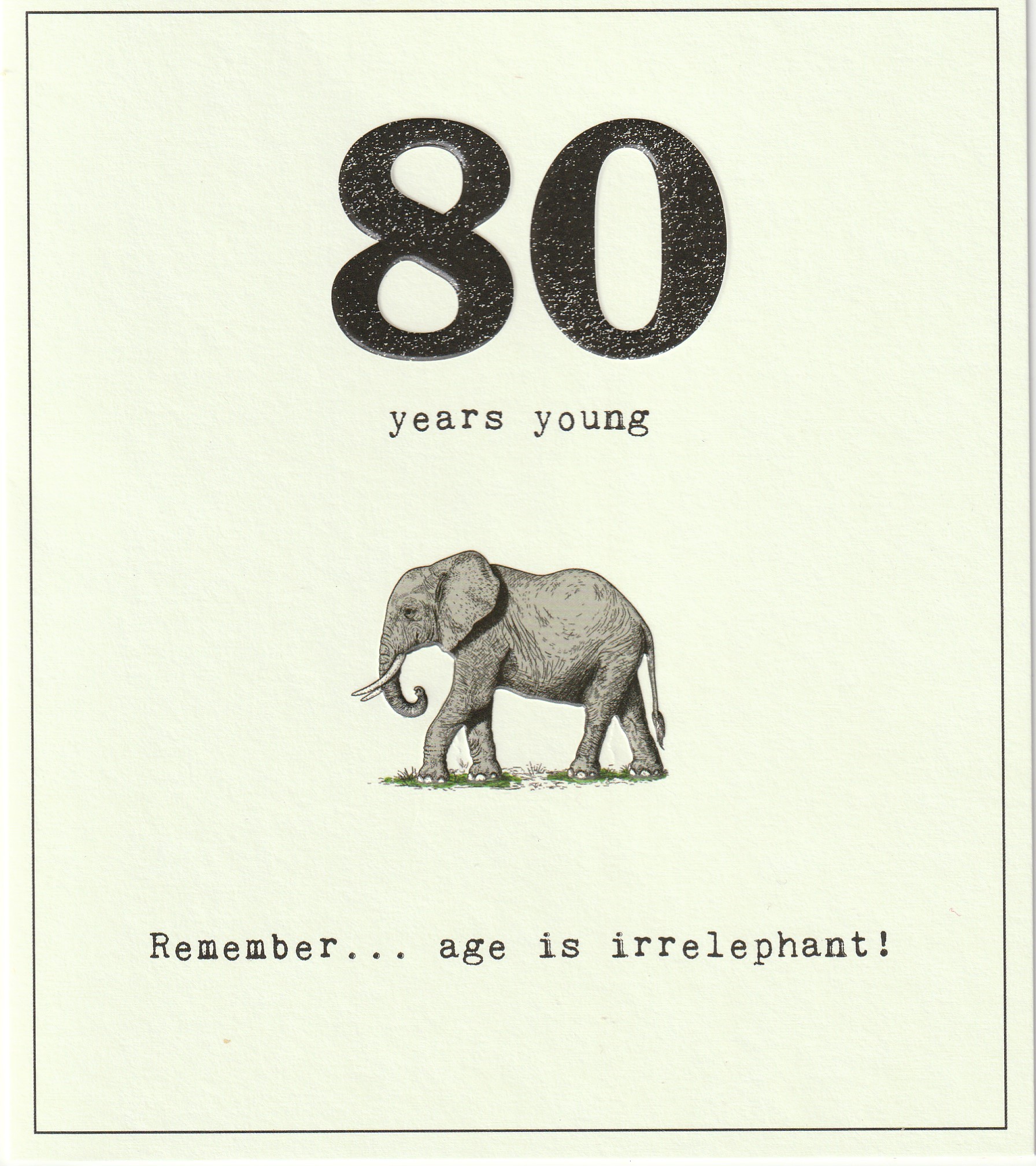
I have just had my 80th Birthday and received two cards which both stated “Remember… age is irrelephant!” along with a picture of an Elephant.  Here is one of them below.

Birthday card “80 years young” and “age is irrelephant!” by Pigment Productions Ltd.

This reminded me of my continuous line elephant with colour sequence which was exhibited at the International Amateur Art Exhibition, at Warwick Square Gallery, London, in February 1973 and at the National Society Open Exhibition at the Mall Galleries, London, in March 1973.  It is the forerunner of “Elephant Grass” at the top of these posts.  I call it “Fluorescephant”.

“Fluorescephant” continuous line exhibited at the International Amateur Open Exhibition and at the National Society Open Exhibition in 1973.

My flatmate Phil suggested that I call it “Fluorescephant”, which I thought was an excellent suggestion.  This word is still uniquely referenced to me on Google.  When I googled “irrelephant” some dictionaries say that it means “Not related to elephants: irrelevant to the discussion of elephants”.

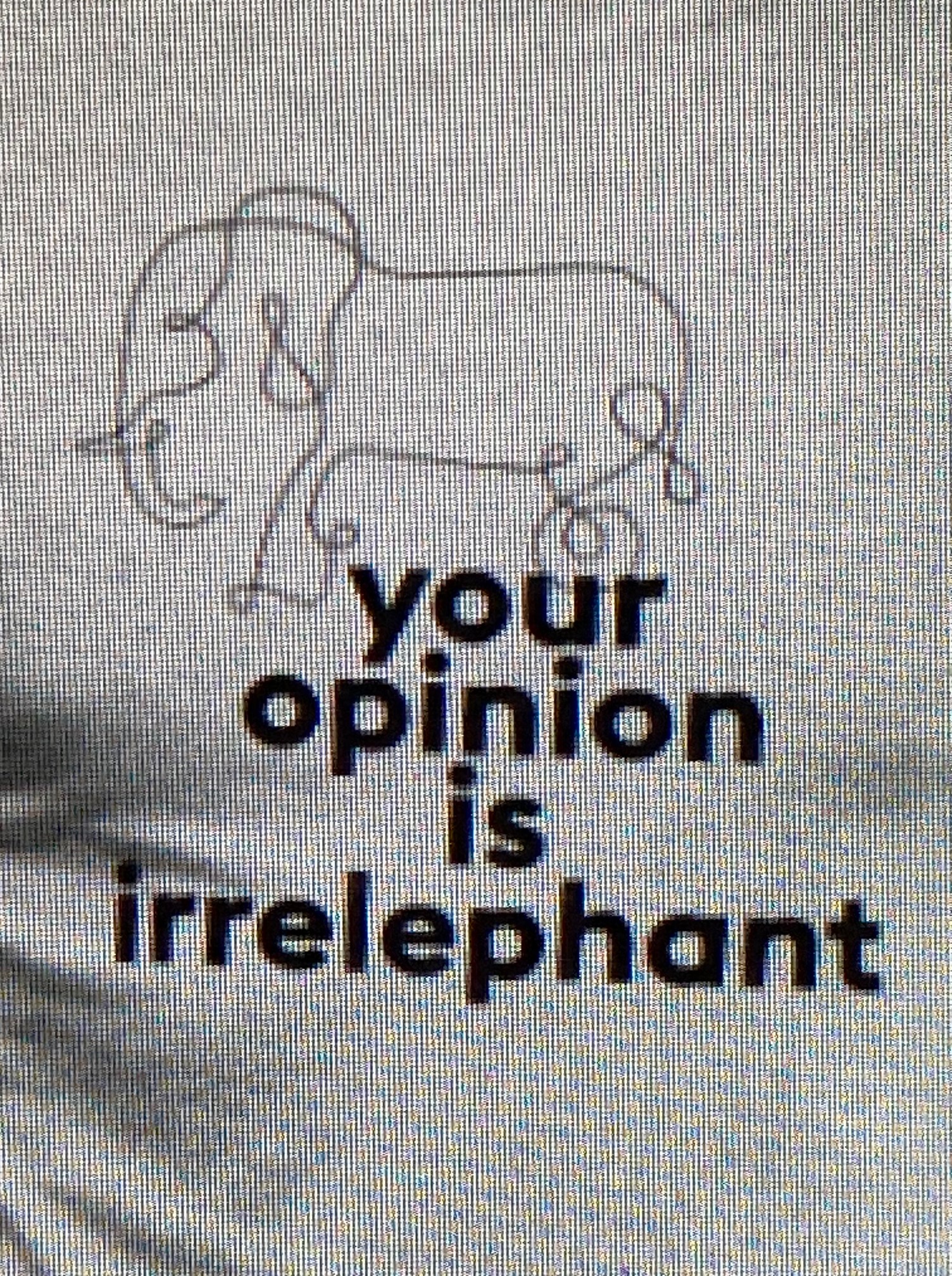
One image that popped up was actually a single continuous line elephant which appears on a shirt produced by “Spreadshirt”.  I am impressed, even though they say that my opinion is irrelephant.

Single continuous line Elephant “Your opinion is irrelephant” on shirt produced by “Spreadshirt”.

This play on words is a bit like “Answersmash”, a game played on the TV game show “House of Games” presented by Richard Osman.

Being 80 triggers all sorts of daft thoughts.  I have told people that I was wondering about Best Before dates on things.  I have decided to adopt one for myself.  About 10 years ago, at a table tennis venue where the home team had a box of wrapped biscuits for visitors, we joked that most of them were past their “Best before dates”.  But I found one that was fine and it’s date was 29.04.3013.  That will do for me!

Cadbury Flake wrapper Best Before Date of 29.04.3013. Mick Burton, continuous line artist.


“That’s our Water on the Gold Coast”.

“That’s our Water on the Goldcoast”. Reaction by Terry when shown “Climate Change Down Under”, a continuous line drawing by Mick Burton.

Our friends Cathy and Terry, who live in Queensland, Australia, were over here recently.  I showed them a photo of my painting “Climate Change Down Under” which I featured in a recent post         Climate Change Hits Australia, continuous line drawing.

I show it again below.  Terry immediately said “That’s our Water!”.

Climate Change hits Australia. Continuous line drawing. Mick Burton.

When I painted it I simply wanted to include a shape depicting Water in blue, in contrast to the Fire in red and the Sunshine in yellow on the land behind.  We knew that Cathy and Terry lived on the Gold Coast and overlooked some moorings, but I did not realise that their waterways were so similar to my painting.
Here is a broader view of their wonderful part of the Gold Coast, which is near Brisbane in Queensland.  Their “water” is at the bottom of the map.

Runaway Bay, on the Gold Coast, showing Cathy and Terry’s “water” at the bottom. Mick Burton, continuous line artist.

When Joan and I visited Cathy and Terry in May 2013, they lived inland as I mentioned in the post of October 2022.  Cathy dropped us off in the Gold Coast for the day and here are a few photos.

Gold Coast, Queensland. May 2013. Mick Burton, continuous line artist.

Pelicans near the beach, Gold Coast, Queensland. May 2013. Mick Burton, continuous line artist.

Sunset on the Gold Coast, Queensland. May 2013 at about 4.30pm. Mick Burton, continuous line artist.