Tag Archives: Mick Burton

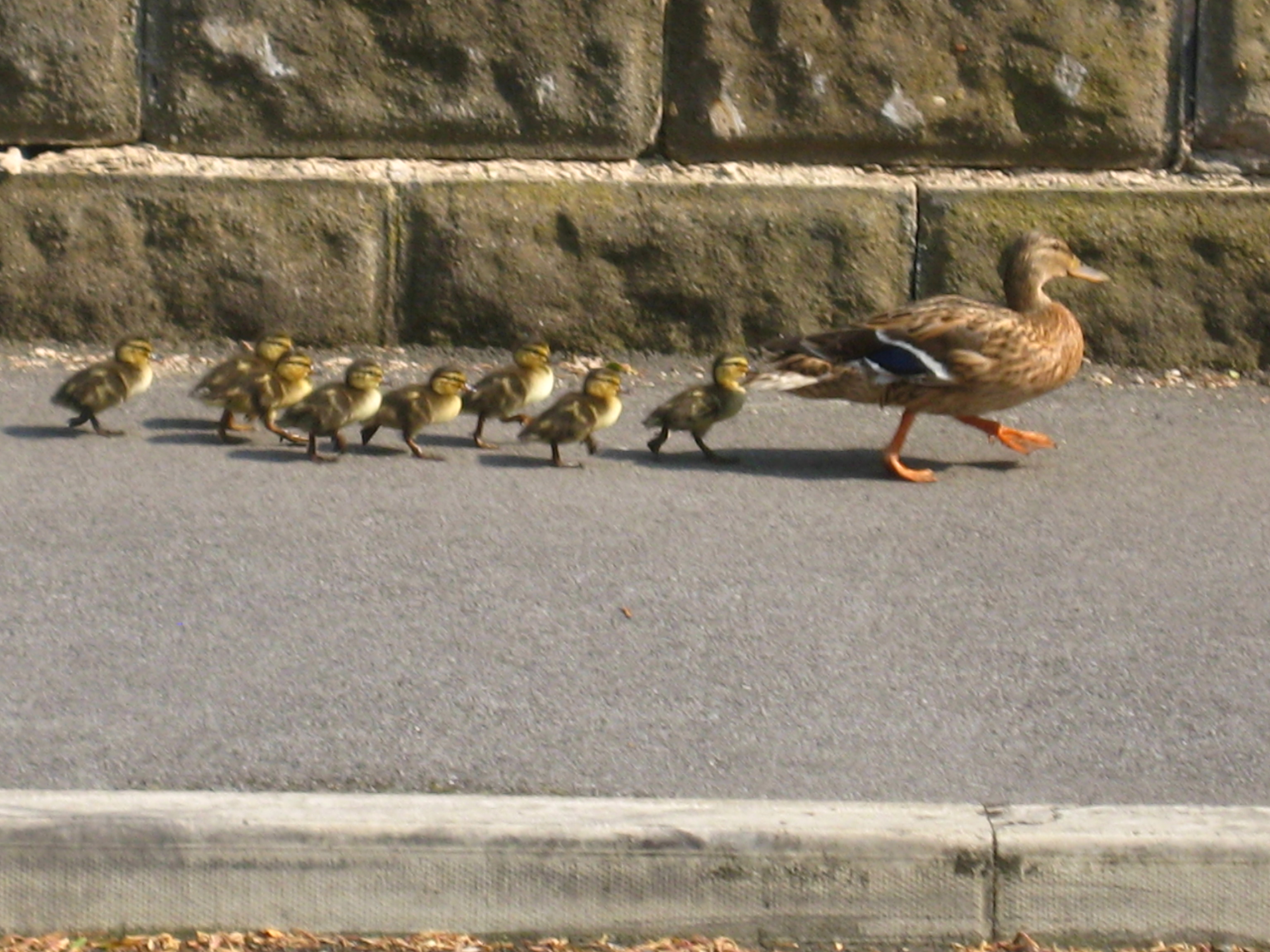
Mallard steams by towing eight ducklings in a continuous line.

Mallard steams by towing eight ducklings in a continuous line. Photo Mick Burton, 7.8.2016, Well House Drive, Gledhow Valley, Leeds.

Mallard steams by towing eight ducklings in a continuous line. Photo Mick Burton, 7.5.2016, Well House Drive, Gledhow Valley, Leeds.

After a couple of hours digging rocks and roots in the back garden, I emptied the roots into the brown bin and glanced towards the road at the front. There was a gap between the car and the gate post and I glimpsed a line of ducklings going by on the other side of the road.  What were the chances of that happening?
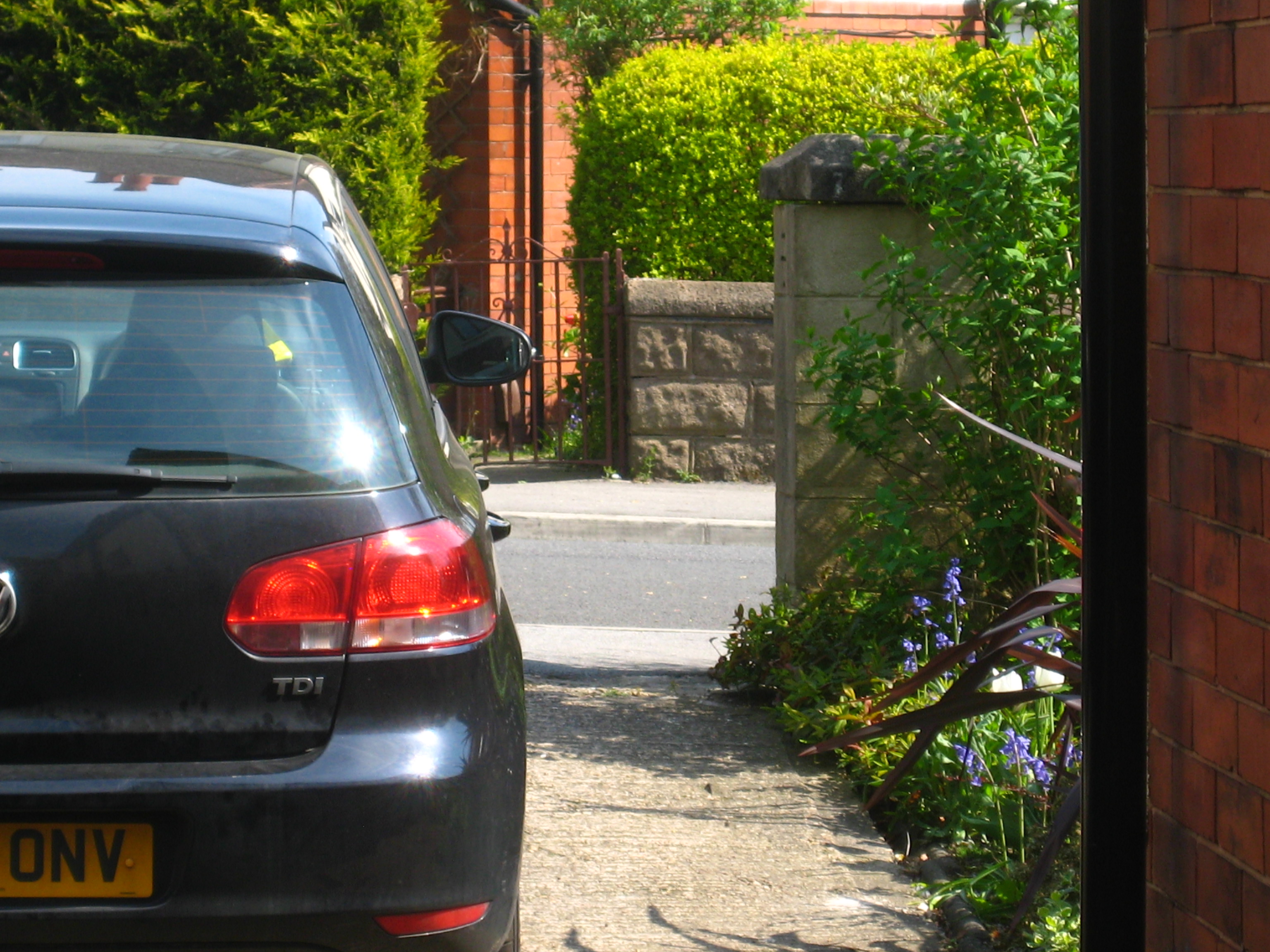
View across the road where a line of ducklings went by. Photo Mick Burton, continuous line artist,7.5.16.

View across the road where a line of ducklings went by. Photo Mick Burton, continuous line artist,7.5.16.

I rushed inside the house for my camera and ran to catch up with the female Mallard mother marching down the road with her brood in tow.  There were some kids in gardens not yet aware and cars going up and down the road.  I took the photo which appears at the top of this post.

But what was this Mallard mother doing coming down our road with her ducklings, when I knew of no streams or ponds in the streets higher up?

Anyway, I knew where she was likely to be going.  If she turned right at the bottom of the road she was on Gledhow Valley Road and the houses along there all had the Gledhow Beck flowing through their gardens.  She started to move out towards the curb to assess when to cross the road.

Mallard mum starting to move out towards the curb. Photo Mick Burton, continuous line artist.

Mallard mum starting to move out towards the curb. Photo Mick Burton, continuous line artist.

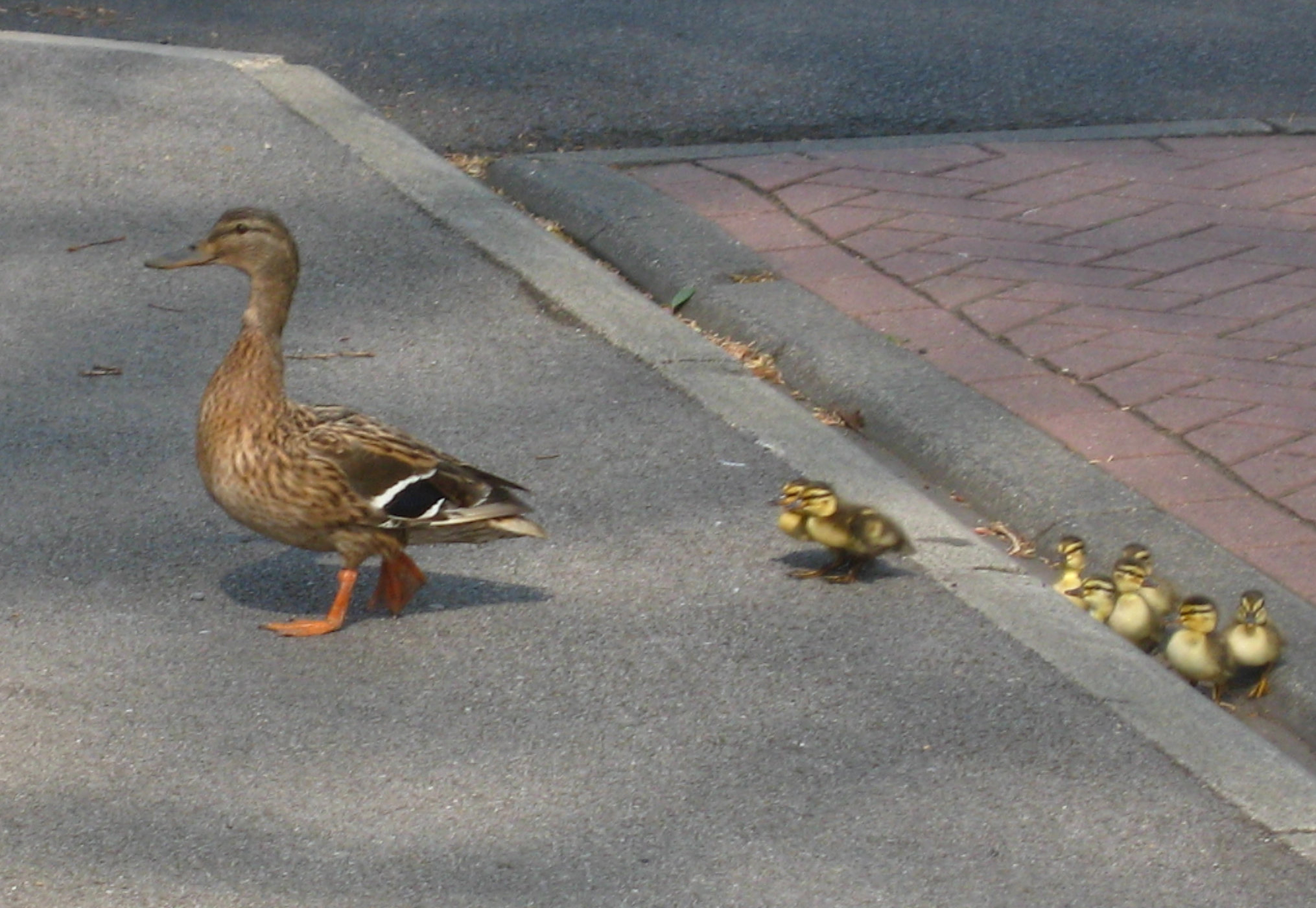
I took another closer view of the bird as she headed along parallel to the curb.  There is an eighth duckling just out of shot at the back.
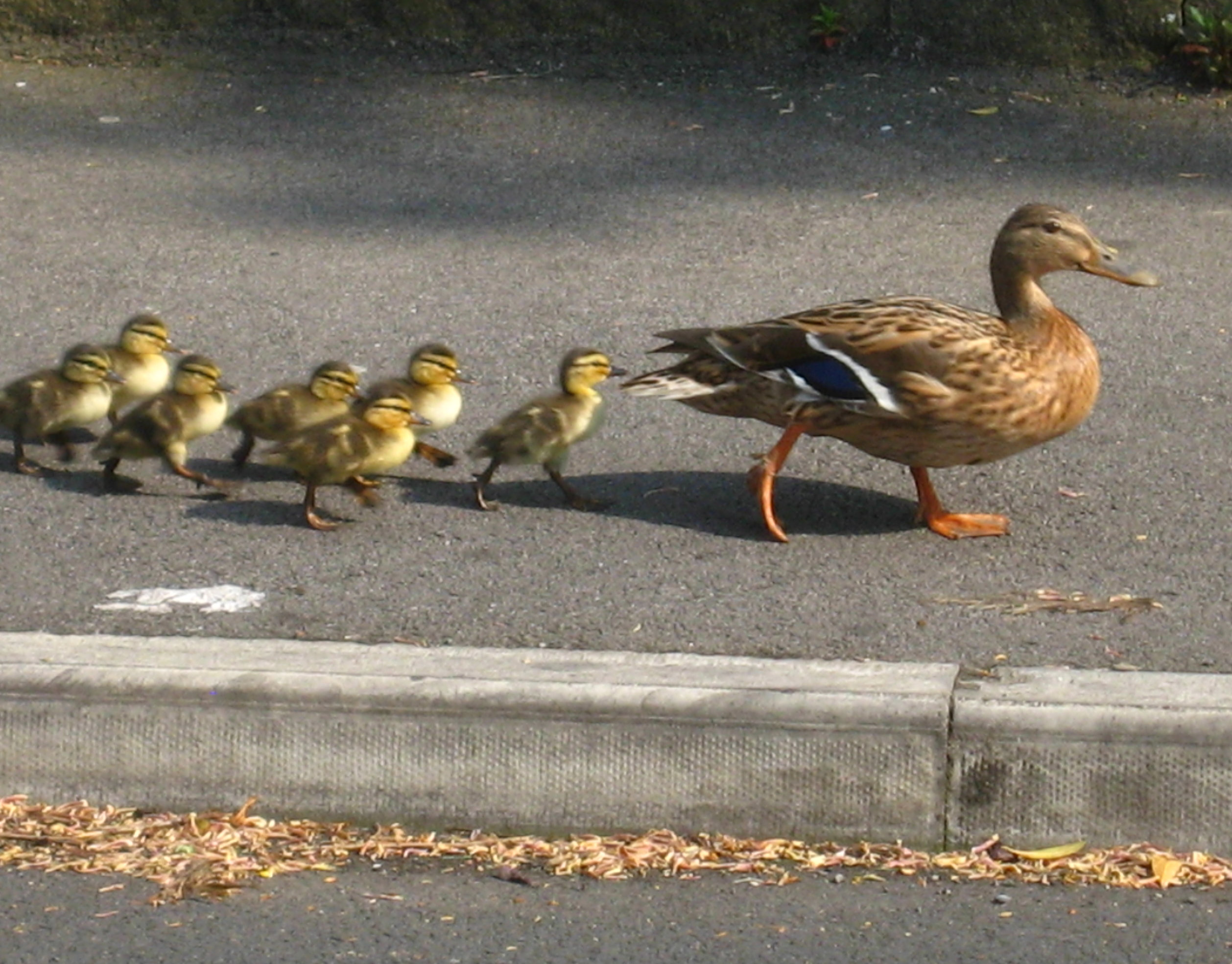
Closer view of female Mallard with seven ducklings in the picture. Photo Mick Burton, continuous line artist, 7.5.16, Gledhow Valley.

Closer view of female Mallard with seven ducklings in the picture. Photo Mick Burton, continuous line artist, 7.5.16, Gledhow Valley.

Looking at these photos reminds me of my  train spotting days as a youth when I saw the  A4 pacific steam engine “Mallard” at speed pulling many carriages.  No wonder they decided to name the fastest ever steam locomotive after such a sleek bird.  Here is a photo I took of the “Mallard” steam engine at the National Railway Museum in York three years ago, along with my son Matthew.
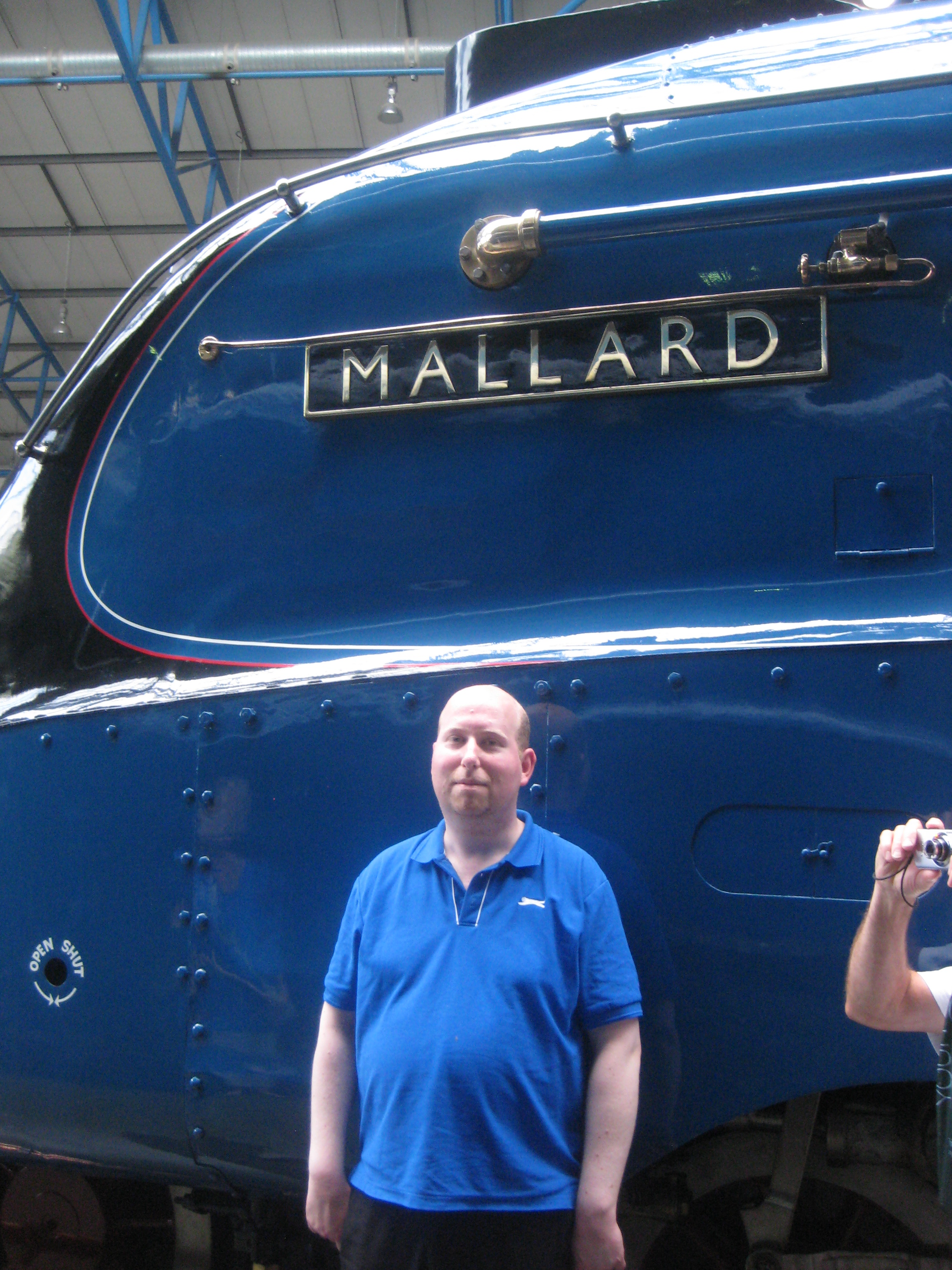
Mallard, the fastest ever steam engine, at York National Railway Museum along with my son Matthew. Photo Mick Burton, continuous line artist.

Mallard, the fastest ever steam engine, at York National Railway Museum along with Matthew Burton.  Photo Mick Burton, continuous line artist.

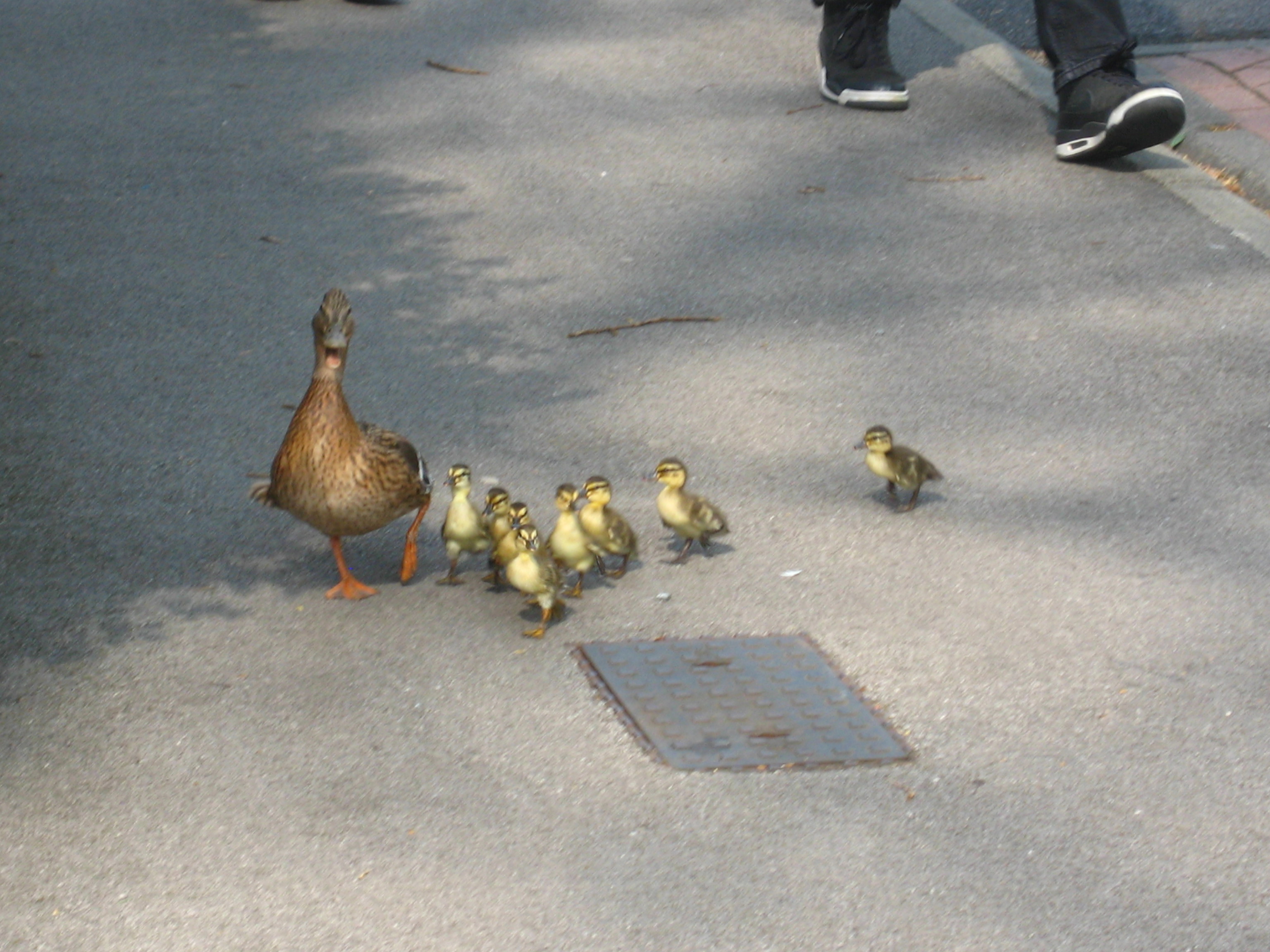
Now back to the ducks and the dangerous task of crossing the road.  The road seemed clear so Mum decided to cross.  A car was signalling to turn left into our road and I flagged it down just as it was turning, which gave me little time to get a photo of the ducks in the middle of the road.  The result was a bit shaky.
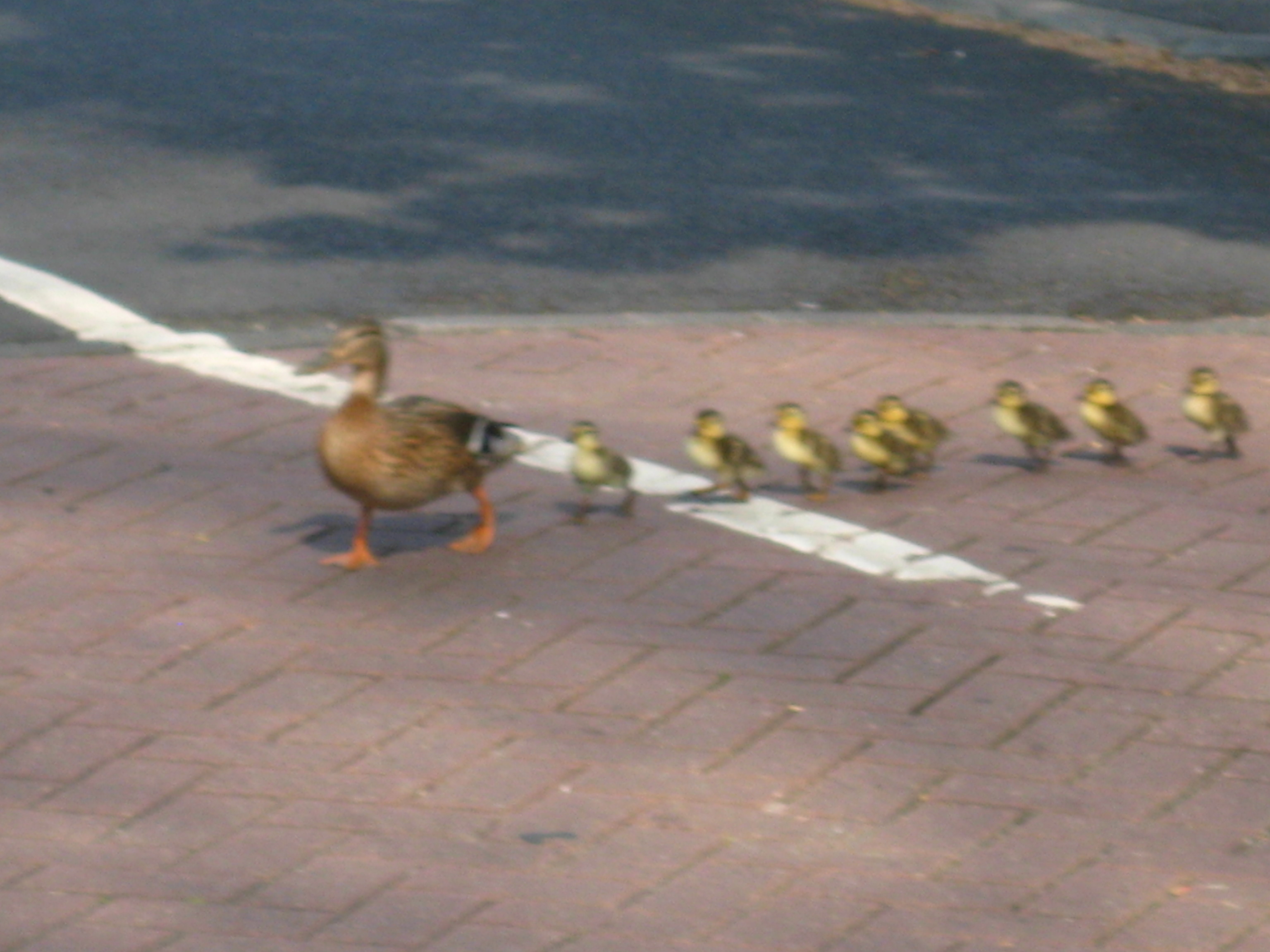
Mallard Mum and eight ducklings crossing the road in front of a waiting car in Gledhow Valley. Photo Mick Burton, continuous line artist.

Mallard Mum and eight ducklings crossing the road in front of a waiting car in Gledhow Valley. Photo Mick Burton, continuous line artist.

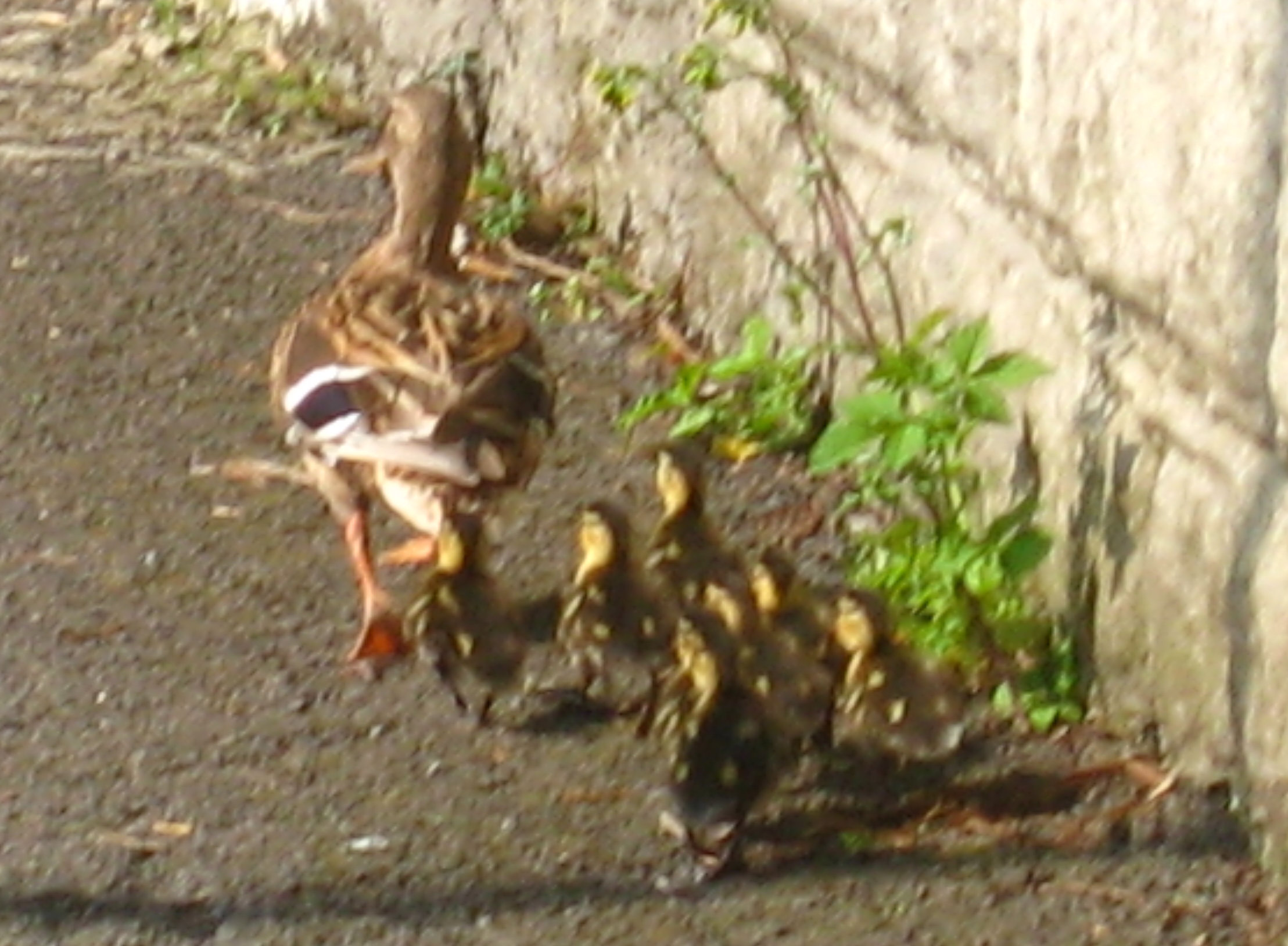
When you are a very small duckling it’s not easy to mount a pavement you can’t really see over, and there’s not much sympathy from Mum.
Ducklings struggle to mount a pavement higher than they are. Photo Mick Burton, continuous line artist.

Ducklings struggle to mount a pavement higher than they are. Photo Mick Burton, continuous line artist.

Pause to regroup and a crowd of kids is starting to gather.
Ducklings regroup on the pavement after mounting to kerb. Photo Mick Burton, continuous line artist.

Ducklings regroup on the pavement after mounting to kerb. Photo Mick Burton, continuous line artist.

The worst is over and the female Mallard turns right into Gledhow Valley Road.

Mallard and ducklings turn right into Gledhow Valley. Photo Mick Burton, continuous line artist.

Mallard and ducklings turn right into Gledhow Valley. Photo Mick Burton, continuous line artist.

The Mallard Mum and her train of ducklings can speed up as they enter the home straight.  I am sure now that they will turn right into a drive soon.
The train of Mallard ducklings speed up as they enter the home straight. Photo Mick Burton, continuous line artist.

The train of Mallard ducklings speed up as they enter the home straight. Photo Mick Burton, continuous line artist.

The crowd of kids is becoming a bit intrusive and I ask them to keep their distance, but without much effect.
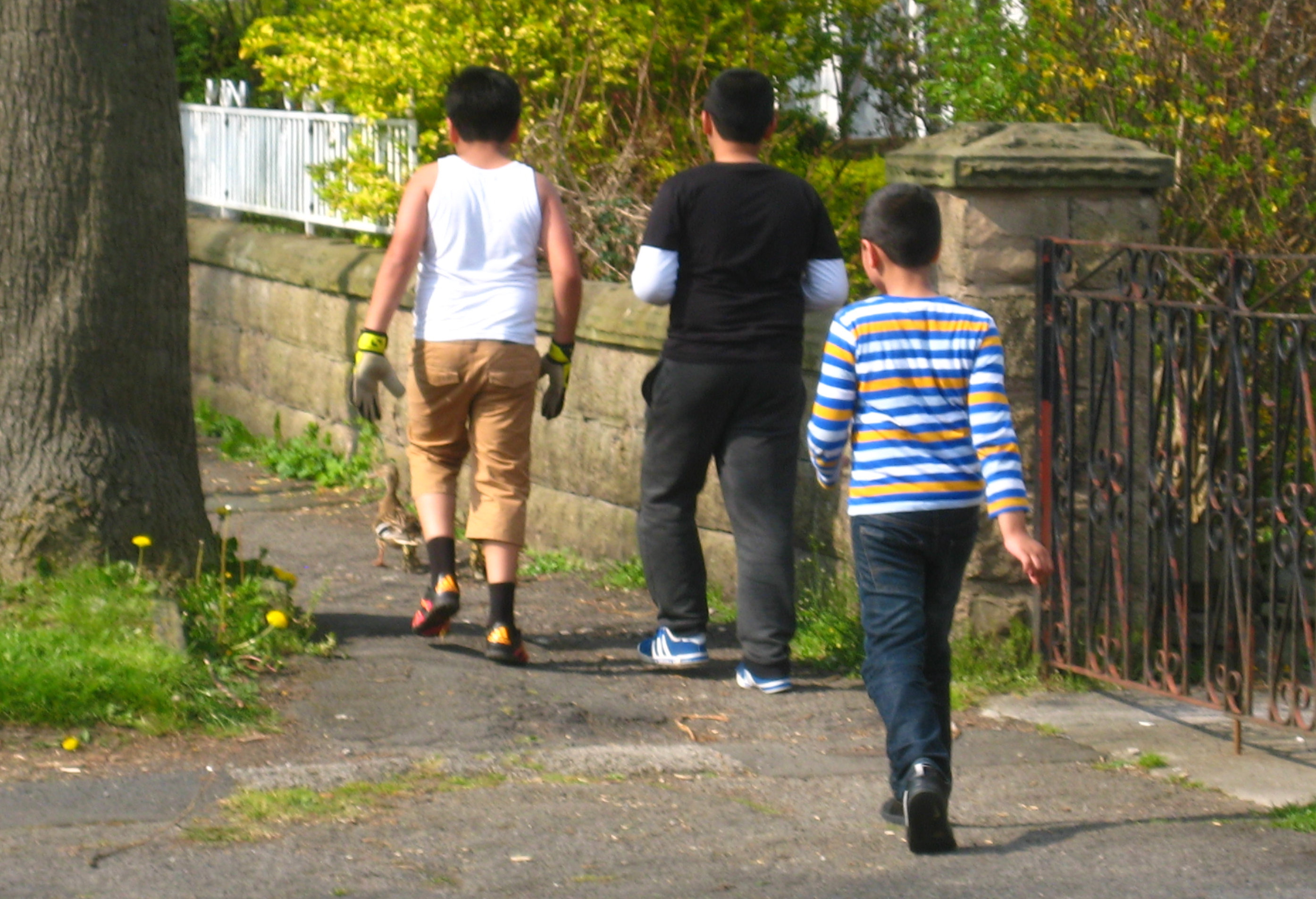
Kids arriving from all directions are beginning to crowd the ducks. Photo Mick Burton, continuous line artist.

Kids arriving from all directions are beginning to crowd the ducks. Photo Mick Burton, continuous line artist.

The Mallard Mum’s preferred garden is a bit further along I think, but she decides that she will turn into this drive anyway to escape the kids and go down to the stream.

The Mallard and her brood turn down a drive to escape the kids and to head for their stream. Photo Mick Burton, continuous line artist.

The Mallard and her brood turn down a drive to escape the kids and to head for their stream. Photo Mick Burton, continuous line artist.

Just another incident with wildlife in the valley.  Not long ago Joan and I helped a family of swans to cross Gledhow Valley Road, whilst policemen held up traffic from both directions, but that’s a story for another day.
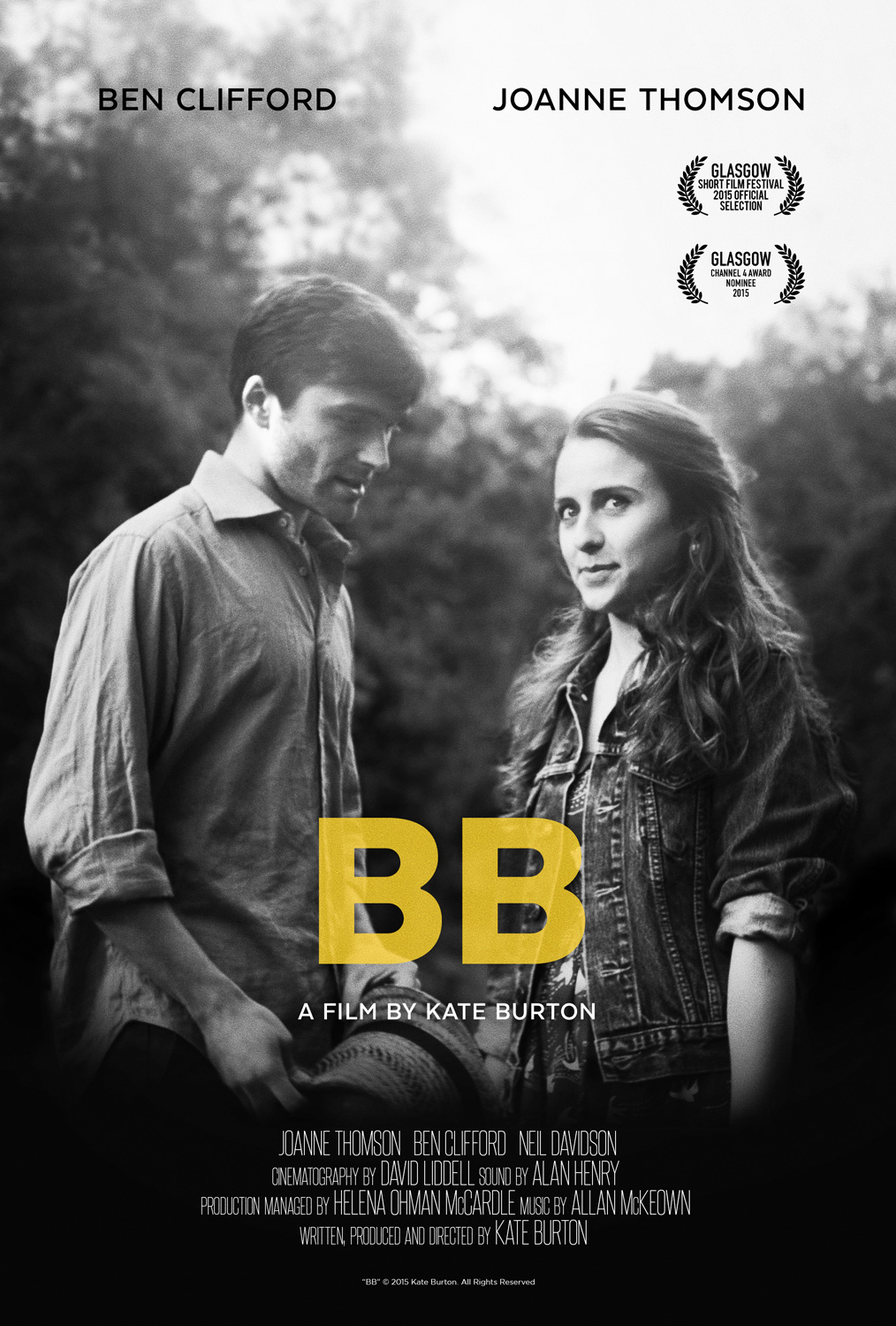
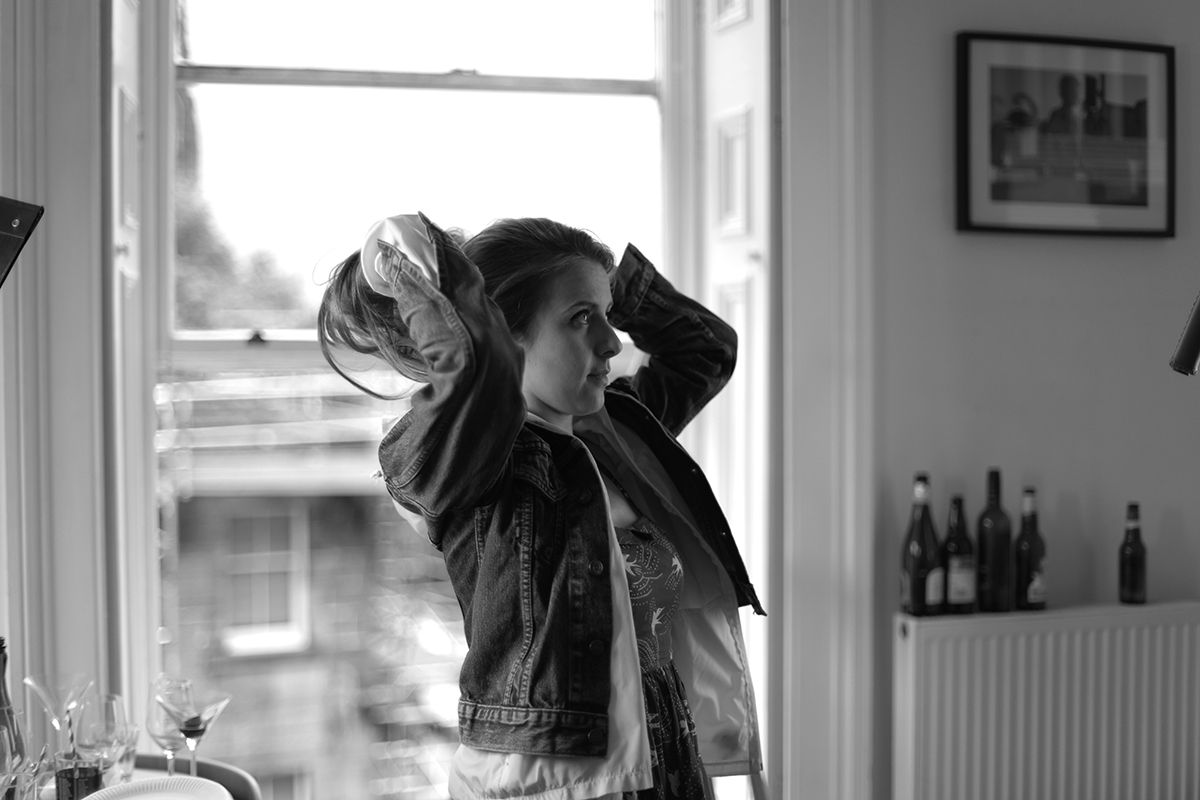
“BB” by Kate Burton, Glasgow filmmaker, at London Short Film Festival.

BB-poster-online

Poster For ‘BB’ Written and Directed by Kate Burton. Poster Design by Jen Davies

My daughter Kate has recently attended the London Short Film Festival where her latest film “BB” is showing.  The film was also selected by the Glasgow Short Film Festival and the Inverness Film Festival, and was nominated for Channel 4 innovation in storytelling award 2015.

The action starts with a bee buzzing around, the synopsis  reads “When Anna discovers an unwelcome intruder in her home she enlists the help of her mild mannered neighbour.  Frank enters into Anna’s strange and chaotic world and finds himself well removed from his comfort zone.  Amusingly awkward social challenges follow and an unlikely relationship is formed.”

The film was shot in Kate’s previous flat in Glasgow, and in the local area.  She was determined to make the film before she left.

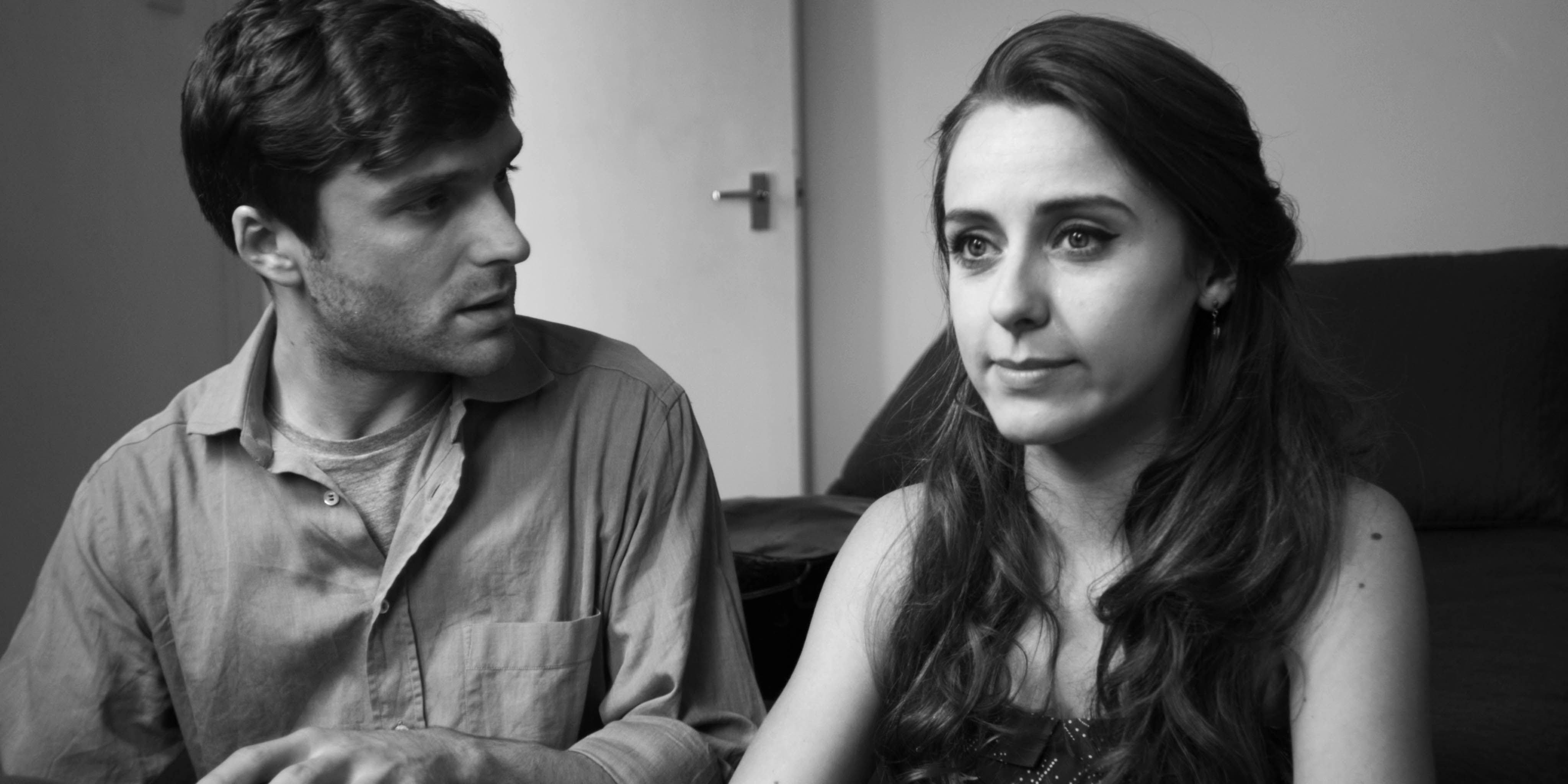
Joanne Thomson in the Kate's flat, featured in "BB", short film by Kate Burton, Glasgow, 2015..

Joanne Thomson in Kate’s flat, featured in “BB”, short film by Kate Burton, Glasgow filmmaker, 2015. Photograph by Helena Ohman

I asked Kate to give me the background to the film. 

“At the time I wrote the script I was living in a small one bedroom flat in a Victorian townhouse conversion in the west end of Glasgow.  The ceilings were high and there was a split level mezzanine where I worked and completed the script.

There was a huge rose garden opposite the flat and in the summer confused bumble bees would fly inside my flat and roll up into fuzzy balls on my window ledge.  This and many other elements of my surrounding environment fed into the content of the script.”

Kate Burton watches as David Liddell and Helen Ohman McCardle take a close up for "BB", a film by Kate Burton, Glasgow.

Kate Burton director, David Liddell cinematographer and Hannah Kelso assistant camera on the set of  “BB”, a film by Kate Burton, Glasgow. Photograph by Helena Ohman

“I knew the characters very well after a lengthy development time, but the story for the short came relatively fast and after two months writing, in between filmmaking jobs, I was finally ready to let other people read it.

‘BB’ is a character driven story capturing the awkwardness of first attractions.  It takes place mainly in one location.  I wanted the cinematography and style to reflect the simplicity of the story and I decided that I wanted to shoot in black and white to give a heightened feel, emphasising the unique lines of the interior space.  I was interested in long duration takes and capturing physical and theatrical comedy within the frame.  Some of my research references were Woody Allen’s ‘Annie Hall’ and ‘Manhattan’, ‘Breakfast at Tiffany’s’ by Blake Edwards and ‘Francis Ha’ by Noah Baumbach.”

Kate04

Kate Burton, writer/director, on set of ‘BB’ 2015.

Ben Clifford and Joanne Thomson in "BB", as short film by Kate Burton, Glasgow, 2015.

Ben Clifford and Joanne Thomson in “BB”, by Kate Burton, Glasgow filmmaker, 2015. Still from film. 

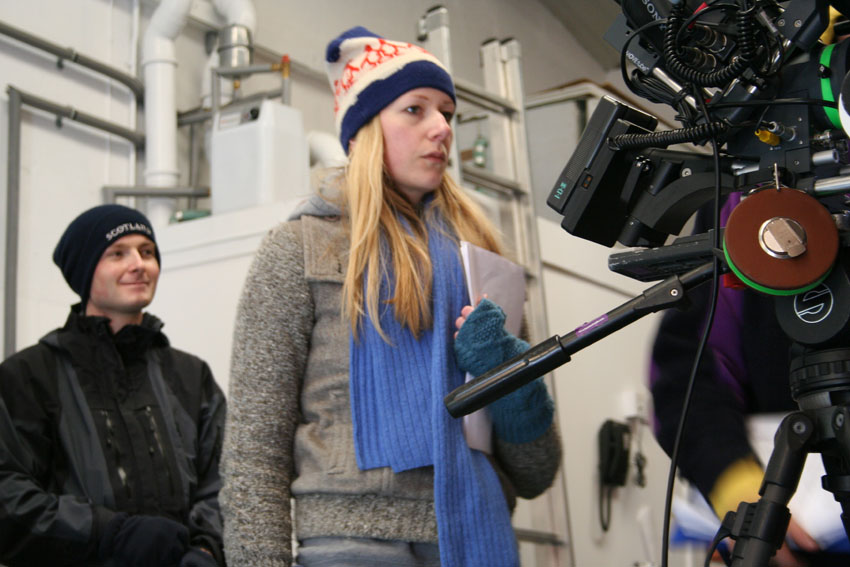
One of Kate’s earlier films was “The Ice Plant”.  I thought that this was a strange title until she told me that it was about ice cubes and that her research led her to  Highland Ice Ltd, a factory in Aberdeen which makes ice cubes, which kindly agreed to let her film there.  She has a good photo of the film crew standing around in woolly hats and scarves.

ice plant still 04

ICE PLANT.022

The Ice Plant 2007.mov.01_02_35_04.Still010

Festivals showing “The Ice Plant” were – Edinburgh International, Glasgow International, Clemont Ferrand International, Seattle International Film Festival, preceding a feature presentation at the GFT Glasgow.

Current television period dramas “War and Peace” and “Dickensian”, featuring Tuppence Middleton, have reminded me of a film Kate made in 2010, “Ever Here I Be”, a 16 minute ‘Digicult’ Film, UK Film Council & Scottish Screen.  Shown at Edinburgh International Film Festival, Nashville International Film Festival, Palm Springs Short Film Festival , Portabello Film Festival London and Inverness Film Festival Scotland. 

76695_133904063331334_1915421_n

Tuppence Middleton, Ever Here I Be, photograph by Janet Johnstone

Portfolio .056

Ever Here I Be Master - cow.mov.10_01_07_15.Still031

Ever Here I Be starred Tuppence Middleton and Christopher Simpson and was nominated for the Underwire ‘Best Female Character’ award 2012.

Kate was a talented artist from a very young age and it was a delight to watch her progress.

She went to Allerton Grange High School in Leeds, where Damien Hirst was a former pupil, and then completed a Foundation course in Fine Art at the Leeds College of Art and Design, where she increasingly studied film.  Kate then moved to Glasgow in 1999 to study Environmental Art at Glasgow School of Art, during which she went on exchange to Massachusetts College of Art and Design, Boston to study filmmaking.

Kate graduated in 2002 and has written and directed a number of shorts, documentary and promotional films.  These include several commissions from Glasgow School of Art to make documentaries and promotional films for them.

Kate has a passion for film education and has taught filmmaking and screenwriting to children and young people for the past 8 years through Into Film, Project Ability Glasgow, Glasgow Film, Edinburgh Filmhouse, Glasgow Media Access Centre and Visible Fictions theatre Company.

Her website is  www.kateburtonfilm.com  which highlights all her main films.  You can watch many, such as “Mrs Pickering’s Music Cabinet”, 2015, where Helen McCook, Artisan Embroidery & Artist, has been requested to reproduce the lost textile screen to go into an original Rennie Mackintosh cabinet.

Kate is currently working on an outline for her first feature film script.


Stainbeck Arts Club Exhibition at Chapel Allerton Arts Festival

Stainbeck Arts Club Exhibition at Chapel Allerton Arts Festival, Leeds.  on Saturday 5 September 2015.  Paintings by Mick Burton, continuous line artist, are included.

Stainbeck Arts Club Exhibition at Chapel Allerton Arts Festival, Leeds. on Saturday 5 September 2015. Paintings by Mick Burton, continuous line artist, are included.

Stainbeck Arts Club, my local art club which is based in Chapel Allerton in north Leeds next to Gledhow Valley, is holding its Annual Art Exhibition as part of the Chapel Allerton Arts Festival.  The Exhibition held in Chapel Allerton Methodist Church, which is situated at the lower end of the main Festival area, will be open from 10.00 to 16.00 on Saturday 5 September 2015.

There will be many quality pictures on display, so if you are attending the Arts Festival do pop in and have a look.  Admission is free.

Chapel Allerton Arts Festival 2015, front cover of brochure.

Chapel Allerton Arts Festival 2015, front cover of brochure.

The Chapel Allerton Arts Festival was started in 1998 by members of the local community in a small way, with a few stalls and two bands playing from the back of a lorry in the evening.

It now runs from Monday to Sunday and involves many parts of the community at lots of venues during the week, including a Short Film Festival and an Art Trail. At the weekend two streets are closed off and the central parking areas taken over for all the stalls and events, including a main stage for the many quality bands. The festival is still run entirely by volunteers.

This year the Festival starts on Monday 31 August and the main day will be Saturday 5 September when people will arrive from all over the place to attend one of the star attractions in the Leeds calendar.

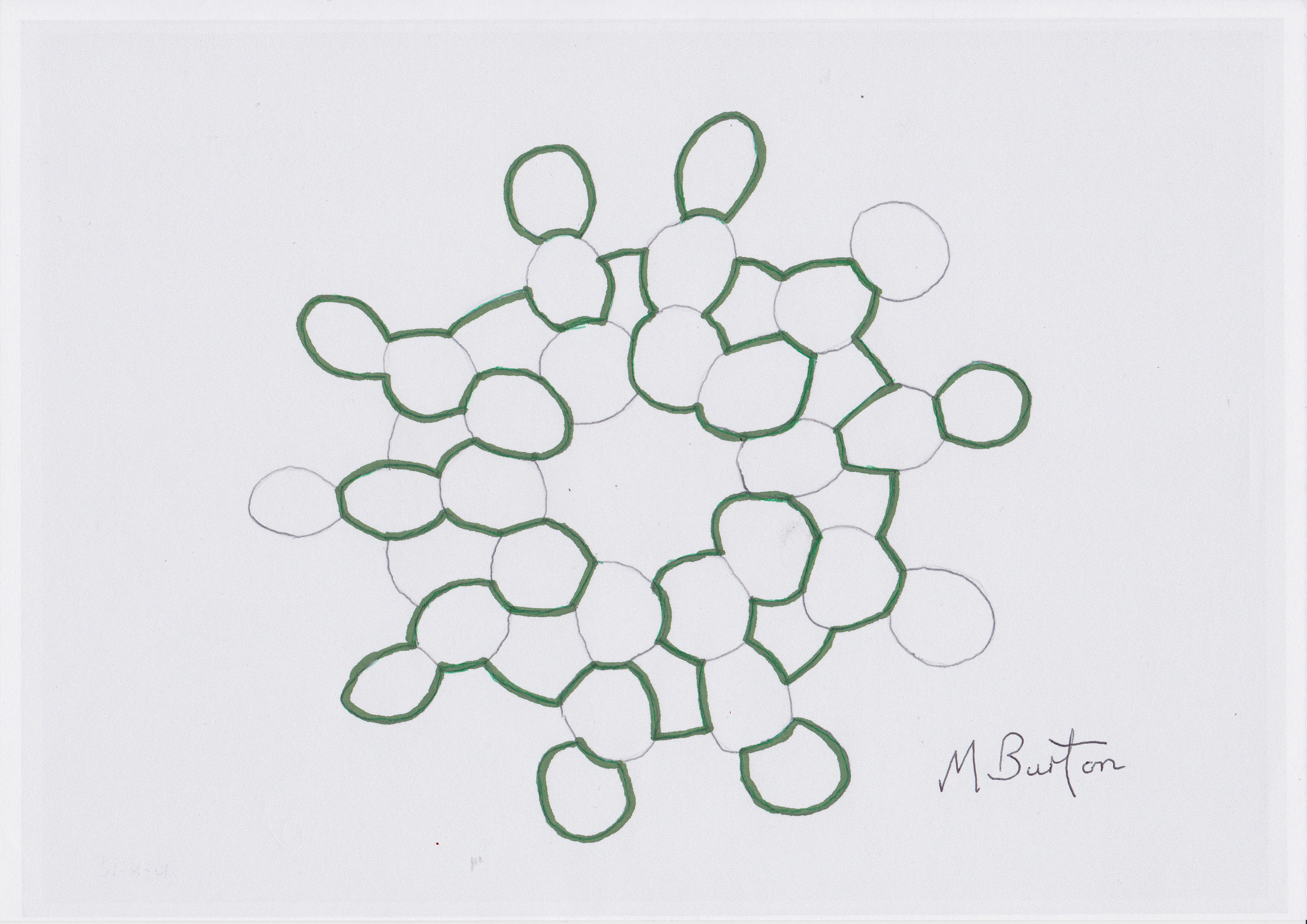
Four Colour Theorem continuous line overdraw.

Continuous lines overdrawn on Skydiver formation design, using Four Colour Theory method. Mick Burton

Continuous lines overdrawn on Skydiver formation design, using Four Colour Theory method. Mick Burton

My recent post about the formation design used by the record breaking skydivers included a continuous line overdraw of their design (modified slightly be me to complete links which would have been present with more skydivers).  I said that I would explain how the overdraw (above) was completed.

The structure is made up of circles which have 3 way junctions throughout (3 handed in the case of skydivers ! ).  This can be regarded a map and so I will apply my Four Colour Theorem continuous line overdraw which I devised in the early 1970’s.

I was trying to prove the Four Colour Theorem, which states that no more than four colours are required to colour all the regions of a map.  My basic idea was that drawing a single continuous overdraw throughout a map would split it into two chains of alternate regions, which would demonstrate that only 4 colours were required.  If more than one continuous overdraw resulted then there were still only two types of chains of alternate regions.

As you will probably know, this theorem has many complexities which I will not attempt to cover here.  In the mid 1970’s I corresponded with two mathematicians at the Open University about my approach, Robin Wilson and Fred Holroyd, who were both very helpful and encouraging.  The theorem was proven in 1976 by Kenneth Appel and Wolfgang Haken, running one of the biggest computers for over 1000 hours.  I soon decided that it was time to go onto other things!  However, my journey had been fascinating with numerous amazing findings which have been so useful in my art.

I can keep to relatively simple methods for my pictures.

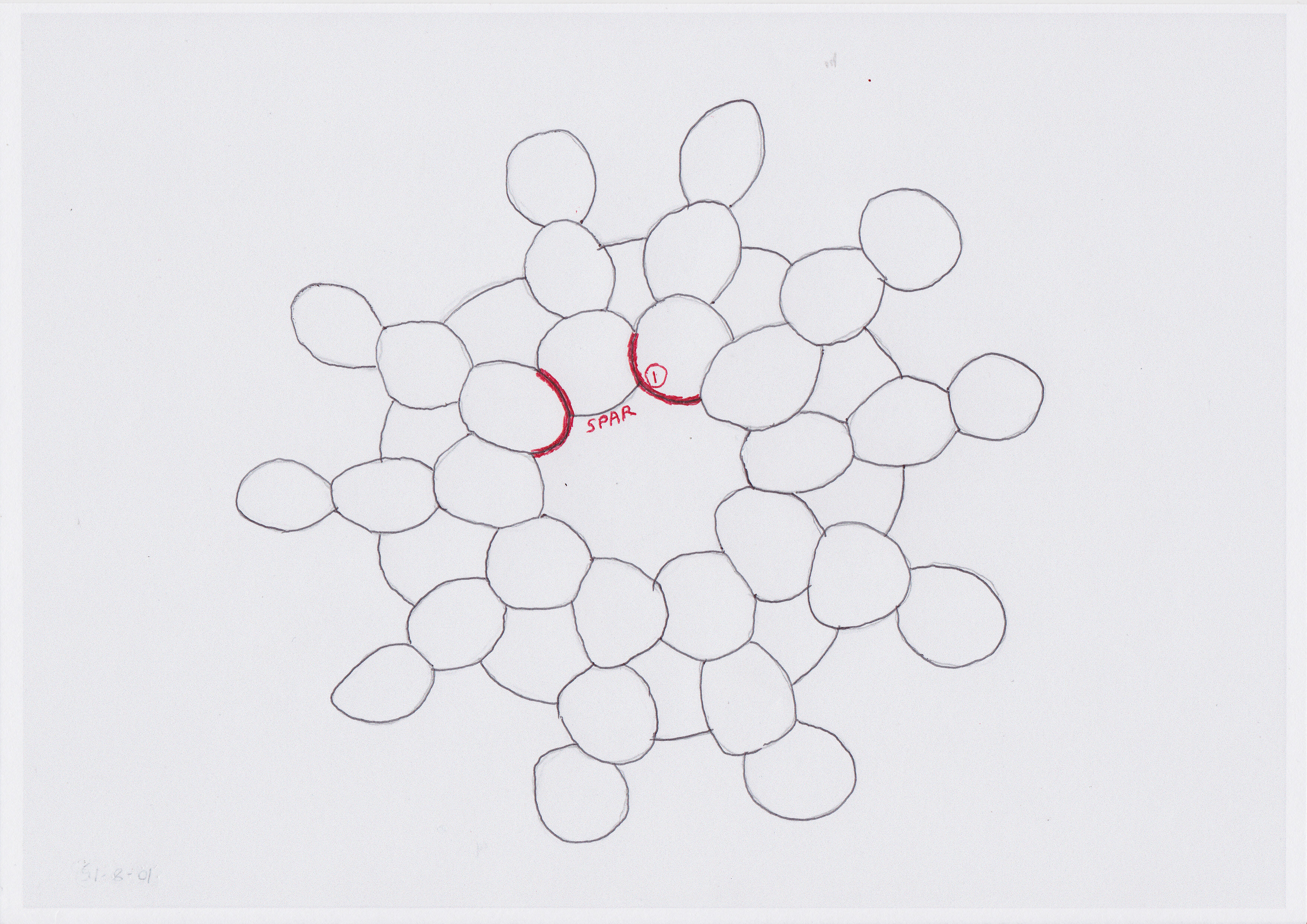
 Here is the design, used above, with my initial overdraws shown in red.

Assumed formation design used by Skydivers, with initial overdraws. Mick Burton four colour overdraw.

Assumed formation design used by Skydivers, with initial overdraws. Mick Burton four colour overdraw.

On final completion of the overdraws, every junction should have two of its three legs overdrawn and so the start decision (1) above overdraws two legs and this means that the third leg, which I call a “spar”, links to another junction where the other two legs must be overdrawn.

We then carry on making decisions which trigger other overdrawn lines across spars.  Usually there is a “knock on” effect where new overdraws connect with already overdrawn lines which then trigger more overdraws.

If we go wrong and a junction is triggered which has all three legs overdrawn, or none, we have to go back and change earlier decisions in a controlled process.  I usually photocopy the overdraws completed, every two or three stages, so that going back is not too time consuming.

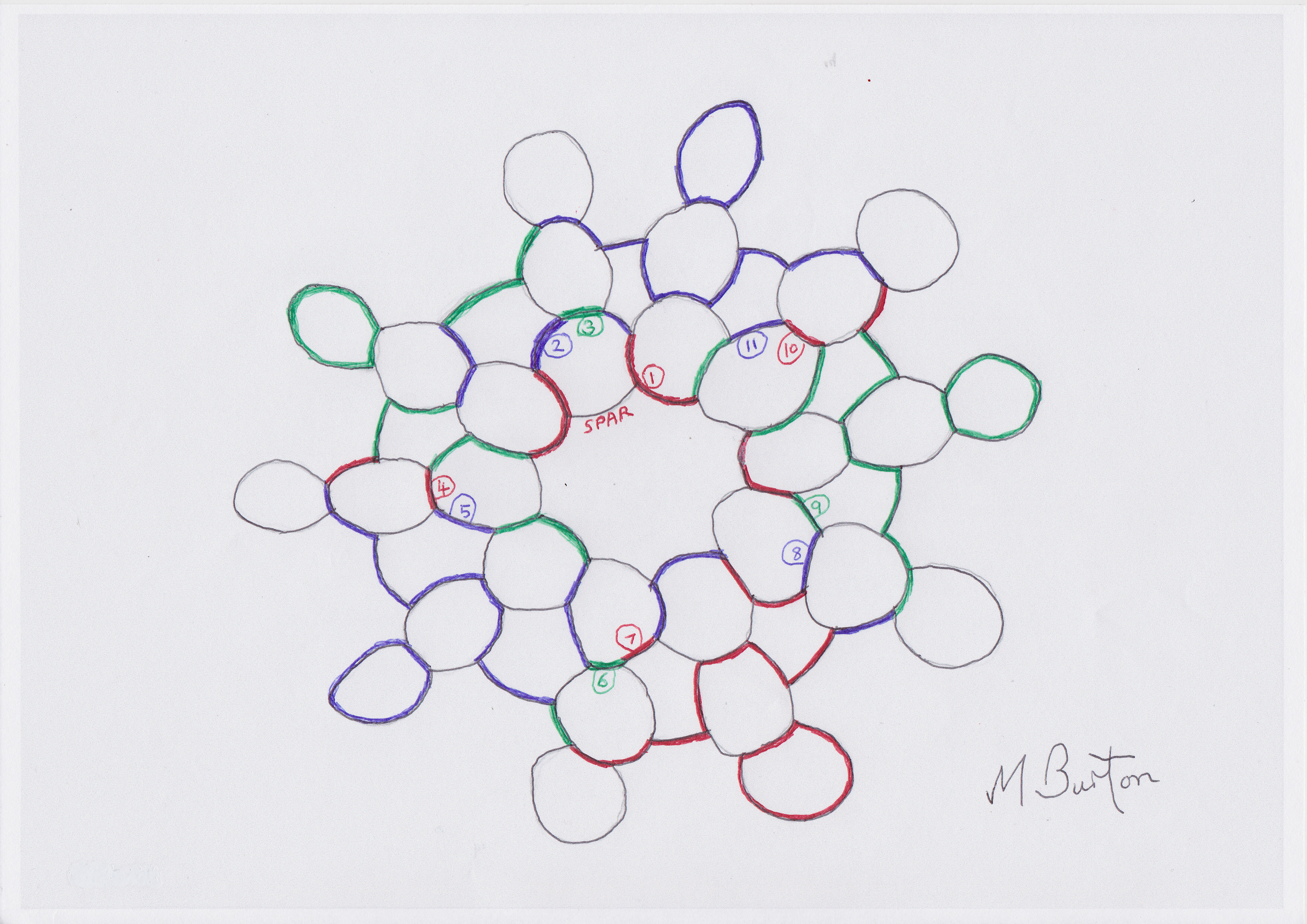
Here is the situation after decision (3).  Decision (2) in blue had only triggered two overdraw sections but decision (3), in green, has triggered ten sections to be overdrawn in green.

Four Colour Overdraw decision 3 triggers 10 further overdraws, in green. Mick Burton, continuous line artist.

Four Colour Overdraw decision 3 triggers 10 further overdraws, in green. Mick Burton, continuous line artist.

Here is the completed overdraw.  It can be seen that some decisions still only trigger one or two overdraws, but decisions 5 and 7 triggered 13 and 12 overdraws respectively.  There are 80 junctions in the design and it took 11 decisions to complete the overdraws.

completed Four Colour Theorem overdraw, on design based upon Skydivers formation design. Mick Burton, continuous line artist.

completed Four Colour Theorem overdraw, on design based upon Skydivers formation design. Mick Burton, continuous line artist.

The completed overdraw has several continuous overdraws.  I tried other variations but had to accept that this design cannot be overdrawn with a Single Continuous overdraw.  This is due to the design having basically only two full rings of circles, which means that some tips of petals cannot be included in a continuous overdraw.

Continuous lines overdrawn on Skydiver formation design, using Four Colour Theory method. Mick Burton

Continuous lines overdrawn on Skydiver formation design, using Four Colour Theory method. Mick Burton

This situation can be overcome by adding links between the tips of the petals to produce that extra ring of areas.  Here is the expanded design and the stages of overdraw.  I managed to complete the Single Continuous overdraw in one sequence without having to go back to change any decisions.

Increased size design with successful Single Line Overdraw using Four Colour Theorem method. Overdraw decisions shown. Mick Burton.

Increased size design with successful Single Line Overdraw using Four Colour Theorem method. Overdraw decisions shown. Mick Burton.

Of course it looks better with one solid colour overdraw and no decision numbers.

Skydiver formation design with links between out petals completed, overdrawn with a Single Continuous Line using Four Colour Theorem method. Mick Burton.

Skydiver formation design with links between out petals completed, overdrawn with a Single Continuous Line using Four Colour Theorem method. Mick Burton.

I have said that the method of overdraw was developed with Four Colours in mind, and so you could use one pair of colours alternately within the above overdraw and another pair of colours on the outside of the overdraw (which can include the background).

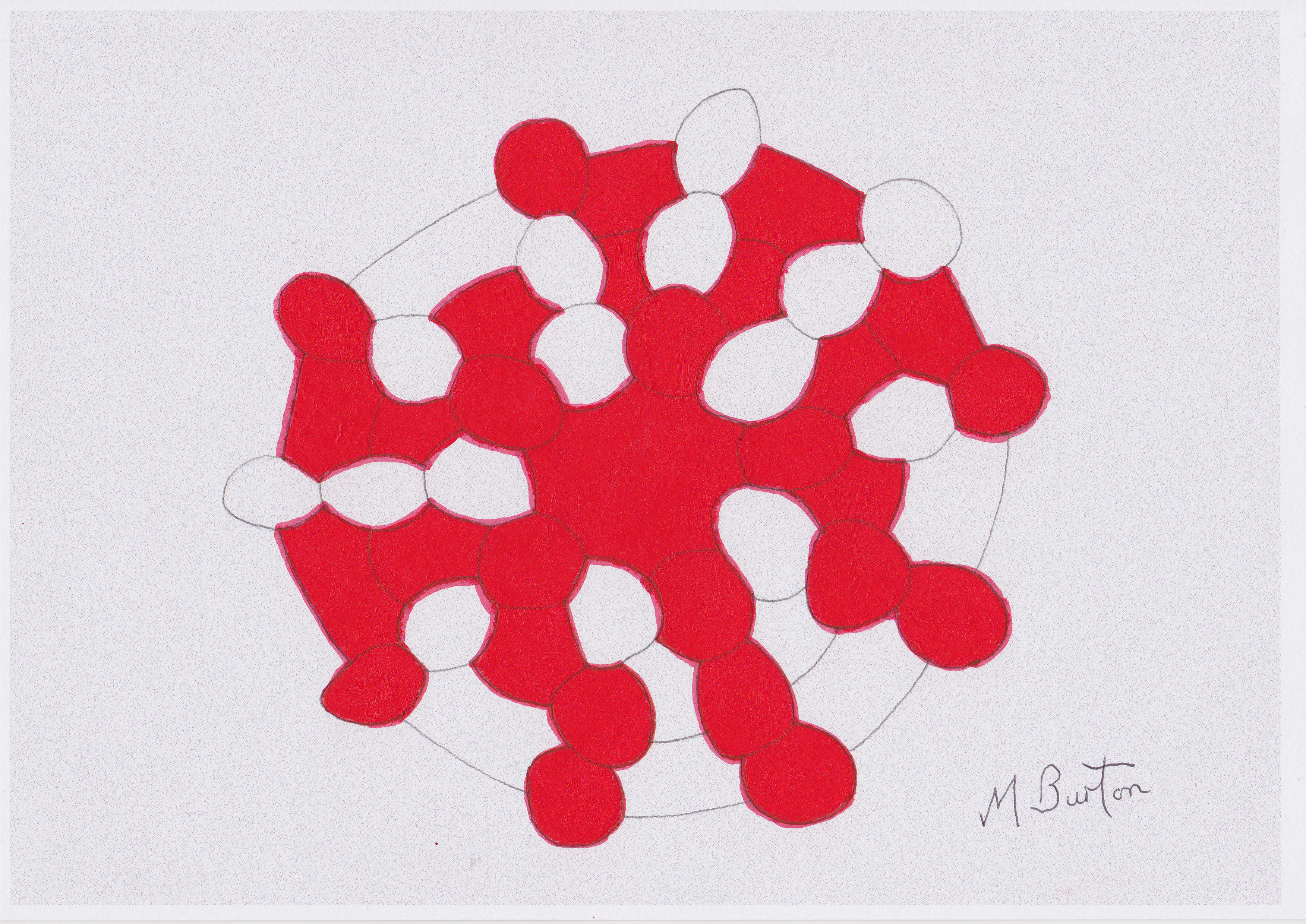
I have found another interesting result in that if you use strong colours inside the overdraw, as it is the main image, and neutral colours outside (or even leave the outside blank) then the gaps between the “petals” show good use of space.  Here is the design simply coloured in strong red inside the overdraw, which creates a good contrast as the background seeps in. 

Solid colour within single continuous overdraw, with Four Colour method, showing good use of space. Mick Burton.

Solid colour within single continuous overdraw, with Four Colour method, showing good use of space. Mick Burton.

The chains of areas produced by the continuous overdraws can be coloured, not just in two pairs of colours to demonstrate Four Colours, but with a colour sequence or a mixture of sequence, alternate colours or even one colour.  In the last picture I have used colour sequence on main chains of areas related to the central space and, as a contrast,  light grey on the chains connected to the outside of the design.

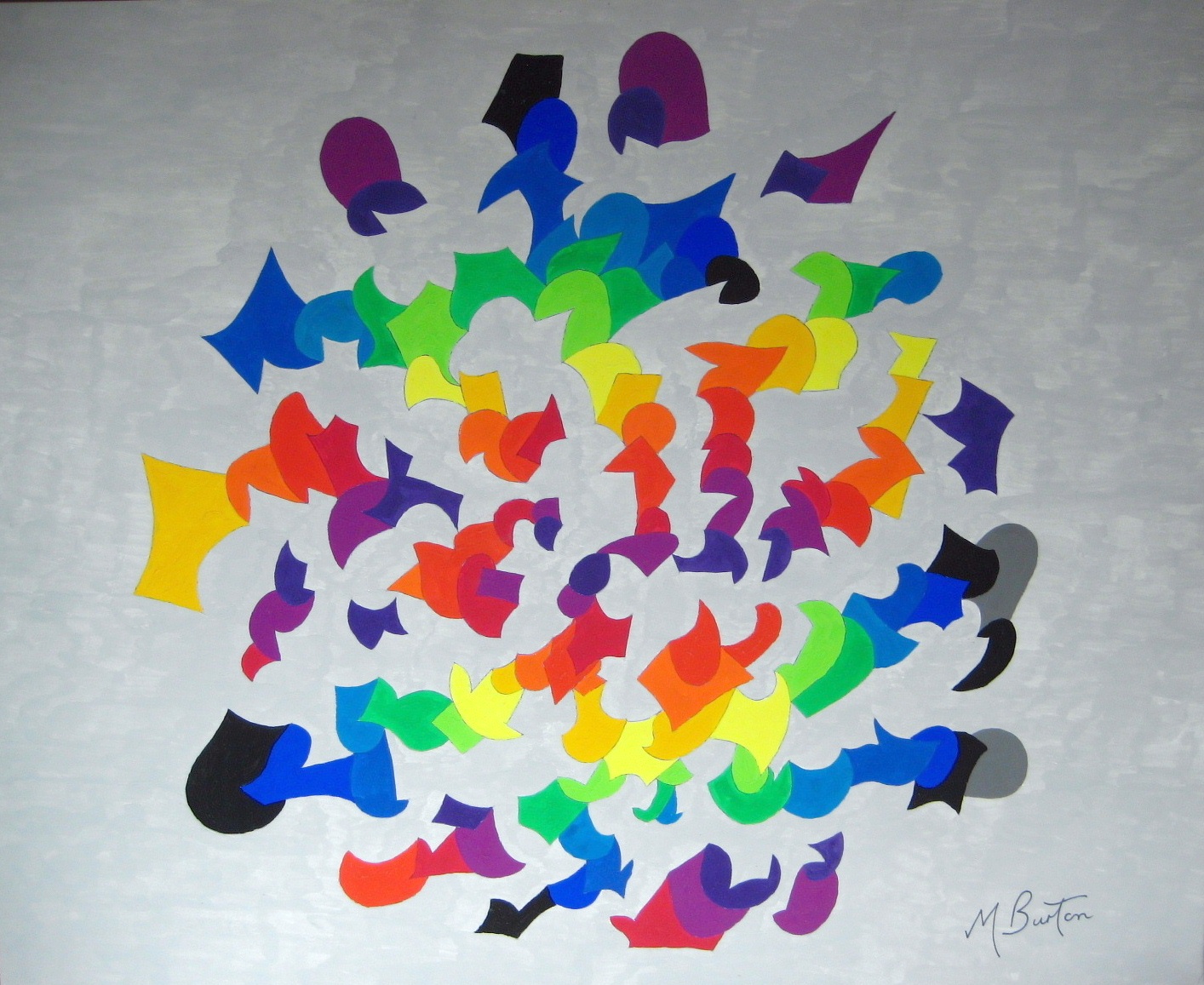
Star Burst. Four Colour Theorem applied to a map of shell shapes wound round from the centre. Rainbow sequence of colours. Mick Burton, 1971

Star Burst. Four Colour Theorem applied to a map of shell shapes wound round from the centre. Rainbow sequence of colours. Mick Burton, 1971

This is one of the first paintings that I produced after discovering my Four Colour Theorem overdraw in 1971. I called the picture “Star Burst”, one of my first planetary pictures.


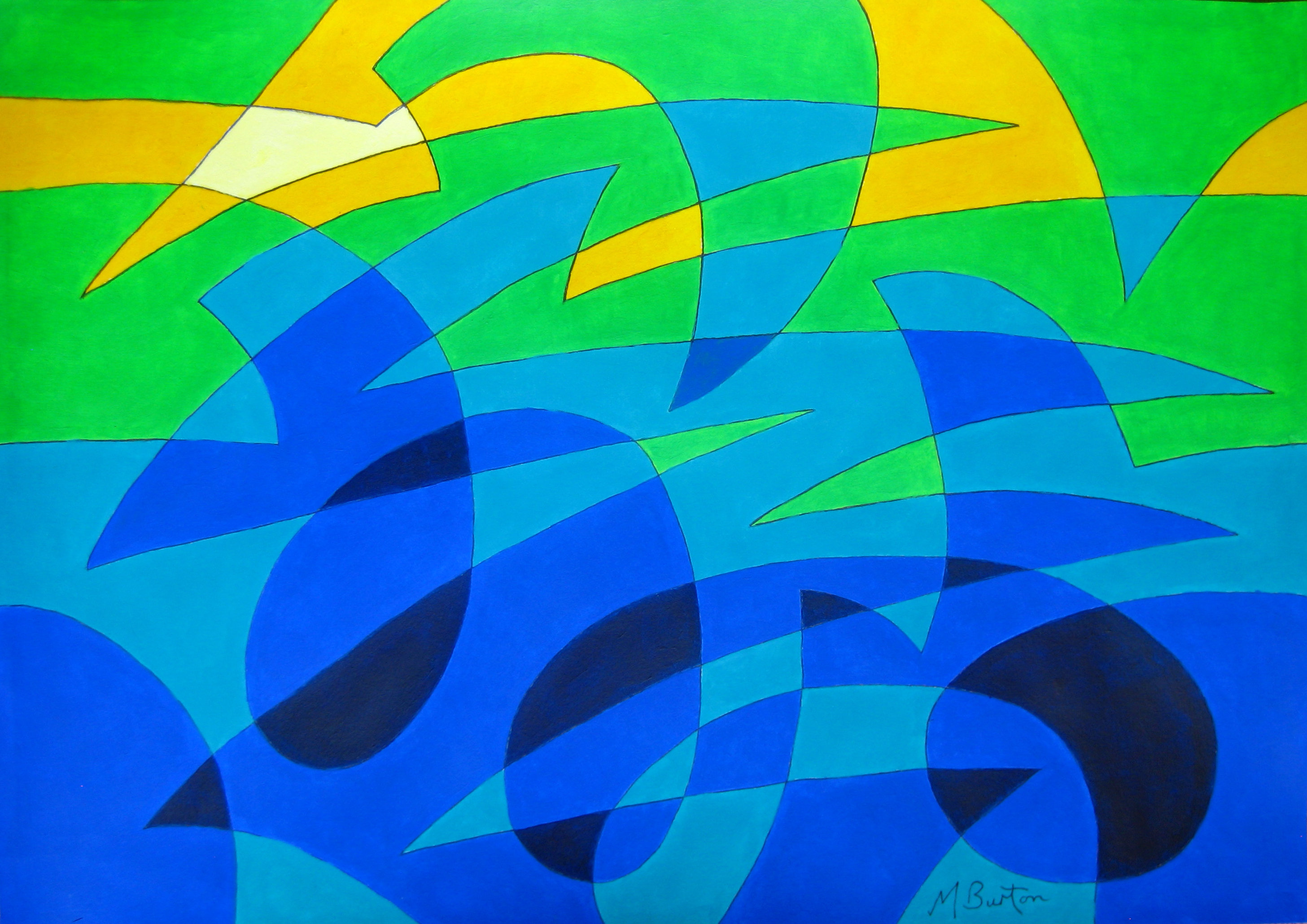
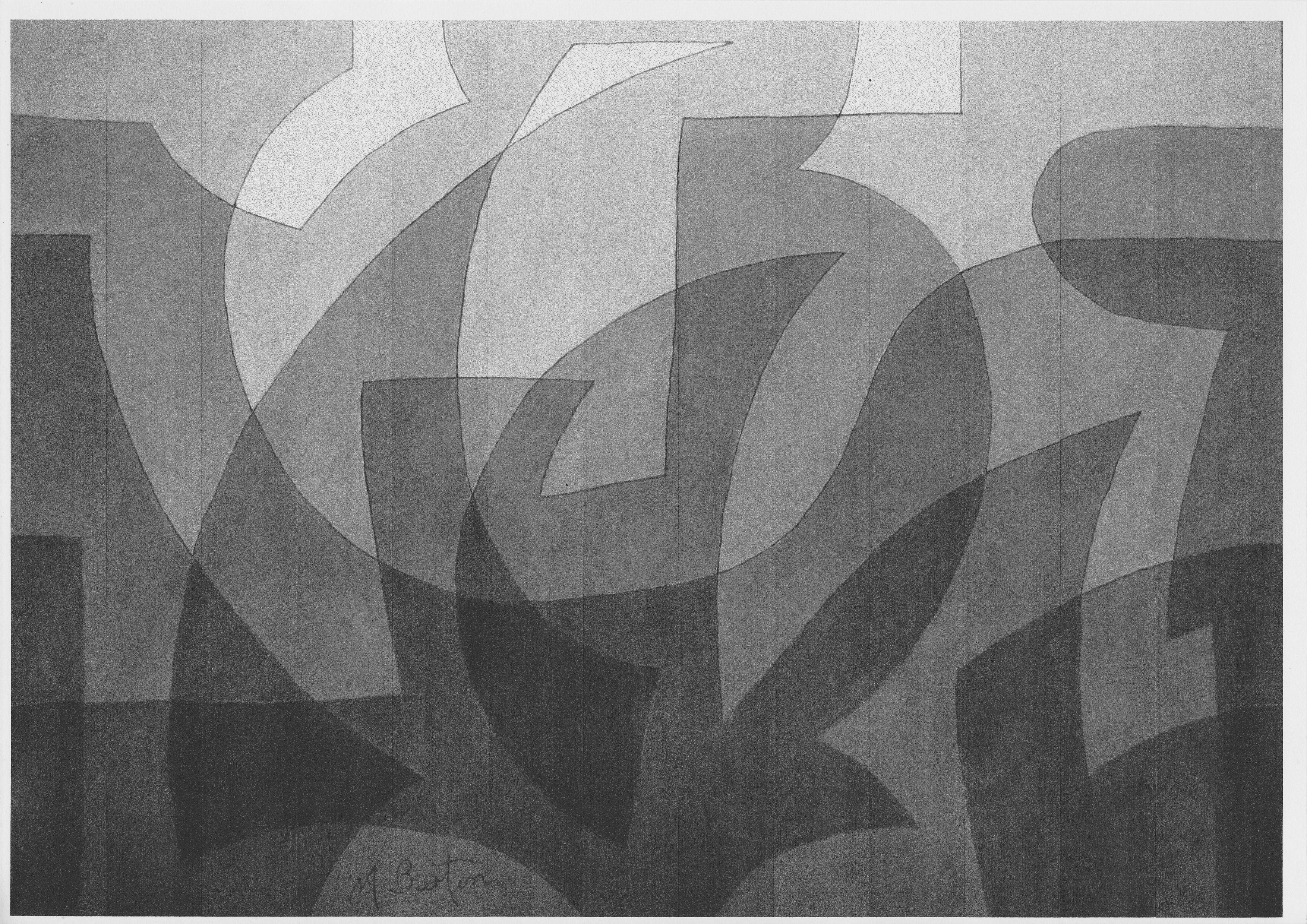
Spherical Continuous Line Abstract with Colour Sequence.

Spherical continuous line with colour sequence. Flypast Over Rolling Hills. Mick Burton 2015.

Spherical single continuous line drawing with colour sequence. Flypast Over Rolling Hills. Mick Burton, continuous line artist 2015.

I have modified my Spherical approach to continuous line from the method I described in my Continuous Line Blog post of 9 July 2014, which did not quite reflect the reality I was seeking.

I have kept the idea that when you draw out of one SIDE of the paper you need to return at the opposite SIDE at the corresponding point, so that the pattern matches vertically and after colour sequence the colours also match if you pull the paper round into a tube shape.  This is similar to the equator on a globe of the world matching.

Previously I had said that when going out of the top of the drawing you also need to return at the corresponding place at the bottom.  I was correct to say that the colours would not match, which would be equivalent to the poles on the globe of the world not meeting, but the treatment of the lines needed to be modified.

I realised that the bunching effect of the top being pulled together totally separately to the bottom being pulled together was fine regarding separate sets of colours but matching the line patterns from top to bottom was the wrong approach.

So, when I go out at the TOP now I need to come BACK IN AT THE TOP at the corresponding distance from the other end of the top.   Similarly if I go out at the bottom I come back in at the bottom.  You could then imagine that folding the picture vertically down the middle would mean that both pattern and colour sequence would now match at the top and bottom respectively (don’t actual fold it and spoil the picture ! ).

I recently drew the following for a demonstration/workshop at Stainbeck Arts Club in Leeds.  I started drawing the line a couple of inches in from the top left side and did a few rolling curves diagonally down from left to right, followed by several exits and returns to the picture – initially out at the lower right side and back in at the lower left side, then down and out at the bottom left and back in at the bottom right.

Spherical continuous line drawing with rolling and jagged lines. Mick Burton 2015.

Spherical single continuous line drawing with rolling and jagged lines. Mick Burton, continuous line artist 2015.

I later tried some “shark fin” curves and a couple of large jagged sequences.

All the time I tried to draw the line cleanly through existing shapes (avoiding going near previous junctions) and being aware of areas I had not visited much.  Finally I needed to work out how to get back to my start point without spoiling the composition too much (here going out and back in can be handy).

I hope you can check the route of the line through the whole picture fairly easily.  I then applied my Colour Sequence to produce the picture at the top of this post.

The first stage is my usual alternate overdraw of the line (if you are overdrawing a section as you go out of the picture you need to continue to overdraw as you re-enter, or if not overdrawing going out it’s not overdrawing when you re-enter).  See my post of 10 September 2014 for the full ALTERNATE OVERDRAW process and my post of 27 September 2014 for the COLOUR SEQUENCE process.

I have used a series of 6 colours from Pale Yellow through greens to Prussian Blue which I have tried to work out in steps of tone.  This is partly to highlight the overlap effect of continuous lines and the natural depth of the abstract.  As always, there is choice of direction of colours – light to dark or dark to light.  Here it seemed best to have the single lightest area at the top and several darker areas across the lower part of the picture.  The picture also has an Optical Art look about it.

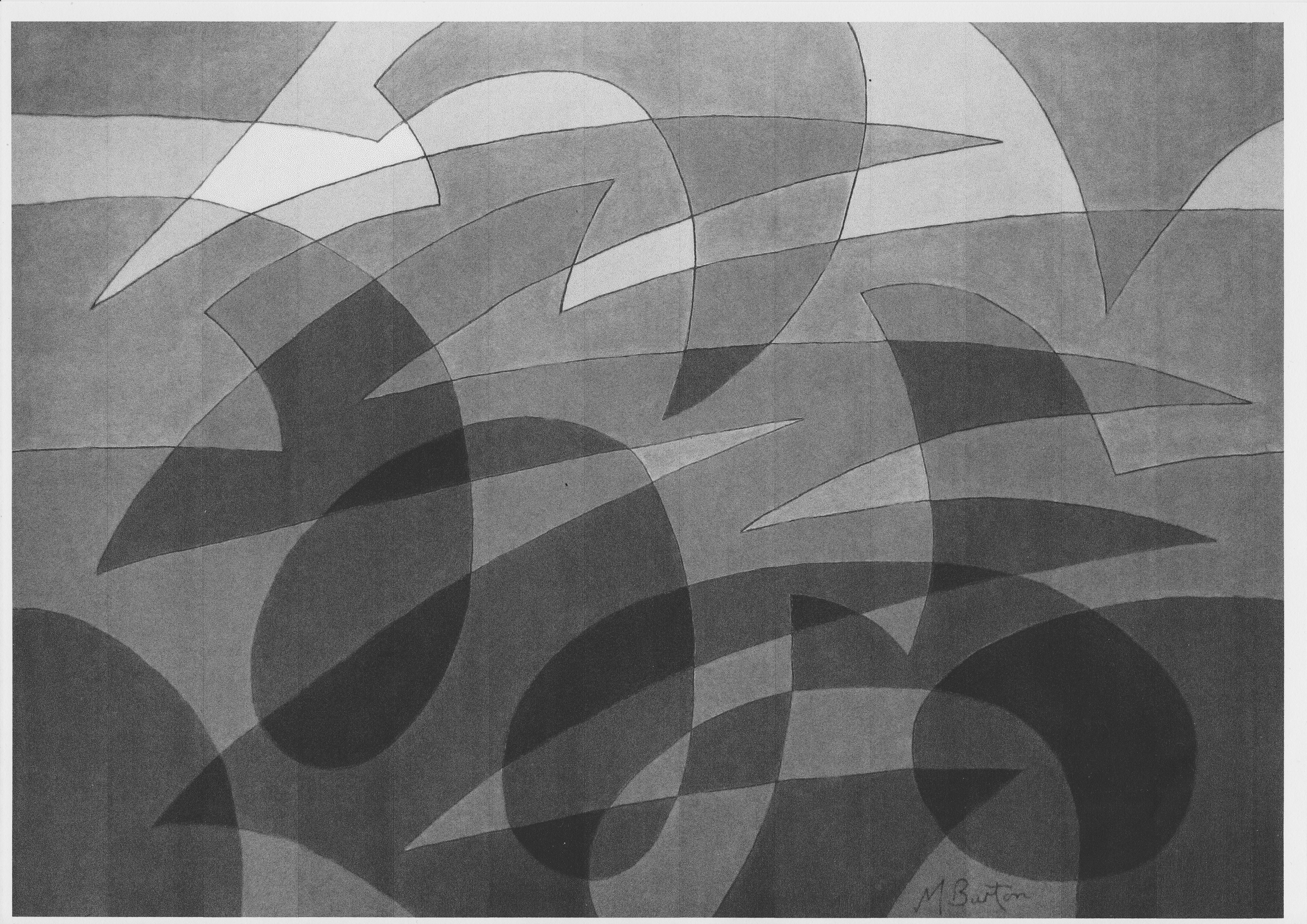
Printing the picture in Monotone is usually a good way of checking the steps of colour and light to dark.  So here it is.

Monotone of Spherical Continuous Line

Monotone of Spherical Single Continuous Line Drawing “Flypast Over Rolling Hills”. Mick Burton 2015.

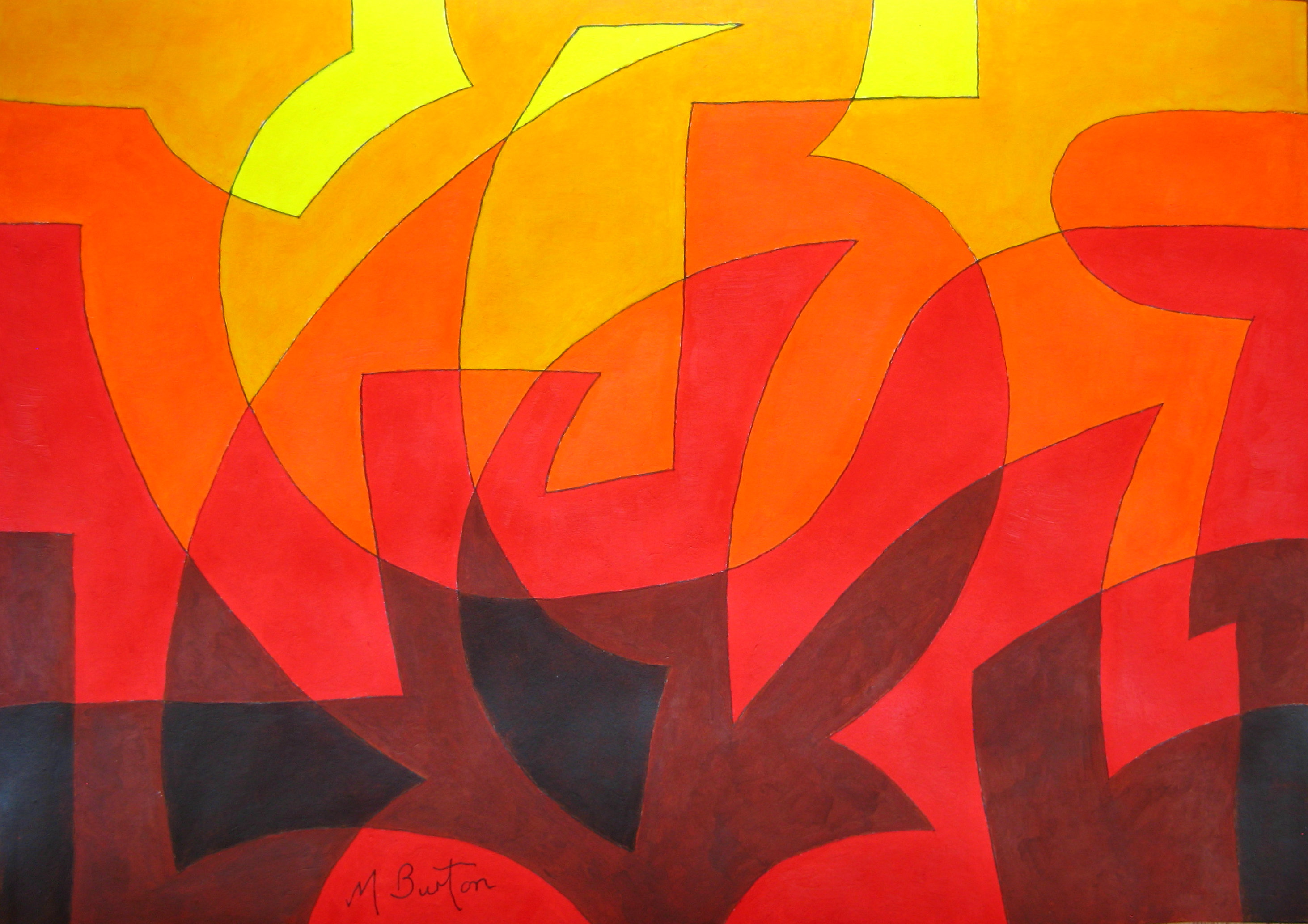
I also produced another similar abstract for the Demonstration at Stainbeck Arts Club to show the Spherical approach with a different flow of lines and colours.  I had coloured the drawing with a sequence from Yellow through Reds to dark Brown.

Spherical Continuous Line with Colour Sequence. Forest Fire. Mick Burton 2015.

Spherical Single Continuous Line Drawing with Colour Sequence. Forest Fire. Mick Burton 2015.

Here is the Monotone of this picture.

Monotone of Spherical Continuous Line

Monotone of Spherical single continuous line drawing “Forest Fire”. Mick Burton 2015.

How do you construct Haken’s Gordian Knot?

After completing my drawings of Haken’s Gordian Knot, which I covered in my previous continuous line blog post, I decided that I needed to find out more about how this unknot was created.  It is one thing me portraying the route of the two strands running through a completed structure, but possible something very different if I construct it from scratch.

A Google search for Haken’s Gordian Knot took me to a page of MathOverflow website, where a question that appeared “Are there any very hard unknots?” posed by mathematician Timothy Gowers, in January 2011.  In an update after many answers he said that he had arrived at Haken’s “Gordian Knot”.

Haken's Gordian Knot, from Ian Agol. A simple circle of string (an Unknot) formed into a complicated continuous line.

Haken’s Gordian Knot, from Ian Agol. A simple circle of string (an Unknot) formed into a complicated continuous line.

Timothy said that, after studying the knot for some time, “It is clear that Haken started by taking a loop, pulling it until it formed something close to two parallel strands, twisting those strands several times, and then threading the ends in and out of the resulting twists”. This approach is something like the suggestions I made in my last post on the basis of my Twisting, Overlapping, Envelope painting of the Haken Knot.

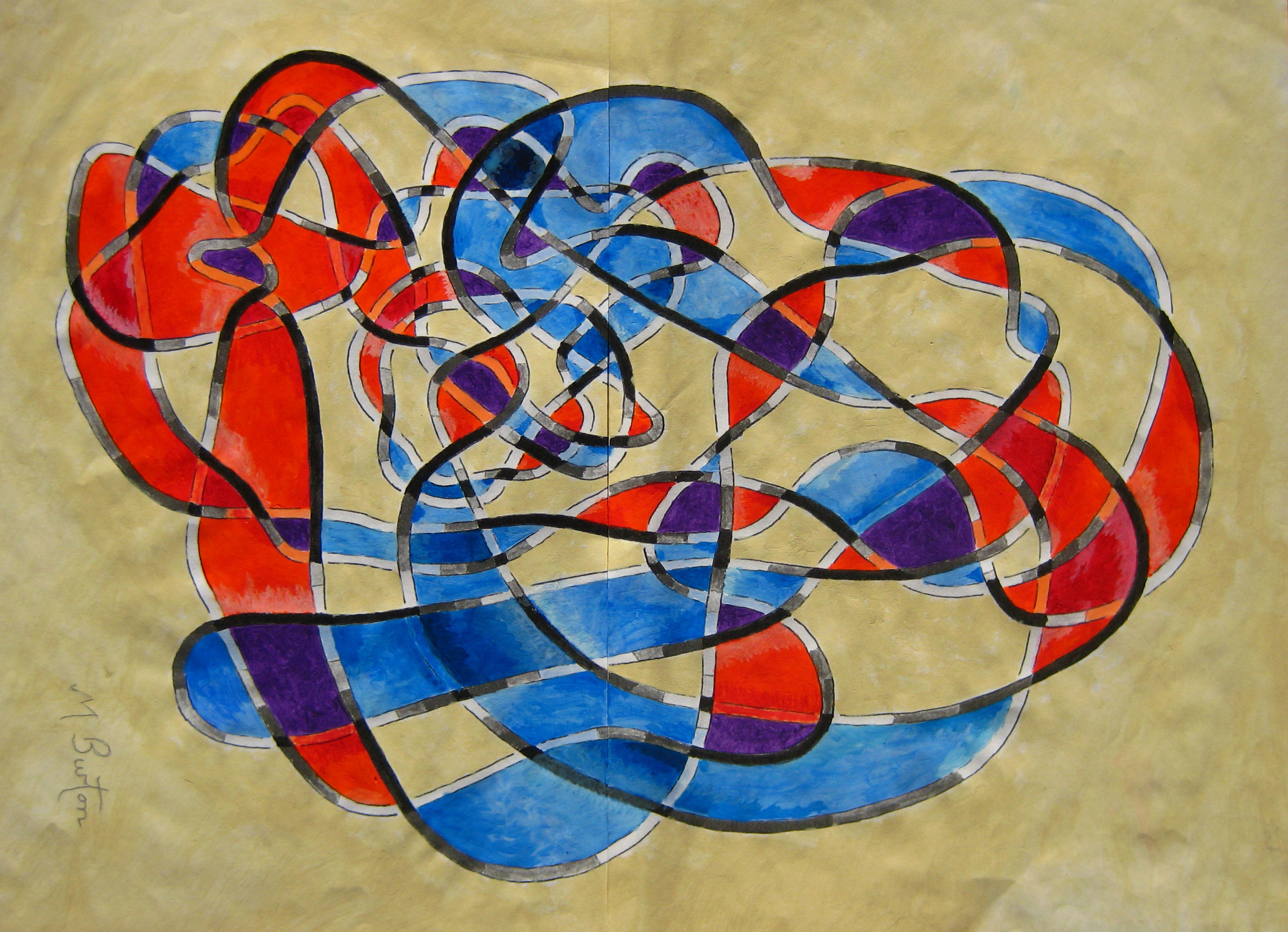
Twisting, overlapping colouring of Haken's Gordian Knot. Mick Burton painting.

Twisting, overlapping colouring of Haken’s Gordian Knot. Mick Burton single continuous line drawing painting.

Timothy then added that “The thing that is slightly mysterious is that both ends are “locked” “.  When I started to build the structure from scratch I began to realise what “locked” may mean.

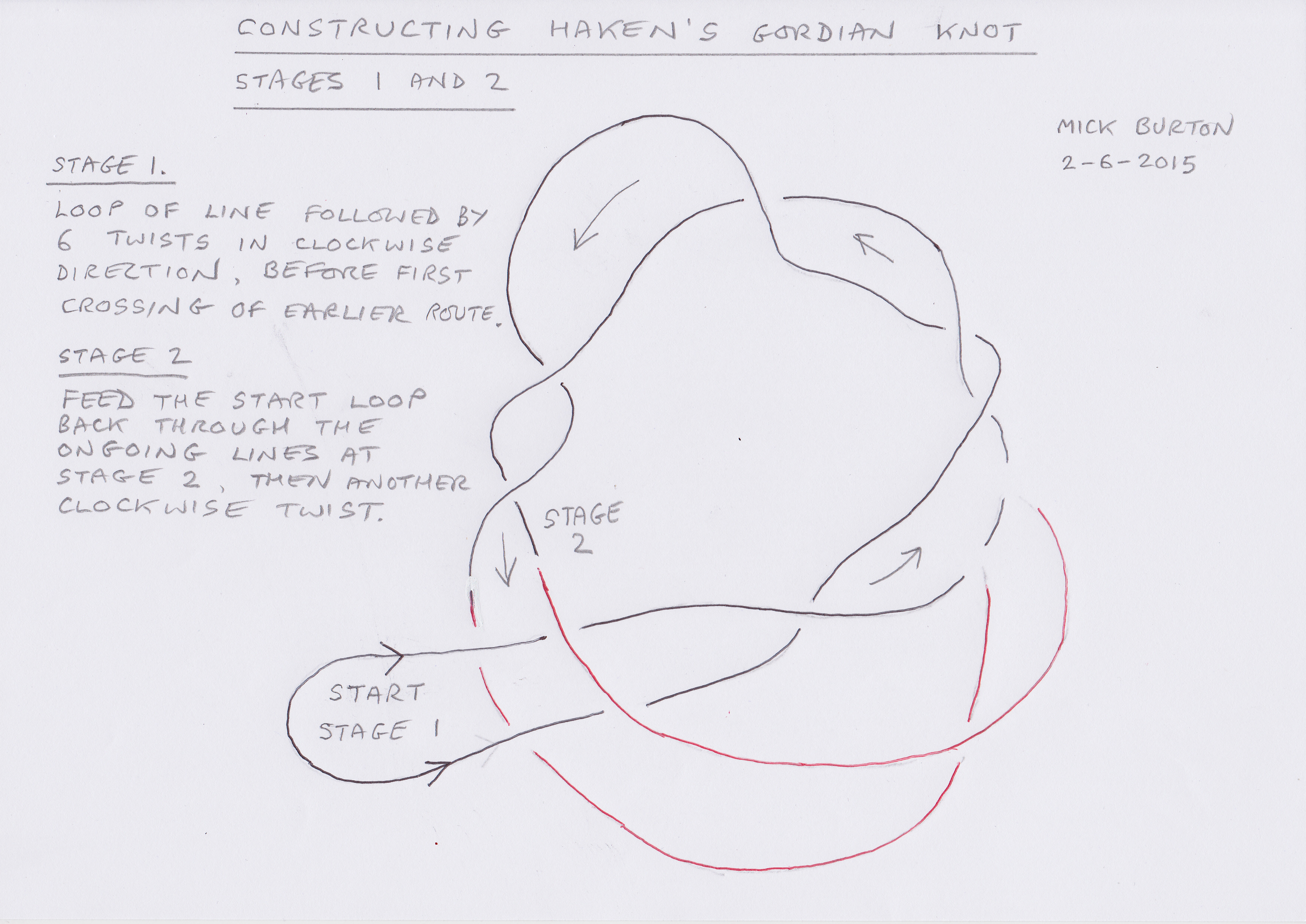
Constructing Haken's Gordian Knot. Stages 1 & 2. Mick Burton.

Constructing Haken’s Gordian Knot. Stages 1 & 2. Mick Burton.

After leaving the looped end at the start, the ongoing route first meets its earlier self at Stage 2.  However instead of the ongoing route going through the earlier one, the initial loop goes back through the later one. This must be what is meant by the first “lock”.

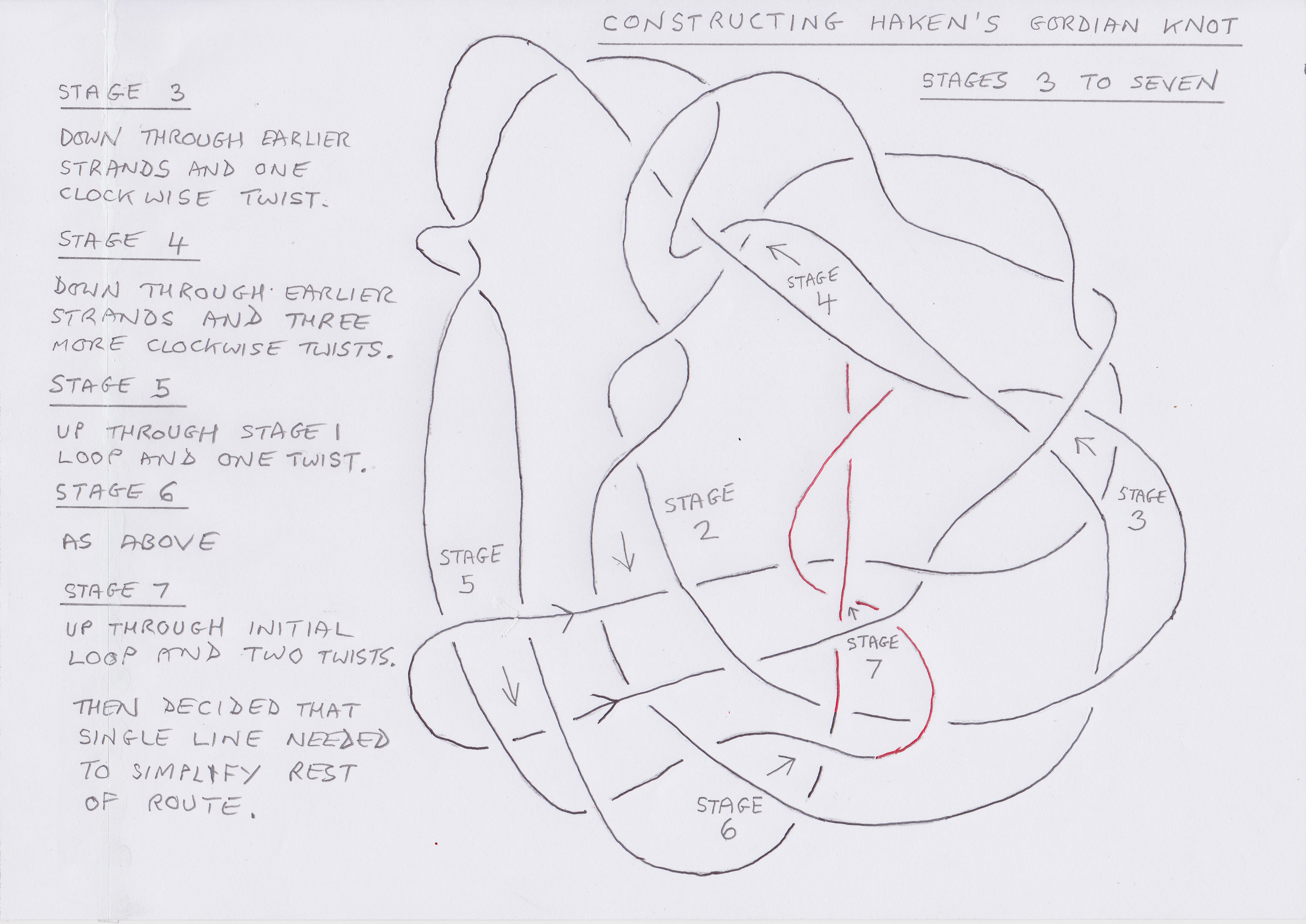
Constructing Haken's Gordian Knot. Stages 3 to 7. Mick Burton

Constructing Haken’s Gordian Knot. Stages 3 to 7. Mick Burton

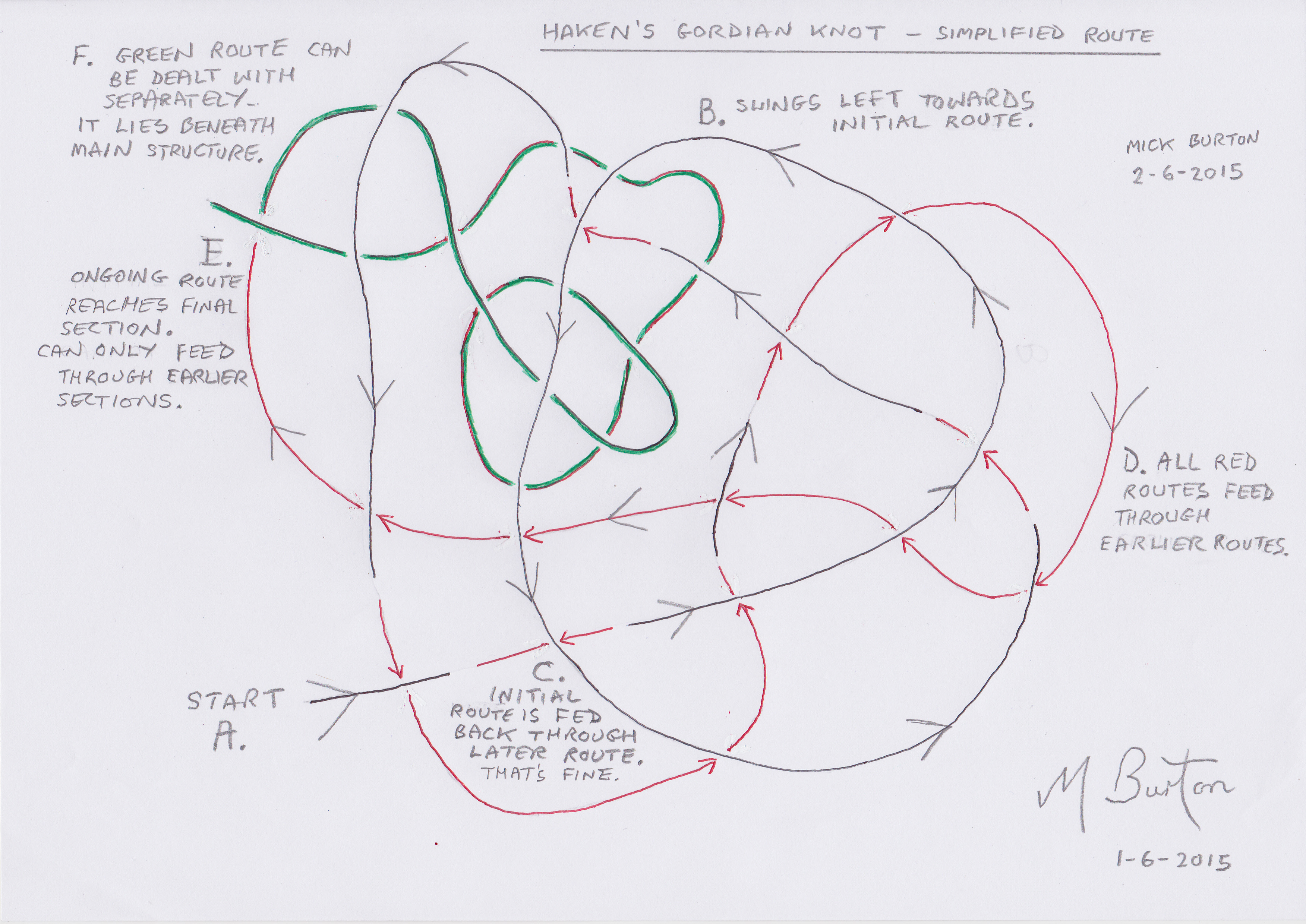
Continuing, things were as expected up to Stage 7.  I now realised that the route could be simplified to one line, as the Twists were not affecting progress but the feed through points were crucial.  I switched to drawing the route by using a simple line (to represent the twin twisting strands) and showed Feed Through points as Red Arrows.

Haken's Gordian Knot, Simplified Route showing Feed Points. Mick Burton.

Haken’s Gordian Knot, Simplified Route showing Feed Points. Mick Burton.

You can see that after point “C”, where the reverse Feed occurs, there are 12 expected Feed Through points until you arrive at point “E”.  Here instead of Feeding through an earlier part of the route, Haken indicates that you are expected to Feed through the End Loop at “E” which is too soon. This must be the other “Lock”.

At this stage, of course, I had no idea what to do.  Timothy did not seem to be using a lot of paper like me, but a “twisted bunch of string” and a small unknot diagram.  So I found some string, but was at a loss to make much sense of anything using that.  Timothy, however, was disappointed that it was so easy with his string initially, but delighted when it became more difficult !

What I did realise about the sections of route lying beyond point “E”, which I have coloured Green, is that they all lie beneath the rest of the structure.

This would allow the Green Area to be constructed separately before you sort of sweep it underneath as a final phase.  When I say “separately” I can only assume that you would need to do all this first, feed the result through the final loop and encapsulate the result.  You would then take this bundle to the start and use it to spearhead the building of the structure, leaving the loop at the other end of the two stranded string back at the start.

Haken's Gordian Knot, Prior action for the Green Route, before starting main structure. Mick Burton.

Haken’s Gordian Knot, Prior action for the Green Route, before starting main structure. Mick Burton.

Timothy said that he would love to put a picture of the process on the website and asked for suggestions.

Even though I am an artist and not a mathematition, I had already done two pictures of Haken’s knot before I found the MathOverflow website and was fascinated by the production process of the knot and so did some extra diagrams of my own.

I will ask if my drawings match Timothy’s thoughts in any way.

Haken’s Gordian Knot and the Twisting, Overlapping, Envelope Elephant.

I constantly look for Continuous Lines in many fields of art, history, mathematics – anywhere, as I just do not know where they are going to crop up.  Currently I am casting an eye on Islamic Art and Celtic art and am developing ideas on those.

Recently I glanced through a book called “Professor Stewart’s Cabinet of Mathematical Curiosities” and came across Haken’s Gordian Knot, a really complicated looking knot which is really an unknot in disguise – a simple circle of string (ends glued together) making a closed line. Here it is.

Haken's Gordian Knot, from Ian Agol. A simple circle of string (an Unknot) formed into a complicated continuous line.

Haken’s Gordian Knot, from Ian Agol. A simple circle of string (an Unknot) formed into a complicated continuous line.

When I looked at the Knot, it reminded me of my “Twisting, Overlapping, Envelope Elephant” continuous line in that it has a lot of twists. I realised straight away that a narrow loop on the outside (left lower) seemed to lead into the structure with its two strands twisting as it went, each time in a clockwise direction.  I followed the two twisting lines throughout the drawing until they ended in a loop on the outside (left higher).

I wanted to draw and paint this knot. My first drawing was of the line on its own. The depth of some of the lines reminded me of one of my earliest paintings “Leeds Inner Ring Road Starts Here”, which was based upon a sign board which appeared near Miles Bookshop in 1967 informing us of the route the new road would carve through the City. This was several years before Spagetti Junction was built near Birmingham. My picture had lines swirling all over at various heights in one continuous line.
Leeds Inner Ring Road Starts Here. Use of varying thickness of continuous line, overs and unders. Pre dates Spagetty Junction near Birmingham. Mick Burton, 1967.

Leeds Inner Ring Road Starts Here. Use of varying thickness of single continuous line drawing, overs and unders. Pre dates Spagetty Junction near Birmingham. Mick Burton, 1967.

My first picture of the Gordian Knot, in black and white, concentrated on the heights of the lines following the overs and unders shown by Haken.

Depth of lines in black and white, in Haken's Gordian Knot. Mick Burton, continuous line drawing.

Depth of lines in black and white, in Haken’s Gordian Knot. Mick Burton, single continuous line drawing.

But my main aim now was to use blue and red to show the twisting nature of the pair of lines running between the starting loop and the end loop.  This was intended to allow the viewer to more easily follow the loop and the twists throughout the structure.

Twisting, overlapping colouring of Haken's Gordian Knot. Mick Burton continuous line.

Twisting, overlapping colouring of Haken’s Gordian Knot. Mick Burton single continuous line drawing.

Just like viewing my “Twisting, Overlapping, Envelope Elephant”, from my previous post, imagine that you have a strip of plastic which is blue on the front and when you twist it over it is painted red on the back.  Where blues cross each other you have darker blues, and correspondingly with reds.  Where blue crosses red you have violet.  I show the strips feeding through each other, like ghosts through a wall.  There are some darks and lights in there as well.  Most usefully, the background shines through to help make the strips stand out.

You can now get more of a feel for what is going on.  I counted 35 clockwise twists and two anti-clockwise (numbers 19 and 26).  Continued twists in the same direction tie in the ongoing loop, when it feeds through the two strands of its earlier route at least 12 times.  

This is a preparatory painting, in acrylic but on two sheets of copy paper sellotaped together.  When I exhibit these pictures they will be hung as portrait, rather than the landscape shown here for comparison with Haken (as you will note from where my signature is).  I think they look a bit like the head of the Queen in portrait mode !

Having got this far, I realised that I should find out more about the Haken knot (or unknot), beyond Professor Stewart’s brief introduction.  How did Haken construct the knot and why?

Please see my next post, on this continuous line blog, to see how I got on.

Escher Islamic Mosaic Continuous Lines, Create and Change Border. STAGE 4.

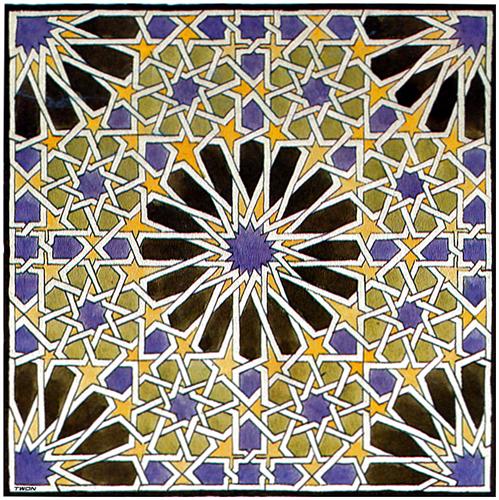
A key part of the Mural Mosaic tile painting by Escher in 1922, is that he has included the Border in detail. The Border gives an indication of what happens to the lines when they hit the sides and where they feed back into the design. In the quarter section detail of the mural below you can see marks on the Border.

A line leaving the design either joins the border (so that you can follow where it goes) or goes under the border (and you can deduce where it re-emerges).  It is not easy to work all these paths out at first, but there is a logic to it.  If in doubt between two choices, one of them usually has a clear answer leaving only one option for the other.  Another aid to us is that each side of the Border is identical in the same direction around the design, so if the marks are not clear on one side you can check at a corresponding point on another side.

Detail to show Border. Escher mural mosaic in the Alhambra. WikiArt. Mick Burton study.

Detail to show Border. Escher mural mosaic in the Alhambra. WikiArt. Mick Burton study.

.
When I first started this research I did a basic hand copy showing all the lines hitting the sides and then showed each one as a loose end outside the square.  I then studied the border on the Mosaic to work out how all the loose ends should be joined up and charted them – this initial chart was in STAGE 1, and I show it again at the end of this post.

That was relatively easy, observing the result of what artist had done.  The hard bit is working out  from scratch which loose ends to tie up to produce continuous lines in a way which would still enable the colours to be allocated by the Alternate Overdraw (or equivalent process used by the artist).

According to Eric Broug in his demonstration video’s, the tile rectangle containing the design would be selected out of a larger pattern area.  In my own art, when I have drawn a large continuous line pattern and completed the Alternate Overdraw (so that I know the colour sequence everywhere) I can pick out a small section to display which of course already has the Alternate Overdraws.  Similarly, the Islamic artist producing the Mosaic would know the full colouring etc for the tile section.

I show below the design with all the loose ends and Alternate Overdraws in Red.  At this stage the artist would not know how many continuous lines would occur in the tile section on its own.  He will have also needed to produce a straight edge on the corners and other parts of the perimeter to block unwanted lines which encroached from the outside pattern.

Section of larger pattern with Alternate Overdraws and loose ends showing whether overdrawn. Mick Burton study.

Section of larger pattern with Alternate Overdraws and loose ends showing whether overdrawn. Mick Burton study.

You will see from the loose ends that half of them are overdrawn in Red and half not. If you connect up pairs of the overdrawn, and pairs of the not overdrawn, loose ends then there will be continuous lines throughout the design and the Alternate Overdraw Template will be unaffected. If I connect up the not overdrawn pairs around each corner of the design, then working along the sides both overdrawn pairs and not overdrawn pairs work out consecutively. This matches the line direction message in the Border on the Mosaic design.  Here is a chart (previously in STAGE 1) showing all the loose end connections.  We know from STAGE 1 that there are two continuous lines, which makes the case strong regarding the artist using Alternate Overdraw, but it would not have mattered if there were more than two.

Escher Islamic Tile. Basic line structure, with border connections. Mick Burton continuous line study.

Escher Islamic Tile. Basic line structure, with border connections. Mick Burton continuous line study.

Having looked at Borders in detail, that prepares us for the final STAGE 5 where I show how we can turn this into a Single Continuous Line design.  

I will also give you my opinion on what the original Artist thought about a Single Continuous Line and why I think he is definitely an Artist and not just a craftsman.

Mick Burton Continuous Line Blog.

Alternate Overdraw Applied to Escher Islamic Mosaic Continuous Lines, STAGE 2.

Escher painting 1922 of Islamic Mosaic tile at the Alhambra. WikiArt. Continuous line study by Mick Burton.

Escher painting 1922 of Islamic Mosaic tile at the Alhambra. WikiArt. Continuous line study by Mick Burton.

Before applying my Alternate Overdraw, which I use to allocate colours to Continuous Lines, I will give you my analysis of the colours in the original Mosaic and what I feel were the artist’s ideas behind the design.

Eric Broug states, in his YouTube demonstration “How Grids and Patterns Work Together” that this is a 16 point star surrounded by 8 point stars.  Geometrically you can produce stars with many different numbers of points.  Having done many planetary paintings myself, I feel that the original artist has realised that in this case we have a central Sun and 8 planets surrounding it which can represent our solar system (we can ignore Pluto as a planet as it only featured as such for a part of the last century).  The colours the artist uses reflect many aspects of this planetary situation –

a.  YELLOW is used as the colour for the flaming surfaces of the central Sun and the corner Suns.  All other yellow areas have star like shapes and represent distant stars peppering the background.

b.  PURPLE is used for the centres of the Suns and the 8 Planets.  Purple is also used for the lines of areas along the sides, vertically and horizontally from the centres of the sides and diagonally (the lines of purple areas may simply be decorative).

c.  BLACK is used for the “fan blade” shapes emanating from the Suns.  In my planetary paintings I often use black for the background outside a drawing and for the gaps through the  drawing .  The artist here could be using the same idea, so that the blades are in fact deep space seen beyond the Suns.

d.  GREEN is used to surround each Planet and I interpret this as representing life on each Planet, not just ours.

The process for completing an Alternate Overdraw is covered in my Post dated 10 September, 2014  (9/10/2014)  entitled “Alternate Overdraw on Continuous Line Drawing”.

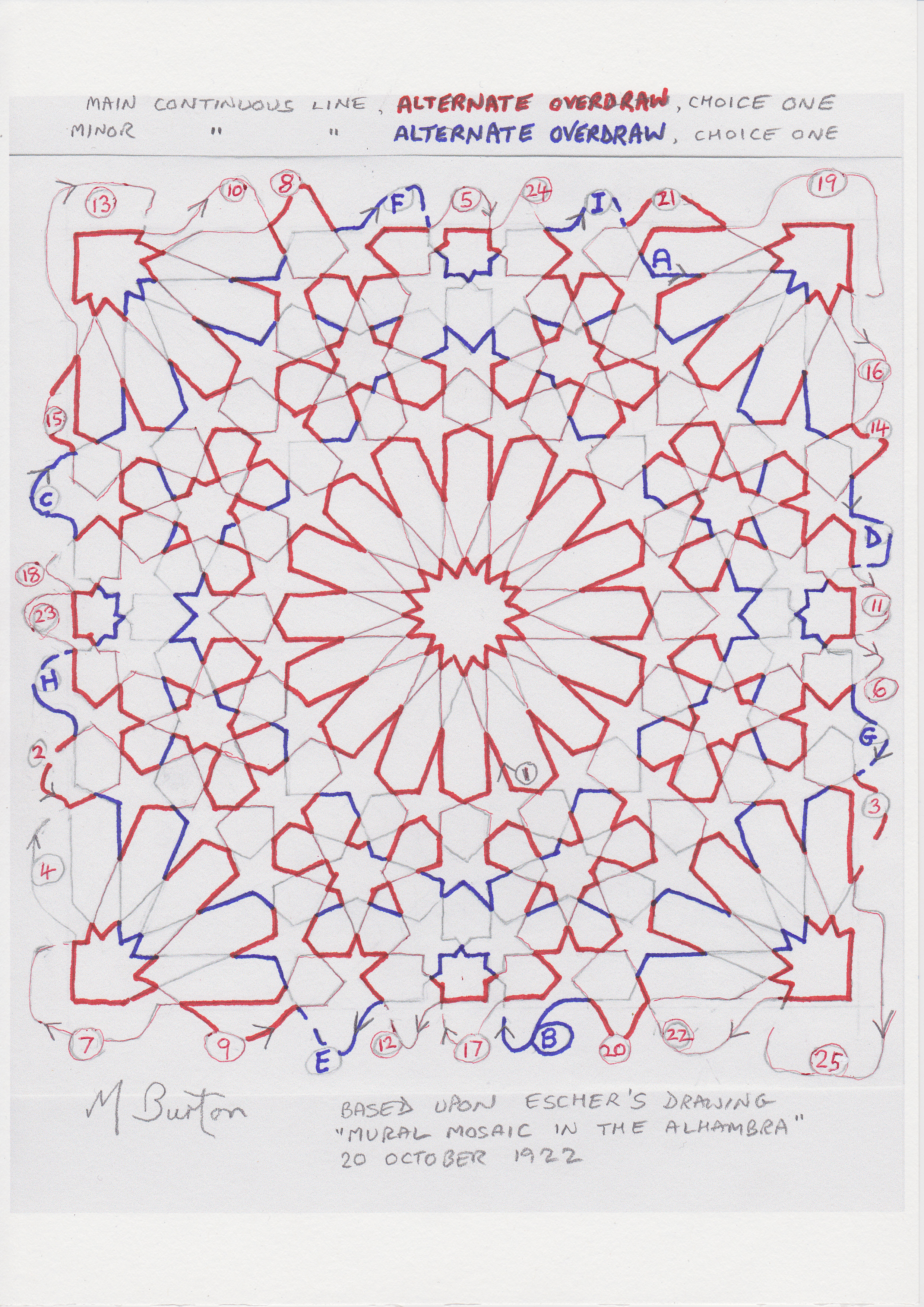
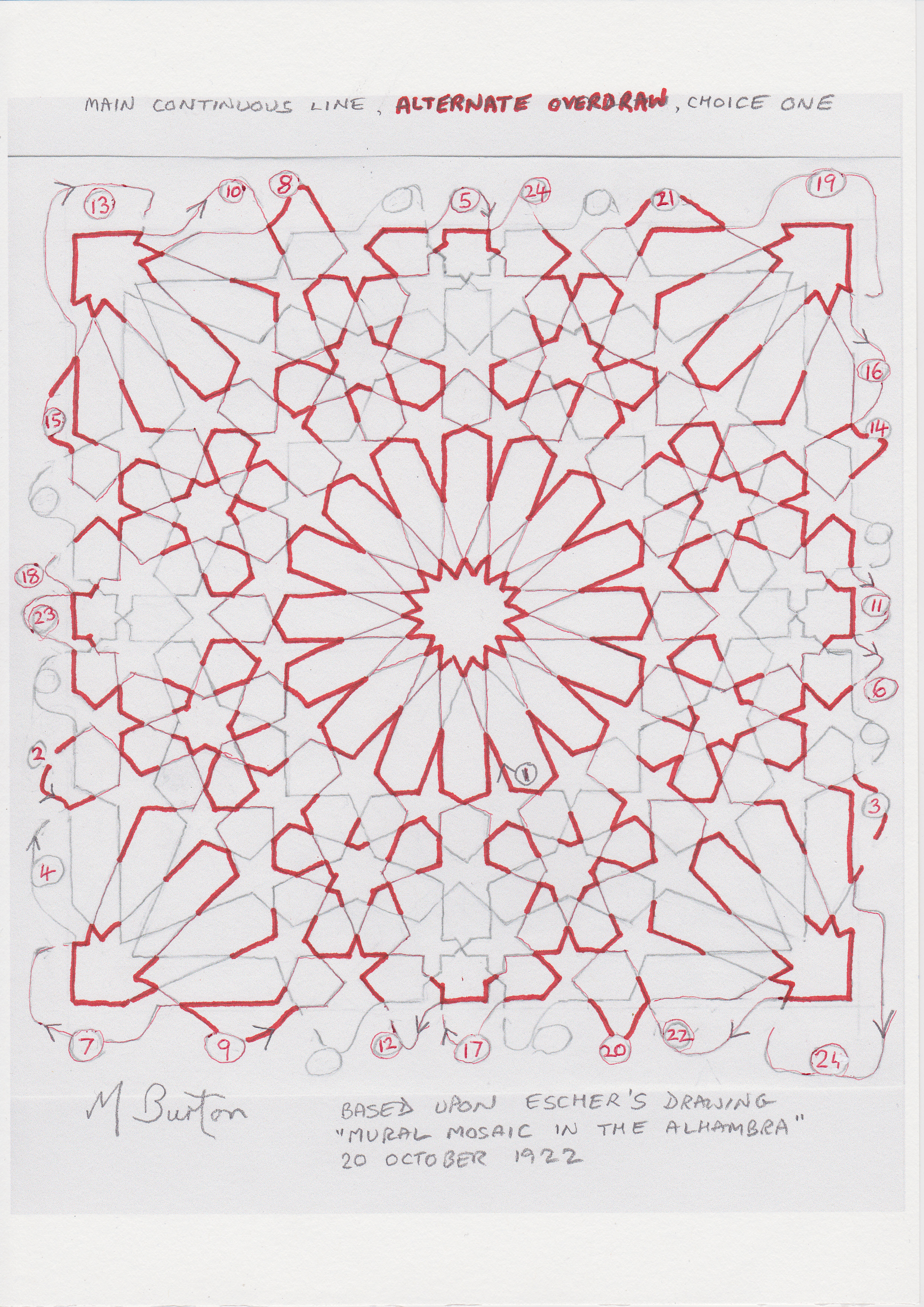
In the previous post, STAGE 1, I showed that there are two continuous lines in the Mosaic.  I apply my Alternate Overdraw to produce a template for me to work with to allocate a colour sequence.  I have to bear in mind that there are 2 Overdraw results and 1 colour sequence for a single continuous line and 4 Overdraw results and 2 colour sequences for two continuous lines.

My experience tells me that the Alternate Overdraw, which will produce a Template best representing this Planetary composition, will have –

a.  An Overdraw for the Main continuous line commencing by overdrawing (in Red) a side of a fan blade of the central Sun, and

b.  An Overdraw for the Minor continuous line commencing by overdrawing (in Blue) a side of a fan blade on a corner Sun.

Main continuous line, Alternate Overdraw, choice 1. Mick Burton, Escher Mosaic study.

Main continuous line, Alternate Overdraw, choice 1. Mick Burton, Escher Mosaic study.

Minor Continuous Line, Alternate Overdraw in Blue, Choice 1. Mick Burton Escher Mosaic study.

Minor Continuous Line, Alternate Overdraw in Blue, Choice 1. Mick Burton Escher Mosaic study.

The aim  of the Alternate Overdraw is to create channels within the design where two colours can be allocated alternately within each channel and that adjacent channels have different pairs of colours.  An overall sequence of colours then follows across channel boundaries.

My experience told me, at this stage, that my colour sequence was likely to match the original Mosaic in and around the five Suns, but less so elsewhere.

I will show my attempts at allocating corresponding colours in the NEXT POST.  I will also explain why I feel that the original artist may have used the Alternate Overdraw or an equivalent method.

Mick Burton Continuous Line Blog.

Salvador Dali continuous line drawing

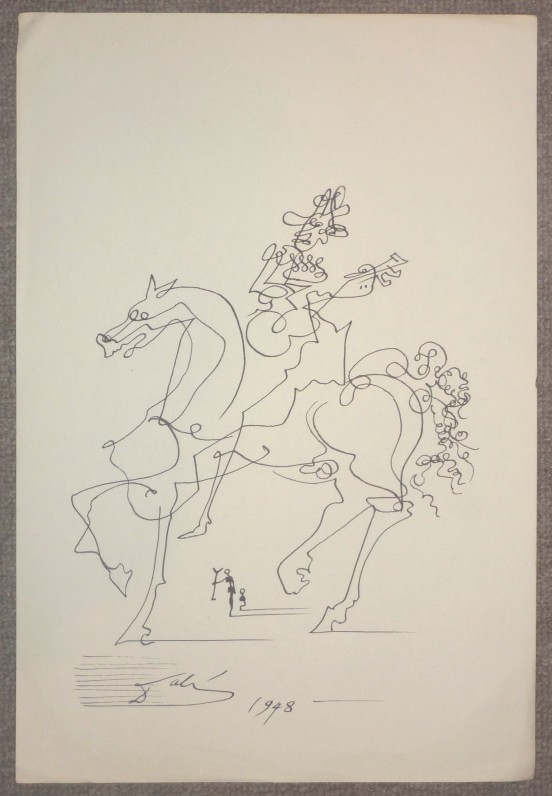
Dali continuous line drawing in pen and ink, guitar player on horse, dated 1948.

Dali continuous line drawing in pen and ink, guitar player on horse, dated 1948.

 This is an original pen and ink drawing on paper and is dated 1948 and signed Dali.  I have referred to One Line drawings by Picasso in a previous post, but this drawing is virtually a continuous line drawing.

When I say virtually, I mean that the artist has used a series of lines throughout the drawing which could be connected up.  I presume that using a dip pen meant that as ink ran out he took the pen off the paper to dip the nib and then continued from a point nearby. 

In effect, he has drawn all the key areas in single lines, which is the initial stage in my drawings, but presumably with no intention of connecting them up or reviewing them further.  I have little doubt that the whole drawing would have been completed relatively quickly in one session.

I bought the drawing “in the manner of Salvador Dali”, as there was no provenance with it, but my first glance convinced me that I had to have it if possible.  It was the continuous line drawing effect, with an added bonus when I saw the signature.  Whoever did the drawing greatly impressed me and my researches into Dali pictures of around that time confirmed that he was producing drawings similar to this, with several elements the same. 

Many of these elements appear in “50 Secrets of Magic Craftsmanship” by Salvador Dali published in 1948.  In fact he seems to have done a quick drawing inside the front cover of  some of the original edition copies.