Tag Archives: Mick Burton Yorkshire artist

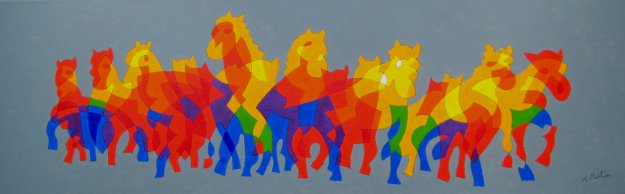
Kaleidoscopic Wild Horses, continuous line drawing with colour sequence.

Wild Horses, June 2017

Kaleidoscopic Wild Horses. Single Continuous Line Drawing with colour sequence in acrylic on canvas.  I happened to have a canvas 36″ x 10″ previously intended for an upright picture idea.  Mick Burton continuous line artist 2017.

This painting originated from a continuous line drawing which I produced for a demonstration at Stainbeck Arts Club, Chapel Allerton in Leeds in May 2017.  

IMG_0883 -Horses line.

Wild Horses,  single continuous line drawing. Demonstration at Stainbeck Arts Club. Mick Burton, continuous line artist 2017.

When I was thinking about a subject for the demonstration I saw an advert on the TV for the Cheltenham Festival which just showed loads of horses running – why there were no riders or jumps I do not know.  This also reminded me of one of my favourite paintings – “Scotland Forever” by Lady Butler in Leeds Art Gallery, painted in 1881.  A bit like “Charge of the Light Brigade” but straight at you, with the horses wild eyed and seeming to leap out of the painting.

See it at   http://www.leedsartgallery.co.uk/gallery/listings/l0081.php

Lady Butler painted a lot of war scenes and of course she had no military experience.  She was, however, married to a General and she persuaded him to let her watch manoeuvres.  In preparation for this picture she asked that the cavalry ride straight towards her so that she could get the feel for facing a charge.

When I had finished the demonstration, which was a result considerably rougher than the above, the members asked about colours.  I had not intended to talk much about colours, as I thought that my approach to drawing the lines would be enough at this session, but we had a solid half hour talking about my method and ideas about colour.  They said that they looked forward to seeing the image in full colour, so here it is.

My original intention was to do a black and white alternate shading version only, and this is shown below.  The tweaking which I did on the horses heads to achieve a better result in black and white was essential both to improve the continuous line and later to enhance the colouring.

IMG_0888 - Horses black & white

Wild Horses, single continuous line drawing with black and white alternate shading.  Mick Burton, continuous line artist 2017

Initially I did my normal approach to colour sequence, where I devised a 6 colour range (white, lemon, golden yellow, orange, vermilion red and crimson alizarin) to fit my alternate overdraw template for this image.  

This resulted in gold and vermilion appearing on all outer areas and I thought that I needed a darker effect in the lower half of the image.  So I substituted cobalt blue for gold along the bottom legs of the horses and finished up also substituting, on an ad hoc basis, some dark blue, violet and green to try and naturally leach colour balance upwards to meet existing vermilion and gold.

A fellow artist who likes my alternate overdraw and colour sequence method has told me that I should always apply it fully to get the natural result.  Generally I would agree, but thought that I needed to break some rules on this occasion.  I try and mirror nature in my art and of course nature evolves by breaking a few rules. 

Joan and I visited my Aunty Ann a couple of weeks ago.  She is 99 years old and still as bright as a bobbin.  She is a good artist and only gave up painting relatively recently, and always wants to see my latest stuff.  i took the Wild Horses along.  It took up the length of the settee and she was delighted with the colours.  I then realised that the painting’s reflection in the shiny metal fire surround made the composition even more abstract.
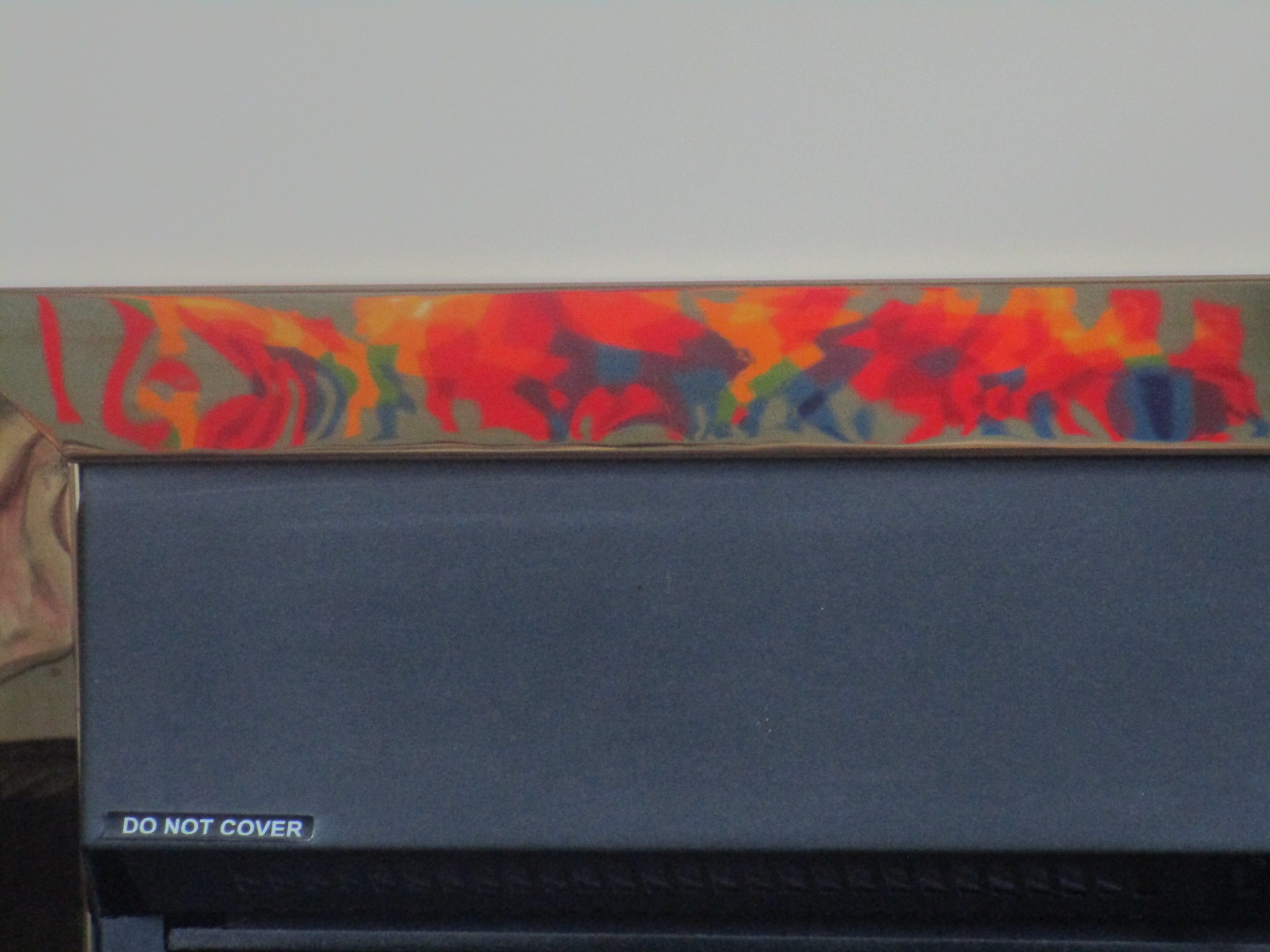
Aunty Ann’s shiny metal fire surround reflecting Wild Horses. Mick Burton, continuous line artist, 2017.


Two different Reflections of Wild Horses on metal fireplace surround, detail strips. Mick Burton, continuous line artist.
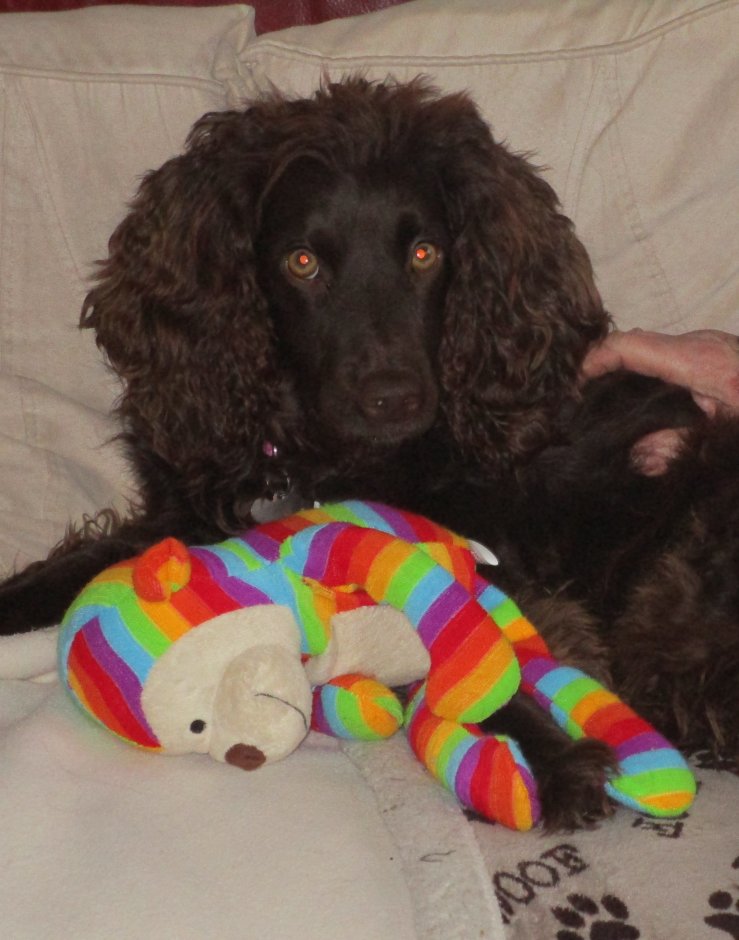
Nessie the cockapoo visits Gledhow Valley

img_0485

Nessie the cockapoo arrives with a favourite toy. How did she know my favourite colour range. Mick Burton, continuous line artist.
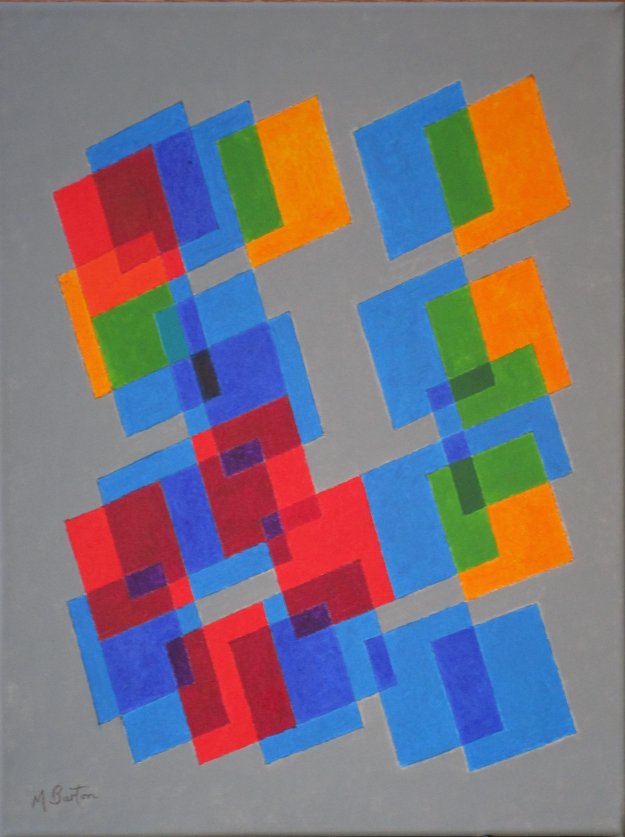
Nessie the cockapoo has come to stay for a week whilst Helen and Janet are in California.  She arrived waving one of her favourite toys, which just happens to have a range of colours similar to those in a recent painting of mine.

img_0224

“Knight’s Tour Fragments”, acrylic on canvas. Exhibited at Harrogate and Nidderdale Art Club Exhibition in November 2016. Mick Burton, continuous line artist.
Nessie is two and a half and lives in a village in Worcestershire in a house almost surrounded by common land.  Strangely, there are no cats in the village and no squirrels (although several years ago one appeared in the garden the day we arrived for a visit, and it was suggested that it had been a stowaway in our car).  Hens roam free in the garden – so where are the foxes?  No greater spotted woodpeckers, they are all green.

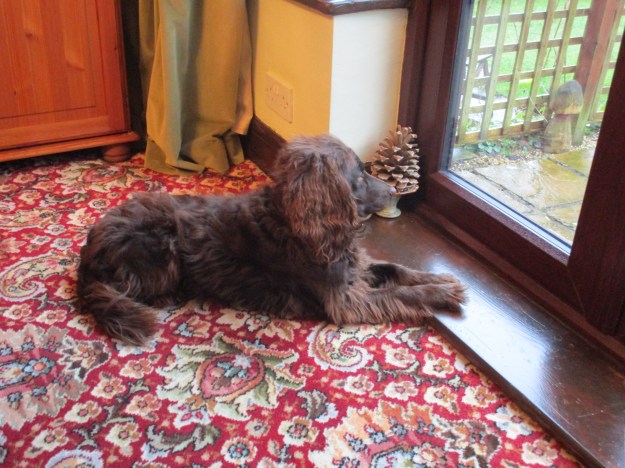
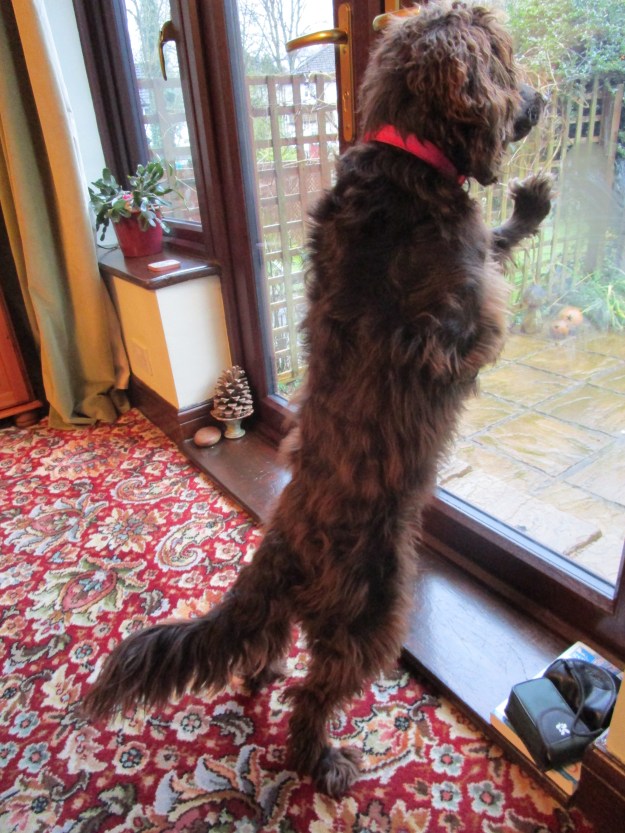
Nessie’s favourite spot in our house is by the French Windows at the back.  She watches the birds and squirrels endlessly, and it is good to lie down on the job.

img_0510

Nessie, the cockapoo, watching birds and squirrels. Why not take it easy?   Mick Burton, continuous line artist.
But Nessie is not used to seeing cats, and we have plenty of those.  Suddenly we hear barking and scraping at the window.

img_0519

Nessie spots a cat and all hell breaks loose.  Mick Burton, continuous line artist.
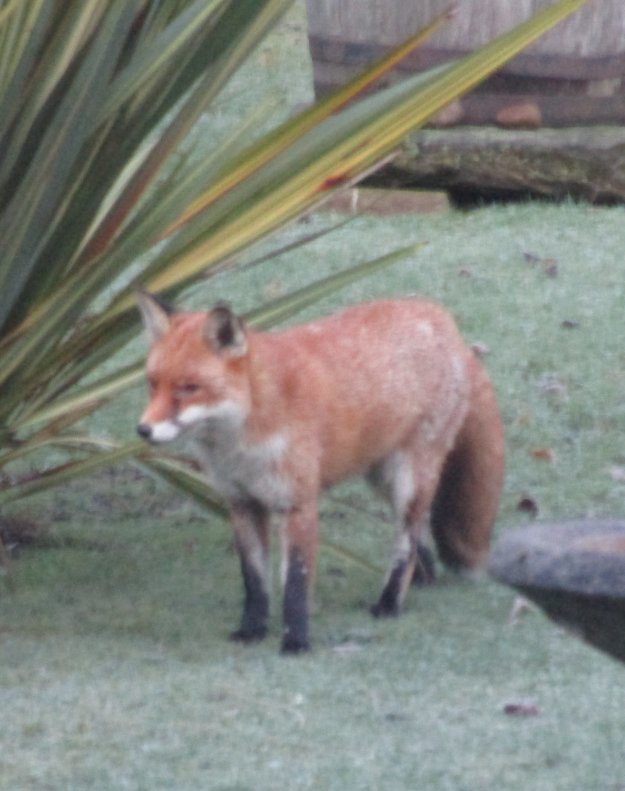
Hopefully one of the foxes will turn up whilst Nessie is here.  We often see one or more during the day, and we even had one on the garage roof marking its territory.  Here is a photo of one in the garden in late January 2017.

img_0334

A Gledhow Valley fox in the garden in January 2017.  Mick Burton, continuous line artist.
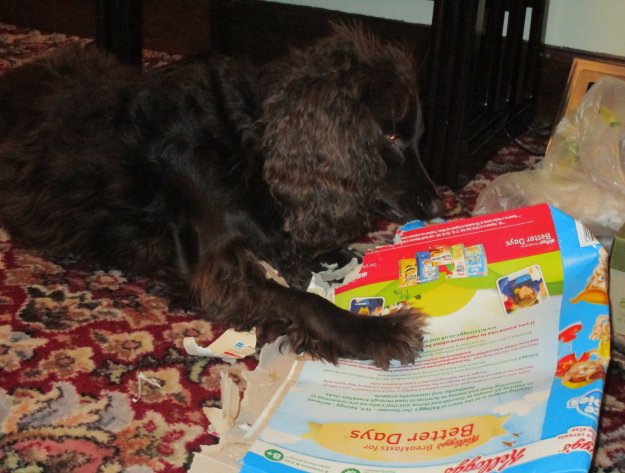
Nessie eats sensibly and feels that there my be more nurishment in the cardboard box than in the breakfast cereals themselves.

img_0498

Nessie tucking in to a cardboard box which had contained breakfast cereals.  Mick Burton, continuous line artist.
Of course the highlight of each day for Nessie is the walk through Gledhow Valley Woods to the lake.

img_0551

Nessie, the cockapoo, can’t wait to go to Gledhow Valley Woods, and the lake, with Joan and me.  Mick Burton, continuous line artist.
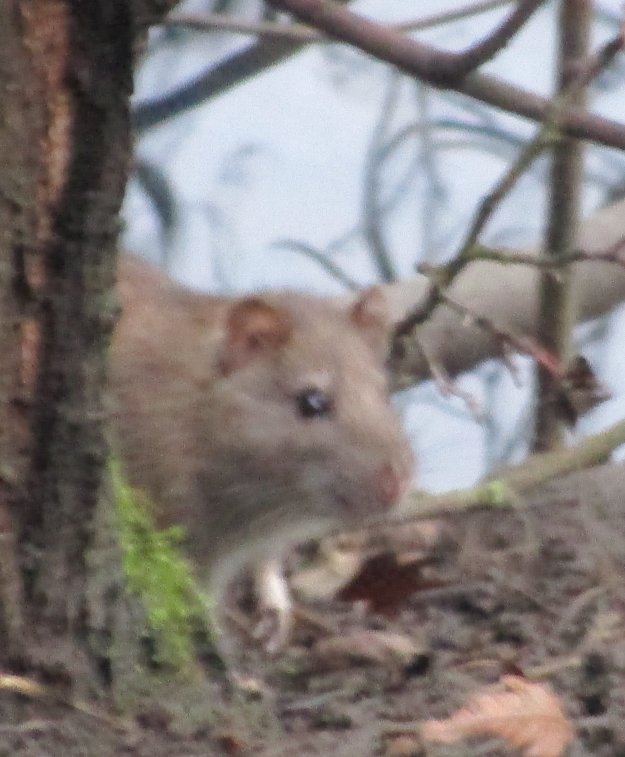
We are used to seeing the odd rat scamper across the path by the lake, as well as seeing how well they swim.  One rat dashing across suddenly realised that Nessie was passing and took off, missing Nessie’s nose by a whisker.  I am not good at taking photos of flying rats, so here is one nearby wondering what is going on.

img_0389

A rat peeping from behind a tree on the banks of Gledhow Valley Lake.  Mick Burton, continuous line artist.
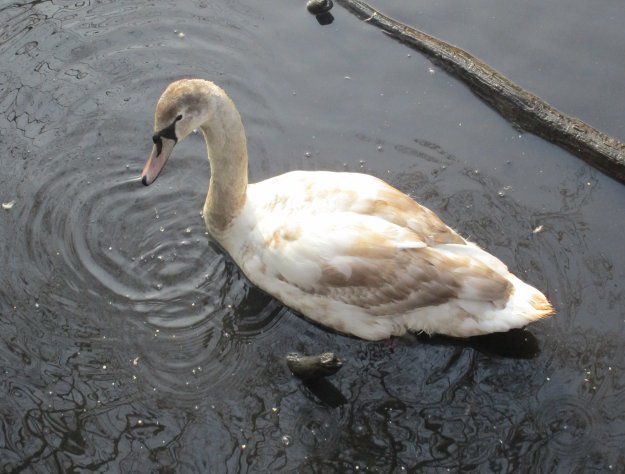
Twenty ducks who were sitting on the bank and the path fly off when they see Nessie, and Joan has brought some oats to feed to the Swan.  There is only one swan left at the lake just now and it is still in its first year.

img_0536

Young swan, now living alone on Gledhow Valley Lake.  Mick Burton, continuous line artist.

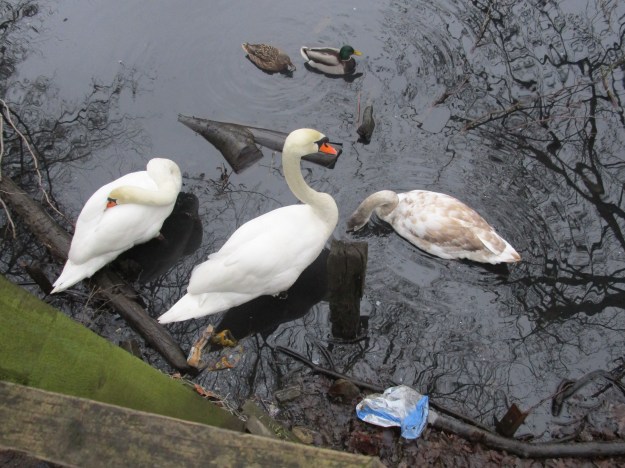
We have been concerned for some months about the swans, particularly since the water level dropped after a digger cleared rubbish from the dam end. Large areas of silt have been on view where the swans nest.  Here are the adults and one youngster in late January 2017.

img_0358

Family of swans on Gledhow Valley Lake. Photo taken in late January 2017 before the adults abandoned the lake.  I hope the swans did not have to pull bread slices from this wrapper themselves.   Mick Burton, continuous line artist.

At the time of this photo, showing the two adults and the above young swan in late January 2017, the second youngster had been ostracized and was sitting in a corner of the lake.  When we were litter picking this Sunday on the monthly action day with Friends of Gledhow Valley Woods, they told us that soon after the photo foxes killed this young bird and then the adults left the lake.  One adult was found wandering in the Harehills area and the RSPCA took it to Roundhay Park lake.  A lady told us that the other adult was walking past her house in Oakwood, presumably heading for Roundhay Park lake too.  So we hope that things work out well for the adults at Roundhay and our young  survivor here in Gledhow.

img_0541

Nessie spots a cat she has not seen before. Henry adopts defensive mode.  Mick Burton, continuous line artist, Leeds.

On the way home from the lake, Nessie confronted a cat.  This is Henry and he stood sideways and seemed to double in size.  Nessie was on her lead, which was probable just as well for Nessie.

img_0543-copy

Henry the marmalade cat from Gledhow Valley.  Dogs beware.   Mick Burton, continuous line artist.
Anna and Emma, the children next door, went to the woods with Nessie today and had been looking forward to it for days.  Nessie gets on well with everyone.

She has enjoyed her holiday in Gledhow Valley and we are taking her back to the land of green woodpeckers.

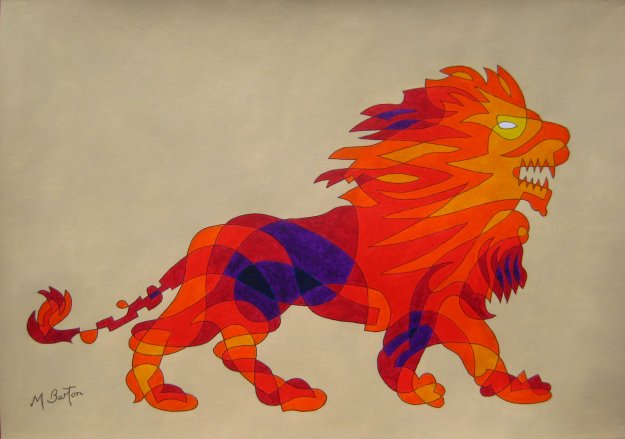
Leeds Olympic Lion, a new single continuous line painting by Mick Burton.

Leeds Olympic Lion.   Mick Burton

Leeds Olympic Lion, coloured in many shades of red, white and blue to commemorate all the Leeds based athletes and swimmers who brought back medals from the Rio Olympics, 2016.  Mick Burton single continuous line drawing with colour sequence.

I did a demonstration at Farsley Art Group on 12 July 2016 and the continuous line drawing I used as an example was the basis for the above painting. The Group showed a lot of interest and produced many fine attempts at continuous line during my workshop. The club kindly featured me on their website, showing some of my drawings as well as work by members.  I gave them a free hand to put their own stamp on their continuous lines so we had some great variations.

Joan, my partner, watched many swimming and diving events on the TV during the Olympics broadcasts.  She worked at the Leeds International Pool and the new John Charles Centre, in various swimming organising roles, before she retired in 2012 and was delighted with the results of the Leeds members of the Great Britain team and their coaches.

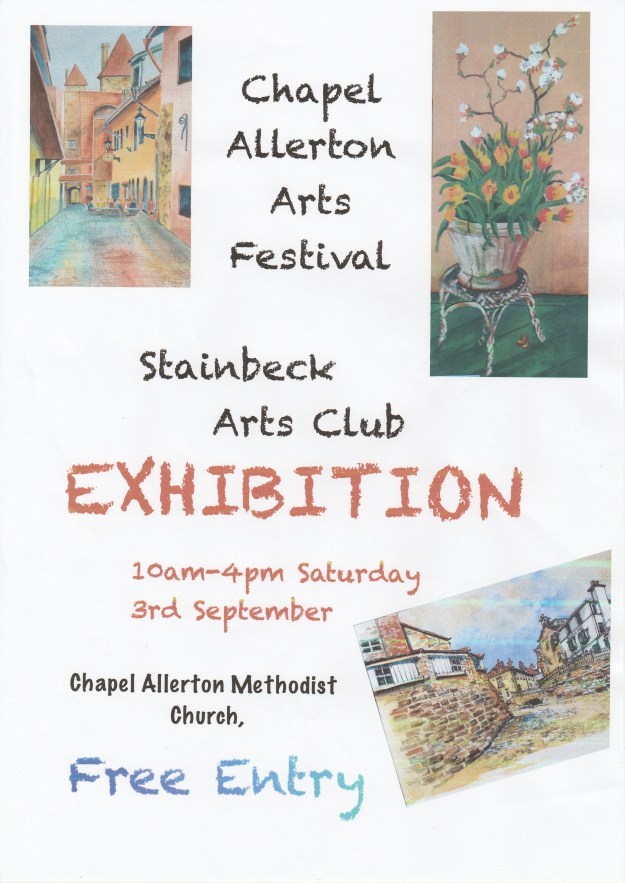
As the athletes all had the red, white and blue lion on their track suits I felt I had to colour my Lion in a range of similar colours and call it the Leeds Olympic Lion.  The painting will be exhibited in the Stainbeck Arts Club Annual Exhibition on Saturday 3 September 2016.  The exhibition is part of the Chapel Allerton Arts Festival taking place in north Leeds this week.Stainbeck Arts Club Poster

Joan’s daughter, Helen Frank, represented Great Britain in the 100 metres breast stroke in the Seoul Olympics in 1988 and was one of five swimmers from Leeds.  Adrian Moorhouse won a swimming gold medal, in the 100 metres breastroke, in 1988.  A gold by a British swimmer was not achieved again by a  British swimmer until 2016.

Leeds Olympic Swimmers at Seoul 1988

Helen brought back a commemorative plate from Seoul, which is part of Joan’s collection of Olympic Plates.

Seoul 1988 Olympics plate


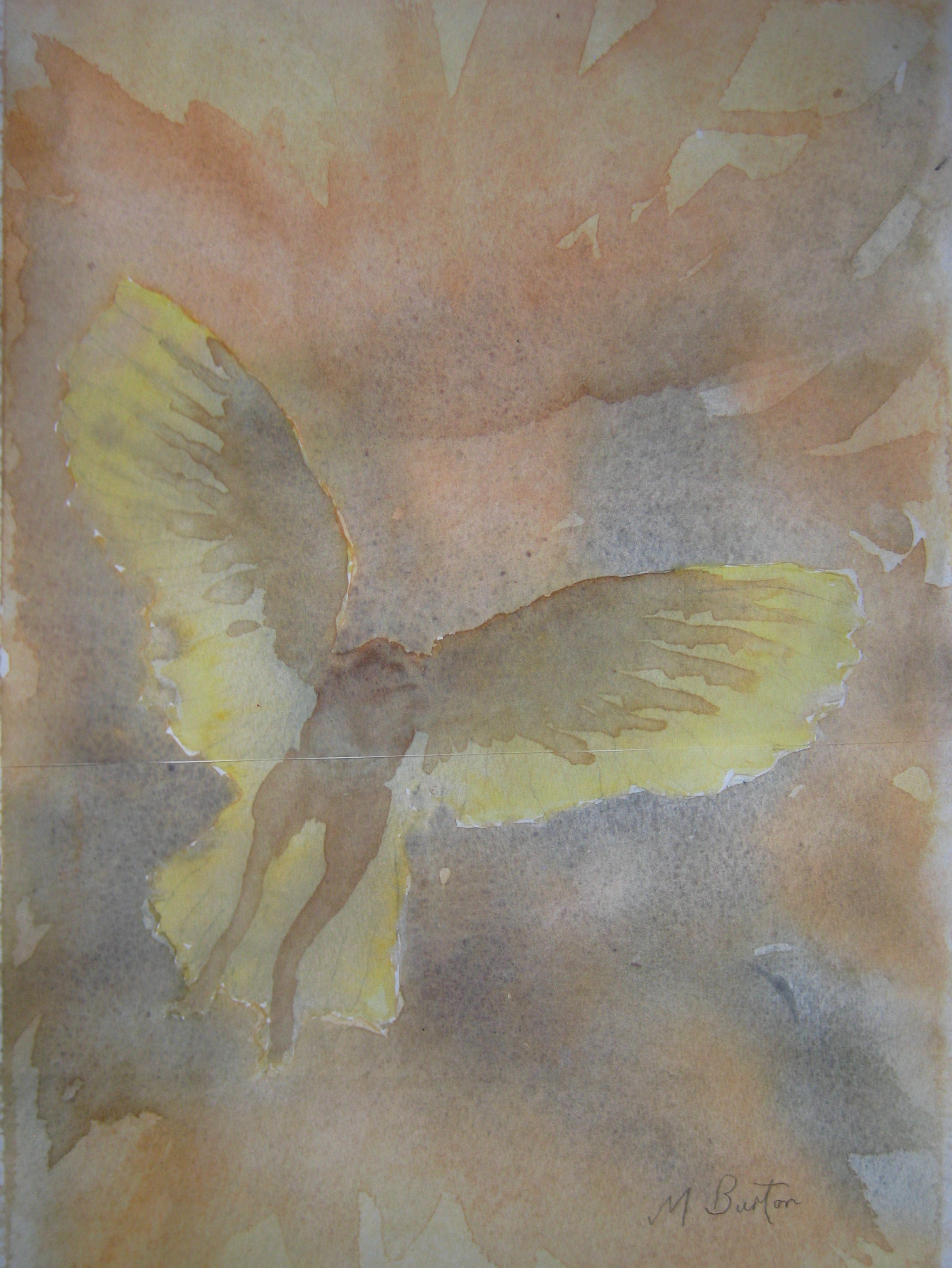
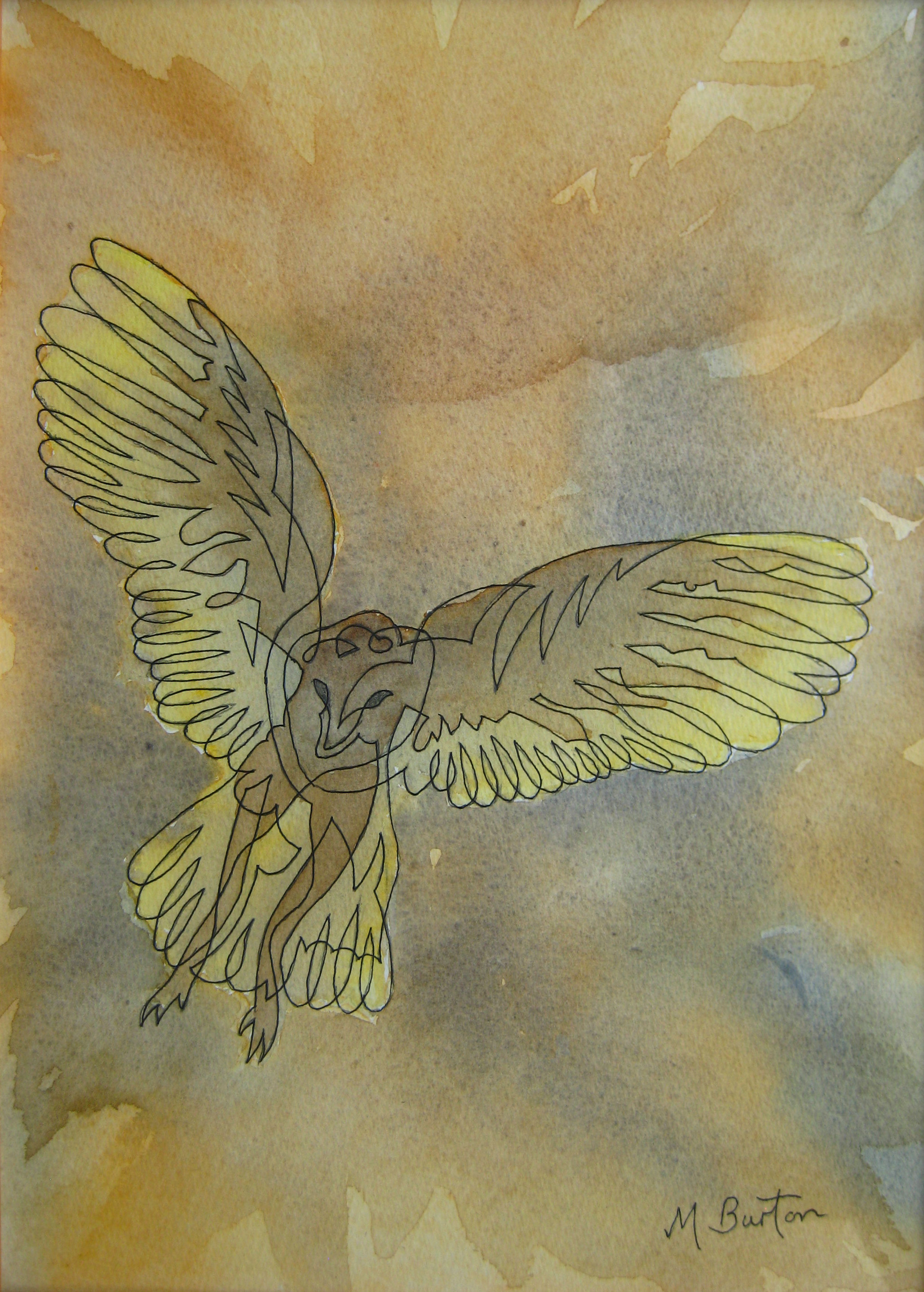
Barn Owl continuous line drawing at Harrogate and Nidderdale Art Exhibition

Continuous line drawing of Barn Owl onto Wet on Wet watercolour. Mick Burton.

Single continuous line drawing of Barn Owl onto Wet on Wet watercolour. Mick Burton continuous line artist, 2015.

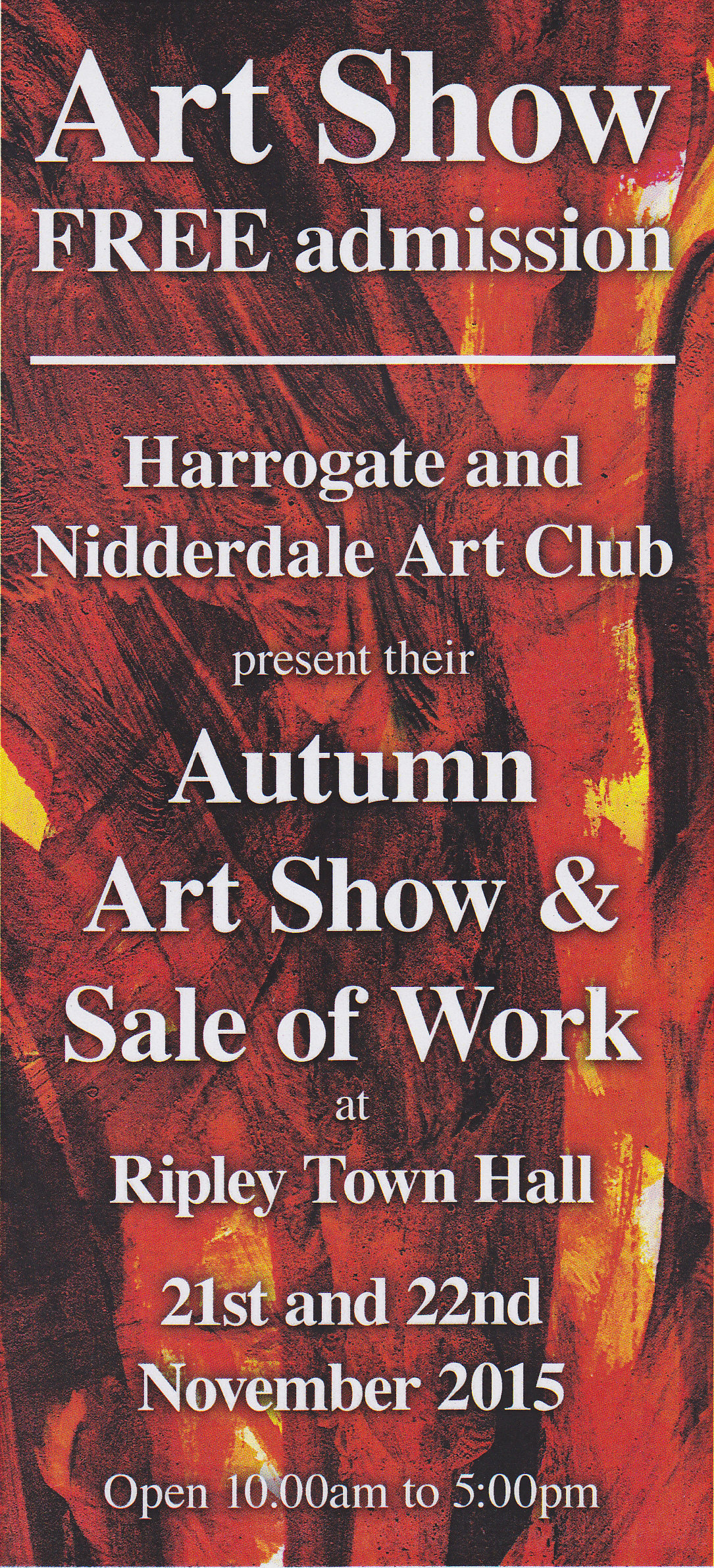
This Barn Owl painting will be one of my eight pictures on display at  the Harrogate and Nidderdale Art Club Autumn Exhibition in Ripley Town Hall, near Harrogate, on 21 & 22 November 2015.  I then intend to submit it to the next Association of Animal Artists Exhibition.

Harrogate and Nidderdale Art Club exhibition at Ripley Town Hall, near Harrogate, 21 & 22 November 2015.

Harrogate and Nidderdale Art Club exhibition at Ripley Town Hall, near Harrogate, 21 & 22 November 2015.

Visiting demonstrators at art clubs are amazingly varied and it is usually useful to attempt whatever they ask the club members to do.  I have done some workshops myself and appreciate the efforts of club members who really have a go at continuous line drawings, and associated things I show, even though to is unlikely that any of them will take up my technique as a main style.  Hopefully people can pick up things which can apply to other styles, such as building abstract patterns, using colour sequences, drawing key identifying parts of a subject and trying to manage a picture which sometimes appears to be drawing itself !

Charles Kelly from Bradford, who I have seen doing demonstrations before, came to Stainbeck Arts Club a couple of months ago and said he was doing a workshop this time.  Watercolour tends to be the most popular topic at art clubs, but Charles has a spectacular approach to “wet on wet” and this time we were doing it too.  Here is an example of his work from a demonstration to Alwoodley Art Group in 2013.

A Pair of Geese, painted by Charles Kelly in a demonstration at Alwoodley Art Group in 2013.

A Pair of Geese, painted by Charles Kelly in a demonstration at Alwoodley Art Group in 2013.

My usual style of strong lines and flat colours (acrylic or poster colour) are poles apart from watercolour but I always learn something.  I have to say that using a big brush to coat large proportions of the paper with water in advance (up to selected boundaries of course) and then squeezing brush loads of watercolour in dollops all over is a bit “hairy”.  Then picking up the paper and waving it about so that the colour swishes around, like tides on a beach, reminds me of relatives of mine “panning” for gold in Victoria in the 1850’s.

Charles had brought many reference pictures which we could use and I chose one of a barn owl.  I thought that I could do washes up to the outline of the owl and also within the owl and later put a continuous line on top which more or less matched the washes.  Here is a copy of the wash I did initially, helped by some tips from Charles along the way.

Copy of Wet on Wet watercolour of Barn Owl, before I attempted the continuous line drawing. Mick Burton.

Copy of Wet on Wet watercolour of Barn Owl, before I attempted the continuous line drawing. Mick Burton.

Later, at home, I worked on the continuous line on top of the above copy.  I started by putting key lines along the outline of the owl, feathering and other features – to match the borders of colours as far as I could.  Then I added more connecting pattern and finally joined everything up and made sure I had a continuous line.

Once I was satisfied with this I traced the continuous line down onto my watercolour painting and drew over the lines in acrylic pen making final changes as I saw how the firm line was developing.

I think that the translucent effect of the feathering has worked well, although this view may not be appreciated by a victim mouse in its last moments.

Red Squirrel continuous line and Grey Squirrel photographs

Red Squirrel, continuous line with colour sequence. Mick Burton, Leeds artist.

Red Squirrel, single continuous line drawing with colour sequence. Mick Burton, Leeds continuous line artist.

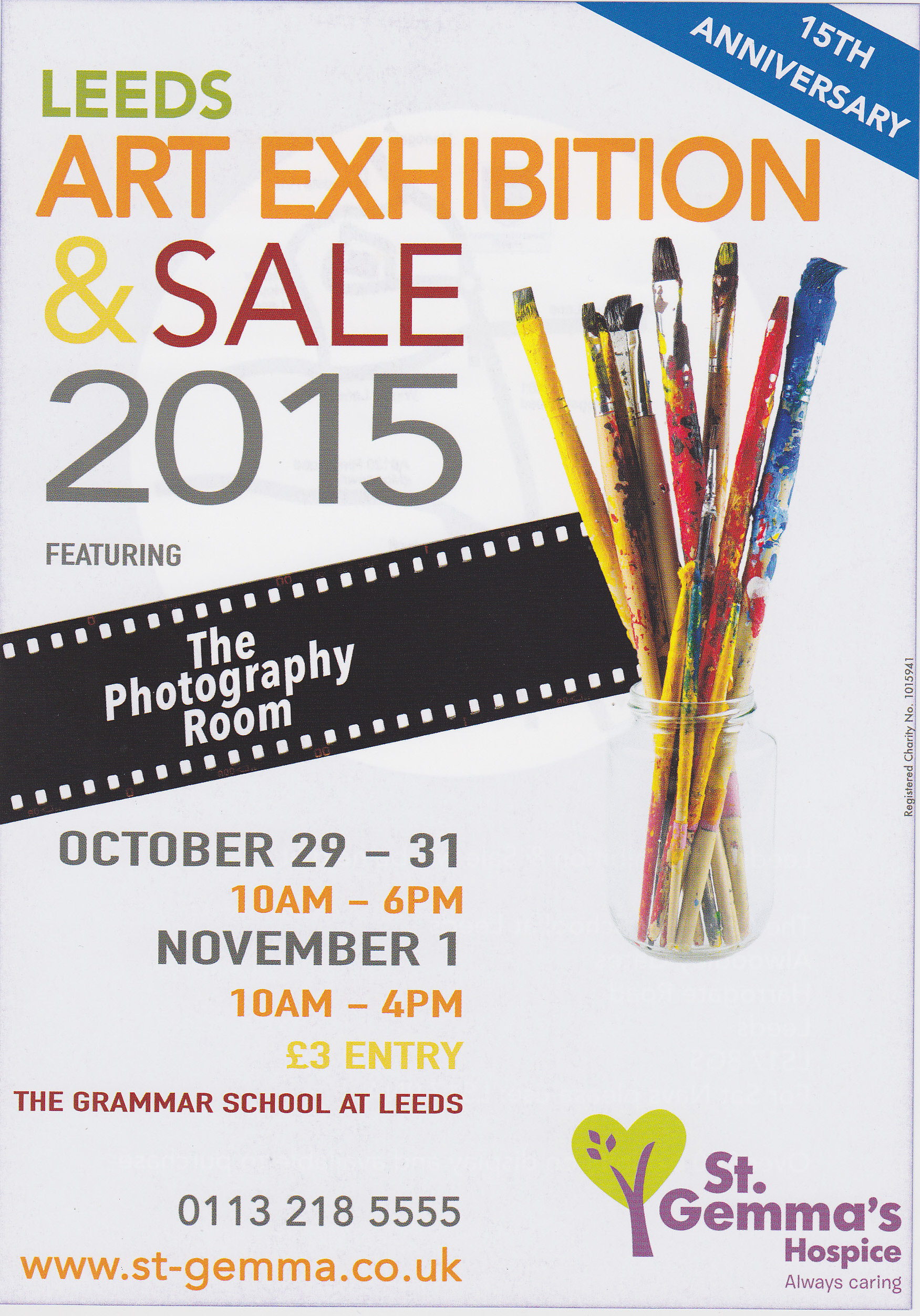
This continuous line Red Squirrel, completed with colour sequence, is one of my pictures to be hung at the Leeds Art Exhibition and Sale put on for the 15th year by St Gemma’s Hospice.

St Gemma's Leeds Art Exhibition. 29 - 31 October 2015

St Gemma’s Leeds Art Exhibition. 29 – 31 October 2015

This colour sequence squirrel is the last of a series which began with my attempt to produce a continuous line drawing with a shimmering fur effect for the squirrel.

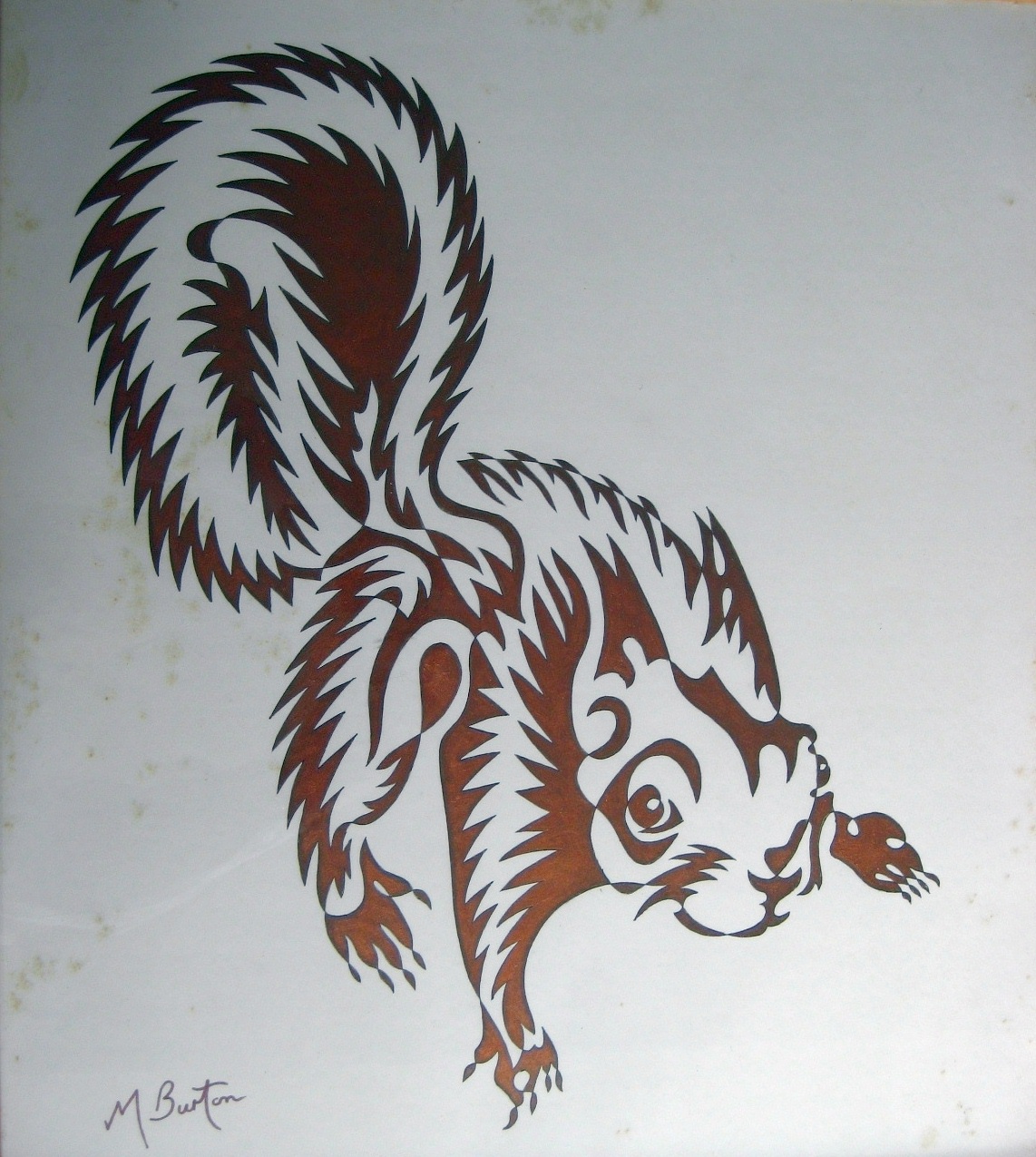
Continuous line squirrel from 1970, with shimmering effect of fur. Mick Burton, Leeds artist.

Single continuous line drawing of squirrel from 1970, with shimmering effect of fur. Mick Burton, Leeds continuous line artist.
I have a treasured memory of seeing a Red Squirrel, when I was four, sitting on a wall next to our cottage at Arncliffe Hall, in the North Riding, where my Dad was Head Gardener to Sir Hugh Bell just after the War.  I thought that completing alternate shading with copper paint would best reflect this colour in this picture from 1970.  My daughter Kate said on the phone today that she remembered this picture being in the hall when she was young.

Red Squirrel with copper alternate shading from 1970. Mick Burton, Leeds artist.

Red Squirrel, single continuous line drawing with copper alternate shading from 1970. Mick Burton, Leeds continuous line artist.
I have many clear memories of living at Ingleby Arncliffe from the age of nearly two, to four and a half when we left.

Falling out of my pram outside the local shop and crawling up the step was the earliest. There was a three legged cat, then at Sunday School one of the stamps I collected was “The Light of the World” by William Holman Hunt (my first taste of the Pre-Raphaelites) and I won the child’s sprint on sports day on the cricket ground.

In the famous terrible winter of 1947, I remember Dad helping to dig a trench in the snow drifts down to the village.  It was amazing to walk along the trench and not be able to see out.

 I once watched a pig being killed in the yard by the cottage and the workman laughed as he squirted me with the pig’s bladder.  This memory came back years later when, as a young police constable, I attended my first post mortem (of a coal miner who had been in an underground tunnel collapse).  My sergeant stood with me and assured me that it would be just like a newly killed pig being cut up, if I had ever seen one.  I said “Yes, I saw one when I was four ! “

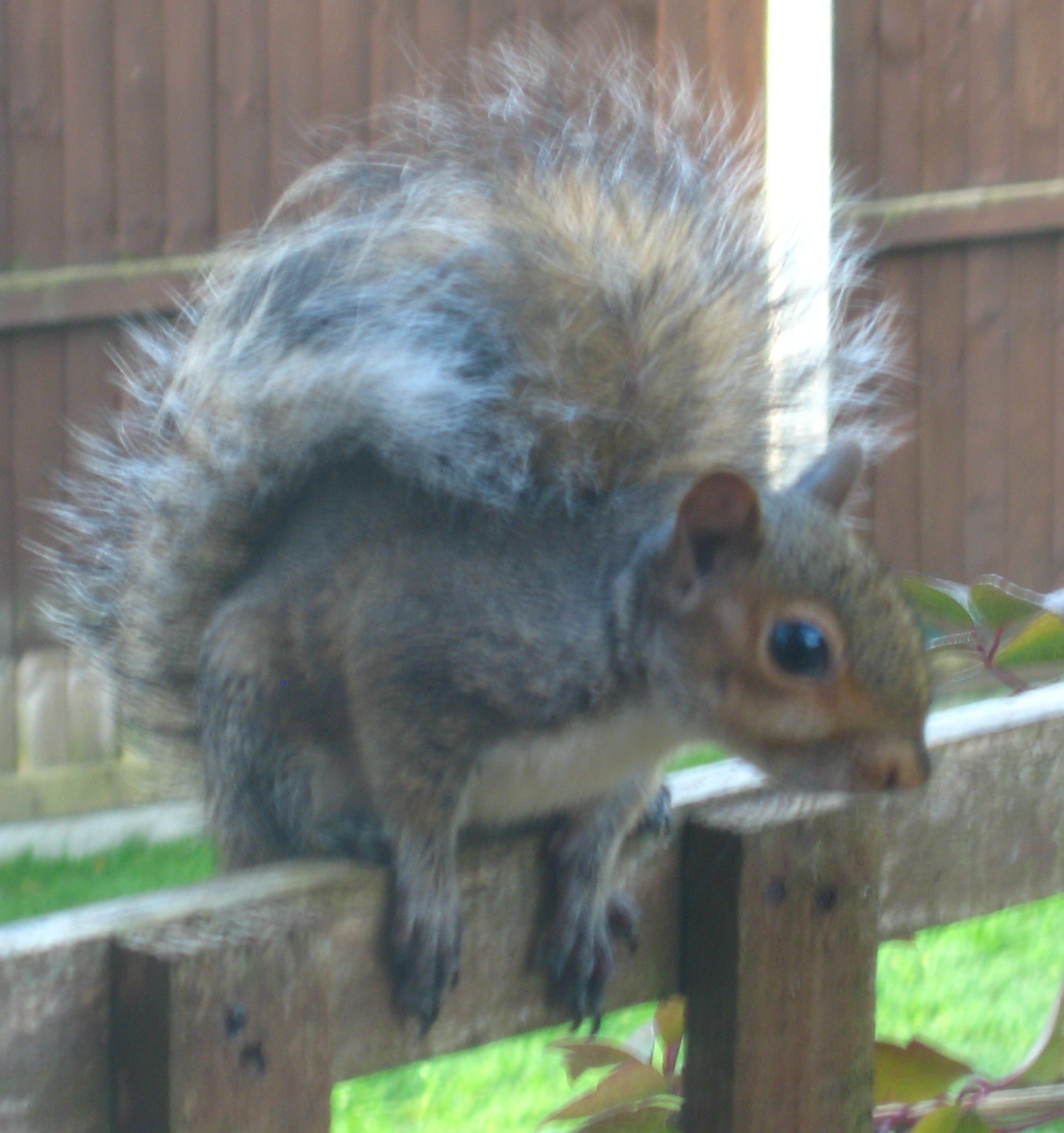
I only see grey squirrels now, mainly helping themselves to the bird seed Joan puts out.  With Gledhow Valley Woods at the end of the garden we can have five of them at a time.  Yesterday, a young squirrel was chased by a cat and ended up on the trellis a few feet from our dining room window.  Joan chased the cat away and called to me as the squirrel was too scared to move.

I took some quick photographs whist it was still there, but it became apparent that it was not going to move and was looking at me pleadingly.  So I went out and shepherded it into the bushes.  Here are some photos of a shimmering fur tail.

Young Grey Squirrel from Gledhow Valley Woods. Three feet from my window after being chased by a cat. Mick Burton, Leeds artist.
Young Grey Squirrel from Gledhow Valley Woods. Three feet from my window after being chased by a cat. Mick Burton, Leeds artist.
Young Grey Squirrel not daring to move, even though Joan had chased the cat away. Mick Burton, Leeds artist.
Young Grey Squirrel not daring to move, even though Joan had chased the cat away. Mick Burton, Leeds artist.

Young Grey Squirrel, imploring me to stop taking photos and do something about the cat. So I went out and shepherded it to the bushes. Mick Burton, Leeds artist.
Young Grey Squirrel, imploring me to stop taking photos and do something about the cat. So I went out and shepherded it to the bushes. Mick Burton, Leeds artist.
Stainbeck Arts Club Exhibition at Chapel Allerton Arts Festival

Stainbeck Arts Club Exhibition at Chapel Allerton Arts Festival, Leeds.  on Saturday 5 September 2015.  Paintings by Mick Burton, continuous line artist, are included.

Stainbeck Arts Club Exhibition at Chapel Allerton Arts Festival, Leeds. on Saturday 5 September 2015. Paintings by Mick Burton, continuous line artist, are included.

Stainbeck Arts Club, my local art club which is based in Chapel Allerton in north Leeds next to Gledhow Valley, is holding its Annual Art Exhibition as part of the Chapel Allerton Arts Festival.  The Exhibition held in Chapel Allerton Methodist Church, which is situated at the lower end of the main Festival area, will be open from 10.00 to 16.00 on Saturday 5 September 2015.

There will be many quality pictures on display, so if you are attending the Arts Festival do pop in and have a look.  Admission is free.

Chapel Allerton Arts Festival 2015, front cover of brochure.

Chapel Allerton Arts Festival 2015, front cover of brochure.

The Chapel Allerton Arts Festival was started in 1998 by members of the local community in a small way, with a few stalls and two bands playing from the back of a lorry in the evening.

It now runs from Monday to Sunday and involves many parts of the community at lots of venues during the week, including a Short Film Festival and an Art Trail. At the weekend two streets are closed off and the central parking areas taken over for all the stalls and events, including a main stage for the many quality bands. The festival is still run entirely by volunteers.

This year the Festival starts on Monday 31 August and the main day will be Saturday 5 September when people will arrive from all over the place to attend one of the star attractions in the Leeds calendar.

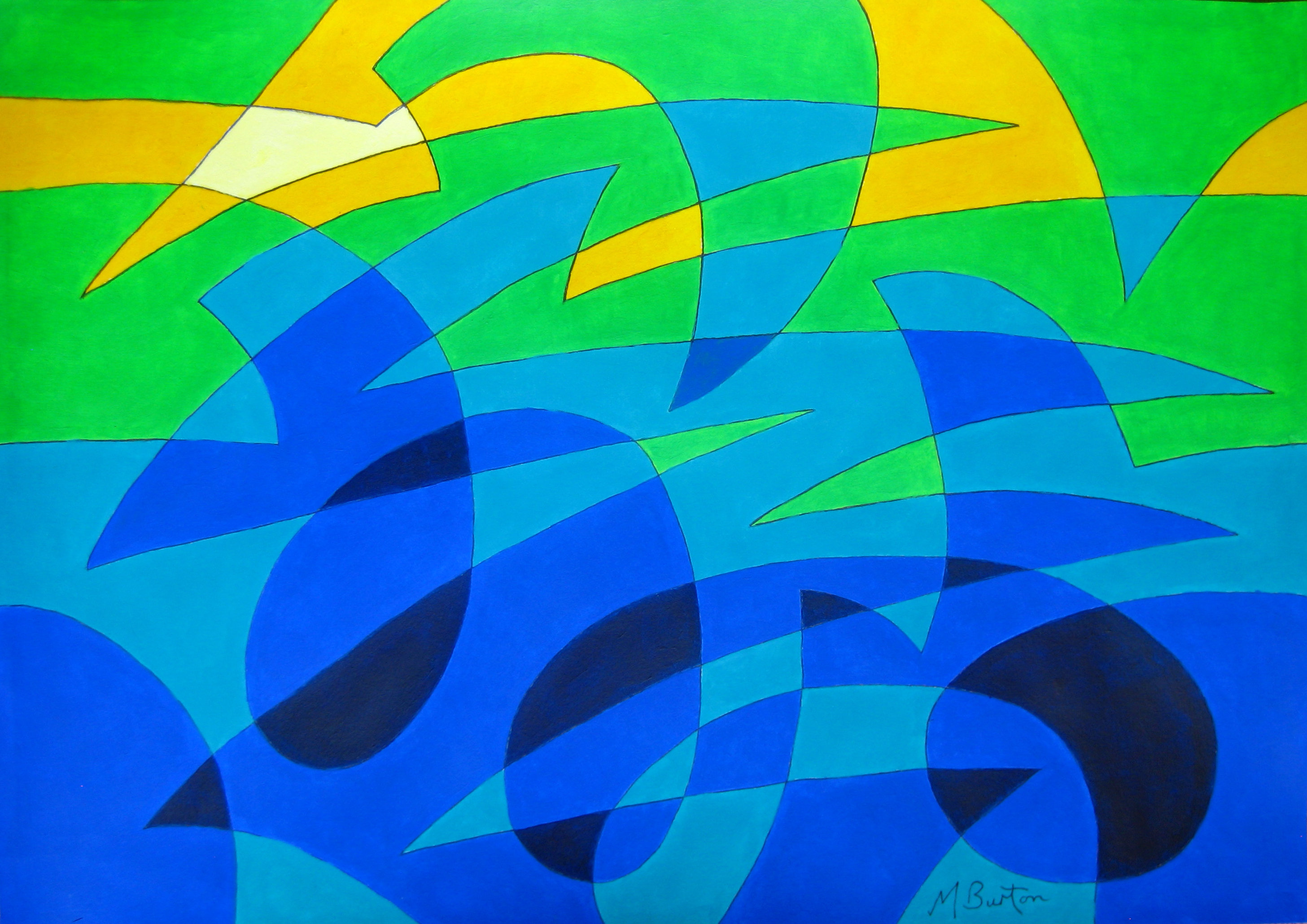
Spherical Continuous Line Abstract with Colour Sequence.

Spherical continuous line with colour sequence. Flypast Over Rolling Hills. Mick Burton 2015.

Spherical single continuous line drawing with colour sequence. Flypast Over Rolling Hills. Mick Burton, continuous line artist 2015.

I have modified my Spherical approach to continuous line from the method I described in my Continuous Line Blog post of 9 July 2014, which did not quite reflect the reality I was seeking.

I have kept the idea that when you draw out of one SIDE of the paper you need to return at the opposite SIDE at the corresponding point, so that the pattern matches vertically and after colour sequence the colours also match if you pull the paper round into a tube shape.  This is similar to the equator on a globe of the world matching.

Previously I had said that when going out of the top of the drawing you also need to return at the corresponding place at the bottom.  I was correct to say that the colours would not match, which would be equivalent to the poles on the globe of the world not meeting, but the treatment of the lines needed to be modified.

I realised that the bunching effect of the top being pulled together totally separately to the bottom being pulled together was fine regarding separate sets of colours but matching the line patterns from top to bottom was the wrong approach.

So, when I go out at the TOP now I need to come BACK IN AT THE TOP at the corresponding distance from the other end of the top.   Similarly if I go out at the bottom I come back in at the bottom.  You could then imagine that folding the picture vertically down the middle would mean that both pattern and colour sequence would now match at the top and bottom respectively (don’t actual fold it and spoil the picture ! ).

I recently drew the following for a demonstration/workshop at Stainbeck Arts Club in Leeds.  I started drawing the line a couple of inches in from the top left side and did a few rolling curves diagonally down from left to right, followed by several exits and returns to the picture – initially out at the lower right side and back in at the lower left side, then down and out at the bottom left and back in at the bottom right.
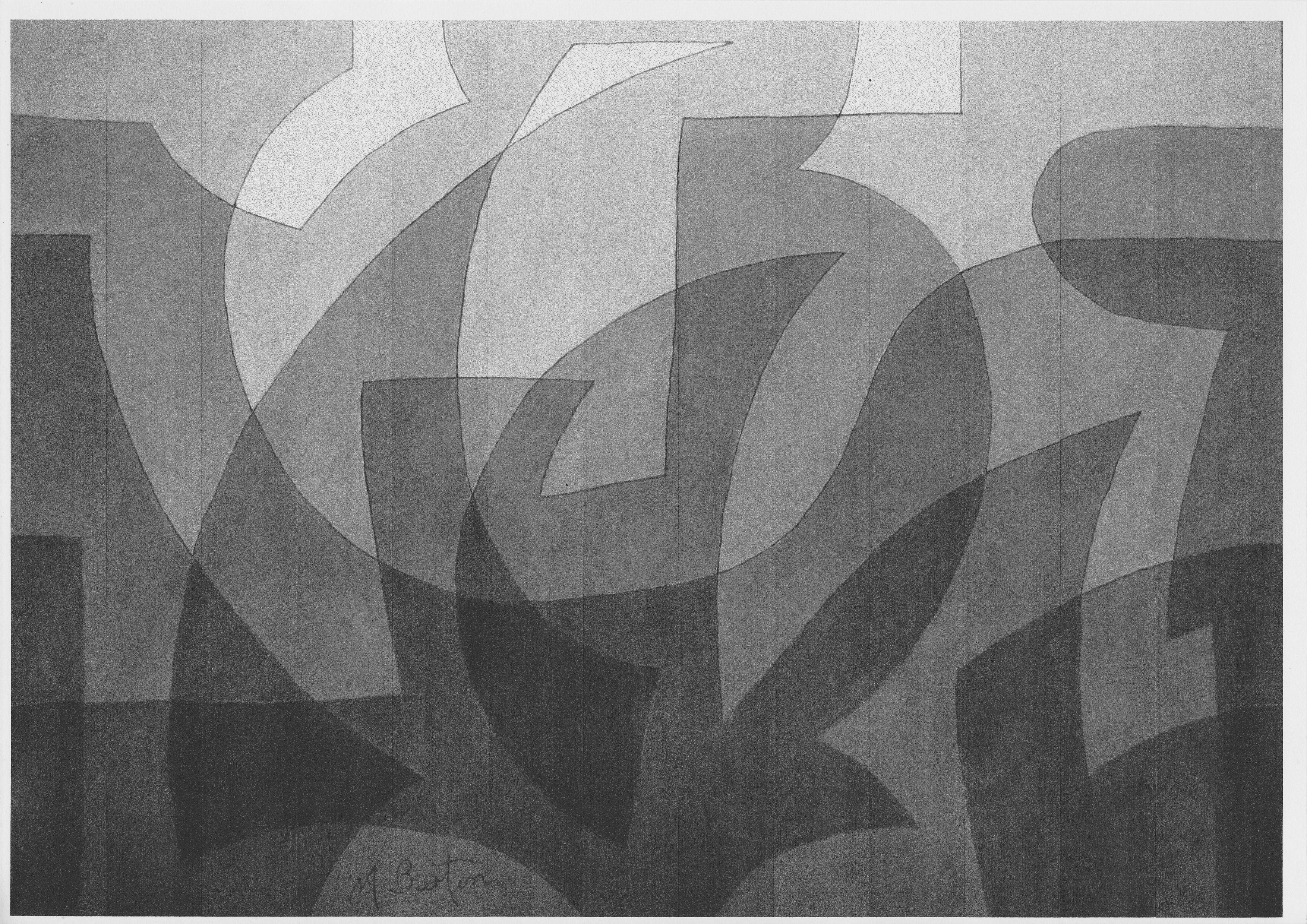
Spherical continuous line drawing with rolling and jagged lines. Mick Burton 2015.
Spherical single continuous line drawing with rolling and jagged lines. Mick Burton, continuous line artist 2015.

I later tried some “shark fin” curves and a couple of large jagged sequences.

All the time I tried to draw the line cleanly through existing shapes (avoiding going near previous junctions) and being aware of areas I had not visited much.  Finally I needed to work out how to get back to my start point without spoiling the composition too much (here going out and back in can be handy).

I hope you can check the route of the line through the whole picture fairly easily.  I then applied my Colour Sequence to produce the picture at the top of this post.

The first stage is my usual alternate overdraw of the line (if you are overdrawing a section as you go out of the picture you need to continue to overdraw as you re-enter, or if not overdrawing going out it’s not overdrawing when you re-enter).  See my post of 10 September 2014 for the full ALTERNATE OVERDRAW process and my post of 27 September 2014 for the COLOUR SEQUENCE process.

I have used a series of 6 colours from Pale Yellow through greens to Prussian Blue which I have tried to work out in steps of tone.  This is partly to highlight the overlap effect of continuous lines and the natural depth of the abstract.  As always, there is choice of direction of colours – light to dark or dark to light.  Here it seemed best to have the single lightest area at the top and several darker areas across the lower part of the picture.  The picture also has an Optical Art look about it.

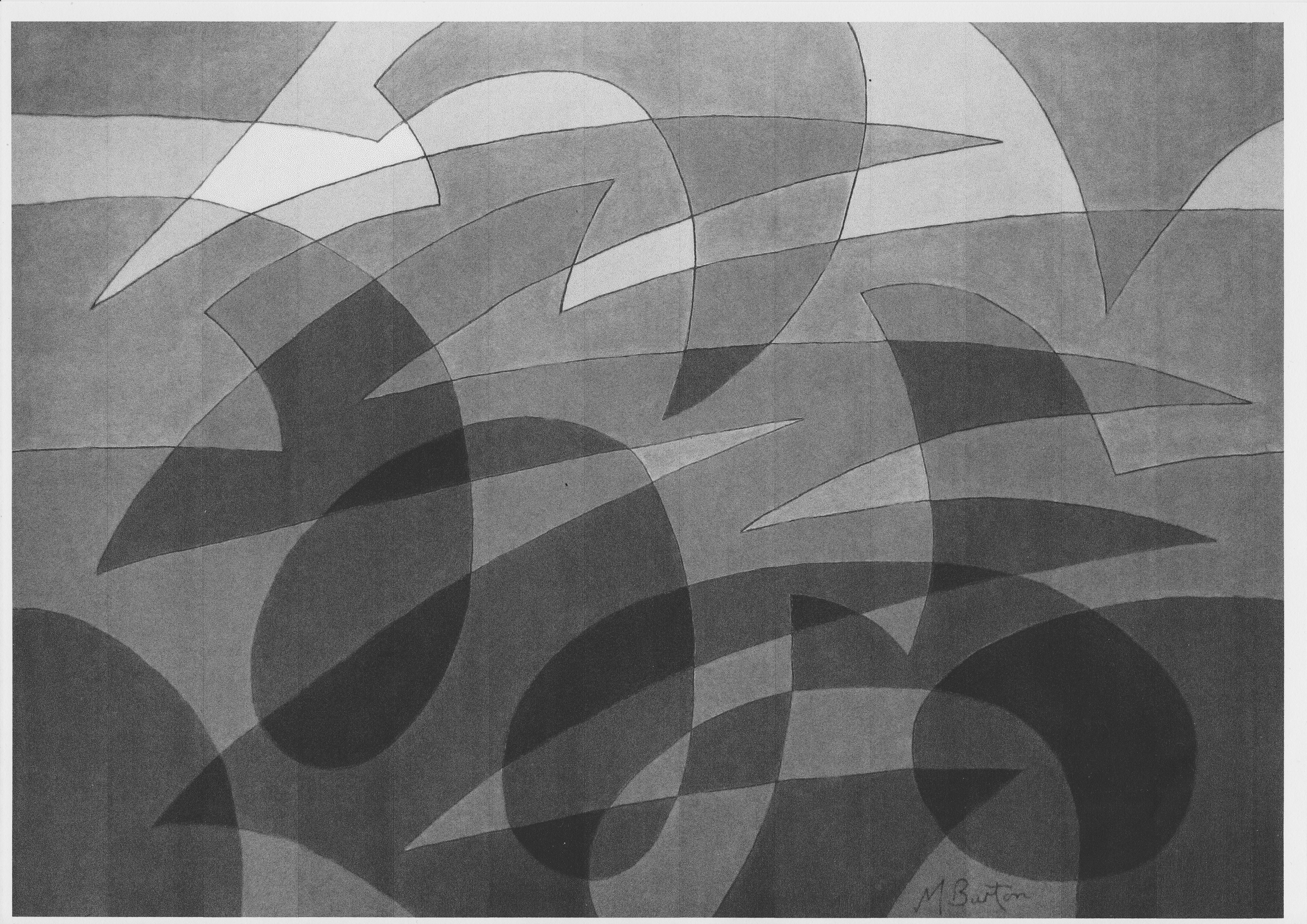
Printing the picture in Monotone is usually a good way of checking the steps of colour and light to dark.  So here it is.

Monotone of Spherical Continuous Line

Monotone of Spherical Single Continuous Line Drawing “Flypast Over Rolling Hills”. Mick Burton 2015.

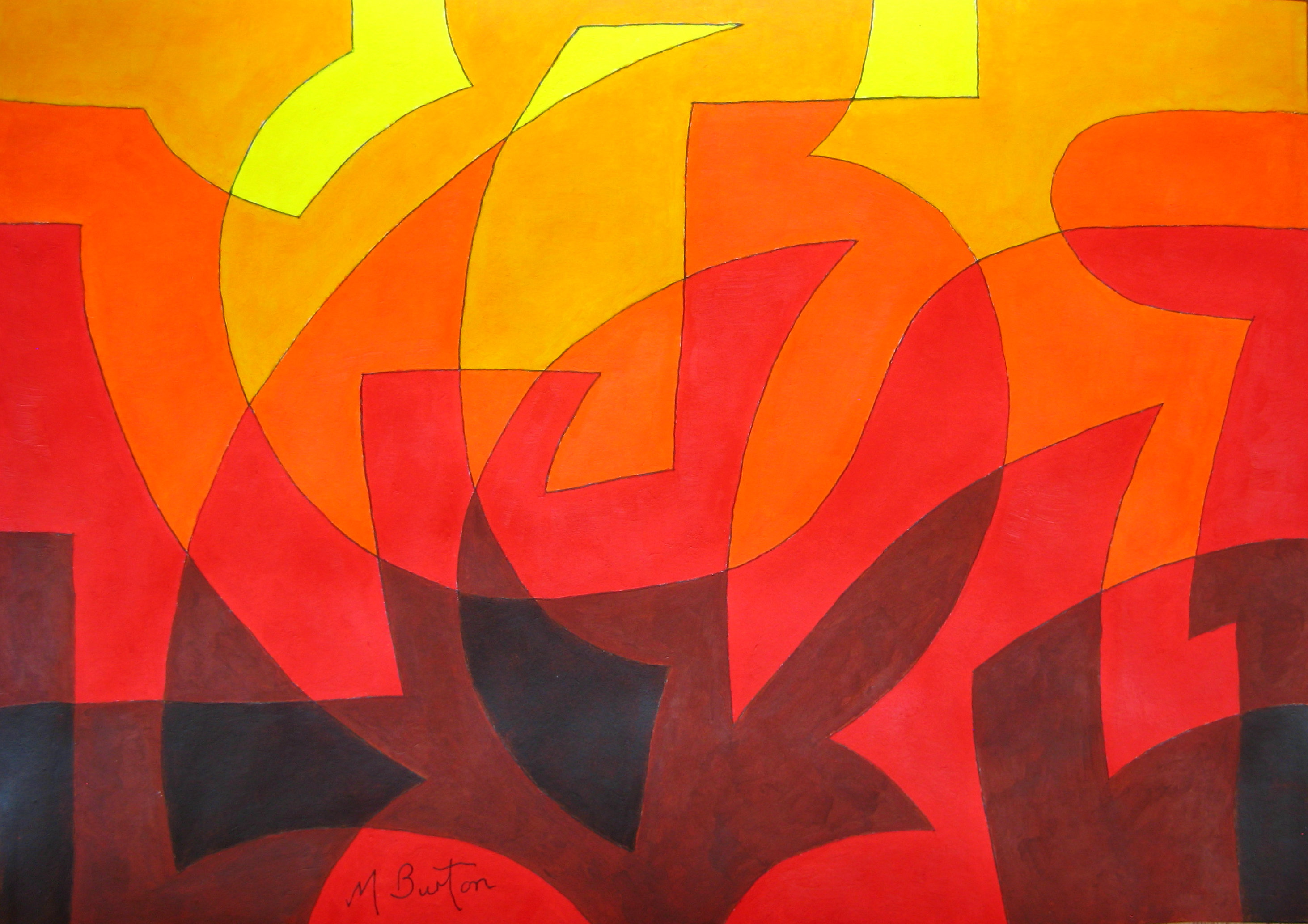
I also produced another similar abstract for the Demonstration at Stainbeck Arts Club to show the Spherical approach with a different flow of lines and colours.  I had coloured the drawing with a sequence from Yellow through Reds to dark Brown.

Spherical Continuous Line with Colour Sequence. Forest Fire. Mick Burton 2015.

Spherical Single Continuous Line Drawing with Colour Sequence. Forest Fire. Mick Burton 2015.

Here is the Monotone of this picture.

Monotone of Spherical Continuous Line

Monotone of Spherical single continuous line drawing “Forest Fire”. Mick Burton 2015.

How do you construct Haken’s Gordian Knot?

After completing my drawings of Haken’s Gordian Knot, which I covered in my previous continuous line blog post, I decided that I needed to find out more about how this unknot was created.  It is one thing me portraying the route of the two strands running through a completed structure, but possible something very different if I construct it from scratch.

A Google search for Haken’s Gordian Knot took me to a page of MathOverflow website, where a question that appeared “Are there any very hard unknots?” posed by mathematician Timothy Gowers, in January 2011.  In an update after many answers he said that he had arrived at Haken’s “Gordian Knot”.

Haken's Gordian Knot, from Ian Agol. A simple circle of string (an Unknot) formed into a complicated continuous line.

Haken’s Gordian Knot, from Ian Agol. A simple circle of string (an Unknot) formed into a complicated continuous line.

Timothy said that, after studying the knot for some time, “It is clear that Haken started by taking a loop, pulling it until it formed something close to two parallel strands, twisting those strands several times, and then threading the ends in and out of the resulting twists”. This approach is something like the suggestions I made in my last post on the basis of my Twisting, Overlapping, Envelope painting of the Haken Knot.

Twisting, overlapping colouring of Haken's Gordian Knot. Mick Burton painting.

Twisting, overlapping colouring of Haken’s Gordian Knot. Mick Burton single continuous line drawing painting.

Timothy then added that “The thing that is slightly mysterious is that both ends are “locked” “.  When I started to build the structure from scratch I began to realise what “locked” may mean.

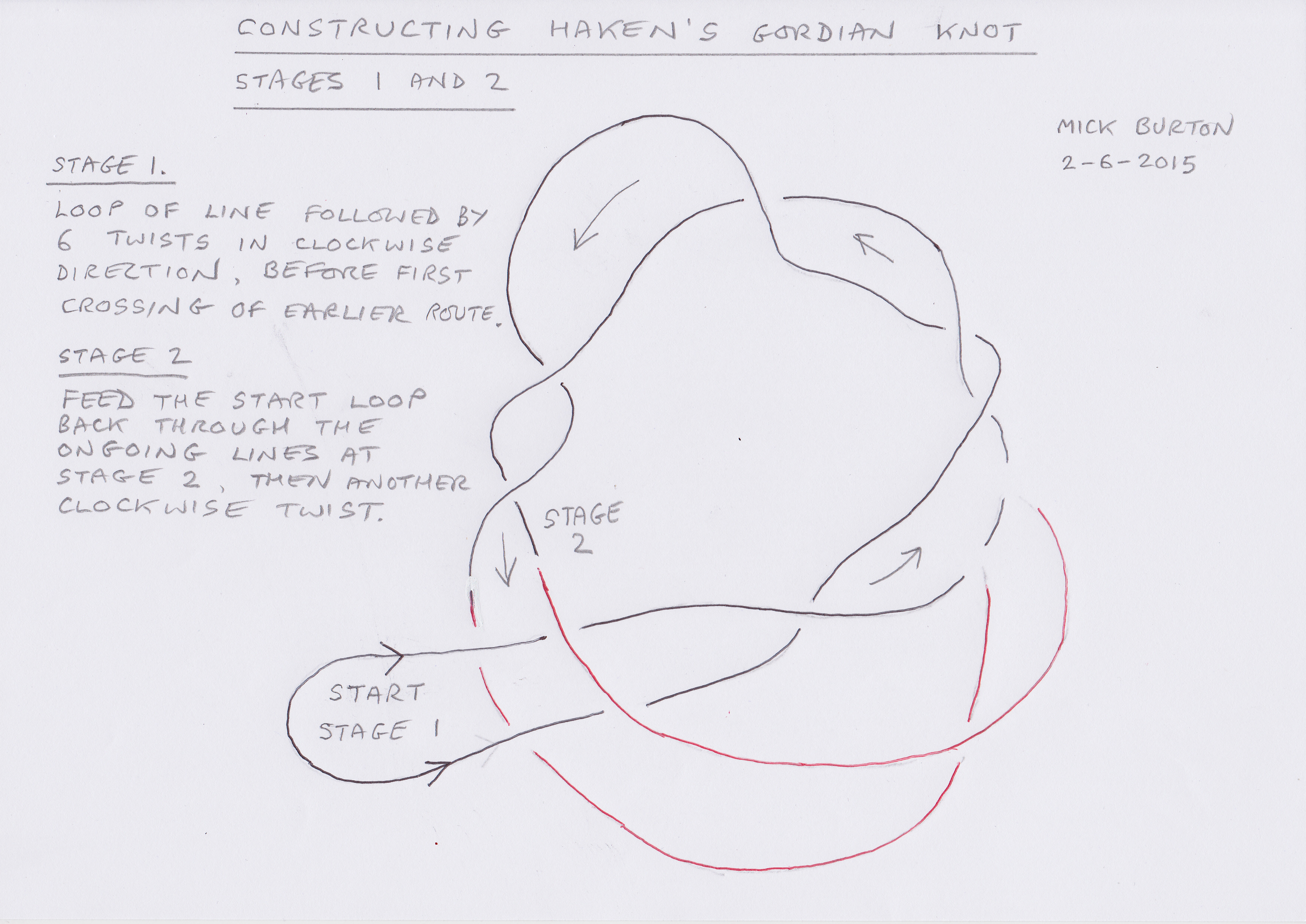
Constructing Haken's Gordian Knot. Stages 1 & 2. Mick Burton.

Constructing Haken’s Gordian Knot. Stages 1 & 2. Mick Burton.

After leaving the looped end at the start, the ongoing route first meets its earlier self at Stage 2.  However instead of the ongoing route going through the earlier one, the initial loop goes back through the later one. This must be what is meant by the first “lock”.

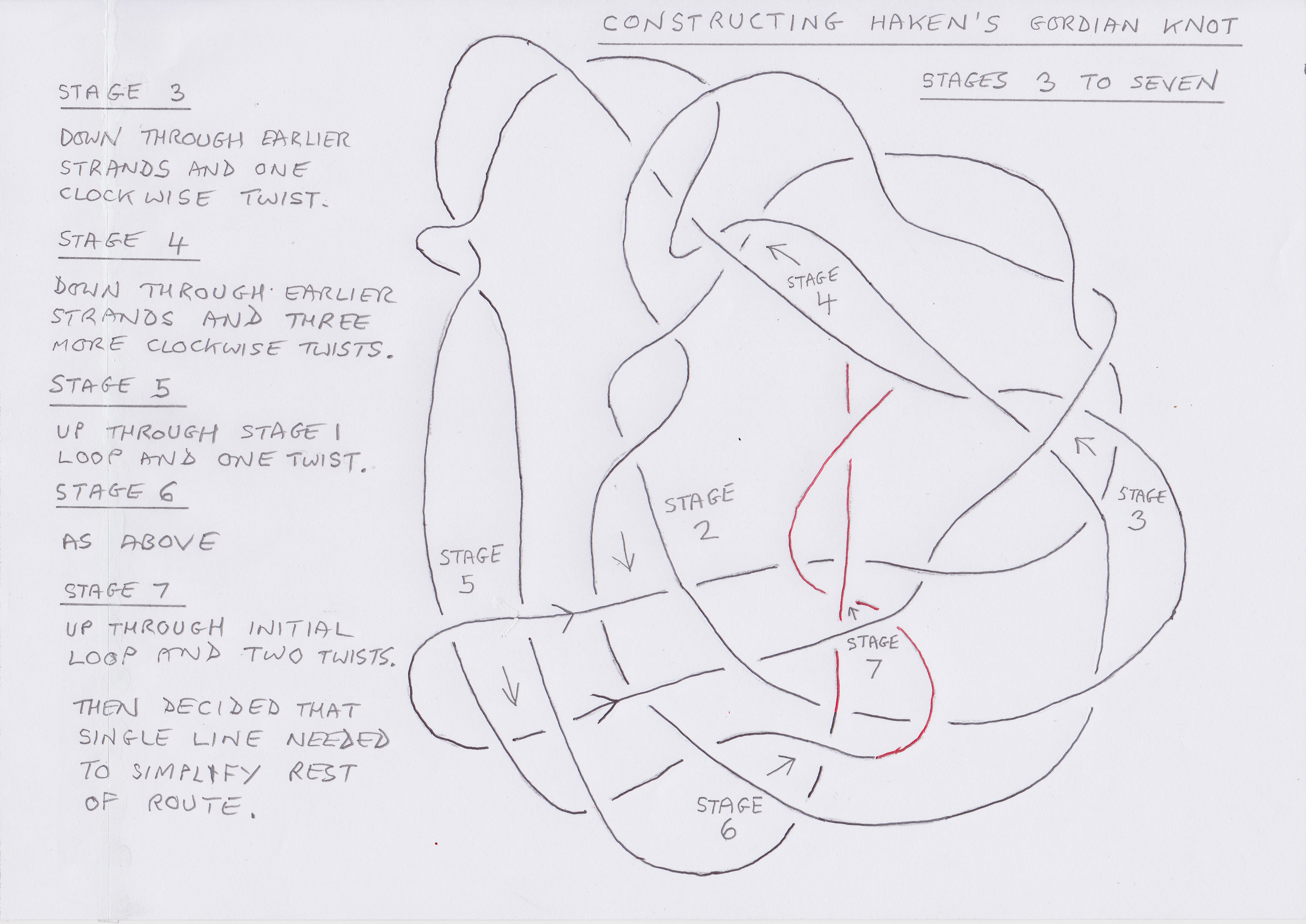
Constructing Haken's Gordian Knot. Stages 3 to 7. Mick Burton

Constructing Haken’s Gordian Knot. Stages 3 to 7. Mick Burton

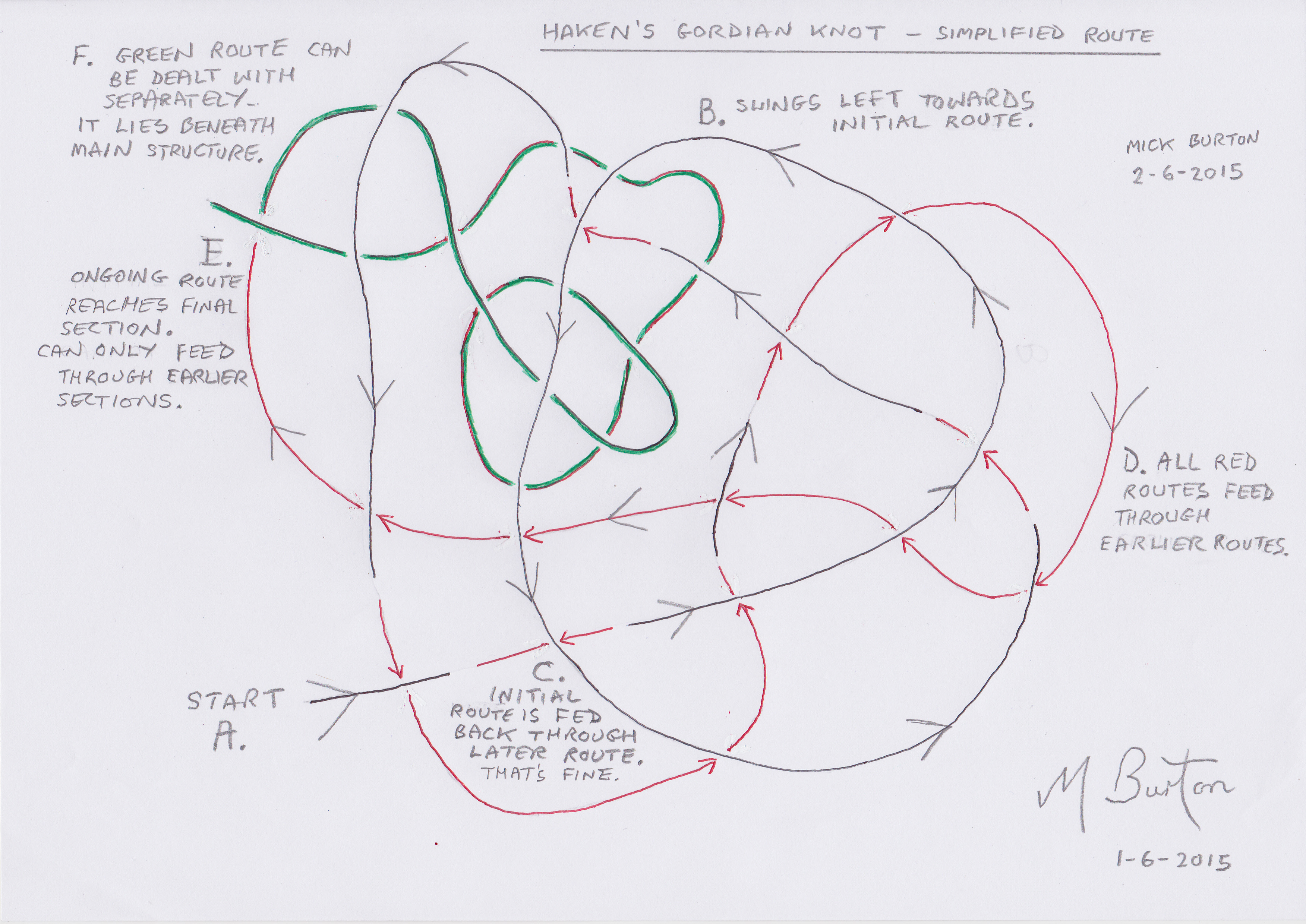
Continuing, things were as expected up to Stage 7.  I now realised that the route could be simplified to one line, as the Twists were not affecting progress but the feed through points were crucial.  I switched to drawing the route by using a simple line (to represent the twin twisting strands) and showed Feed Through points as Red Arrows.

Haken's Gordian Knot, Simplified Route showing Feed Points. Mick Burton.

Haken’s Gordian Knot, Simplified Route showing Feed Points. Mick Burton.

You can see that after point “C”, where the reverse Feed occurs, there are 12 expected Feed Through points until you arrive at point “E”.  Here instead of Feeding through an earlier part of the route, Haken indicates that you are expected to Feed through the End Loop at “E” which is too soon. This must be the other “Lock”.

At this stage, of course, I had no idea what to do.  Timothy did not seem to be using a lot of paper like me, but a “twisted bunch of string” and a small unknot diagram.  So I found some string, but was at a loss to make much sense of anything using that.  Timothy, however, was disappointed that it was so easy with his string initially, but delighted when it became more difficult !

What I did realise about the sections of route lying beyond point “E”, which I have coloured Green, is that they all lie beneath the rest of the structure.

This would allow the Green Area to be constructed separately before you sort of sweep it underneath as a final phase.  When I say “separately” I can only assume that you would need to do all this first, feed the result through the final loop and encapsulate the result.  You would then take this bundle to the start and use it to spearhead the building of the structure, leaving the loop at the other end of the two stranded string back at the start.

Haken's Gordian Knot, Prior action for the Green Route, before starting main structure. Mick Burton.

Haken’s Gordian Knot, Prior action for the Green Route, before starting main structure. Mick Burton.

Timothy said that he would love to put a picture of the process on the website and asked for suggestions.

Even though I am an artist and not a mathematition, I had already done two pictures of Haken’s knot before I found the MathOverflow website and was fascinated by the production process of the knot and so did some extra diagrams of my own.

I will ask if my drawings match Timothy’s thoughts in any way.

Haken’s Gordian Knot and the Twisting, Overlapping, Envelope Elephant.

I constantly look for Continuous Lines in many fields of art, history, mathematics – anywhere, as I just do not know where they are going to crop up.  Currently I am casting an eye on Islamic Art and Celtic art and am developing ideas on those.

Recently I glanced through a book called “Professor Stewart’s Cabinet of Mathematical Curiosities” and came across Haken’s Gordian Knot, a really complicated looking knot which is really an unknot in disguise – a simple circle of string (ends glued together) making a closed line. Here it is.

Haken's Gordian Knot, from Ian Agol. A simple circle of string (an Unknot) formed into a complicated continuous line.

Haken’s Gordian Knot, from Ian Agol. A simple circle of string (an Unknot) formed into a complicated continuous line.

When I looked at the Knot, it reminded me of my “Twisting, Overlapping, Envelope Elephant” continuous line in that it has a lot of twists. I realised straight away that a narrow loop on the outside (left lower) seemed to lead into the structure with its two strands twisting as it went, each time in a clockwise direction.  I followed the two twisting lines throughout the drawing until they ended in a loop on the outside (left higher).

I wanted to draw and paint this knot. My first drawing was of the line on its own. The depth of some of the lines reminded me of one of my earliest paintings “Leeds Inner Ring Road Starts Here”, which was based upon a sign board which appeared near Miles Bookshop in 1967 informing us of the route the new road would carve through the City. This was several years before Spagetti Junction was built near Birmingham. My picture had lines swirling all over at various heights in one continuous line.

Leeds Inner Ring Road Starts Here. Use of varying thickness of continuous line, overs and unders. Pre dates Spagetty Junction near Birmingham. Mick Burton, 1967.

Leeds Inner Ring Road Starts Here. Use of varying thickness of single continuous line drawing, overs and unders. Pre dates Spagetty Junction near Birmingham. Mick Burton, 1967.

My first picture of the Gordian Knot, in black and white, concentrated on the heights of the lines following the overs and unders shown by Haken.

Depth of lines in black and white, in Haken's Gordian Knot. Mick Burton, continuous line drawing.

Depth of lines in black and white, in Haken’s Gordian Knot. Mick Burton, single continuous line drawing.

But my main aim now was to use blue and red to show the twisting nature of the pair of lines running between the starting loop and the end loop.  This was intended to allow the viewer to more easily follow the loop and the twists throughout the structure.

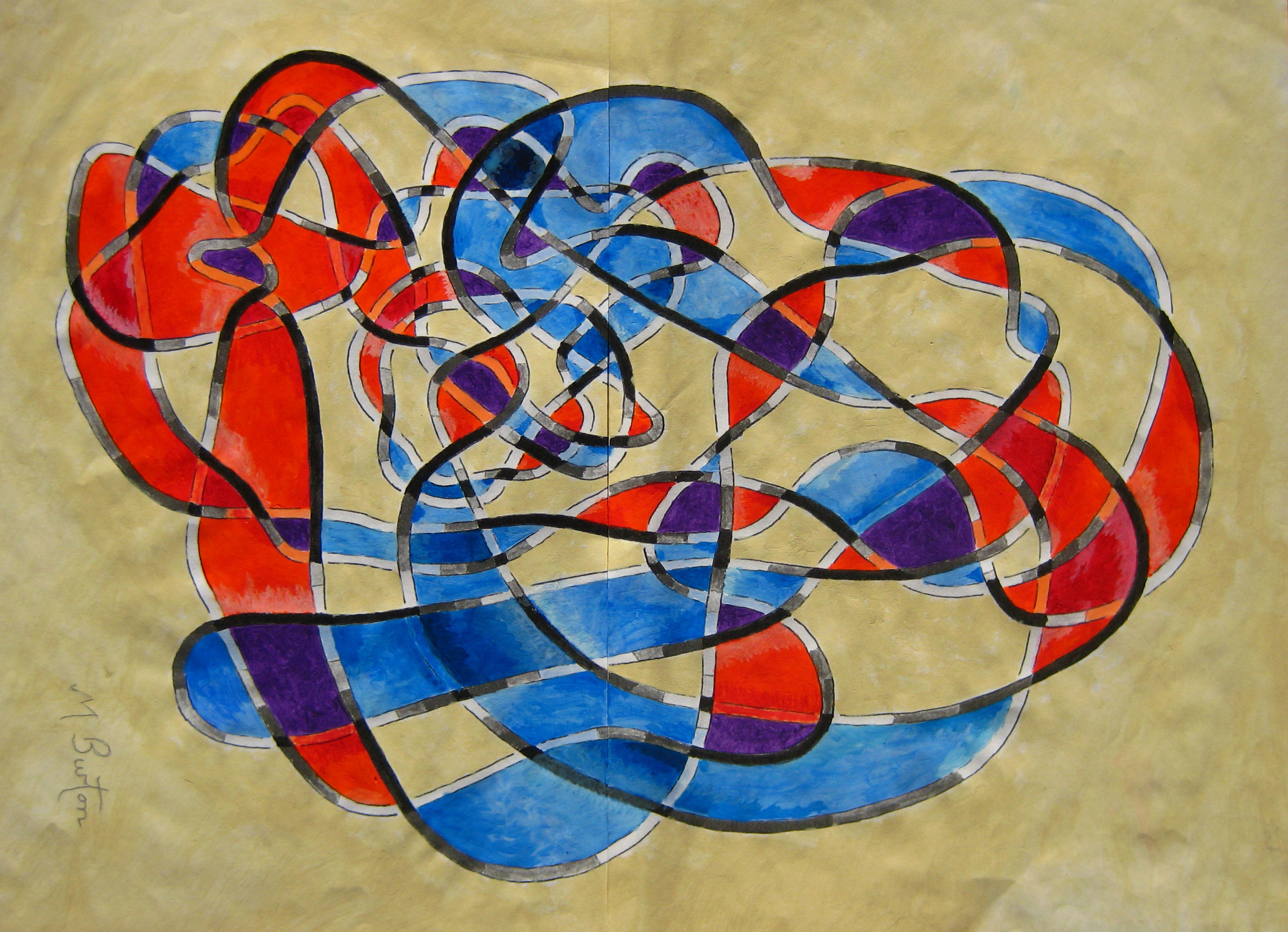
Twisting, overlapping colouring of Haken's Gordian Knot. Mick Burton continuous line.

Twisting, overlapping colouring of Haken’s Gordian Knot. Mick Burton single continuous line drawing.

Just like viewing my “Twisting, Overlapping, Envelope Elephant”, from my previous post, imagine that you have a strip of plastic which is blue on the front and when you twist it over it is painted red on the back.  Where blues cross each other you have darker blues, and correspondingly with reds.  Where blue crosses red you have violet.  I show the strips feeding through each other, like ghosts through a wall.  There are some darks and lights in there as well.  Most usefully, the background shines through to help make the strips stand out.

You can now get more of a feel for what is going on.  I counted 35 clockwise twists and two anti-clockwise (numbers 19 and 26).  Continued twists in the same direction tie in the ongoing loop, when it feeds through the two strands of its earlier route at least 12 times.  

This is a preparatory painting, in acrylic but on two sheets of copy paper sellotaped together.  When I exhibit these pictures they will be hung as portrait, rather than the landscape shown here for comparison with Haken (as you will note from where my signature is).  I think they look a bit like the head of the Queen in portrait mode !

Having got this far, I realised that I should find out more about the Haken knot (or unknot), beyond Professor Stewart’s brief introduction.  How did Haken construct the knot and why?

Please see my next post, on this continuous line blog, to see how I got on.

Twisting, Overlapping, Envelope Elephant. Continuous Line Drawing colouring.

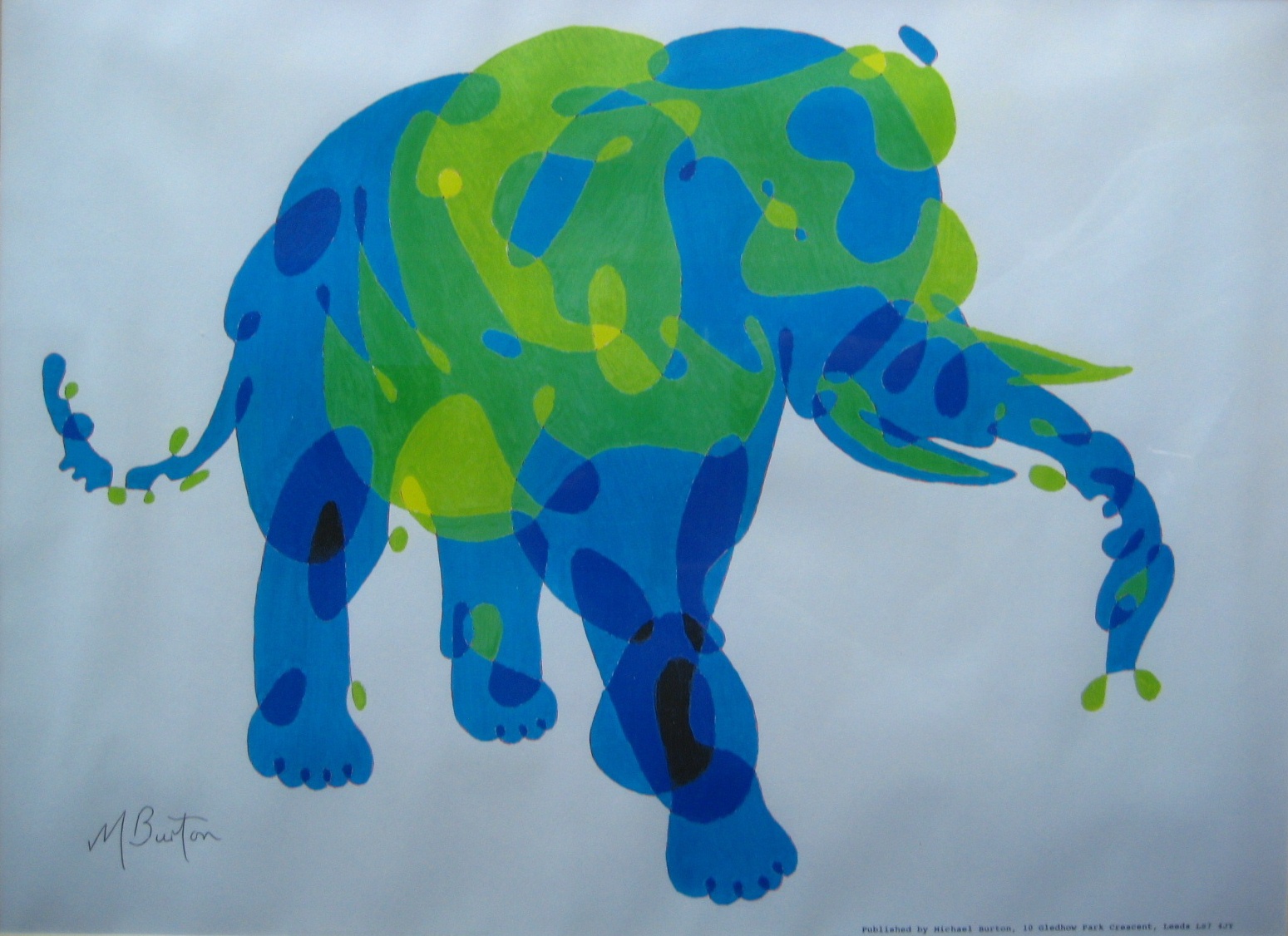
“Fluorescephant”, the original version of “Elephant Grass” which is at the top of this continuous line blog, was my first successful Colour Sequence painting.  The sequence ran from yellow through greens to blues in steps of colour and tones which gave a natural three dimensional effect and dynamism.  Part of this was the overlapping nature of continuous lines which was reflected by the successive darker colouring.

The painting was accepted for the International Amateur Artist exhibition, in Warwick Square London, in February 1973 and then a month later in the National Society annual open exhibition in the Mall Galleries.

Fluorescephant. Continuous line drawing with colour sequence. National Society Open Exhibition, Mall Gallery, London, 1973. Mick Burton.

Fluorescephant. Continuous line drawing with colour sequence. National Society Open Exhibition, Mall Gallery, London, 1973. Mick Burton.

I was never totally happy with the colouring.  I thought that there was an extra natural effect, on top of the overlapping, which I was missing.  When I started my art again in 2012, after a gap of nearly 40 years, I once more tried to sort this out.  I realised that I could enhance the twisting of the design and highlight gaps where the outside would show through.

Here is the result, “Twisting, Overlapping, Envelope Elephant”.  Imagine that the continuous lines are describing a sheet of plastic, which is coloured Blue on the front and Red on the back.  Each time a twist occurs, against the outside background, then I colour it Red.  When the overlaps build up, the shades of the blue front go darker blue, and the shades of the twisted areas become darker red.  Where the blue front and the red back occasionally overlap, then I use violet to reflect the mix.

This continuous line drawing is coloured to represent a

This continuous line drawing is coloured to represent a “Twisting, Overlapping, Envelope Elephant”, which is Blue on one side and Red on the other. Mick Burton, 2013.

You can see considerable areas of background colour within the animal showing through. This looks natural within the form of the elephant.

The blue areas, including darker blue overlaps, are the same as the blue areas in the “Fluorescephant”, so it is good to keep a large part of the original colour sequence in this change of style.