Tag Archives: Alternate Overdraw

Winding Number Theory and Continuous Line Drawing


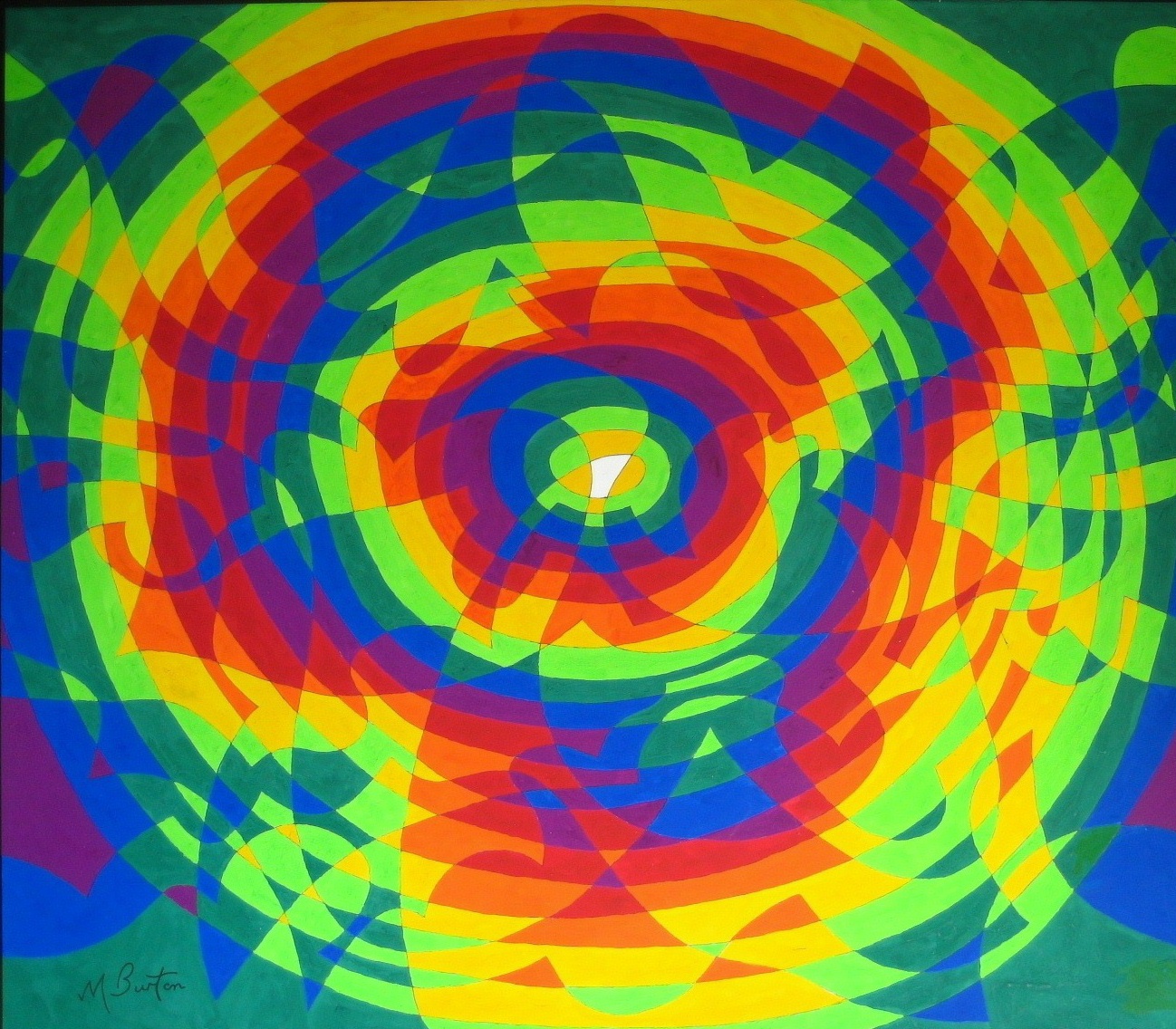
Whirlpool in Space, or Petrol Poluted Puddle. Spherical continuous line with repeat colour sequence with Rainbow colours. Mick Burton, Continuous Line, 1971.

Whirlpool in Space, or Petrol polluted Puddle. Spherical single continuous line drawing with repeat colour sequence with Rainbow colours. Mick Burton, Continuous Line, 1971.

This painting was one of two pictures hung at the Chelsea Painters Open Exhibition, held at the Chenil Galleries, Chelsea,1971.  I walked along the Kings Road looking for the gallery (I had submitted through and agency) and it was great to see the Whirlpool first in a window by the entrance.

The design was triggered by a browse through mathematics books in the library and coming across Winding Number Theory.  This used a continuous line and every time the line was drawn winding in a counter-clockwise direction a level was added and if you wound back in a clockwise direction a level was taken off.

So far, in my colour sequence numbering based upon Alternate Overdraw, I had not had a sequence of colours greater than about nine.  If I used the Winding Number method and continued to wind around counter-clockwise many times I could have a long colour sequence.  I went a bit mad with the Whirlpool, which was done on a spherical basis (allowing drawing out of one side of the paper and back in at the opposite side), and has a sequence of 20.

I did not simply go from light to dark over the whole 20 (the steps in shade between each colour would have been too small), but oscillated up and down with a smaller range of colours similar to a rainbow.  I had seen the rainbow effect produced by sunlight on petrol spilt on a puddle.
Alternate overdraw with colour sequence numbers. Continuous Line, Mick Burton.

Alternate overdraw with colour sequence numbers. Continuous Line, Mick Burton.

To illustrate the difference between my Alternate Overdraw and the Winding Number, I start with the Alternate Overdraw in Red on the left.  As shown in earlier posts, each channel of areas between overdraws has two numbers alternately.  You move naturally up to a higher channel or down to a lower channel, through the red line and continue the numbering.

As before, you start with “0” on the outside and 0 can also appear within the drawing.


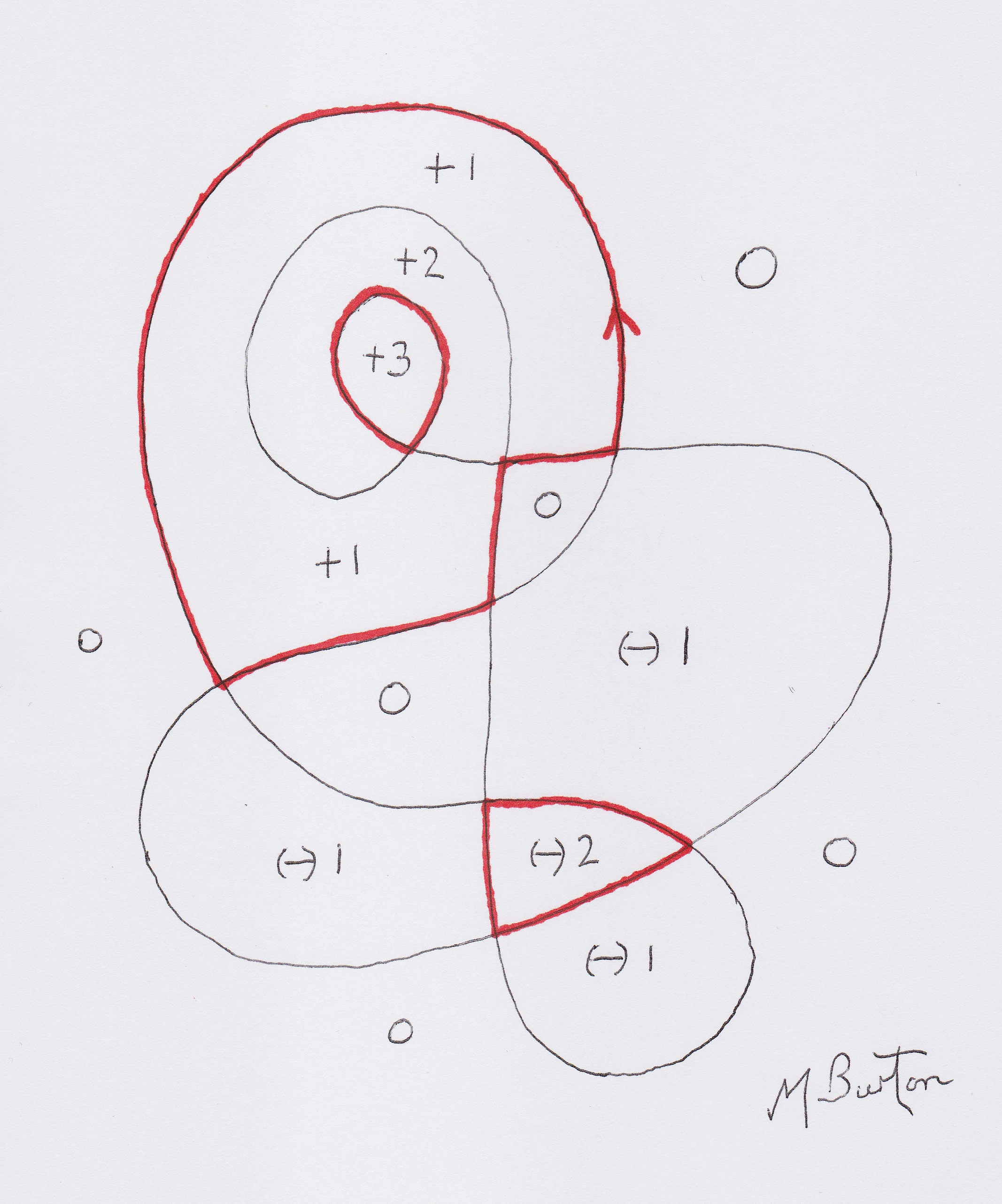
When we come to Winding Number allocation, we can use the same basic drawing with little arrows showing the direction it has been drawn.  It can be either direction of course, but I have chosen one which will match the result above.

Winding number allocation. Continuous Line, Mick Burton.

Winding number allocation. Continuous Line, Mick Burton.

Starting at “0” for the outside, if we cross to another area through a counter-clockwise border for that area, it will be a level higher.  If we cross through a clockwise line we reach a lower area.

Here the + areas are of course higher levels and the (-) areas are lower.

The numbering matches the Alternate Overdraw illustration above.


Now, just to show the initial thrust of the drawing for the Whirlpool, with many levels, the next illustration shows a line spiralling from the centre outwards and I have shown just 13 winds.
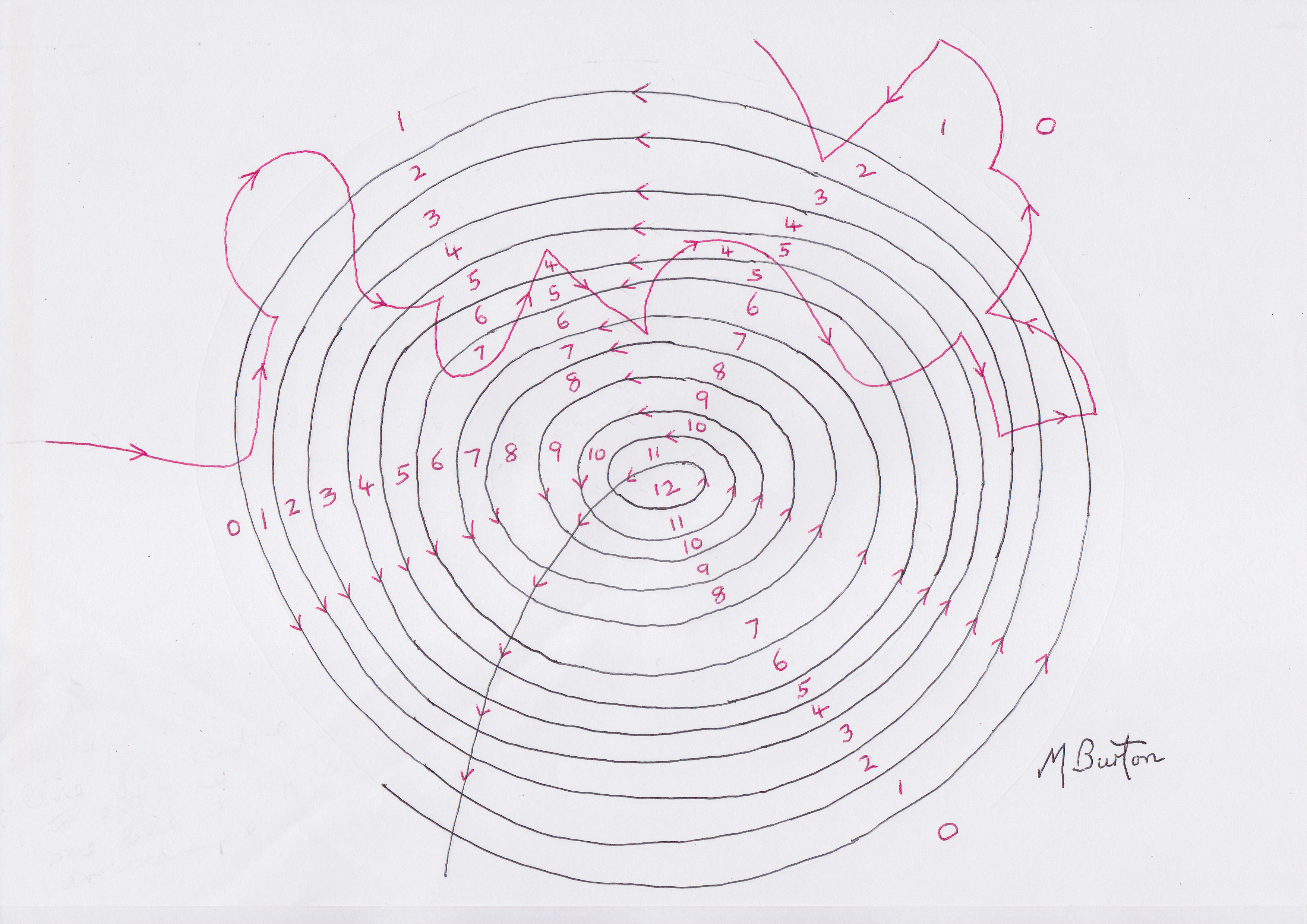
Part of initial Winding Number spiral for Whirlpool painting. Mick Burton, continuous line.

Part of initial Winding Number spiral for the Whirlpool in Space painting.    Mick Burton, single continuous line drawing.

Then I have drawn a line from the centre of the spiral directly back to the bottom of the picture as the first phase of breaking up the spiral so that lots more areas start to  appear.  The next such phase is a meandering line near the top of the picture. 

As I have said, this is a shorter version than the one usd for the main Whirlpool in Space picture above.

Next I have decided that the direction of  the line will be counter-clockwise starting from the bottom of the spiral, so that the levels go up towards the centre.  The numbers have then been added.

On the original painting, which is 24″ x 20″, I used alternate overdraw to allocate the colours.  This was because I was used to using that method and I think it is better for an artist anyway.  The Winding Number theory was simply the inspiration for producing a sequence of 20 or more.

Now, to go off at a tangent, I am interested in other artists in the family who keep coming to light.  As part of my research into my mother’s family, the Mace’s from Bedale (from 1825) and much earlier from Cambridge, I have come across a book by Thomas Mace called “Musick’s Monument” published originally in 1676.  It was published again about six years ago.  Amongst his own illustrations within the book is this one of a spiral depicting his idea of God’s world.
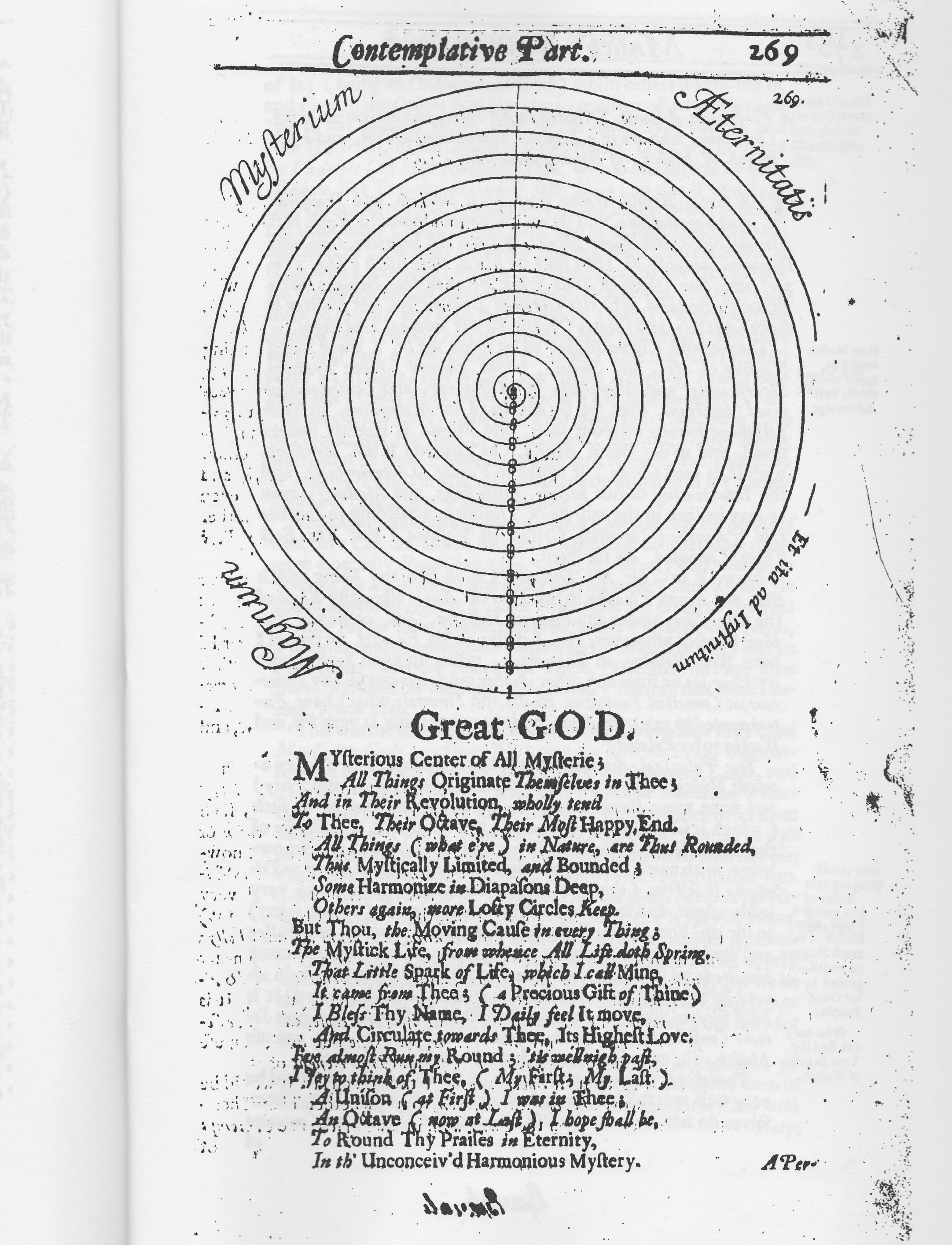
 

“Mysterious Centre of All Mysterie…” in Musick’s Monument, by Thomas Mace, 1676. Continuous Line, Mick Burton.


Thomas was a famous composer of the 17th century, and craftsman who made lutes and viols, whose main job was a chorister at Trinity College, Cambridge.

To add to this “sort of” co-incidence, my Uncle Harry Mace from Bedale, North Yorkshire, was a joiner and builder.  When he retired he started to make old style instruments, such as viols, and sold them to a music shop in Leeds.  I am sure he did not know about Thomas of Cambridge.

Thomas was not too impressed with a relatively new instrument in his time, the violin.


Continuous Line Drawing Alternate Overdraw embedded image.


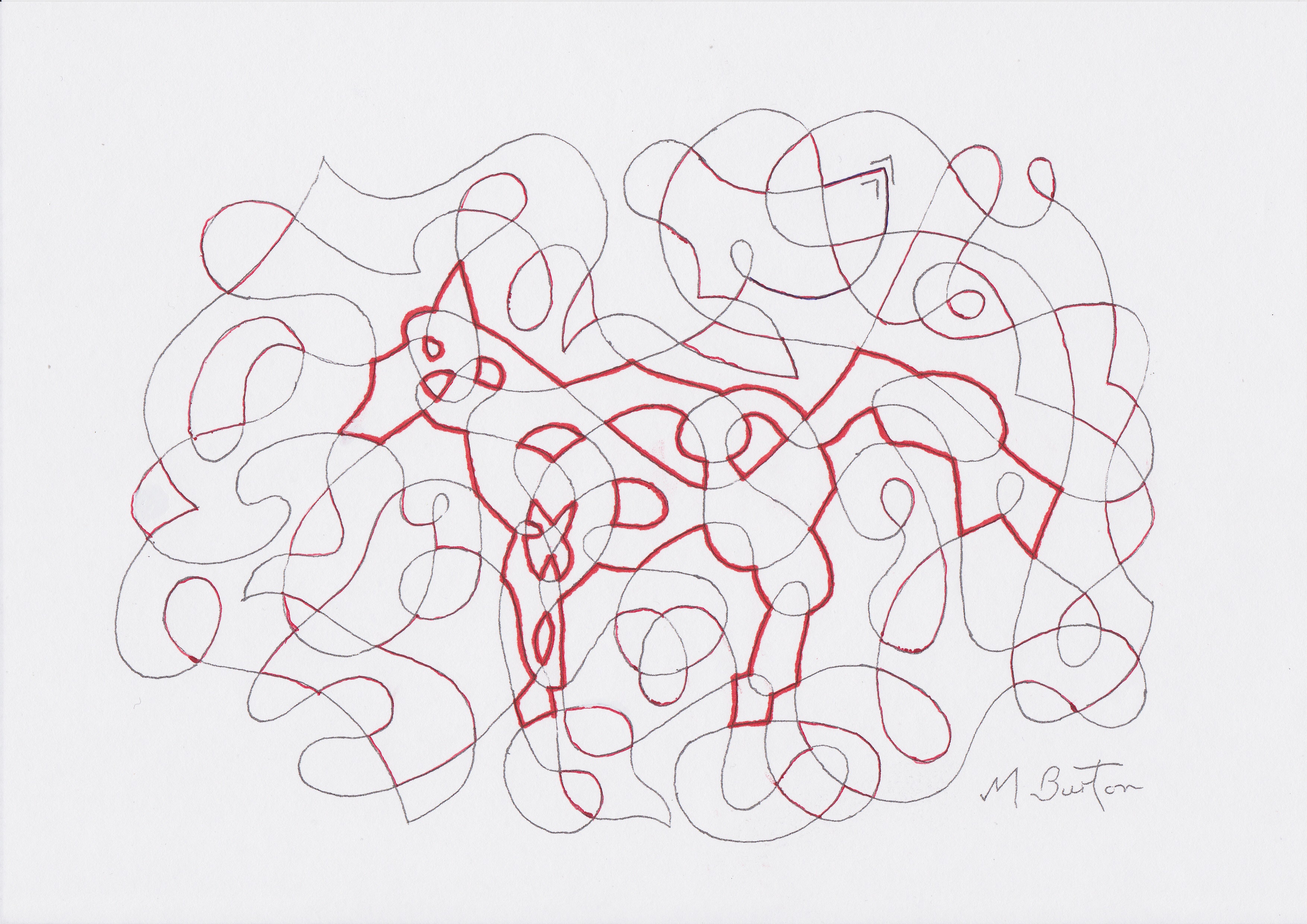
Abstract before Alternate Overdraw  embedded Dog appears.  Mick Burton, Continuous Line.
Abstract before Alternate Overdraw embedded Dog appears. Mick Burton, Single Continuous Line Drawing.


Here is an abstract Continuous Line Drawing which conceals an image of a dog.  Possibly you can see some clues as to where the outline of the dog is.  The idea is to carry out an Alternate Overdraw along the line throughout the picture which will produce the image of the dog.  Start the overdraw with the arc marked with chevrons.

After I developed Alternate Overdraw in 1970, which enabled me to allocate my colour sequence to continuous line drawings, other possibilities started to occur to me.  The first was that you could hide an image of an animal within what looked like a totally abstract continuous line drawing.

See below how the dog finally appears.  In fact it looks a bit like Ben, who we have been looking after this week.

Alternate Overdraw embedded dog appears.  Mick Burton, Continuous Line Drawing.

Alternate Overdraw embedded dog appears. Mick Burton, Single Continuous Line Drawing.

The start of the process was to sketch a simple dog outline and then , knowing that the outline had to include many crossing lines, I broke the outline down into short lines or arcs which were at an angle to each other.

Next, I needed to run lines through the dog, from various directions, which used these arcs.  For it to work, there had to be an odd number of arcs in each line which went across the dog, between each two outer arcs.  This was so that, after completion, when you drew an alternate overdraw across the dog, both arcs on the outline were overdrawn.  This would result in all the arcs around the outline being overdrawn, thus forming one loop of overdraw. 

Within the body of the dog, several overdraw loops were also formed.  Similarly in the background a number of overdrawn loops and inner loops resulted. 

Of course, trial and error is involved in connecting up all the loose ends (of the lines running through the dog) to achieve a single continuous line through the whole drawing.

Finally, having completed a continuous line, I needed to check that there were no obvious sections which would indicate that an animal was in there. 

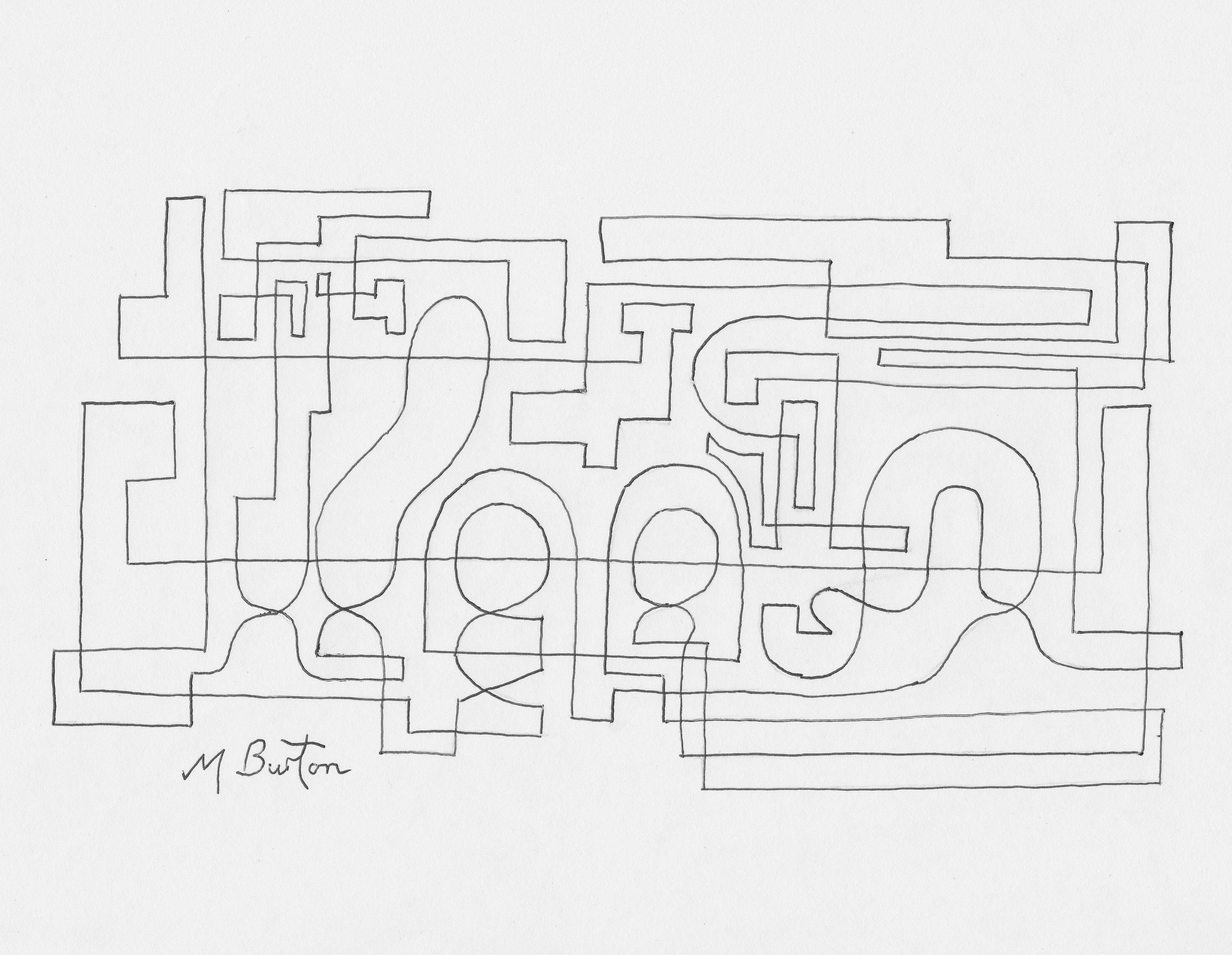
I did one more embedded image in 1970 before moving on to other things.  This time, instead of making the abstract continuous line from flowing curves with no straight lines, I decided to use mostly straight lines and right angles.

Abstract before Alternate Overdraw embedded steam engine appears.  Mick Burton, Continuous Line Drawing.

Abstract before Alternate Overdraw embedded steam engine appears. Mick Burton, Single Continuous Line Drawing.


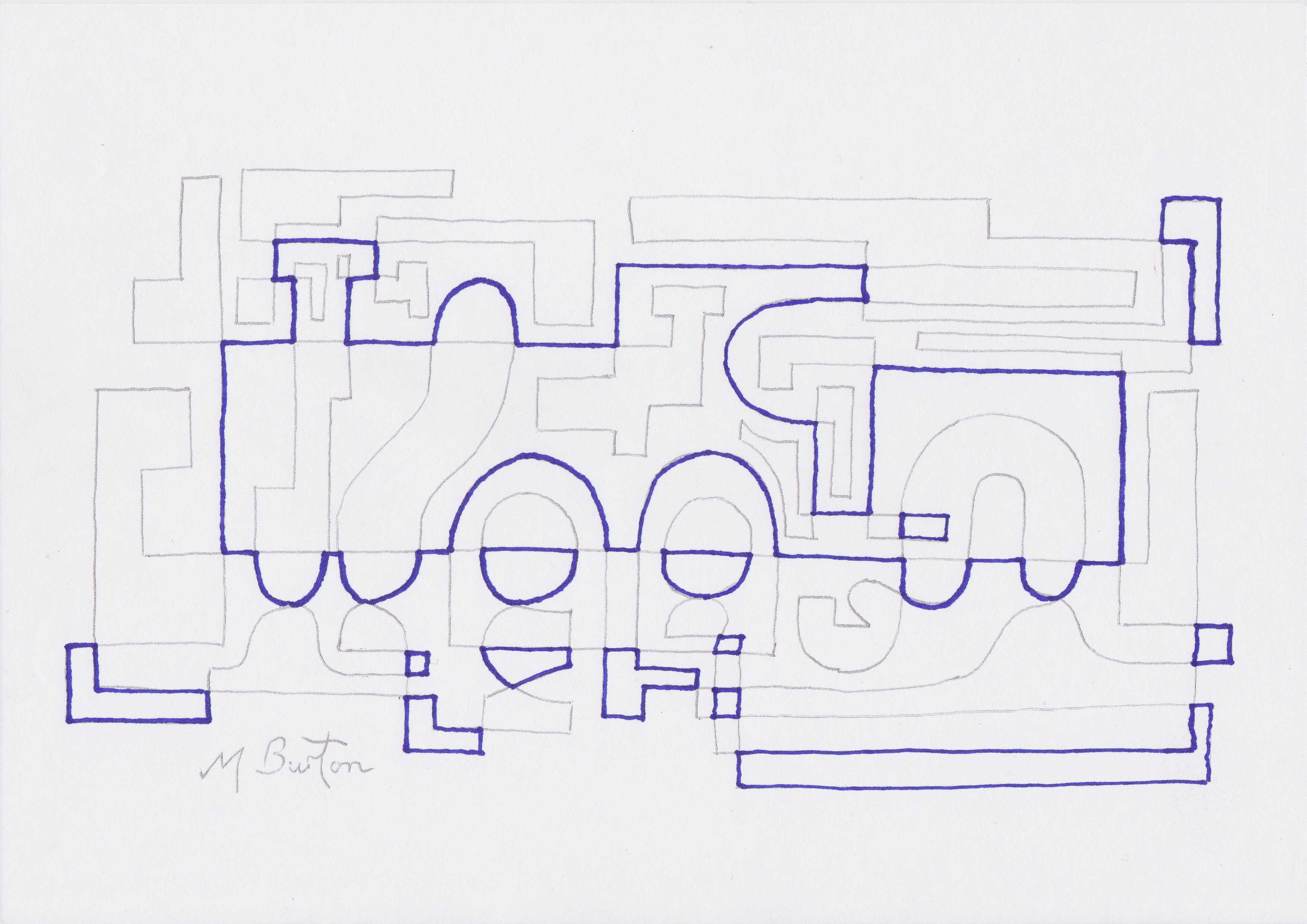
This time I  was concealing a steam engine and the Alternate Overdraw result is shown below.

Alternate Overdraw embedded steam engine appears.  Mick Burton, Continuous Line Drawing.

Alternate Overdraw embedded steam engine appears. Mick Burton, Single Continuous Line Drawing.


As always with my various styles, I wonder who else may be using them  and whether they were in use long ago.

Colour Sequence on Continuous Line Drawing

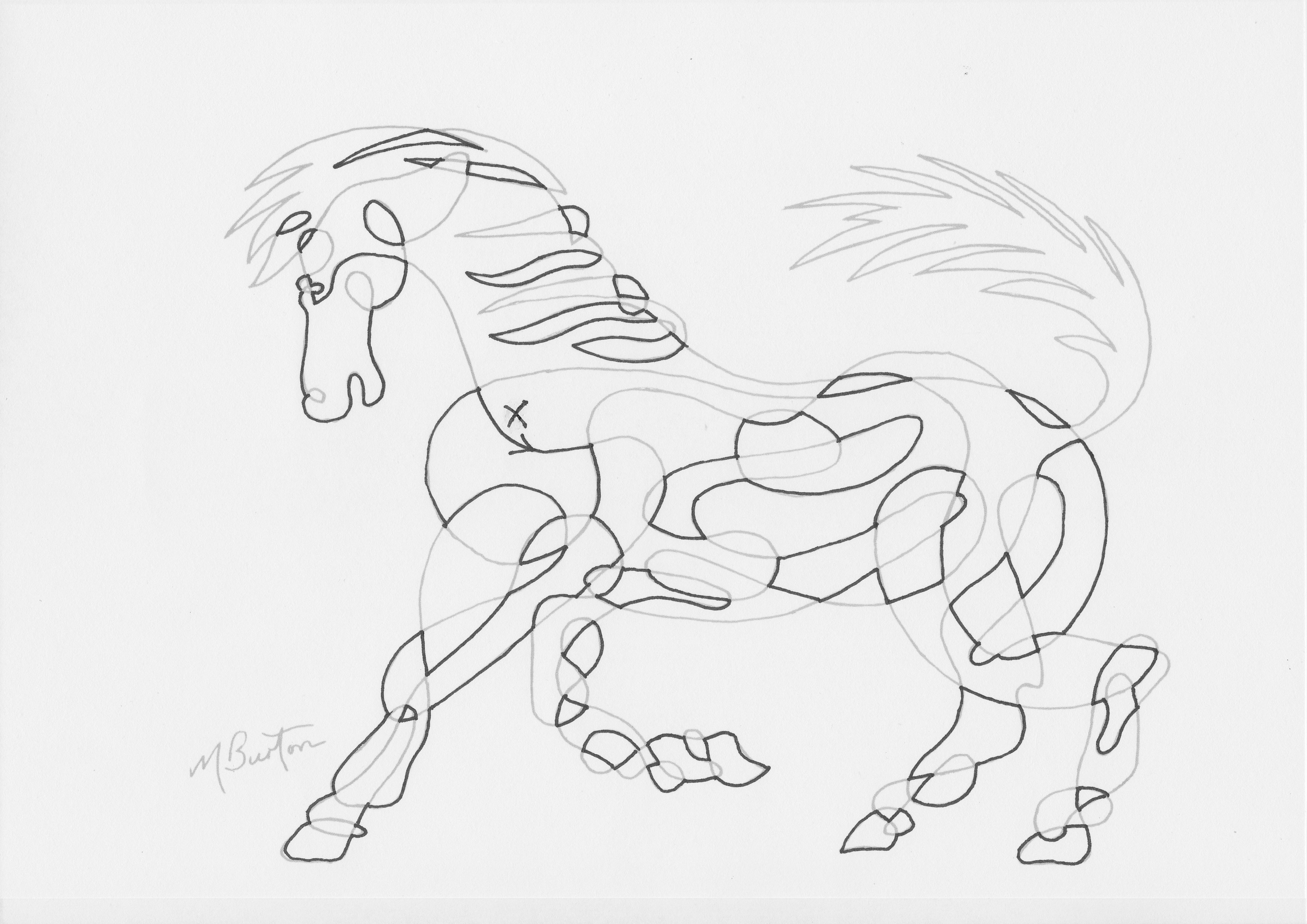
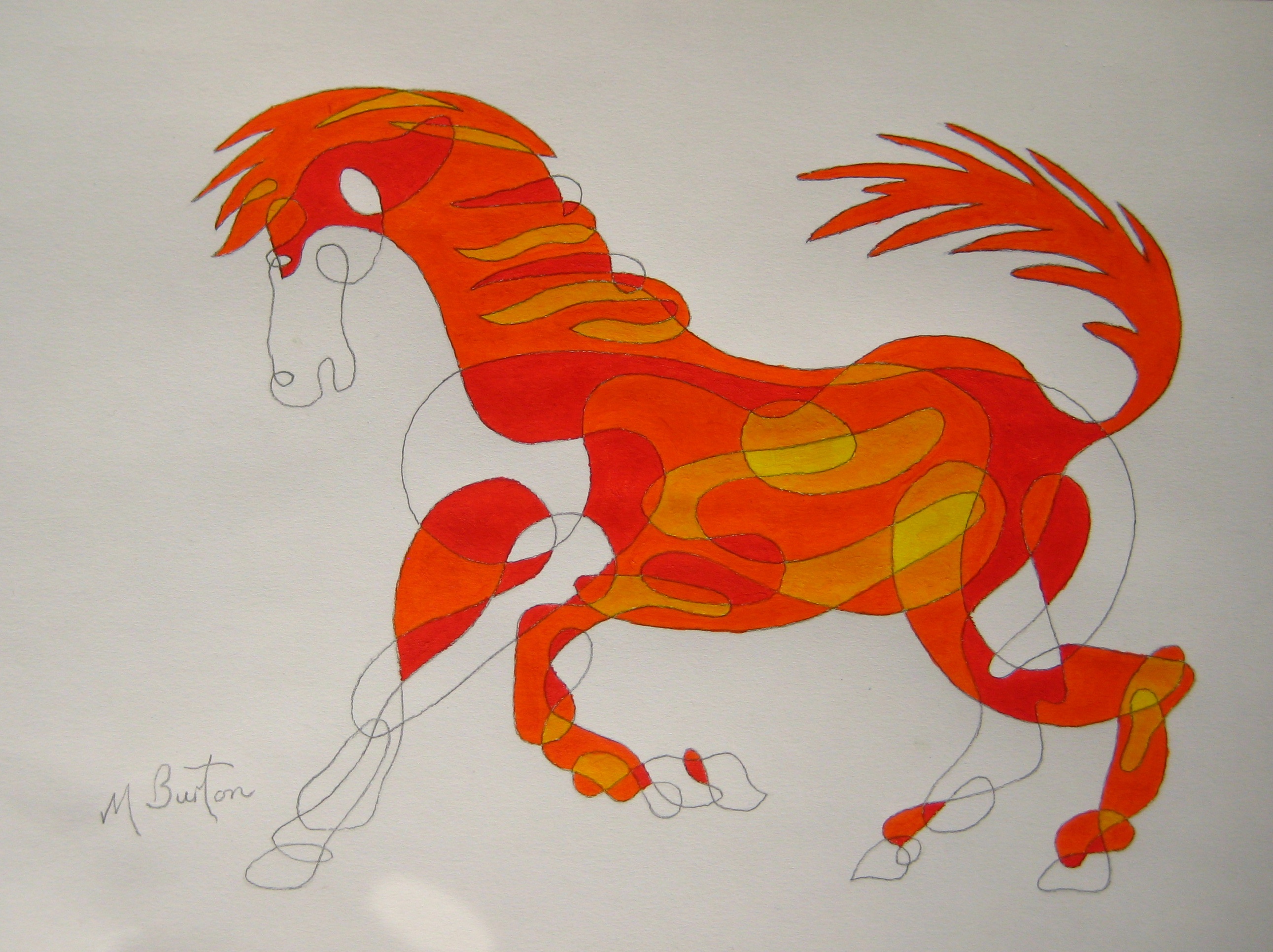
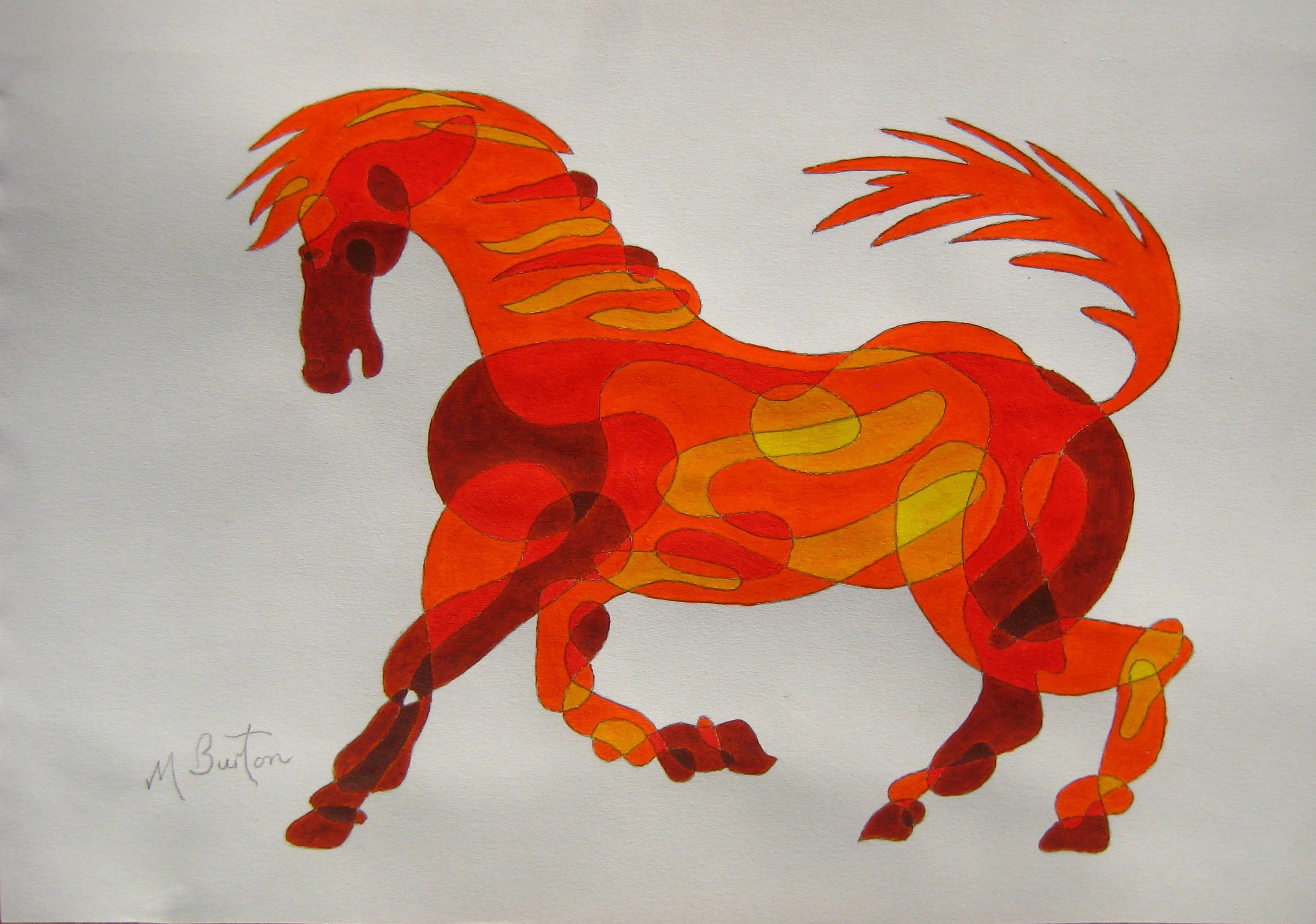
Fig 1. Completed Colour Sequence on Continuous Line Drawing of horse. Mick Burton, Continuous Line Blog.

Fig 1. Completed Colour Sequence on Single Continuous Line Drawing of horse. Mick Burton, Continuous Line Blog.

How do I apply Colour Sequence to my Continuous Line Drawings, which I first developed in the late 1960,s ?  In my last blog post, about Alternate Overdraw of My Continuous Lines, I pointed out that Colour Sequence was the next stage and so here we go.  I will now show the stages involved in completing the colouring of this Horse.

Other Alternate Overdraw on Continuous Line of horse.

Fig 2. Alternate Overdraw on Single Continuous Line Drawing of the Horse, as the first stage of Colour Sequence. Mick Burton, Continuous Line Blog.

From the two Alternate Overdraw examples in the previous post, I have chosen Fig 2 commencing at point “X” for this example (either “A” or “X” would result in the same colour sequence).

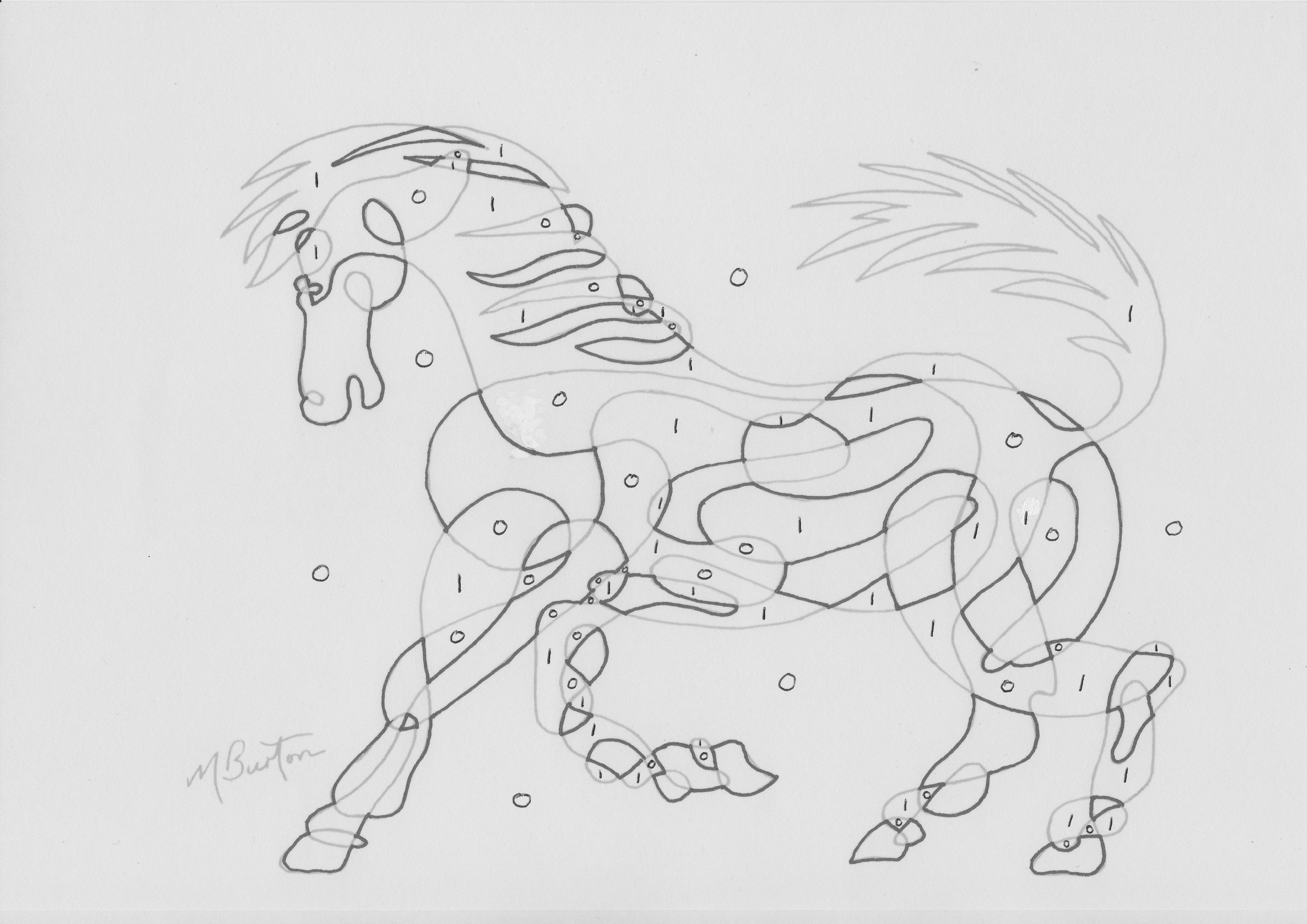
We are going to number all areas of the drawing, commencing with the background which will be numbered “0”.  In this example the background will remain uncoloured but “0” will also occur within the drawing and have a colour. 

Fig 3. Initial numbering (0 and 1) of channels between Alternate Overdraws on the Continuous Line Horse.

Fig 3. Initial numbering (0 and 1) of channels between Alternate Overdraws on the Continuous Line Horse.

You will notice that between all the closed lines, formed by the Alternate Overdraws, there are channels of areas.  These can be completely numbered alternately by only two numbers, which in this case are 0 and 1.  So, starting with 0 on the background, work through all these linked channels, see Fig 3.  This also sets the direction of the number sequence throughout the drawing.


Fig 4. Colour Sequence numbers 2 and 3 on the Continuous Line Horse.

Fig 4. Colour Sequence numbers 2 and 3 on the Continuous Line Horse.


The numbering progresses both upwards through positive numbers and downwards through negative numbers.  We will start with the positive direction and allocate the next pair of numbers, 2 and 3.  By moving from an 0 area into a 1 area, and on through its Alternate Overdraw border, we will enter an un-allocated area we can mark 2.  Now deal with all the other areas in this new channel, marking alternate areas 3 and 2, to complete this allocation.  After this we need to check for any further Alternate Overdraw channel, or channels, at this level adjacent to 1 areas and then allocate 2 and 3 to them also, see Fig 4.

We then need to check for any further Alternate Overdraw channels enclosed within any of the 2 and 3 channels.  If we found one we would allocate 4 and 5 to the new channel or channels.  In this case there is no higher level channel. 

Fig 5. Colour Sequence numbers (-)1 and (-)2 on the Continuous Line Horse. Mick Burton, Continuous Line Blog.

Fig 5. Colour Sequence numbers (-)1 and (-)2 on the Single Continuous Line Horse. Mick Burton, Continuous Line Blog.

Having  completed the numbering of areas in the positive direction, we now go into the negative in Fig 5.  By looking at an area 1 and moving through a 0 area with an Alternate Overdraw border we can cross through that into a (-)1 and (-)2 channel.  Mark the initial one (-)1 and then allocate alternately through the channel with (-)2 and (-)1.  After completing that channel, look for other un-allocated channels adjacent to 0 areas and allocate (-)1 and (-)2 to them.  Now look for further channels in the negative direction enclosed within a (-)1 and (-)2 channel.  There is one such, a single area (enclosed by its own Overdraw) in the front leg of the horse, which I have left blank in Fig 5 , which will be (-)3.

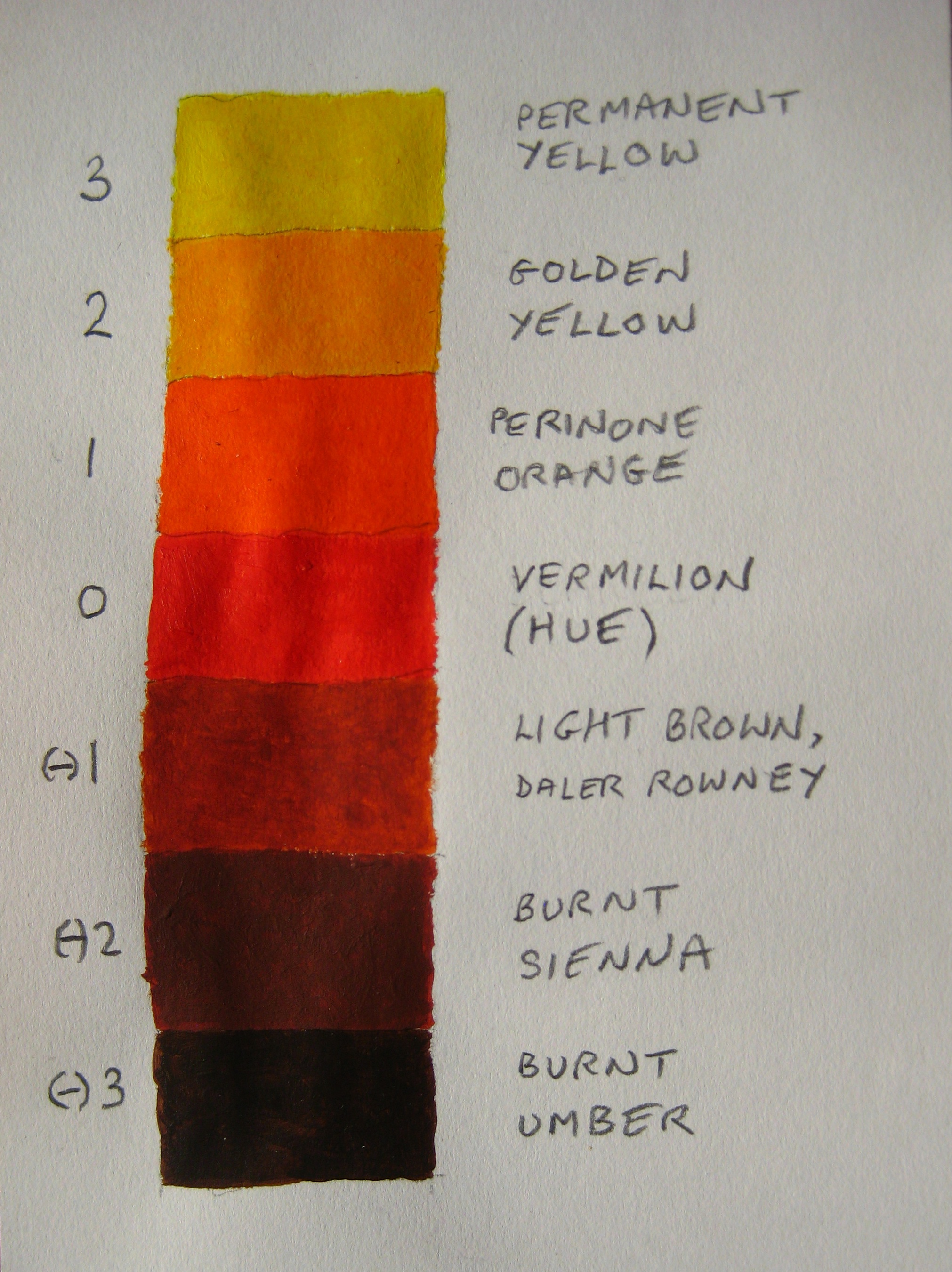
Fig 6. Colour Sequence colour chart for Continuous Line Horse. Mick Burton, Continuous Line Blog.

Fig 6. Colour Sequence colour chart for Continuous Line Horse. Mick Burton, Continuous Line Blog.

I was inspired by Rainbows in deciding on the sort of Colour Sequences I wanted to use for my Continuous Lines.  For shorter sequences, I settled for “partial rainbows” involving two prime colours only with a progression of colour mix and tones from light to dark.  For the Elephant I used yellows, greens and blues and for the Horse it was yellows, orange, red and browns in Fig 6.

I have carefully selected colours which have a stepped progression, both in colour and tone, and where possible I apply them from the tube (poster colour in the late 1960’s or acrylic now) to achieve an even and solid result.  I avoid mixing if I can, to retain the pure consistency of colour application across the painting, but sometimes it is necessary.


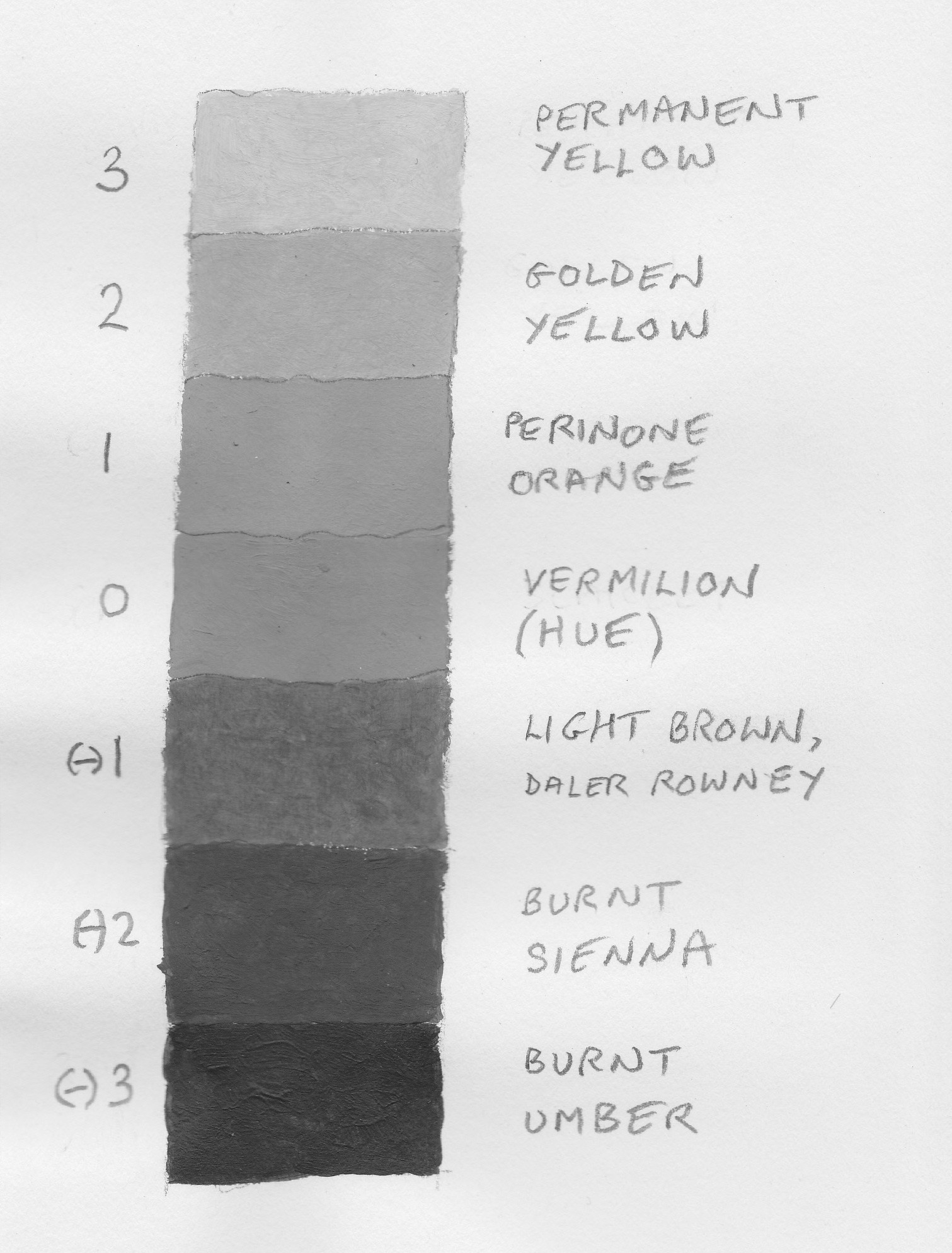
Fig 7. Black and white photocopy of Colour Chart for Continuous Line Horse.

Fig 7. Black and white photocopy of Colour Chart for Continuous Line Horse.


To assess the accuracy of the progression steps of my Colour Sequence chart, I do a black and white (or grayscale) photocopy of my chart to check that the steps still work in monochrome, see Fig 7.

Having produced the Colour Sequence chart, we need to decide the direction of the colours matched to the numbers, ie. Light to dark in an upward or a downward direction.  Generally I see whether a scale would mostly coincide with where a natural highlight would be, or have more darks towards the lower parts in a drawing to infer shadow.  Usually it is fairly obvious, but you can always start again with the other direction of colours.  Note that my style may take advantage of natural hints of highlight or shadow on a subject, but generally these aspects (along with perspective) are absent.

I remember that when doing equations at school, which produced two answers (+ or (-) ), was a puzzle to me which no one could explain.  I understand the concept of a practical outcome from having two answers a bit better now.

Fig 8. Initial Colour Sequence pair of colours on Continuous Line Horse. Mick Burton, Continuous Line Blog.

Fig 8. Initial Colour Sequence pair of colours on Continuous Line Horse. Mick Burton, Continuous Line Blog.

Once we have decided on the colour match with the numbers, the initial two colours can be painted in, ie.  Vermillion = 0 and Orange = 1, see Fig 8.


Fig 9. Second Colour Sequence pair of colours on Continuous Line Horse.

Fig 9. Second Colour Sequence pair of colours on Continuous Line Horse.


We can then match numbers 2 and 3 in areas to the colours required in the next channels up, or simply apply Golden Yellow to areas across the overdraw from Orange and then its alternate colour Permanent Yellow, in Fig 9.


Fig 10. Third Colour Sequence pair of colours, in the negative direction, on the Continuous Line Horse. Mick Burton, Continuous Line Blog.

Fig 10. Third Colour Sequence pair of colours, in the negative direction, on the Single Continuous Line  Drawing of Horse. Mick Burton, Continuous Line Blog.

Now we can match numbers (-)1 and (-)2 in the negative direction, or simply apply Light Brown to areas across the Overdraws from Vermillion.  When these Light Brown and Burnt Sienna channels have been completed the last channel colour is (-)3 which is Burnt Umber.  In Fig 10 I have left this final area blank  (on the front left leg of the Horse).

So you have seen my Colour Sequence method, using Alternate Overdraw, for Continuous Line Drawings.  Sorry if it has been a long explanation (particularly if you grasped it quickly or had already come across parts of it), but I have tried to pitch it as helpfully as I can, based on my demonstration sessions.    

A couple a years after I started Colour Sequence I came across the Winding Number Theory.  There is a connection and I did pick up one or two ideas from it.  I will talk about this in a later post, but as always I am not a trained mathematician and so I will keep talking in pictures. 

 I hope that you will give it a try and I am sure you will enjoy the ride, as I have for so long.

If you display or publish your results, it would be great if you could specifically acknowledge me and my ideas.

Alternate Overdraw on Continuous Line Drawing

After my early attempts at continuous line drawing, and then alternate shading, I tried Alternate Overdraw on top of my continuous line drawings.  This produced some fascinating results which led to developments throughout my art.

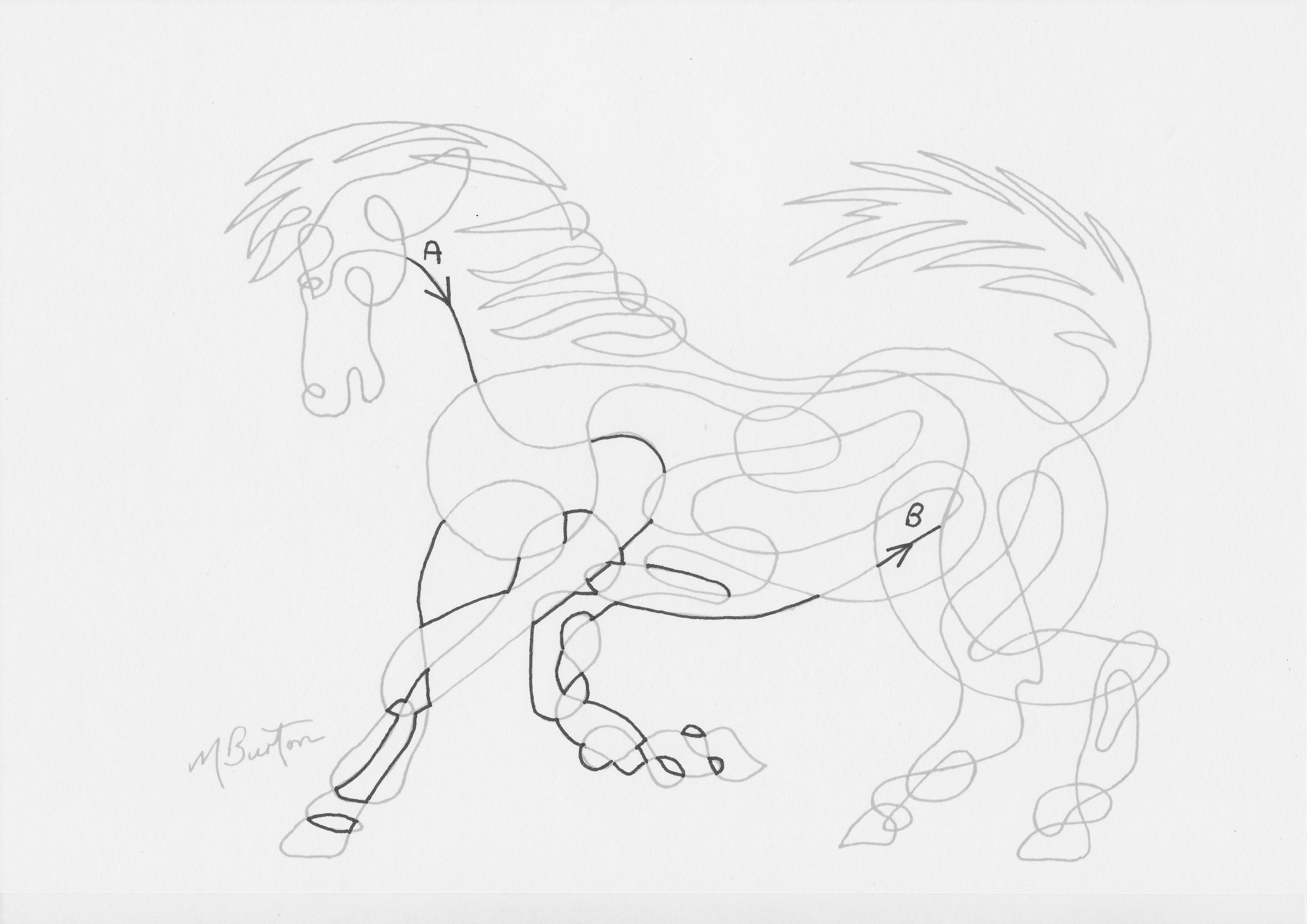
Alternative Overdraw on Continuous Line of the Horse, start A to B.

Draw from A to B to start Alternate Overdraw on Single Continuous Line Drawing of the Horse.

Lets use the Horse as an example.  Here is a lightly drawn Continuous Line (sorry if you have to tilt your lap top to see it all).  Start at point A and use a thicker pen or marker and draw over the first section of line, in the direction of the arrow, between the two crossovers.  Then miss a section before overdrawing the next section of line.  Keep going overdrawing alternate sections to point B.  You will see that already some overdraw sections are forming closed lines.


Alternate Overdraw of continuous line of horse.

Complete Alternate Overdraw of Continuous Line Drawing of horse from point A.


The next illustration shows the complete Alternate Overdraw and all these new darker lines form closed lines.


Naturally, if we start the Alternate Overdraw in a section which was not overdrawn in the above example (eg at X below), then this produces a result where a completely different set of closed lines appear.


Other Alternate Overdraw on Continuous Line of horse.

Other Alternate Overdraw on Single Continuous Line Drawing of horse, starting at X.


From the above findings I first developed my Colour Sequence ideas, which I will expand upon in the next post.

Later I used the closed lines to help in the construction of large models of my continuous line drawings as well as to devise hidden drawings within continuous lines.  More later on those.

The Alternate Overdraw method also led to a way to find a path through Four Colour Theory maps as part of my attempt to prove that theory nearly 40 years ago.

So, watch this space !!