Tag Archives: Mick Burton continuous line blog

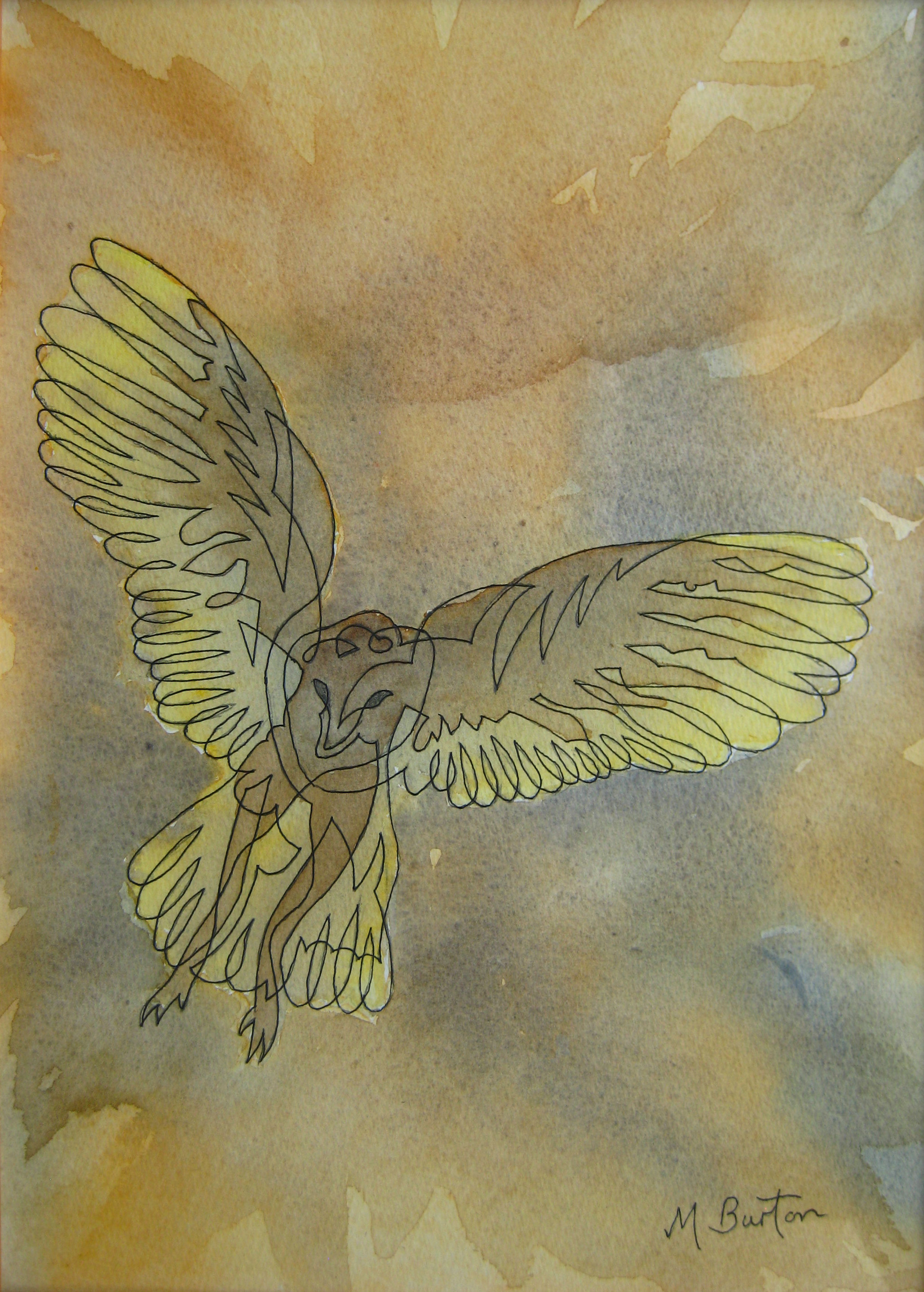
Barn Owl continuous line drawing at Harrogate and Nidderdale Art Exhibition

Continuous line drawing of Barn Owl onto Wet on Wet watercolour. Mick Burton.

Single continuous line drawing of Barn Owl onto Wet on Wet watercolour. Mick Burton continuous line artist, 2015.

This Barn Owl painting will be one of my eight pictures on display at  the Harrogate and Nidderdale Art Club Autumn Exhibition in Ripley Town Hall, near Harrogate, on 21 & 22 November 2015.  I then intend to submit it to the next Association of Animal Artists Exhibition.
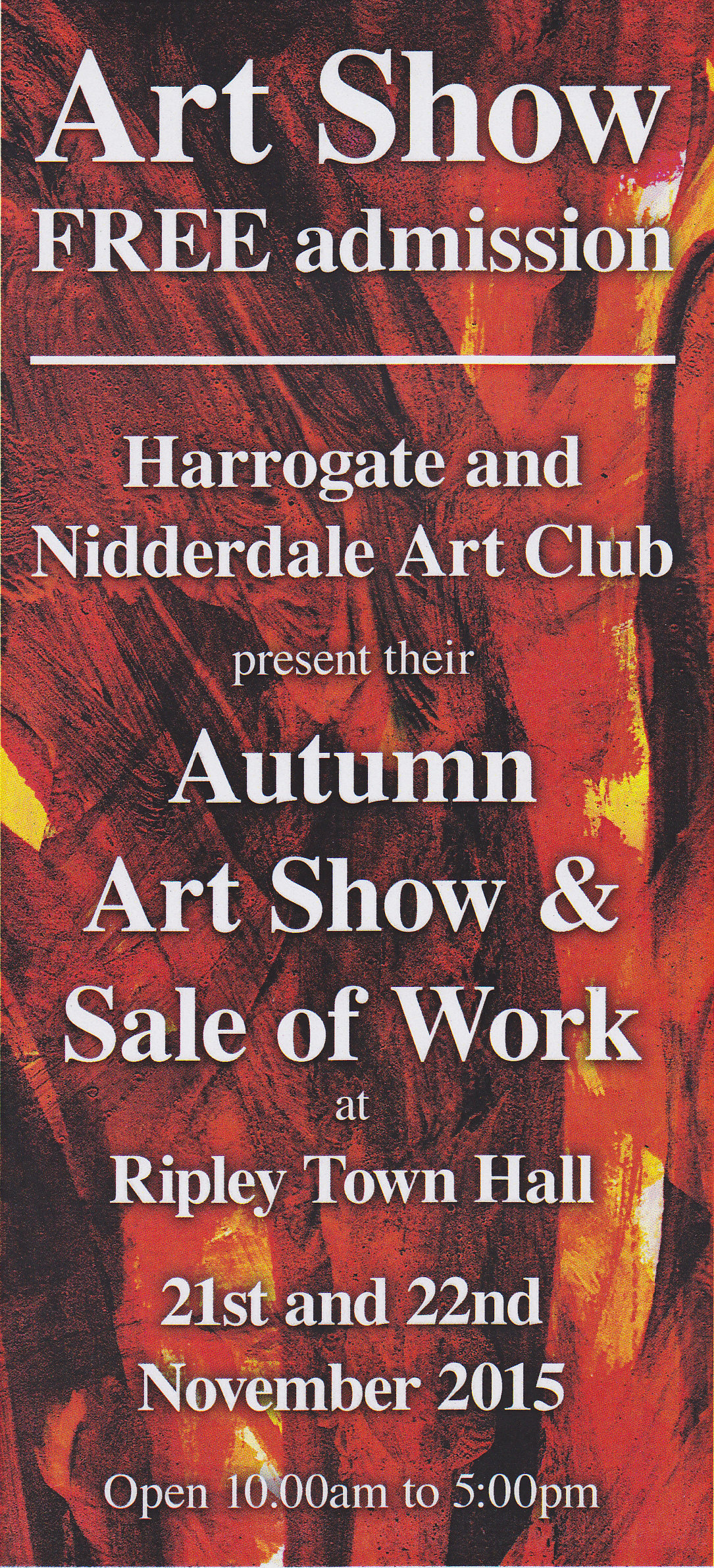
Harrogate and Nidderdale Art Club exhibition at Ripley Town Hall, near Harrogate, 21 & 22 November 2015.

Harrogate and Nidderdale Art Club exhibition at Ripley Town Hall, near Harrogate, 21 & 22 November 2015.

Visiting demonstrators at art clubs are amazingly varied and it is usually useful to attempt whatever they ask the club members to do.  I have done some workshops myself and appreciate the efforts of club members who really have a go at continuous line drawings, and associated things I show, even though to is unlikely that any of them will take up my technique as a main style.  Hopefully people can pick up things which can apply to other styles, such as building abstract patterns, using colour sequences, drawing key identifying parts of a subject and trying to manage a picture which sometimes appears to be drawing itself !

Charles Kelly from Bradford, who I have seen doing demonstrations before, came to Stainbeck Arts Club a couple of months ago and said he was doing a workshop this time.  Watercolour tends to be the most popular topic at art clubs, but Charles has a spectacular approach to “wet on wet” and this time we were doing it too.  Here is an example of his work from a demonstration to Alwoodley Art Group in 2013.

A Pair of Geese, painted by Charles Kelly in a demonstration at Alwoodley Art Group in 2013.

A Pair of Geese, painted by Charles Kelly in a demonstration at Alwoodley Art Group in 2013.

My usual style of strong lines and flat colours (acrylic or poster colour) are poles apart from watercolour but I always learn something.  I have to say that using a big brush to coat large proportions of the paper with water in advance (up to selected boundaries of course) and then squeezing brush loads of watercolour in dollops all over is a bit “hairy”.  Then picking up the paper and waving it about so that the colour swishes around, like tides on a beach, reminds me of relatives of mine “panning” for gold in Victoria in the 1850’s.

Charles had brought many reference pictures which we could use and I chose one of a barn owl.  I thought that I could do washes up to the outline of the owl and also within the owl and later put a continuous line on top which more or less matched the washes.  Here is a copy of the wash I did initially, helped by some tips from Charles along the way.
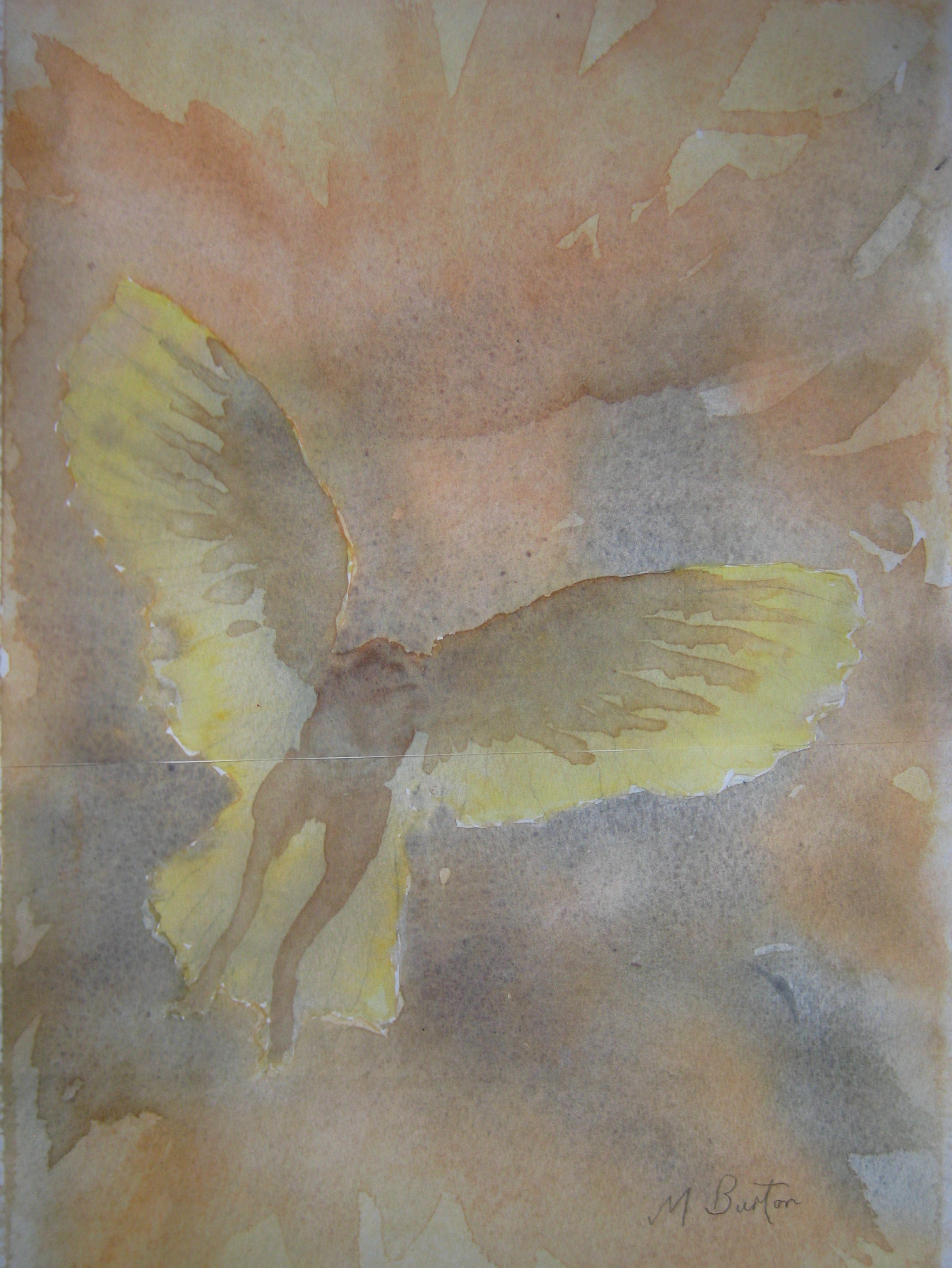
Copy of Wet on Wet watercolour of Barn Owl, before I attempted the continuous line drawing. Mick Burton.

Copy of Wet on Wet watercolour of Barn Owl, before I attempted the continuous line drawing. Mick Burton.

Later, at home, I worked on the continuous line on top of the above copy.  I started by putting key lines along the outline of the owl, feathering and other features – to match the borders of colours as far as I could.  Then I added more connecting pattern and finally joined everything up and made sure I had a continuous line.

Once I was satisfied with this I traced the continuous line down onto my watercolour painting and drew over the lines in acrylic pen making final changes as I saw how the firm line was developing.

I think that the translucent effect of the feathering has worked well, although this view may not be appreciated by a victim mouse in its last moments.

Red Squirrel continuous line and Grey Squirrel photographs

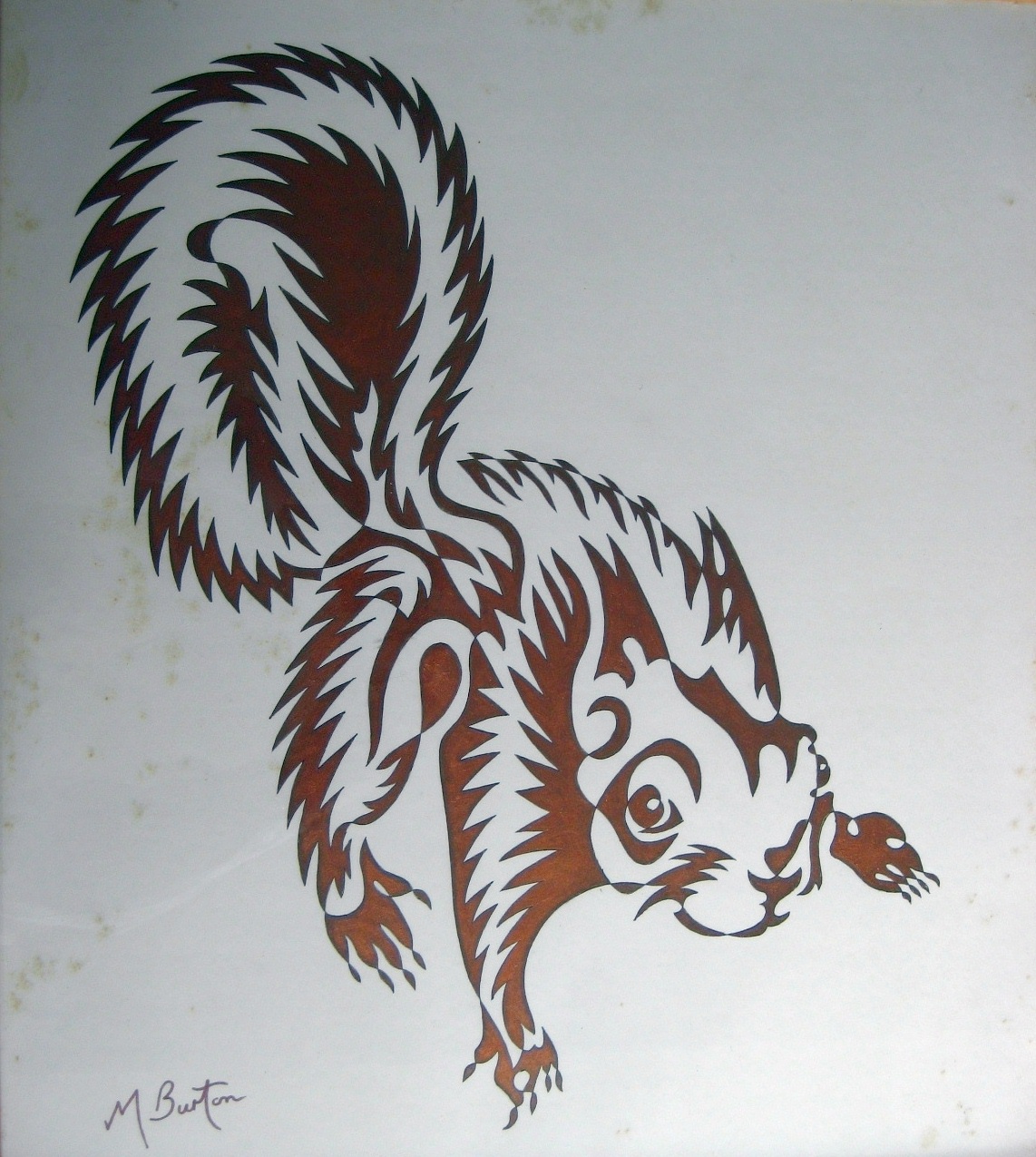
Red Squirrel, continuous line with colour sequence. Mick Burton, Leeds artist.

Red Squirrel, single continuous line drawing with colour sequence. Mick Burton, Leeds continuous line artist.

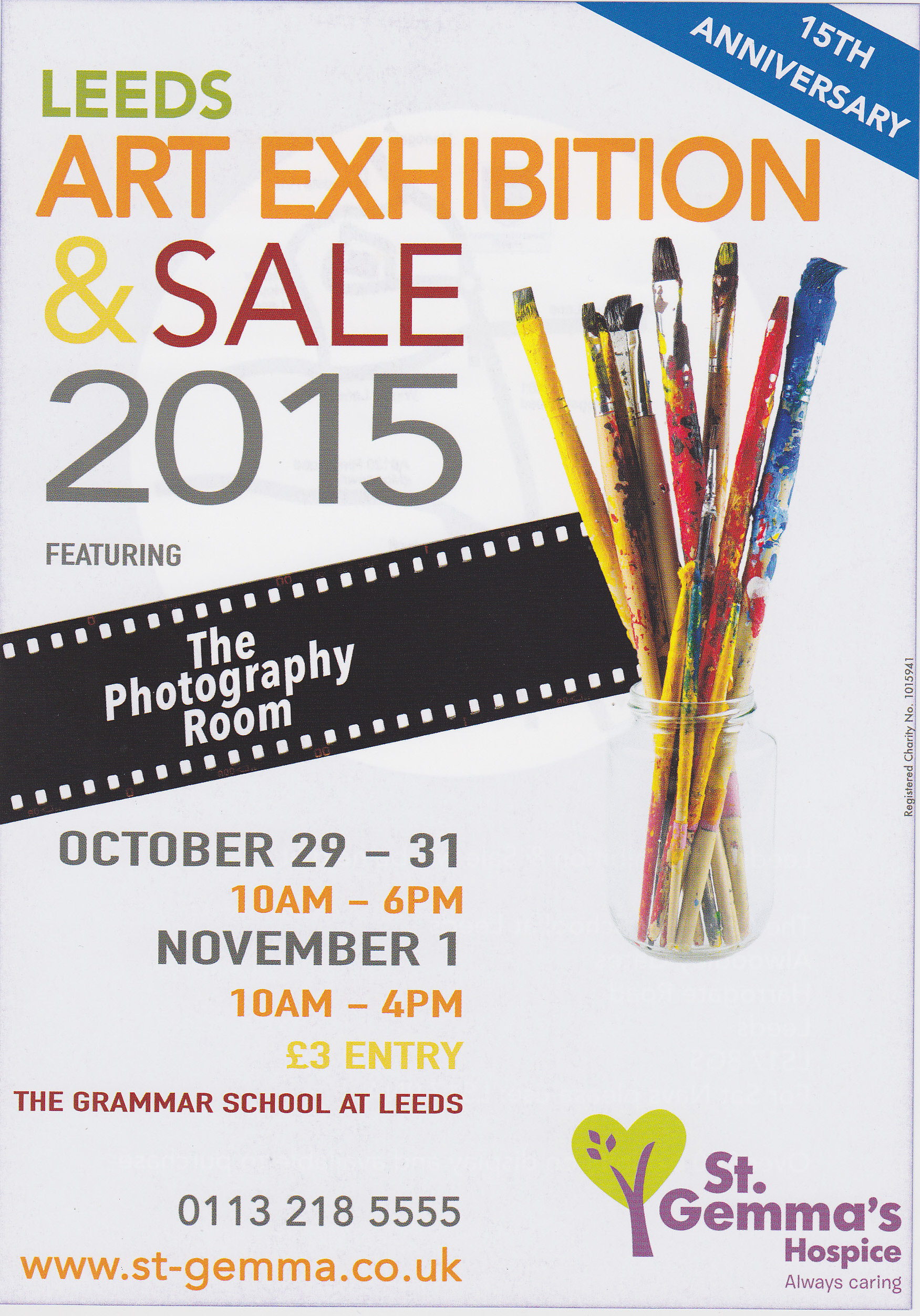
This continuous line Red Squirrel, completed with colour sequence, is one of my pictures to be hung at the Leeds Art Exhibition and Sale put on for the 15th year by St Gemma’s Hospice.

St Gemma's Leeds Art Exhibition. 29 - 31 October 2015

St Gemma’s Leeds Art Exhibition. 29 – 31 October 2015

This colour sequence squirrel is the last of a series which began with my attempt to produce a continuous line drawing with a shimmering fur effect for the squirrel.

Continuous line squirrel from 1970, with shimmering effect of fur. Mick Burton, Leeds artist.

Single continuous line drawing of squirrel from 1970, with shimmering effect of fur. Mick Burton, Leeds continuous line artist.

I have a treasured memory of seeing a Red Squirrel, when I was four, sitting on a wall next to our cottage at Arncliffe Hall, in the North Riding, where my Dad was Head Gardener to Sir Hugh Bell just after the War.  I thought that completing alternate shading with copper paint would best reflect this colour in this picture from 1970.  My daughter Kate said on the phone today that she remembered this picture being in the hall when she was young.

Red Squirrel with copper alternate shading from 1970. Mick Burton, Leeds artist.

Red Squirrel, single continuous line drawing with copper alternate shading from 1970. Mick Burton, Leeds continuous line artist.

I have many clear memories of living at Ingleby Arncliffe from the age of nearly two, to four and a half when we left.

Falling out of my pram outside the local shop and crawling up the step was the earliest. There was a three legged cat, then at Sunday School one of the stamps I collected was “The Light of the World” by William Holman Hunt (my first taste of the Pre-Raphaelites) and I won the child’s sprint on sports day on the cricket ground.

In the famous terrible winter of 1947, I remember Dad helping to dig a trench in the snow drifts down to the village.  It was amazing to walk along the trench and not be able to see out.

 I once watched a pig being killed in the yard by the cottage and the workman laughed as he squirted me with the pig’s bladder.  This memory came back years later when, as a young police constable, I attended my first post mortem (of a coal miner who had been in an underground tunnel collapse).  My sergeant stood with me and assured me that it would be just like a newly killed pig being cut up, if I had ever seen one.  I said “Yes, I saw one when I was four ! “

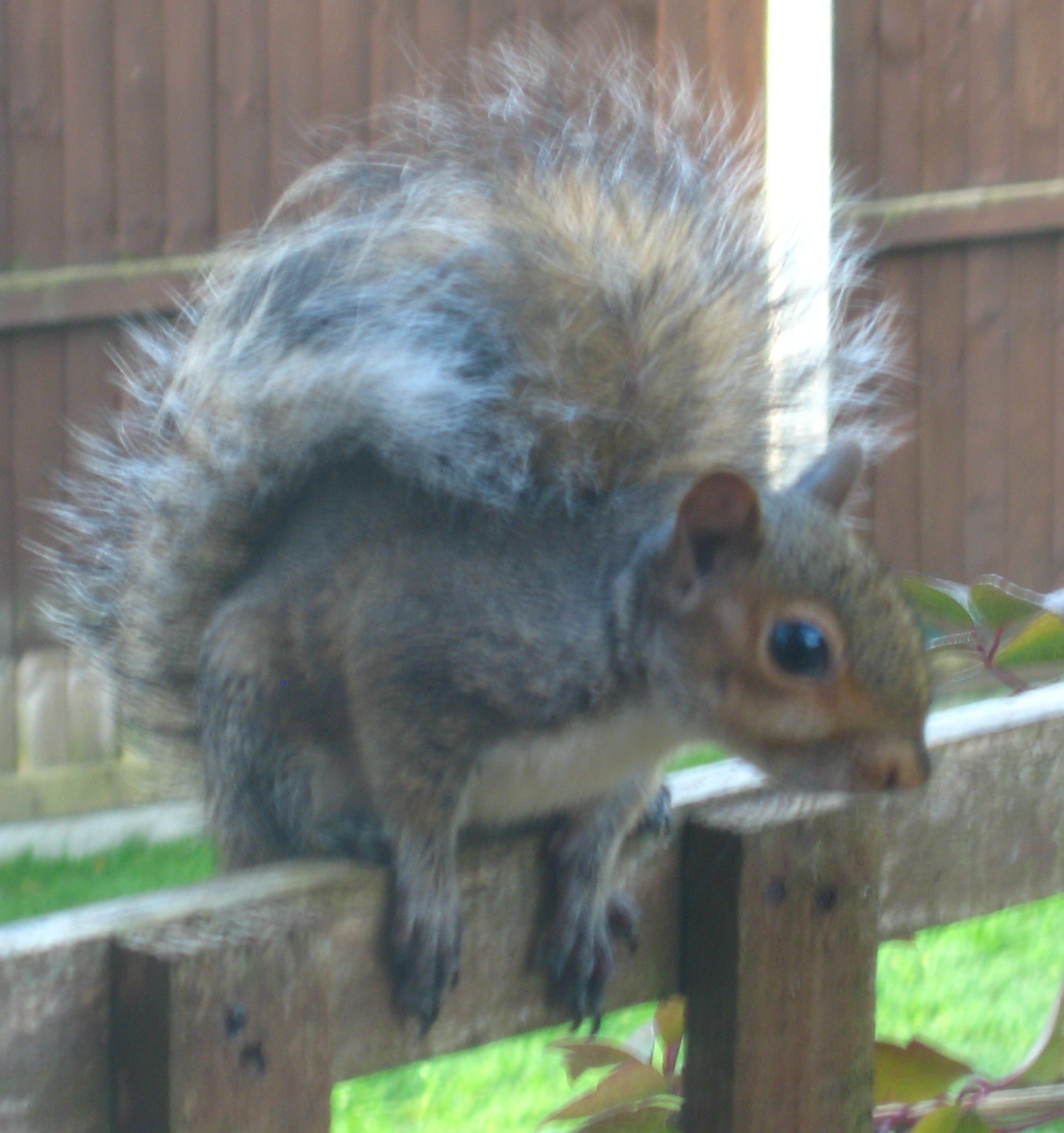
I only see grey squirrels now, mainly helping themselves to the bird seed Joan puts out.  With Gledhow Valley Woods at the end of the garden we can have five of them at a time.  Yesterday, a young squirrel was chased by a cat and ended up on the trellis a few feet from our dining room window.  Joan chased the cat away and called to me as the squirrel was too scared to move.

I took some quick photographs whist it was still there, but it became apparent that it was not going to move and was looking at me pleadingly.  So I went out and shepherded it into the bushes.  Here are some photos of a shimmering fur tail.

Young Grey Squirrel from Gledhow Valley Woods. Three feet from my window after being chased by a cat. Mick Burton, Leeds artist.

Young Grey Squirrel from Gledhow Valley Woods. Three feet from my window after being chased by a cat. Mick Burton, Leeds artist.

Young Grey Squirrel not daring to move, even though Joan had chased the cat away. Mick Burton, Leeds artist.

Young Grey Squirrel not daring to move, even though Joan had chased the cat away. Mick Burton, Leeds artist.

Young Grey Squirrel, imploring me to stop taking photos and do something about the cat. So I went out and shepherded it to the bushes. Mick Burton, Leeds artist.

Young Grey Squirrel, imploring me to stop taking photos and do something about the cat. So I went out and shepherded it to the bushes. Mick Burton, Leeds artist.

Leeds Carnival 2015 with photos by Mick Burton, continuous line artist.

Red Indian head dress costume, Leeds Carnival 2015. Photo by Mick Burton continuous line artist.

Red Indian head dress costume, Leeds Carnival 2015. Photo by Mick Burton continuous line artist.

This was the first costume in the parade, preceded by one of several mobile steel drum bands. We stood on the first bend, near Gledhow Valley, after the parade’s initial stretch from Potternewton Park.

Cockapoo with wet paws waits for the Leeds Carnival parade to approach. Photo by Mick Burton, continuous line artist.

Cockapoo with wet paws waits for the Leeds Carnival parade to approach. Photo by Mick Burton, continuous line artist.

It was a dull afternoon and drizzling. The Cockapoo loved the fuss from the crowd and waited for some action.

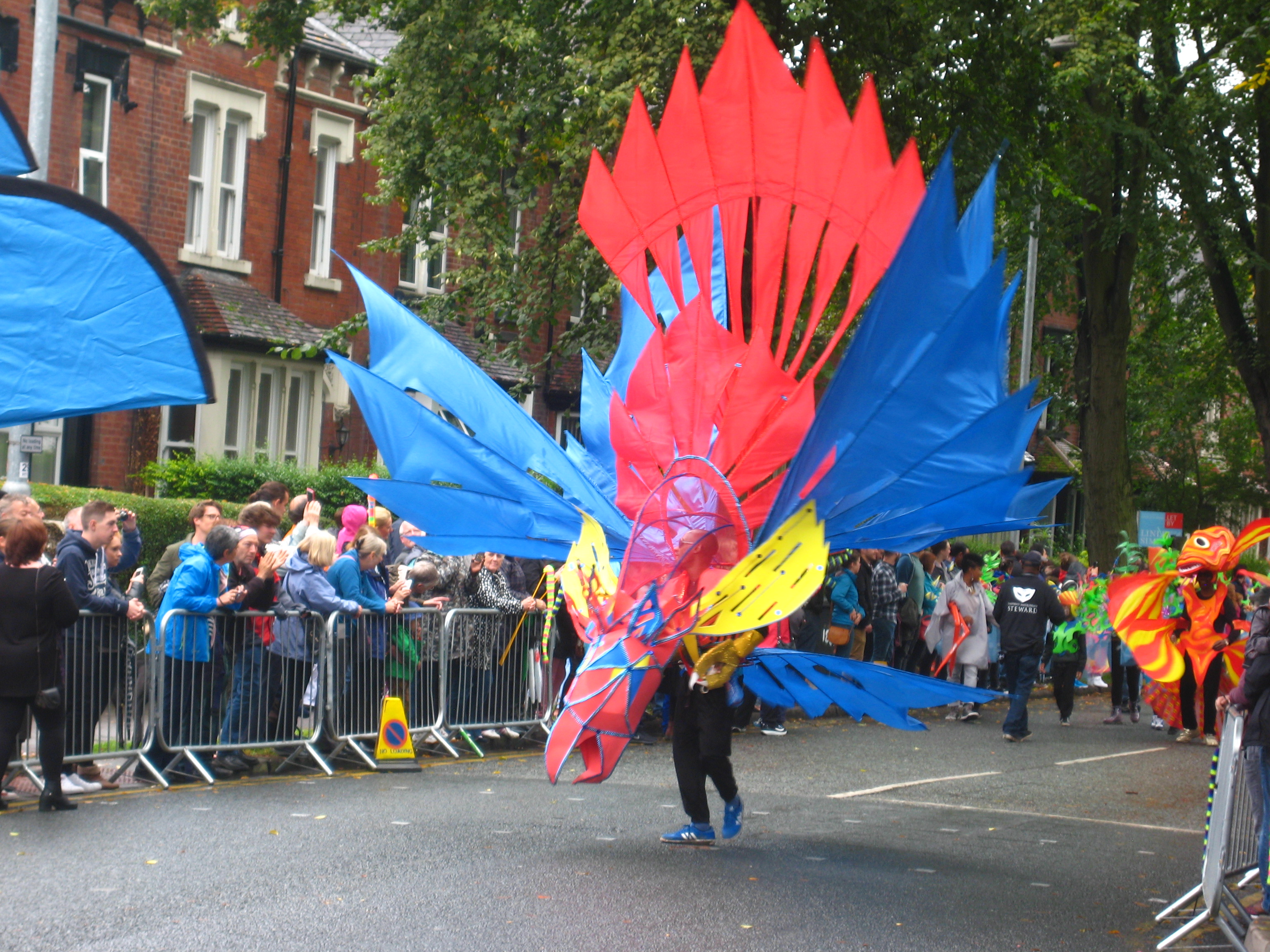
Red and blue costume in the Leeds Carnival matched the drizzle. Photo by Mick Burton, continuous line artist.

Red and blue costume in the Leeds Carnival matched the drizzle. Photo by Mick Burton, continuous line artist.

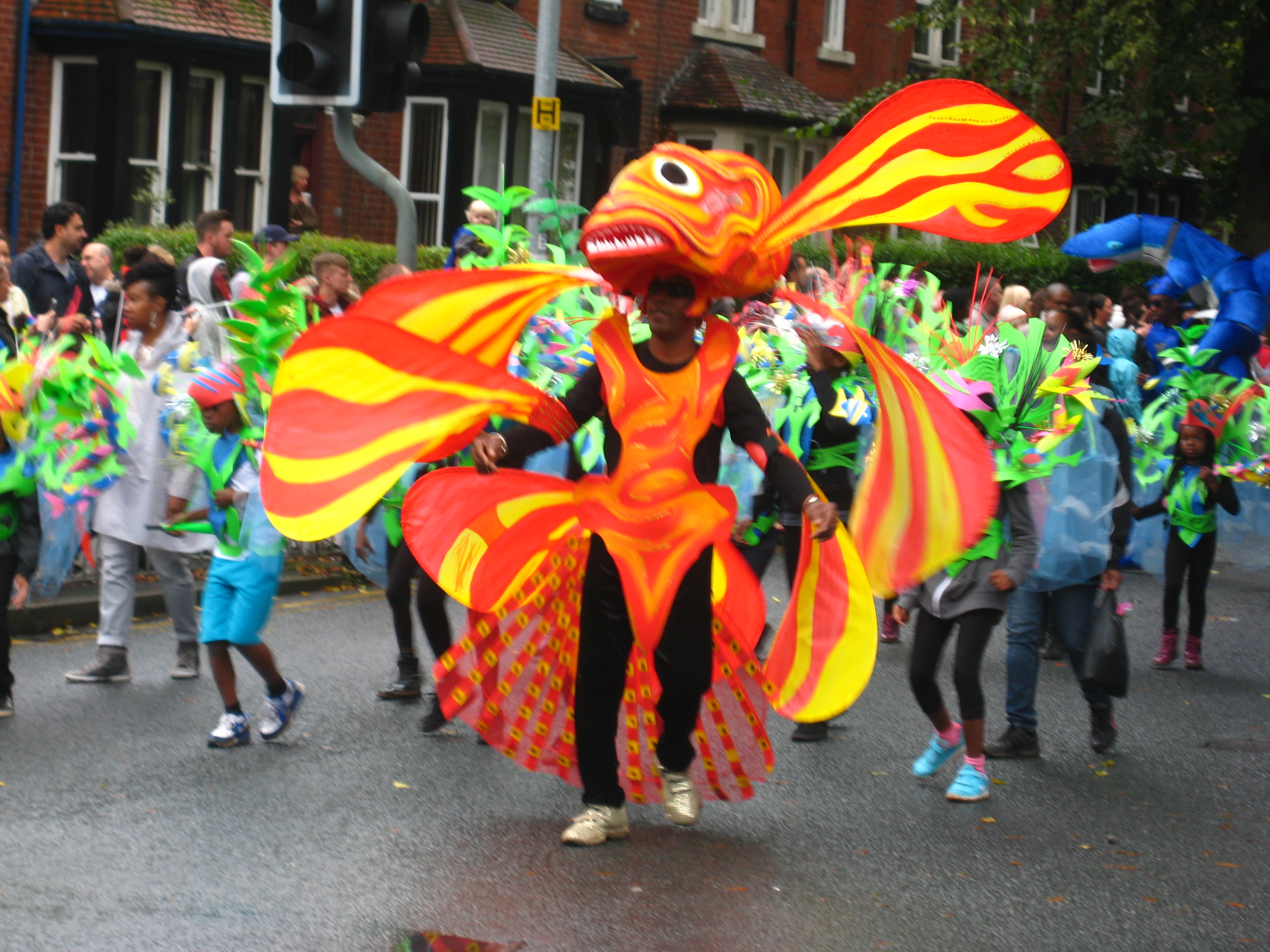
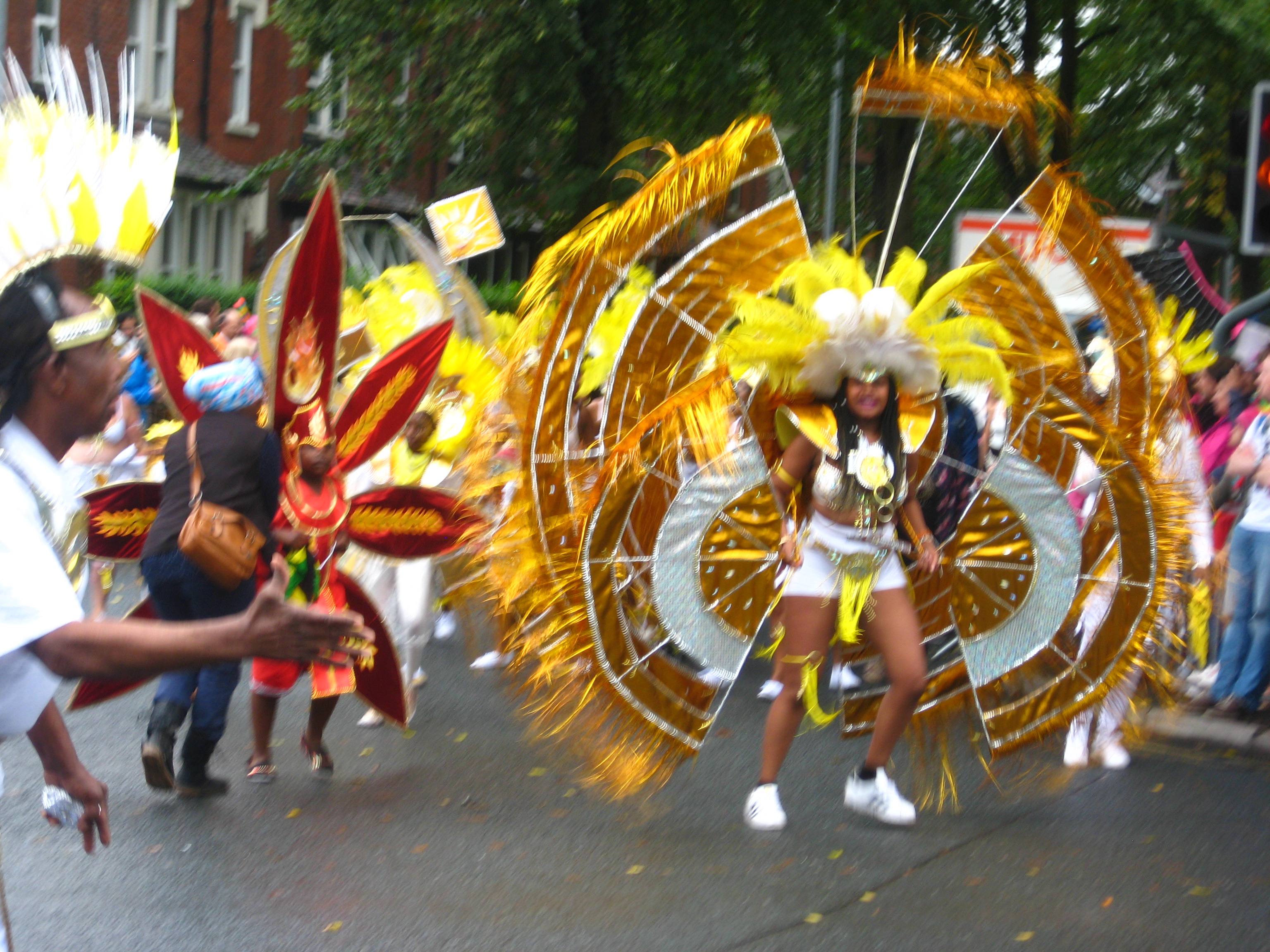
Yellow and orange costume which lit up the parade at the Leeds Carnival. Photo by Mick Burton, continuous line artist.

Yellow and orange costume which lit up the parade at the Leeds Carnival. Photo by Mick Burton, continuous line artist.

The drizzle had stopped and this costume, really lit up the parade.

Violet and yellow costume at the Leeds Carnival. Photo by Mick Burton, continuous line artist.

Violet and yellow costume at the Leeds Carnival. Photo by Mick Burton, continuous line artist.

Razzle and Dazzle at the Leeds Carnival. Photo by Mick Burton, continuous line artist.

Razzle and Dazzle at the Leeds Carnival. Photo by Mick Burton, continuous line artist.

Gold costume at the Leeds Carnival. Photo by Mick Burton, continuous line artist.

Gold costume at the Leeds Carnival. Photo by Mick Burton, continuous line artist.

Lion King at the Leeds Carnival. Photo by Mick Burton, continuous line artist.

Lion King at the Leeds Carnival. Photo by Mick Burton, continuous line artist.

Catherine wheel costume at Leeds Carnival. Photo Mick Burton, continuous line artist.

Catherine wheel costume at Leeds Carnival. Photo Mick Burton, continuous line artist.

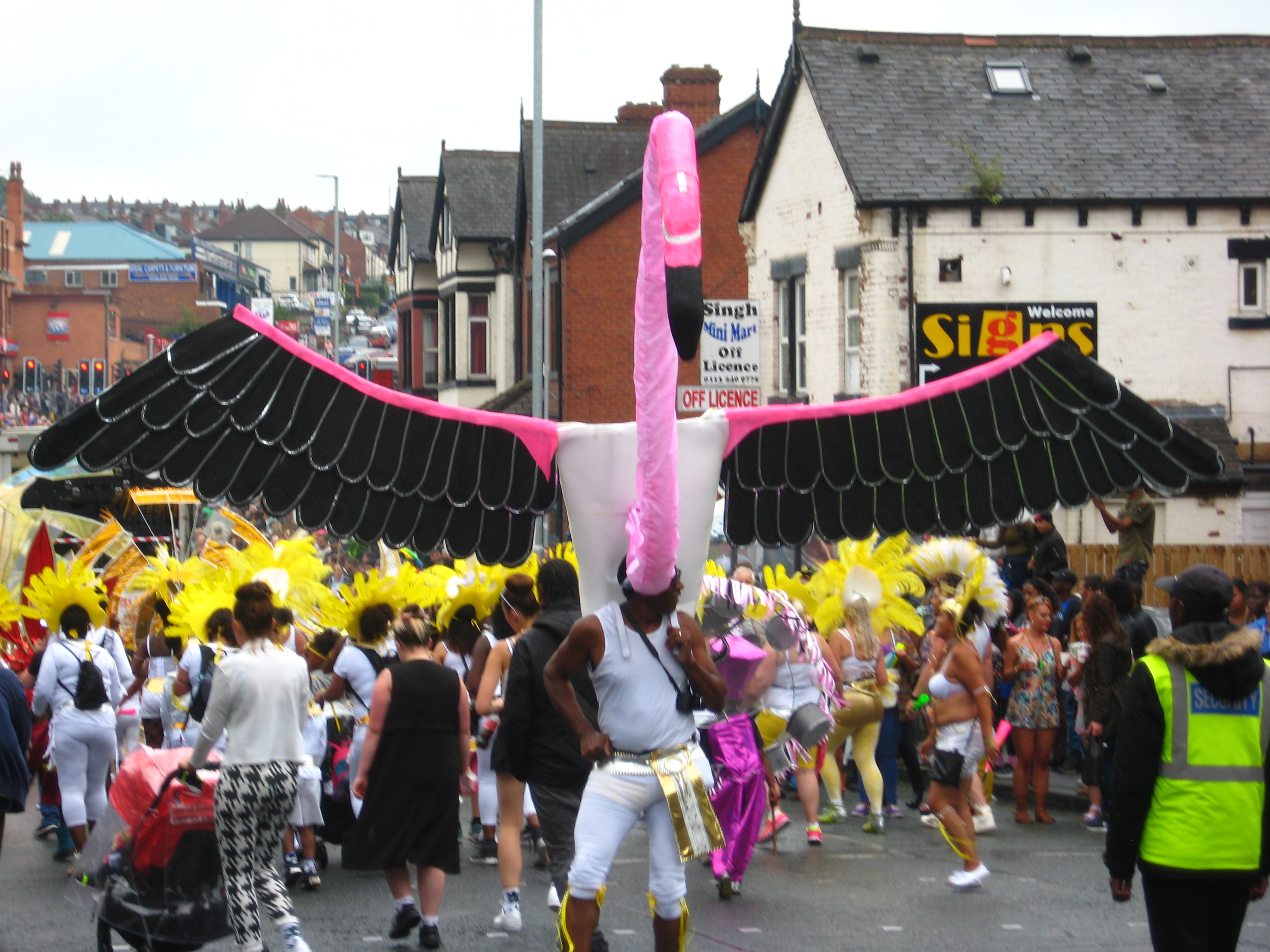
Flamingo costume at Leeds Carnival. Photo by Mick Burton, continuous line artist.

Flamingo costume at Leeds Carnival. Photo by Mick Burton, continuous line artist.

Bolivian costumes, back view, at the Leeds Carnival. Photo Mick Burton, continuous line artist.

Bolivian costumes, back view, at the Leeds Carnival. Photo Mick Burton, continuous line artist.

Jamaican costume at Leeds Carnival. Photo Mick Burton, continuous line artist.

Jamaican costume at Leeds Carnival. Photo Mick Burton, continuous line artist.

Blue and Green costume at Leeds Carnival. Photo Mick Burton, continuous line artist.

Blue and Green costume at Leeds Carnival. Photo Mick Burton, continuous line artist.

Pink costume at Leeds Carnival. Photo Mick Burton, continuous line artist.

Pink costume at Leeds Carnival. Photo Mick Burton, continuous line artist.

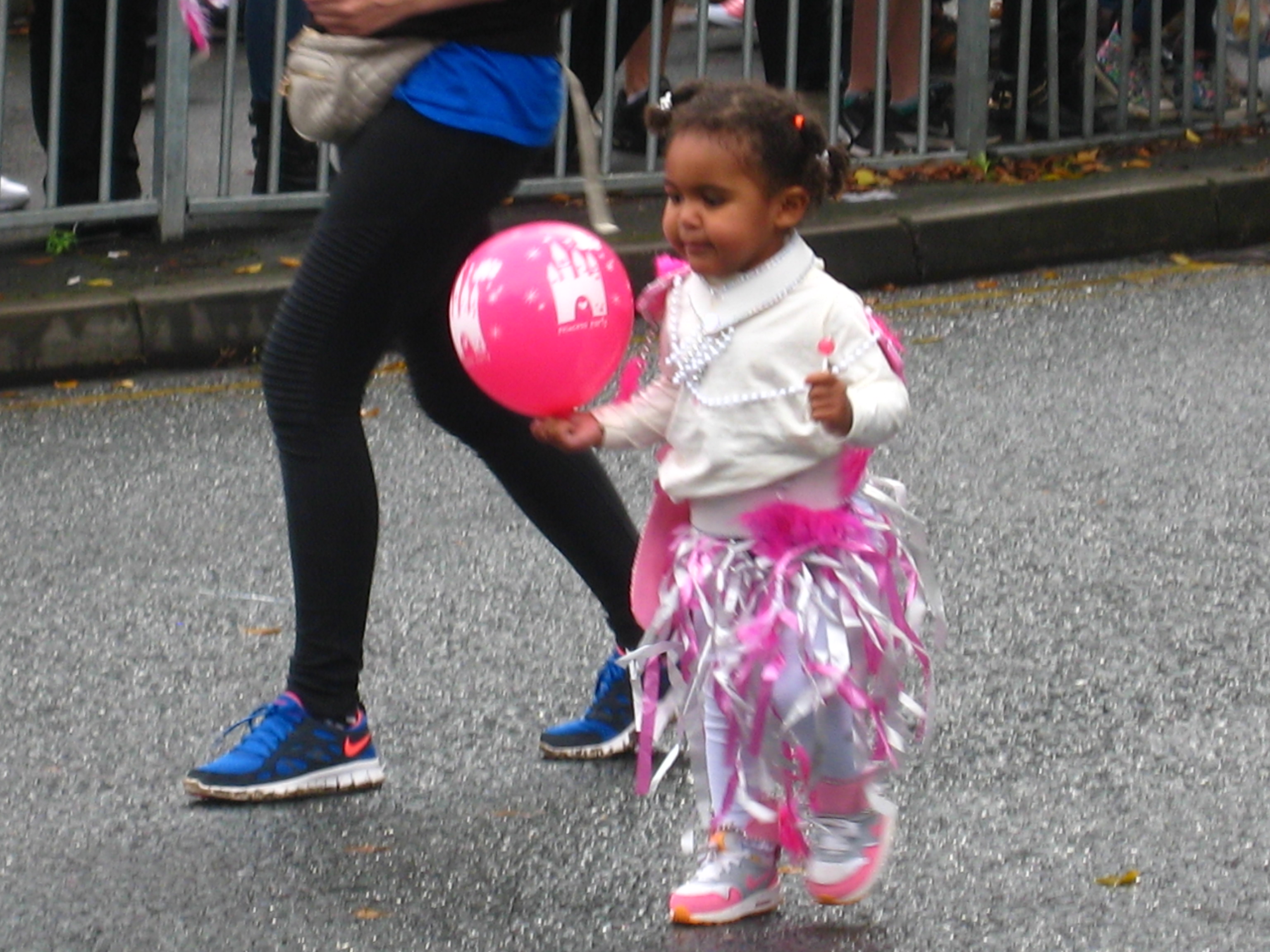
Child with balloon in Leeds Carnival parade. Photo Mick Burton, continuous line artist.

Child with balloon in Leeds Carnival parade. Photo Mick Burton, continuous line artist.

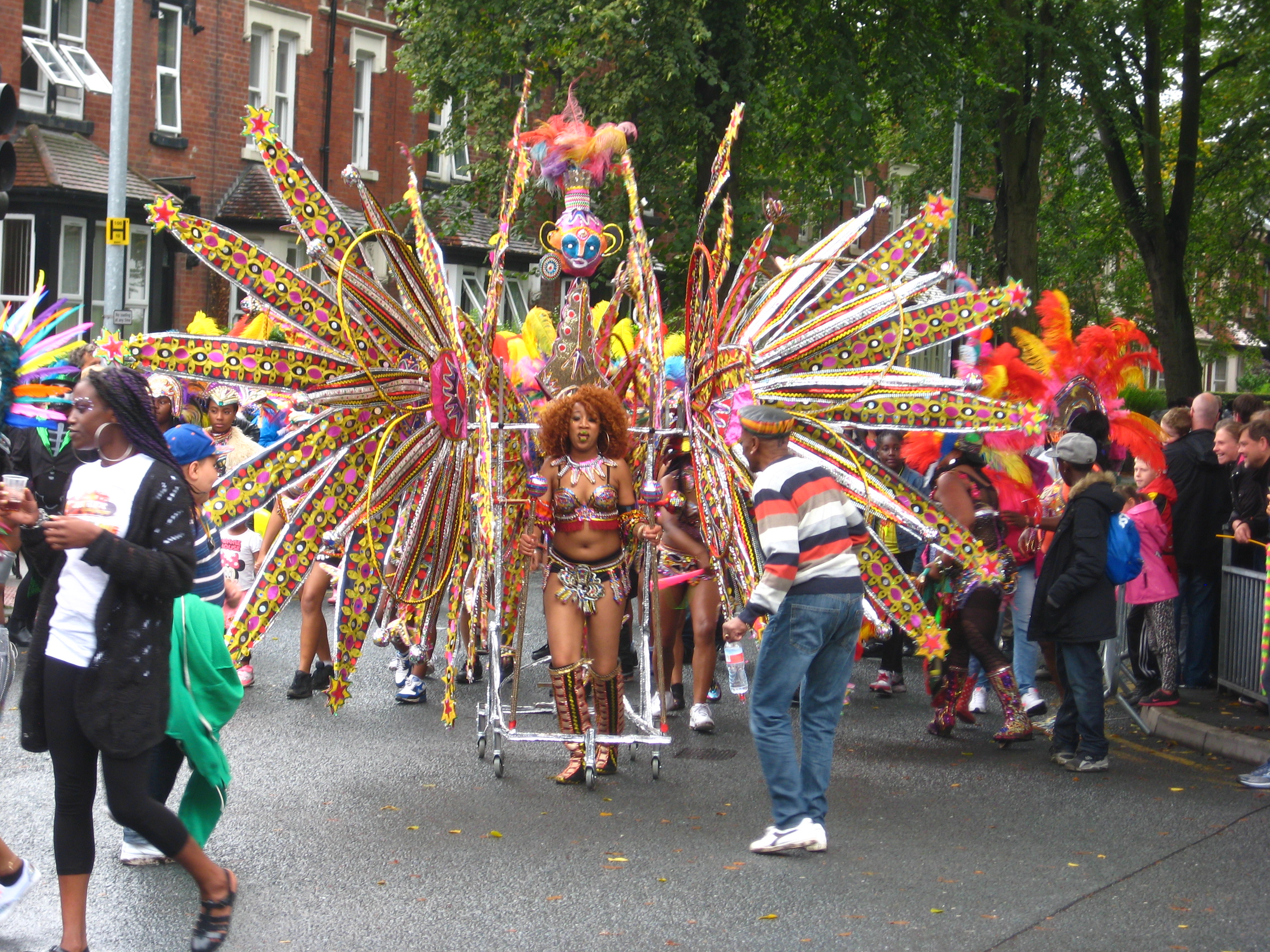
Multi petal costume at Leeds Carnival parade. Photo Mick Burton, continuous line artist.

Multi petal costume at Leeds Carnival parade. Photo Mick Burton, continuous line artist.

So there we are. Another very entertaining Leeds Carnival parade. The colours lit up a dull afternoon until the sun came out.


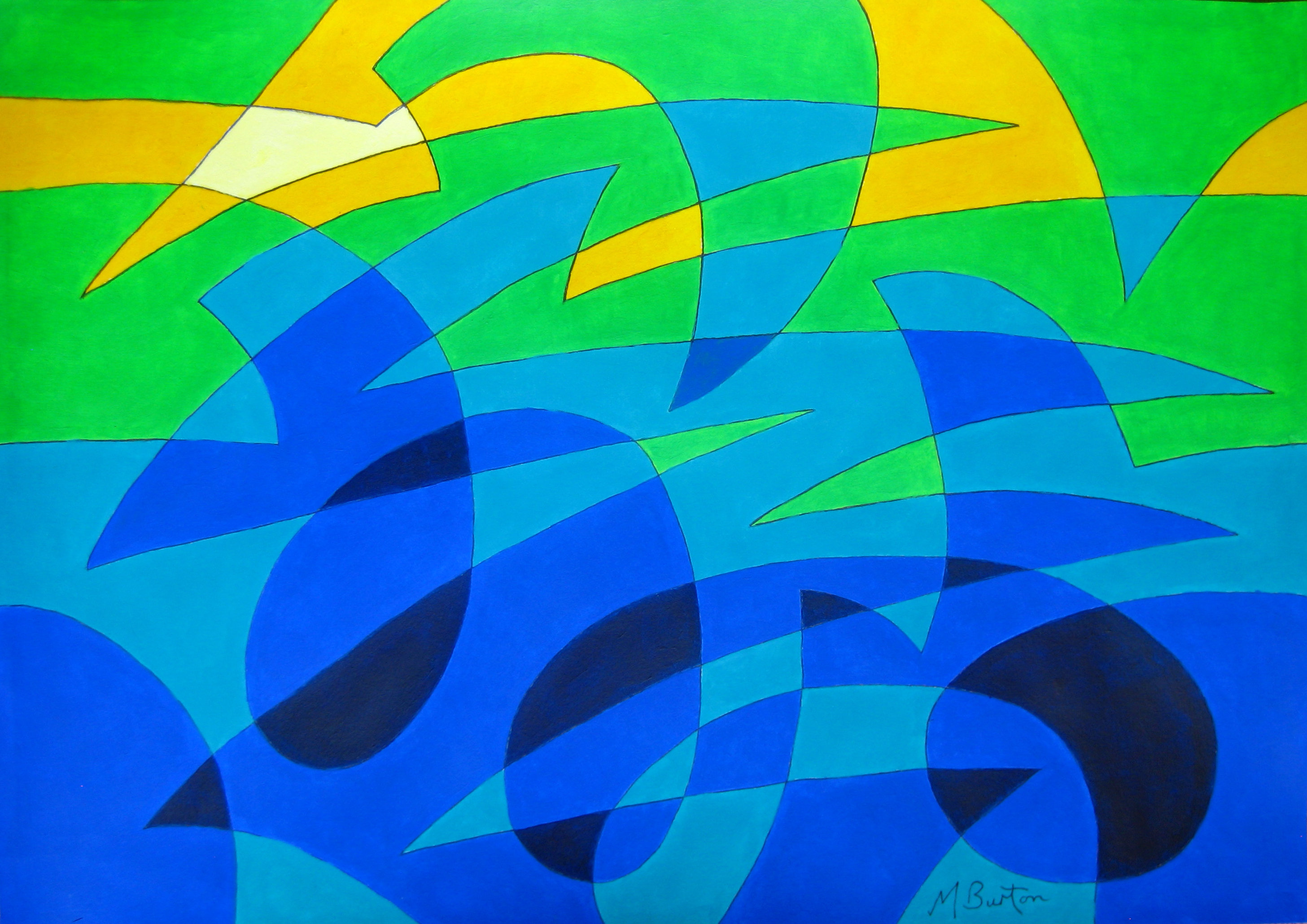
Spherical Continuous Line Abstract with Colour Sequence.

Spherical continuous line with colour sequence. Flypast Over Rolling Hills. Mick Burton 2015.

Spherical single continuous line drawing with colour sequence. Flypast Over Rolling Hills. Mick Burton, continuous line artist 2015.

I have modified my Spherical approach to continuous line from the method I described in my Continuous Line Blog post of 9 July 2014, which did not quite reflect the reality I was seeking.

I have kept the idea that when you draw out of one SIDE of the paper you need to return at the opposite SIDE at the corresponding point, so that the pattern matches vertically and after colour sequence the colours also match if you pull the paper round into a tube shape.  This is similar to the equator on a globe of the world matching.

Previously I had said that when going out of the top of the drawing you also need to return at the corresponding place at the bottom.  I was correct to say that the colours would not match, which would be equivalent to the poles on the globe of the world not meeting, but the treatment of the lines needed to be modified.

I realised that the bunching effect of the top being pulled together totally separately to the bottom being pulled together was fine regarding separate sets of colours but matching the line patterns from top to bottom was the wrong approach.

So, when I go out at the TOP now I need to come BACK IN AT THE TOP at the corresponding distance from the other end of the top.   Similarly if I go out at the bottom I come back in at the bottom.  You could then imagine that folding the picture vertically down the middle would mean that both pattern and colour sequence would now match at the top and bottom respectively (don’t actual fold it and spoil the picture ! ).

I recently drew the following for a demonstration/workshop at Stainbeck Arts Club in Leeds.  I started drawing the line a couple of inches in from the top left side and did a few rolling curves diagonally down from left to right, followed by several exits and returns to the picture – initially out at the lower right side and back in at the lower left side, then down and out at the bottom left and back in at the bottom right.

Spherical continuous line drawing with rolling and jagged lines. Mick Burton 2015.

Spherical single continuous line drawing with rolling and jagged lines. Mick Burton, continuous line artist 2015.

I later tried some “shark fin” curves and a couple of large jagged sequences.

All the time I tried to draw the line cleanly through existing shapes (avoiding going near previous junctions) and being aware of areas I had not visited much.  Finally I needed to work out how to get back to my start point without spoiling the composition too much (here going out and back in can be handy).

I hope you can check the route of the line through the whole picture fairly easily.  I then applied my Colour Sequence to produce the picture at the top of this post.

The first stage is my usual alternate overdraw of the line (if you are overdrawing a section as you go out of the picture you need to continue to overdraw as you re-enter, or if not overdrawing going out it’s not overdrawing when you re-enter).  See my post of 10 September 2014 for the full ALTERNATE OVERDRAW process and my post of 27 September 2014 for the COLOUR SEQUENCE process.

I have used a series of 6 colours from Pale Yellow through greens to Prussian Blue which I have tried to work out in steps of tone.  This is partly to highlight the overlap effect of continuous lines and the natural depth of the abstract.  As always, there is choice of direction of colours – light to dark or dark to light.  Here it seemed best to have the single lightest area at the top and several darker areas across the lower part of the picture.  The picture also has an Optical Art look about it.

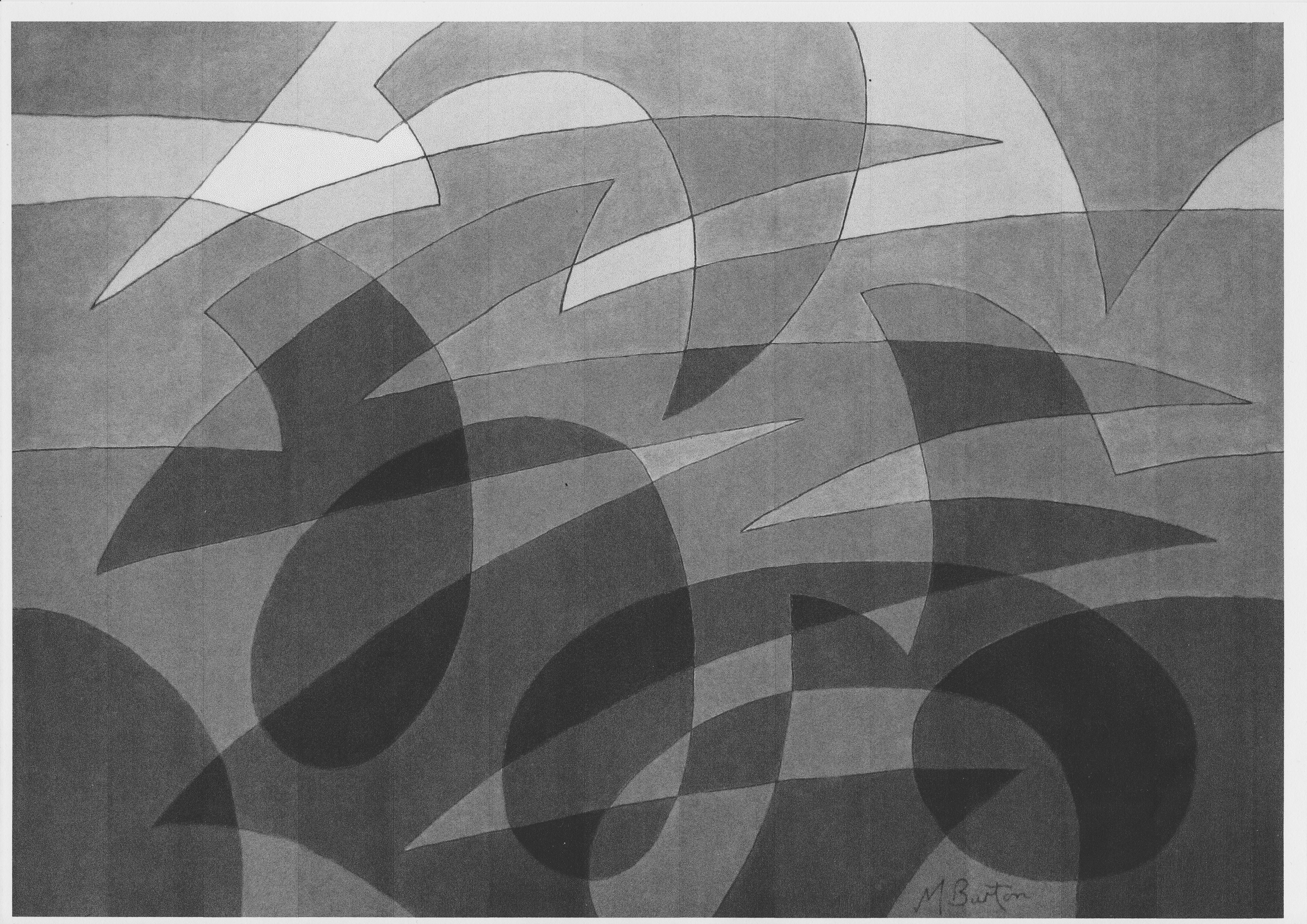
Printing the picture in Monotone is usually a good way of checking the steps of colour and light to dark.  So here it is.

Monotone of Spherical Continuous Line

Monotone of Spherical Single Continuous Line Drawing “Flypast Over Rolling Hills”. Mick Burton 2015.

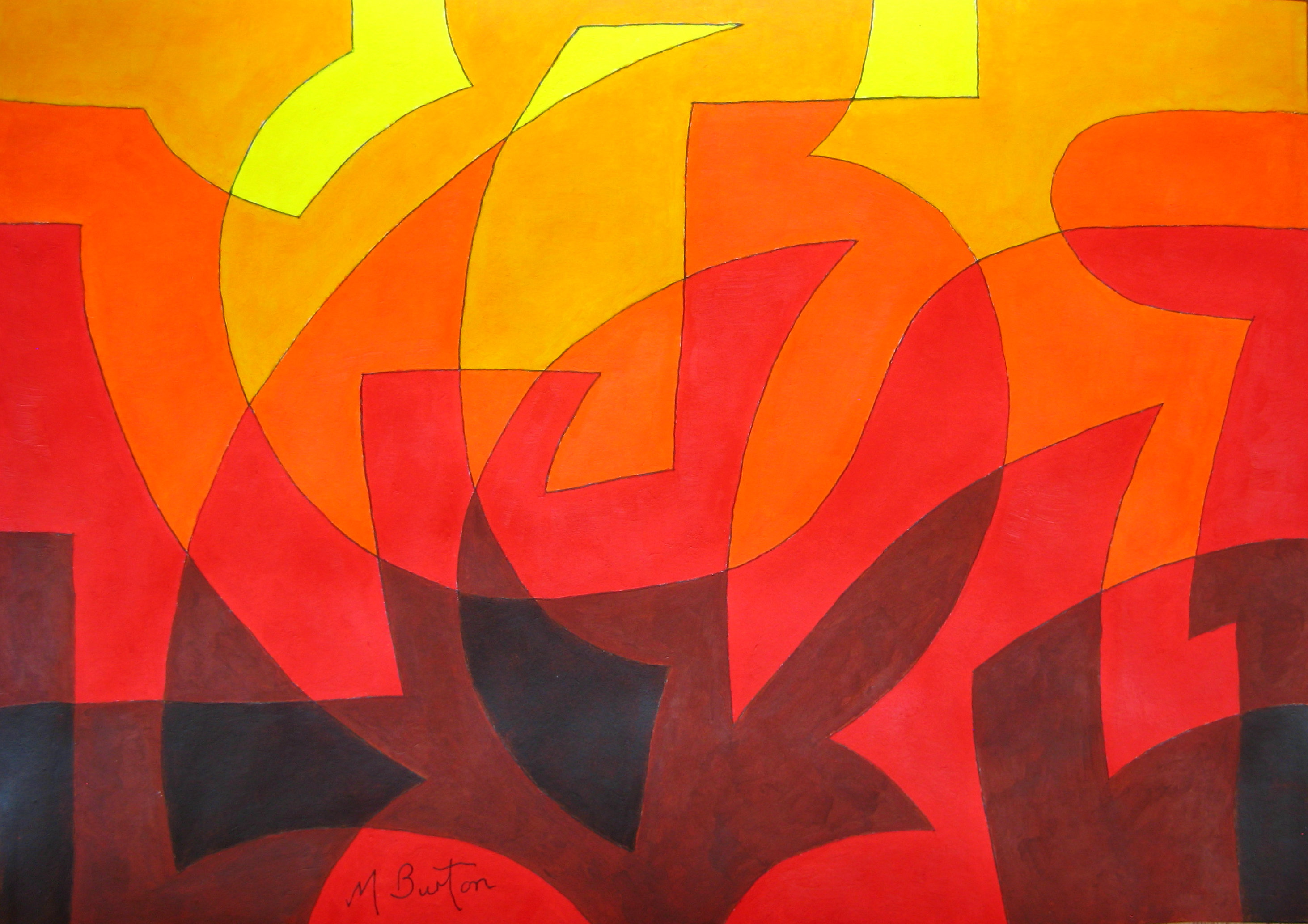
I also produced another similar abstract for the Demonstration at Stainbeck Arts Club to show the Spherical approach with a different flow of lines and colours.  I had coloured the drawing with a sequence from Yellow through Reds to dark Brown.

Spherical Continuous Line with Colour Sequence. Forest Fire. Mick Burton 2015.

Spherical Single Continuous Line Drawing with Colour Sequence. Forest Fire. Mick Burton 2015.

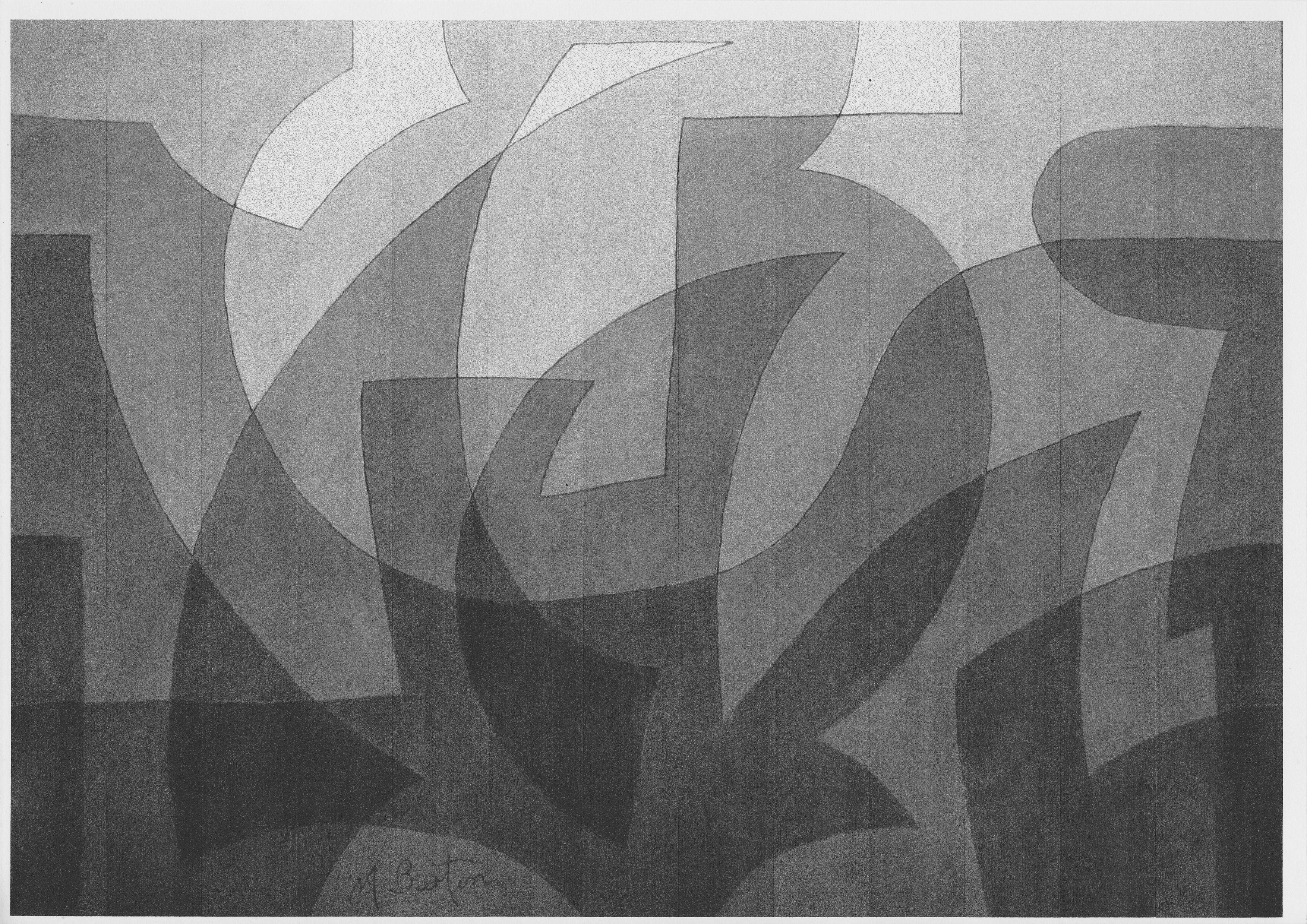
Here is the Monotone of this picture.

Monotone of Spherical Continuous Line

Monotone of Spherical single continuous line drawing “Forest Fire”. Mick Burton 2015.

How do you construct Haken’s Gordian Knot?

After completing my drawings of Haken’s Gordian Knot, which I covered in my previous continuous line blog post, I decided that I needed to find out more about how this unknot was created.  It is one thing me portraying the route of the two strands running through a completed structure, but possible something very different if I construct it from scratch.

A Google search for Haken’s Gordian Knot took me to a page of MathOverflow website, where a question that appeared “Are there any very hard unknots?” posed by mathematician Timothy Gowers, in January 2011.  In an update after many answers he said that he had arrived at Haken’s “Gordian Knot”.

Haken's Gordian Knot, from Ian Agol. A simple circle of string (an Unknot) formed into a complicated continuous line.

Haken’s Gordian Knot, from Ian Agol. A simple circle of string (an Unknot) formed into a complicated continuous line.

Timothy said that, after studying the knot for some time, “It is clear that Haken started by taking a loop, pulling it until it formed something close to two parallel strands, twisting those strands several times, and then threading the ends in and out of the resulting twists”. This approach is something like the suggestions I made in my last post on the basis of my Twisting, Overlapping, Envelope painting of the Haken Knot.

Twisting, overlapping colouring of Haken's Gordian Knot. Mick Burton painting.

Twisting, overlapping colouring of Haken’s Gordian Knot. Mick Burton single continuous line drawing painting.

Timothy then added that “The thing that is slightly mysterious is that both ends are “locked” “.  When I started to build the structure from scratch I began to realise what “locked” may mean.

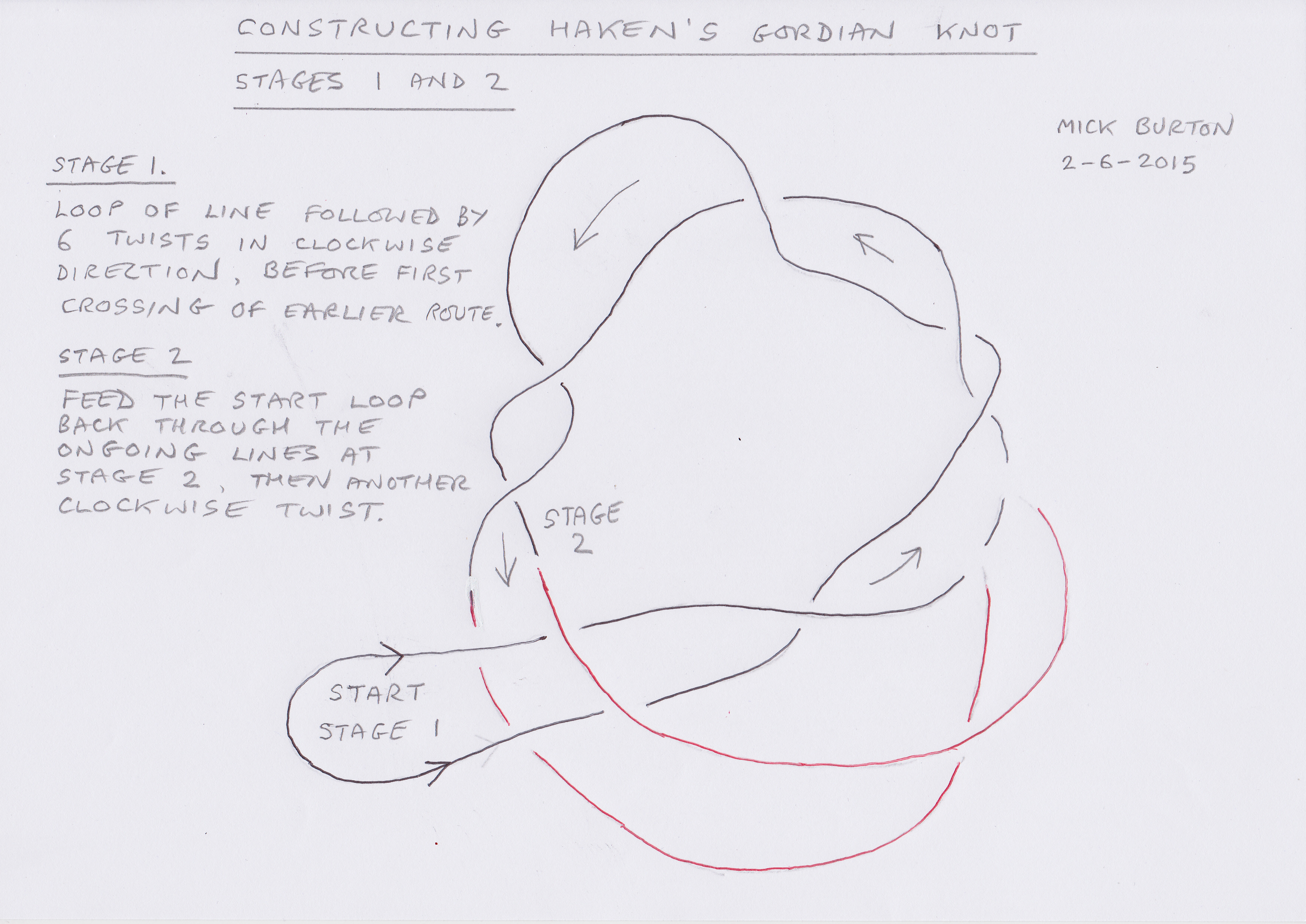
Constructing Haken's Gordian Knot. Stages 1 & 2. Mick Burton.

Constructing Haken’s Gordian Knot. Stages 1 & 2. Mick Burton.

After leaving the looped end at the start, the ongoing route first meets its earlier self at Stage 2.  However instead of the ongoing route going through the earlier one, the initial loop goes back through the later one. This must be what is meant by the first “lock”.

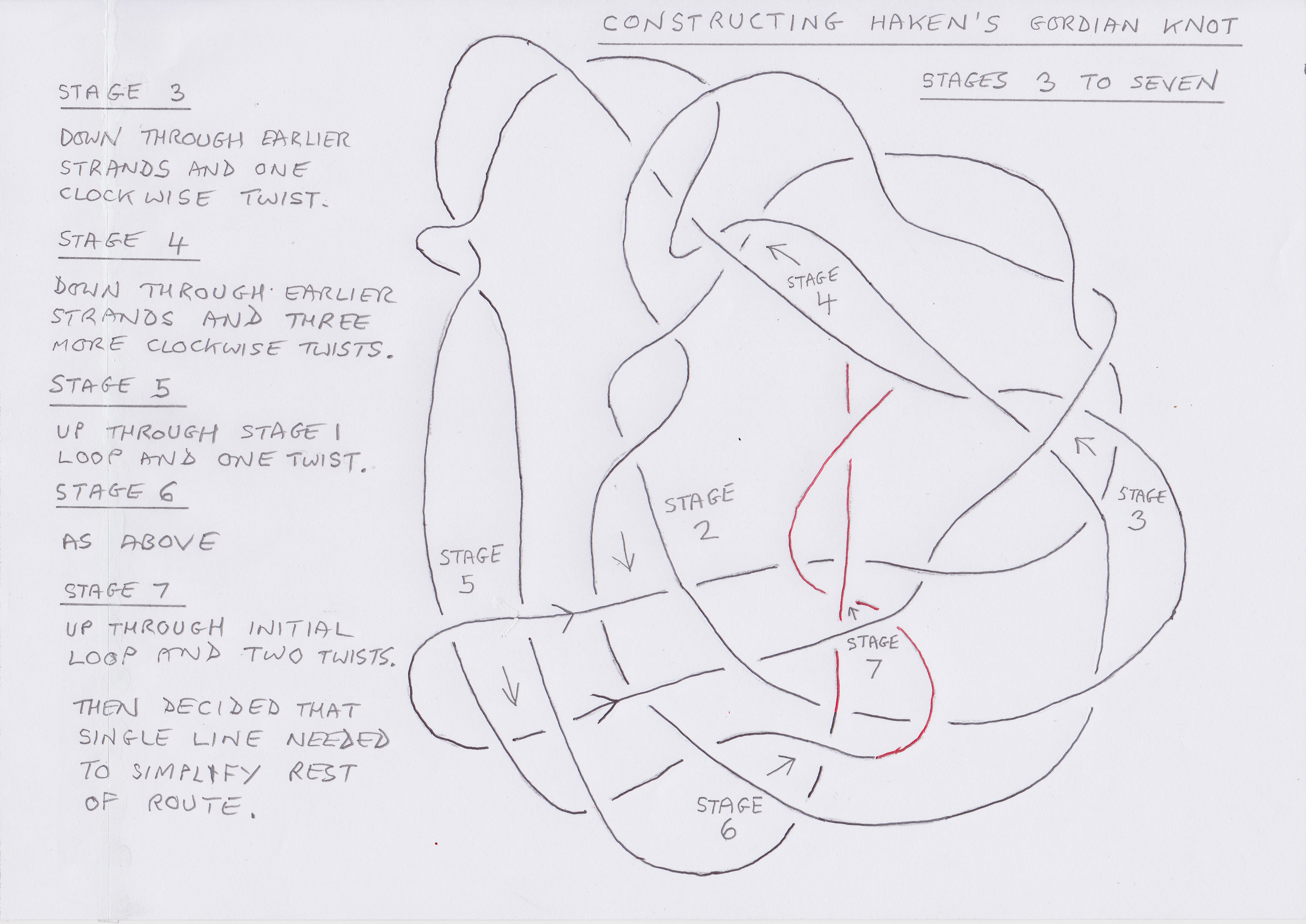
Constructing Haken's Gordian Knot. Stages 3 to 7. Mick Burton

Constructing Haken’s Gordian Knot. Stages 3 to 7. Mick Burton

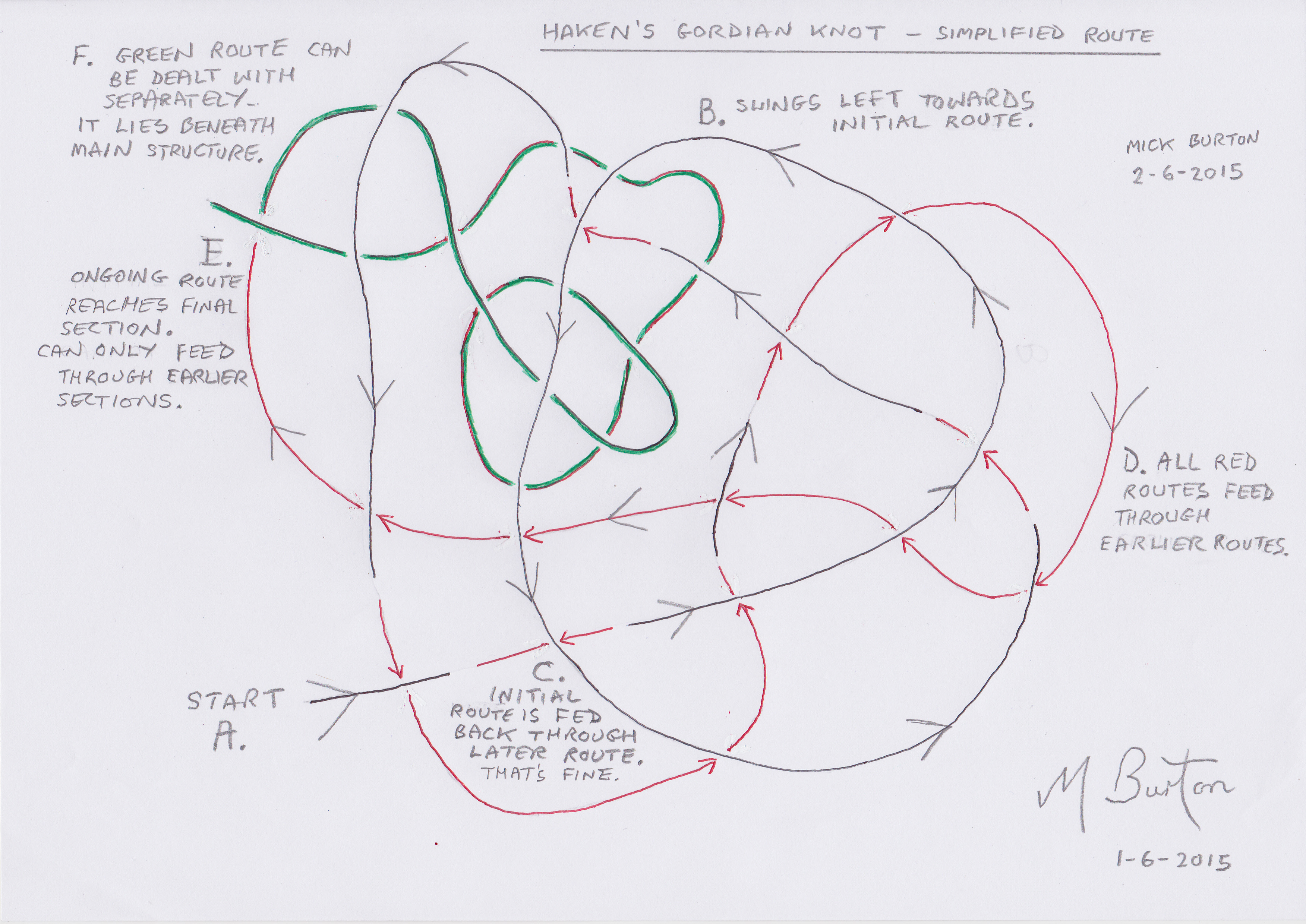
Continuing, things were as expected up to Stage 7.  I now realised that the route could be simplified to one line, as the Twists were not affecting progress but the feed through points were crucial.  I switched to drawing the route by using a simple line (to represent the twin twisting strands) and showed Feed Through points as Red Arrows.

Haken's Gordian Knot, Simplified Route showing Feed Points. Mick Burton.

Haken’s Gordian Knot, Simplified Route showing Feed Points. Mick Burton.

You can see that after point “C”, where the reverse Feed occurs, there are 12 expected Feed Through points until you arrive at point “E”.  Here instead of Feeding through an earlier part of the route, Haken indicates that you are expected to Feed through the End Loop at “E” which is too soon. This must be the other “Lock”.

At this stage, of course, I had no idea what to do.  Timothy did not seem to be using a lot of paper like me, but a “twisted bunch of string” and a small unknot diagram.  So I found some string, but was at a loss to make much sense of anything using that.  Timothy, however, was disappointed that it was so easy with his string initially, but delighted when it became more difficult !

What I did realise about the sections of route lying beyond point “E”, which I have coloured Green, is that they all lie beneath the rest of the structure.

This would allow the Green Area to be constructed separately before you sort of sweep it underneath as a final phase.  When I say “separately” I can only assume that you would need to do all this first, feed the result through the final loop and encapsulate the result.  You would then take this bundle to the start and use it to spearhead the building of the structure, leaving the loop at the other end of the two stranded string back at the start.

Haken's Gordian Knot, Prior action for the Green Route, before starting main structure. Mick Burton.

Haken’s Gordian Knot, Prior action for the Green Route, before starting main structure. Mick Burton.

Timothy said that he would love to put a picture of the process on the website and asked for suggestions.

Even though I am an artist and not a mathematition, I had already done two pictures of Haken’s knot before I found the MathOverflow website and was fascinated by the production process of the knot and so did some extra diagrams of my own.

I will ask if my drawings match Timothy’s thoughts in any way.

Haken’s Gordian Knot and the Twisting, Overlapping, Envelope Elephant.

I constantly look for Continuous Lines in many fields of art, history, mathematics – anywhere, as I just do not know where they are going to crop up.  Currently I am casting an eye on Islamic Art and Celtic art and am developing ideas on those.

Recently I glanced through a book called “Professor Stewart’s Cabinet of Mathematical Curiosities” and came across Haken’s Gordian Knot, a really complicated looking knot which is really an unknot in disguise – a simple circle of string (ends glued together) making a closed line. Here it is.

Haken's Gordian Knot, from Ian Agol. A simple circle of string (an Unknot) formed into a complicated continuous line.

Haken’s Gordian Knot, from Ian Agol. A simple circle of string (an Unknot) formed into a complicated continuous line.

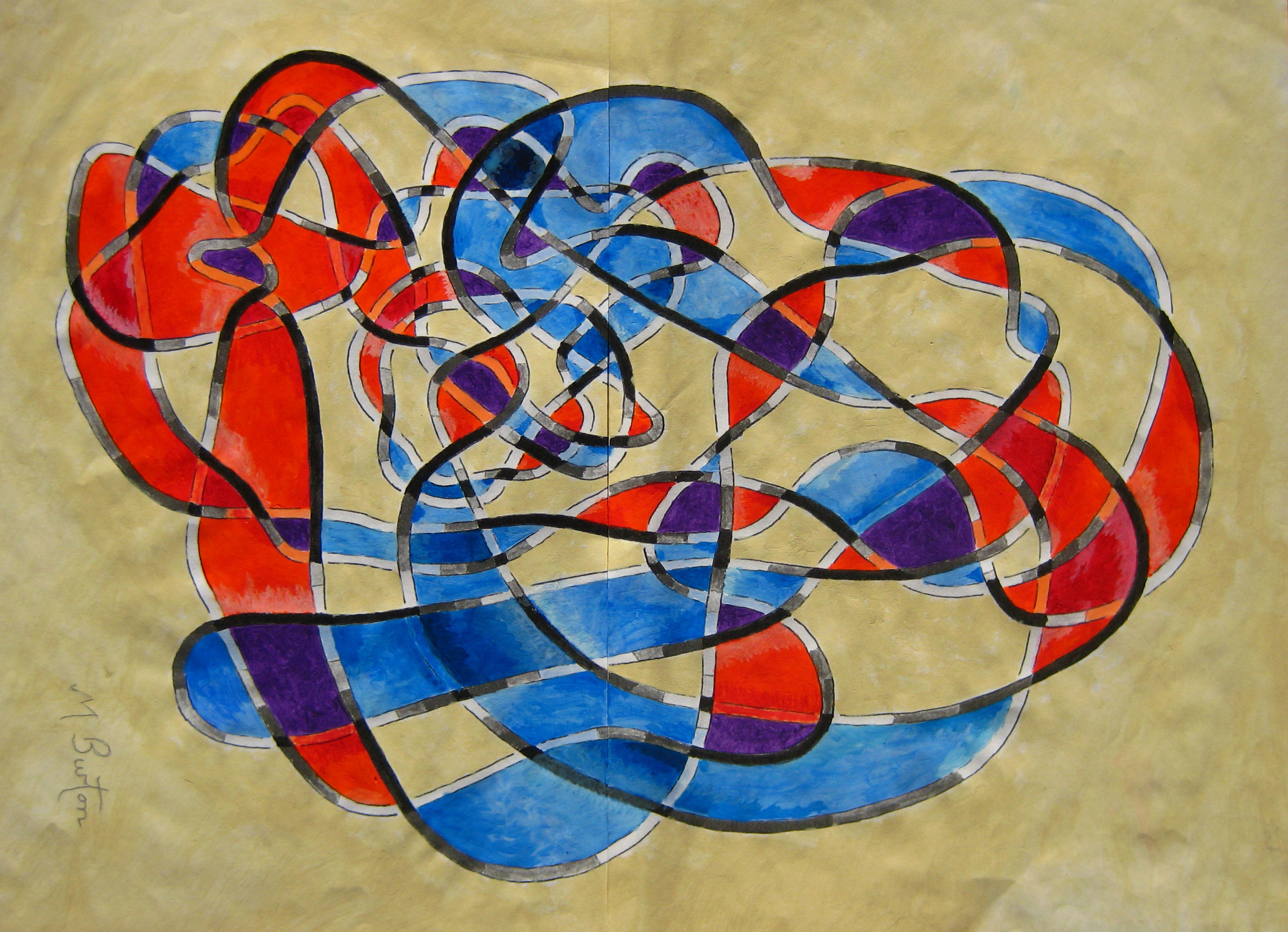
When I looked at the Knot, it reminded me of my “Twisting, Overlapping, Envelope Elephant” continuous line in that it has a lot of twists. I realised straight away that a narrow loop on the outside (left lower) seemed to lead into the structure with its two strands twisting as it went, each time in a clockwise direction.  I followed the two twisting lines throughout the drawing until they ended in a loop on the outside (left higher).

I wanted to draw and paint this knot. My first drawing was of the line on its own. The depth of some of the lines reminded me of one of my earliest paintings “Leeds Inner Ring Road Starts Here”, which was based upon a sign board which appeared near Miles Bookshop in 1967 informing us of the route the new road would carve through the City. This was several years before Spagetti Junction was built near Birmingham. My picture had lines swirling all over at various heights in one continuous line.

Leeds Inner Ring Road Starts Here. Use of varying thickness of continuous line, overs and unders. Pre dates Spagetty Junction near Birmingham. Mick Burton, 1967.

Leeds Inner Ring Road Starts Here. Use of varying thickness of single continuous line drawing, overs and unders. Pre dates Spagetty Junction near Birmingham. Mick Burton, 1967.

My first picture of the Gordian Knot, in black and white, concentrated on the heights of the lines following the overs and unders shown by Haken.

Depth of lines in black and white, in Haken's Gordian Knot. Mick Burton, continuous line drawing.

Depth of lines in black and white, in Haken’s Gordian Knot. Mick Burton, single continuous line drawing.

But my main aim now was to use blue and red to show the twisting nature of the pair of lines running between the starting loop and the end loop.  This was intended to allow the viewer to more easily follow the loop and the twists throughout the structure.

Twisting, overlapping colouring of Haken's Gordian Knot. Mick Burton continuous line.

Twisting, overlapping colouring of Haken’s Gordian Knot. Mick Burton single continuous line drawing.

Just like viewing my “Twisting, Overlapping, Envelope Elephant”, from my previous post, imagine that you have a strip of plastic which is blue on the front and when you twist it over it is painted red on the back.  Where blues cross each other you have darker blues, and correspondingly with reds.  Where blue crosses red you have violet.  I show the strips feeding through each other, like ghosts through a wall.  There are some darks and lights in there as well.  Most usefully, the background shines through to help make the strips stand out.

You can now get more of a feel for what is going on.  I counted 35 clockwise twists and two anti-clockwise (numbers 19 and 26).  Continued twists in the same direction tie in the ongoing loop, when it feeds through the two strands of its earlier route at least 12 times.  

This is a preparatory painting, in acrylic but on two sheets of copy paper sellotaped together.  When I exhibit these pictures they will be hung as portrait, rather than the landscape shown here for comparison with Haken (as you will note from where my signature is).  I think they look a bit like the head of the Queen in portrait mode !

Having got this far, I realised that I should find out more about the Haken knot (or unknot), beyond Professor Stewart’s brief introduction.  How did Haken construct the knot and why?

Please see my next post, on this continuous line blog, to see how I got on.

Escher Islamic Mosaic Continuous Lines, Create and Change Border. STAGE 4.

A key part of the Mural Mosaic tile painting by Escher in 1922, is that he has included the Border in detail. The Border gives an indication of what happens to the lines when they hit the sides and where they feed back into the design. In the quarter section detail of the mural below you can see marks on the Border.

A line leaving the design either joins the border (so that you can follow where it goes) or goes under the border (and you can deduce where it re-emerges).  It is not easy to work all these paths out at first, but there is a logic to it.  If in doubt between two choices, one of them usually has a clear answer leaving only one option for the other.  Another aid to us is that each side of the Border is identical in the same direction around the design, so if the marks are not clear on one side you can check at a corresponding point on another side.

Detail to show Border. Escher mural mosaic in the Alhambra. WikiArt. Mick Burton study.

Detail to show Border. Escher mural mosaic in the Alhambra. WikiArt. Mick Burton study.

.
When I first started this research I did a basic hand copy showing all the lines hitting the sides and then showed each one as a loose end outside the square.  I then studied the border on the Mosaic to work out how all the loose ends should be joined up and charted them – this initial chart was in STAGE 1, and I show it again at the end of this post.

That was relatively easy, observing the result of what artist had done.  The hard bit is working out  from scratch which loose ends to tie up to produce continuous lines in a way which would still enable the colours to be allocated by the Alternate Overdraw (or equivalent process used by the artist).

According to Eric Broug in his demonstration video’s, the tile rectangle containing the design would be selected out of a larger pattern area.  In my own art, when I have drawn a large continuous line pattern and completed the Alternate Overdraw (so that I know the colour sequence everywhere) I can pick out a small section to display which of course already has the Alternate Overdraws.  Similarly, the Islamic artist producing the Mosaic would know the full colouring etc for the tile section.

I show below the design with all the loose ends and Alternate Overdraws in Red.  At this stage the artist would not know how many continuous lines would occur in the tile section on its own.  He will have also needed to produce a straight edge on the corners and other parts of the perimeter to block unwanted lines which encroached from the outside pattern.

Section of larger pattern with Alternate Overdraws and loose ends showing whether overdrawn. Mick Burton study.

Section of larger pattern with Alternate Overdraws and loose ends showing whether overdrawn. Mick Burton study.

You will see from the loose ends that half of them are overdrawn in Red and half not. If you connect up pairs of the overdrawn, and pairs of the not overdrawn, loose ends then there will be continuous lines throughout the design and the Alternate Overdraw Template will be unaffected. If I connect up the not overdrawn pairs around each corner of the design, then working along the sides both overdrawn pairs and not overdrawn pairs work out consecutively. This matches the line direction message in the Border on the Mosaic design.  Here is a chart (previously in STAGE 1) showing all the loose end connections.  We know from STAGE 1 that there are two continuous lines, which makes the case strong regarding the artist using Alternate Overdraw, but it would not have mattered if there were more than two.

Escher Islamic Tile. Basic line structure, with border connections. Mick Burton continuous line study.

Escher Islamic Tile. Basic line structure, with border connections. Mick Burton continuous line study.

Having looked at Borders in detail, that prepares us for the final STAGE 5 where I show how we can turn this into a Single Continuous Line design.  

I will also give you my opinion on what the original Artist thought about a Single Continuous Line and why I think he is definitely an Artist and not just a craftsman.

Mick Burton Continuous Line Blog.

Colour Sequence Allocation on Escher Islamic Mosaic Continuous Lines, STAGE 3.

Now that we have applied my Alternate Overdraw to the Continuous Lines in the Escher Islamic design, I can show how I allocate colours.  We can then compare the result with the colours on the original Islamic design painted by Escher in 1922.

My basic method of allocating colours is covered in my Post on 27 September 2014 entitled “Colour Sequence on Continuous Line Drawing”.

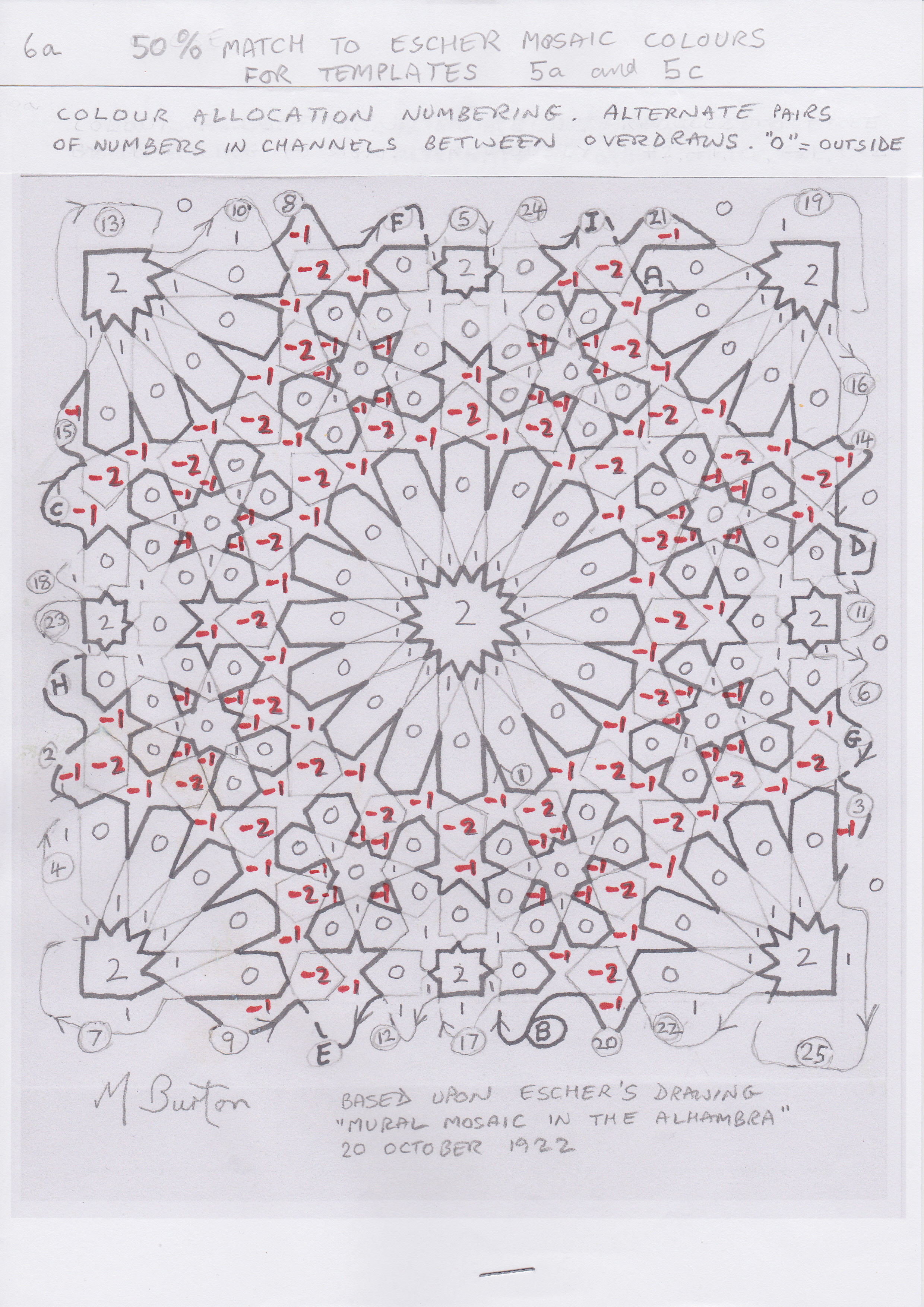
I will start with that same basic process where colour “0” is the outside of the drawing and this is alternated with “1” in its channel or channels.  When we cross through an overdraw from a “1” area we allocate “2” to this adjacent area on the other side and then alternate this with “3” (if there are any) in that channel.  In the negative direction, if we go from a “0” area through an overdraw we will allocate “(-)1” and alternate with “(-)2” in that channel.

Five colour number allocation on continuous lines for Escher Mosaic. Mick Burton study.

Five colour number allocation on continuous lines for Escher Mosaic. Mick Burton study.

There are no areas coloured “3” and so we have 5 colours allocated, compared to only 4 colours used in the original Mosaic.

At this stage things did not look promising.  Trying to equate the 4 original colours in the Mosaic to my 5 numbers produced a best set of matches of 156 out of 313 (I won’t go into much detail here) which is just under 50%.

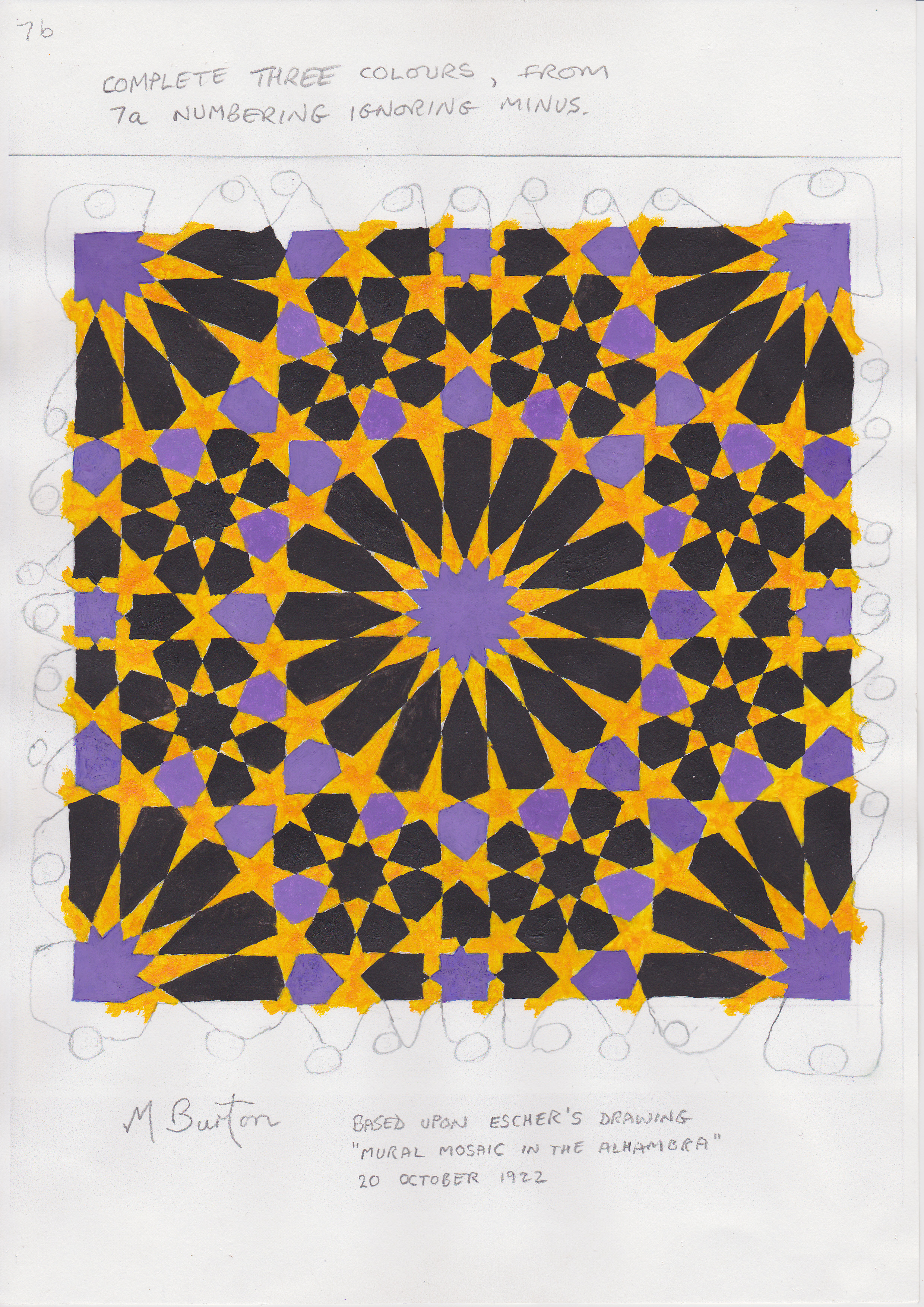
One thing that I did observe was that YELLOW matched “1” on 76 occasions and “(-)1” on 88 occasions.  This reminded me that I occasionally allocate colours positively by ignoring (-) signs.  When switched to simply using “0”, “1” and “2” I had 3 numbers to compare with the 4 original colours on the mosaic.  This now produced a best match of 241 colours out of 313 which gives 77% and was much more respectable.  Here is the 3 colour allocation.

Colour sequence allocation of 3 colours to continuous lines on Escher Mosaic. Mick Burton study.

Colour sequence allocation of 3 colours to continuous lines on Escher Mosaic. Mick Burton study.

Of course the fourth colour GREEN used in the mosaic does not appear at all in mine.

As with a lot of art, including craft, there may be processes (or even rules) which get you a long way in a design but you have to know when, and how, to break away from them.  I may be a bit rigid with my Continuous Lines but my studies of Picasso and Dali doing them demonstrates that nothing is certain.

This Islamic artist, who I regard as very special, probably used a method equivalent to mine to allocate most of his colours but probably made the following over riding decisions to finish the colouring off –

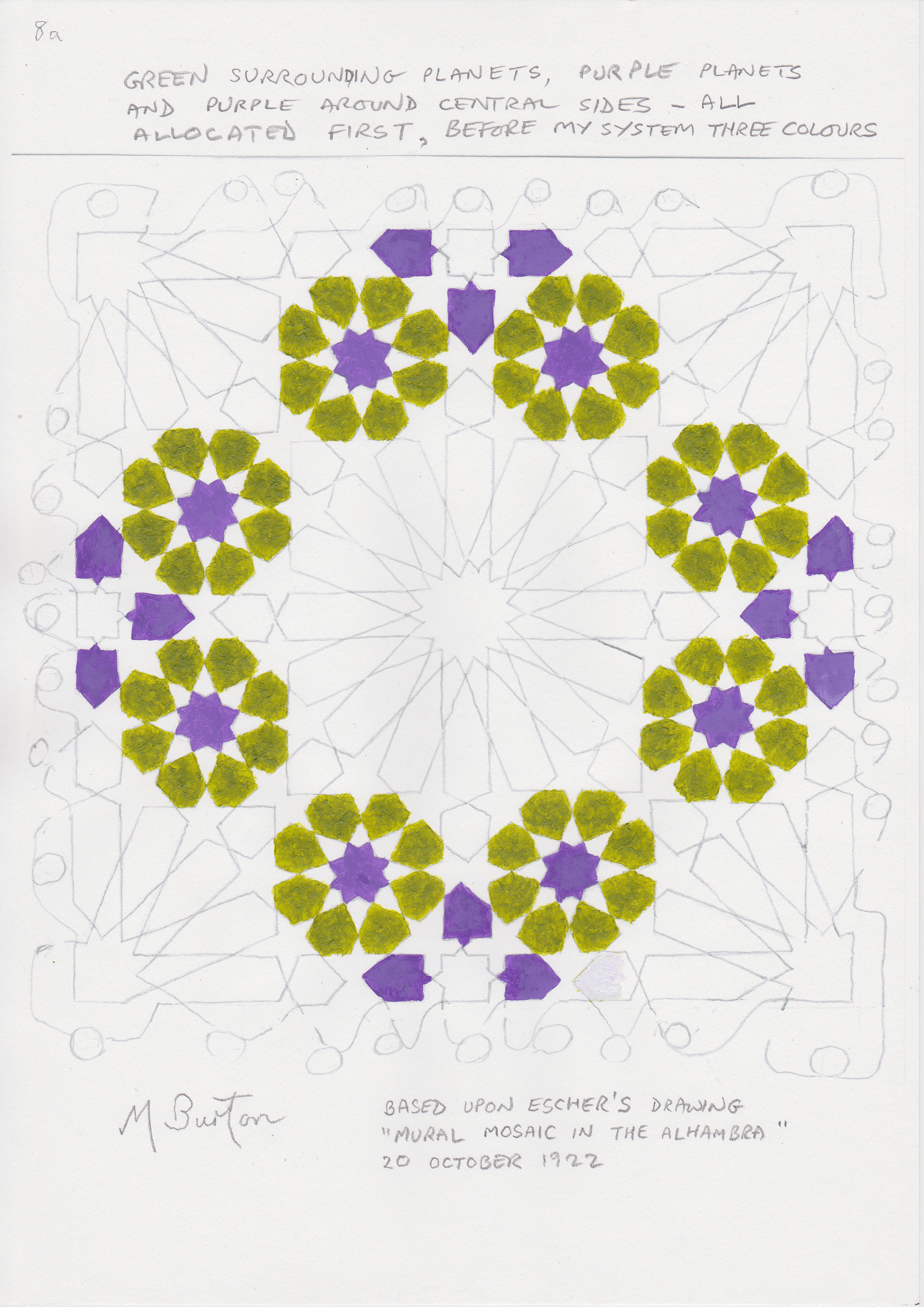
a.   GREEN was allocated to the 8 areas surrounding each of the 8 planets, and nowhere else.

b.  Each of the 8 planets was coloured PURPLE, instead of black, to mirror its use for the centres of the Suns.

c.  Each Purple junction block at the middle of each side has three directional areas surrounding it which are coloured PURPLE instead of black.  I originally considered these to be decorative.

Allocation of all green colours and changes of black to purple on Escher Mosaic. Mick Burton study.

Allocation of all green colours and changes of black to purple on Escher Mosaic. Mick Burton study.

If the above decisions were made first, then the remaining allocations would be made totally on my 3 colour allocation.  That is 229 areas remaining where my allocation matches 100% with the original Escher Mosaic colours.

229 colour sequence areas matching original Escher Mosaic colouring. Mick Burton study.

229 colour sequence areas matching original Escher Mosaic colouring. Mick Burton study.

So there we are. I hope you have found my attempt to explain how this Escher Islamic Mosaic contains two continuous lines, which I believe was deliberate by the artist, and how most colours matched a colour sequence directly linked to the continuous lines.

The basic elements in the design largely match the template produced by my Alternate Overdraw method and, after specific allocation decisions were made by the artist, there was a total match of all other colours allocated by my method using the template.  Whether of not the artist used a similar method to myself, there is a direct link between the colour sequence and the two continuous lines.

In my searches through other forms of art, on the look out for continuous lines, I have not found any other example of art which contained both continuous lines and a related colour sequence, or signs of possible use of Alternate Overdraw with its Template.

There is a modern mathematical theory called “The Winding Number Theory” which could allocate colours in an equivalent way to my initial 5 colours, but it is not as much fun.

I will do a FURTHER POST (STAGE 4) on how the artist could have used Alternate Overdraw to help him to connect up the loose ends on the borders when actually constructing his continuous lines.

Mick Burton Continuous Line Blog.

Alternate Overdraw Applied to Escher Islamic Mosaic Continuous Lines, STAGE 2.

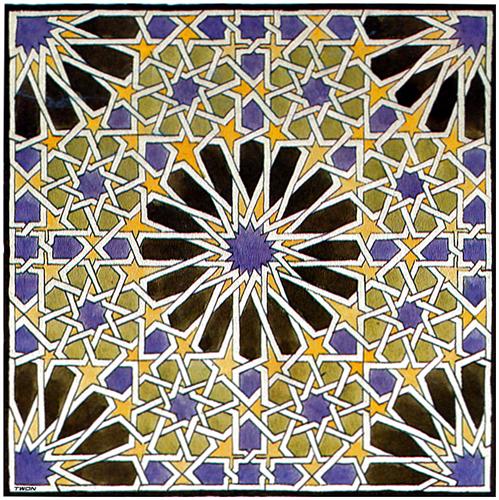
Escher painting 1922 of Islamic Mosaic tile at the Alhambra. WikiArt. Continuous line study by Mick Burton.

Escher painting 1922 of Islamic Mosaic tile at the Alhambra. WikiArt. Continuous line study by Mick Burton.

Before applying my Alternate Overdraw, which I use to allocate colours to Continuous Lines, I will give you my analysis of the colours in the original Mosaic and what I feel were the artist’s ideas behind the design.

Eric Broug states, in his YouTube demonstration “How Grids and Patterns Work Together” that this is a 16 point star surrounded by 8 point stars.  Geometrically you can produce stars with many different numbers of points.  Having done many planetary paintings myself, I feel that the original artist has realised that in this case we have a central Sun and 8 planets surrounding it which can represent our solar system (we can ignore Pluto as a planet as it only featured as such for a part of the last century).  The colours the artist uses reflect many aspects of this planetary situation –

a.  YELLOW is used as the colour for the flaming surfaces of the central Sun and the corner Suns.  All other yellow areas have star like shapes and represent distant stars peppering the background.

b.  PURPLE is used for the centres of the Suns and the 8 Planets.  Purple is also used for the lines of areas along the sides, vertically and horizontally from the centres of the sides and diagonally (the lines of purple areas may simply be decorative).

c.  BLACK is used for the “fan blade” shapes emanating from the Suns.  In my planetary paintings I often use black for the background outside a drawing and for the gaps through the  drawing .  The artist here could be using the same idea, so that the blades are in fact deep space seen beyond the Suns.

d.  GREEN is used to surround each Planet and I interpret this as representing life on each Planet, not just ours.

The process for completing an Alternate Overdraw is covered in my Post dated 10 September, 2014  (9/10/2014)  entitled “Alternate Overdraw on Continuous Line Drawing”.

In the previous post, STAGE 1, I showed that there are two continuous lines in the Mosaic.  I apply my Alternate Overdraw to produce a template for me to work with to allocate a colour sequence.  I have to bear in mind that there are 2 Overdraw results and 1 colour sequence for a single continuous line and 4 Overdraw results and 2 colour sequences for two continuous lines.

My experience tells me that the Alternate Overdraw, which will produce a Template best representing this Planetary composition, will have –

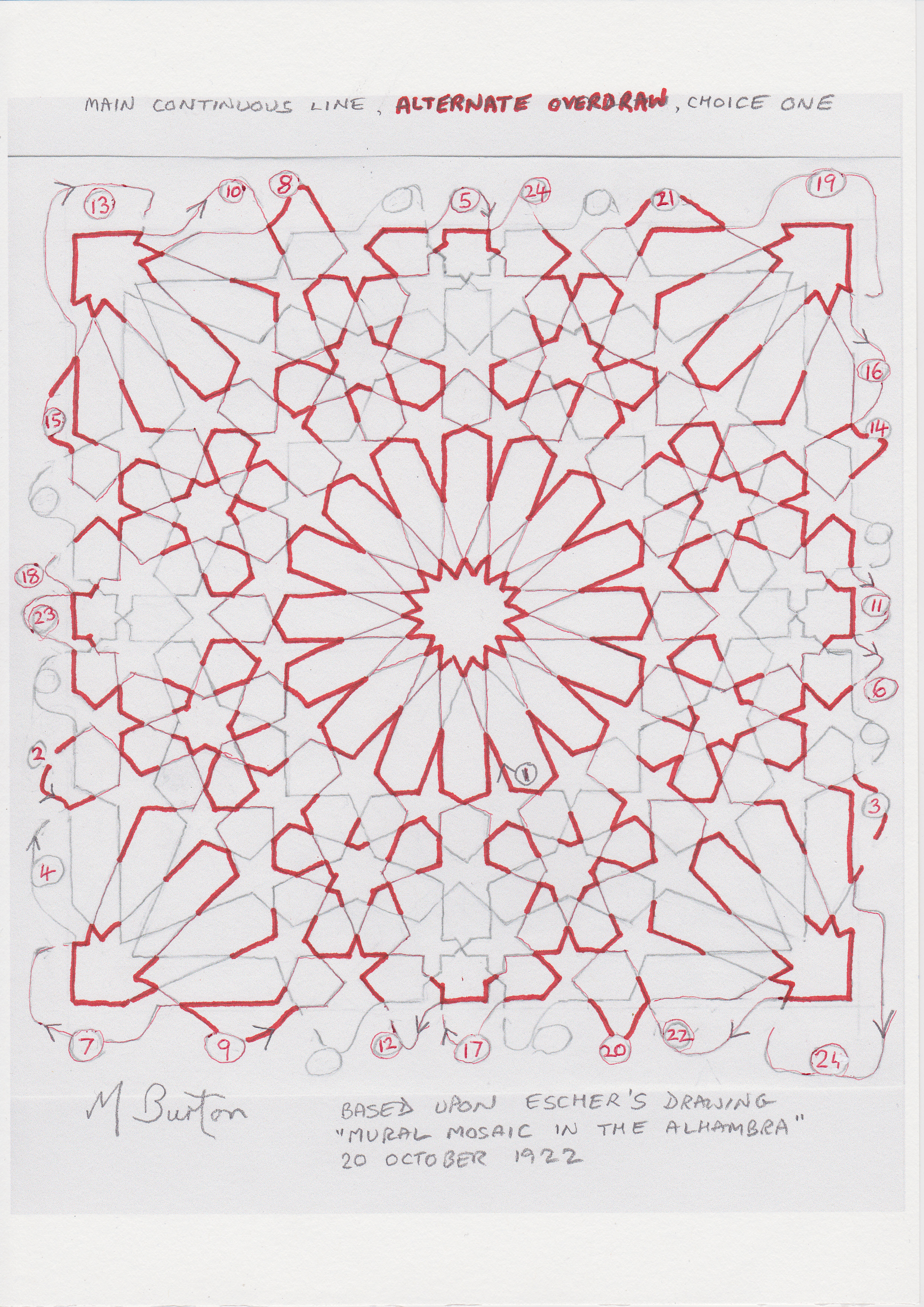
a.  An Overdraw for the Main continuous line commencing by overdrawing (in Red) a side of a fan blade of the central Sun, and

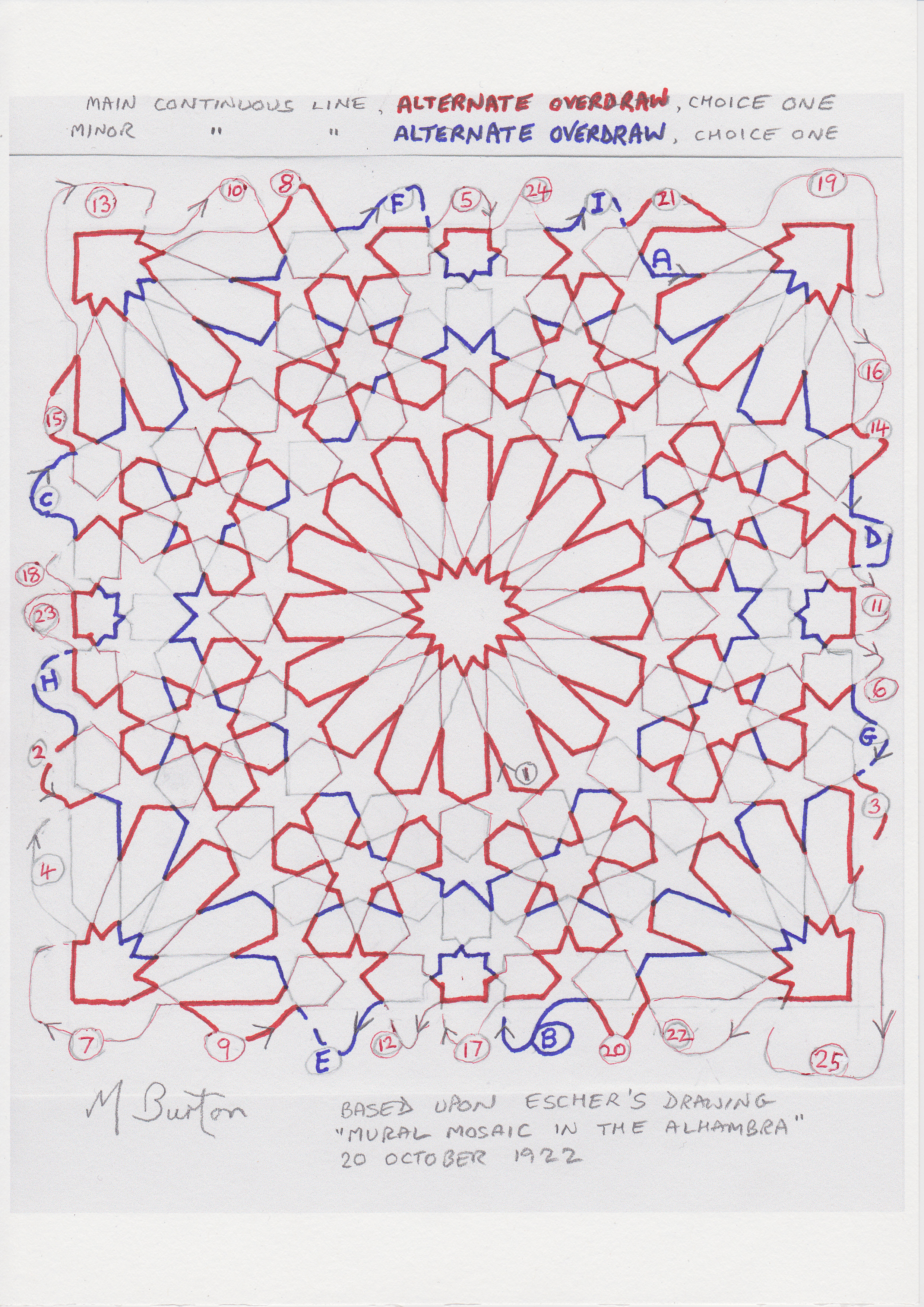
b.  An Overdraw for the Minor continuous line commencing by overdrawing (in Blue) a side of a fan blade on a corner Sun.

Main continuous line, Alternate Overdraw, choice 1. Mick Burton, Escher Mosaic study.

Main continuous line, Alternate Overdraw, choice 1. Mick Burton, Escher Mosaic study.

Minor Continuous Line, Alternate Overdraw in Blue, Choice 1. Mick Burton Escher Mosaic study.

Minor Continuous Line, Alternate Overdraw in Blue, Choice 1. Mick Burton Escher Mosaic study.

The aim  of the Alternate Overdraw is to create channels within the design where two colours can be allocated alternately within each channel and that adjacent channels have different pairs of colours.  An overall sequence of colours then follows across channel boundaries.

My experience told me, at this stage, that my colour sequence was likely to match the original Mosaic in and around the five Suns, but less so elsewhere.

I will show my attempts at allocating corresponding colours in the NEXT POST.  I will also explain why I feel that the original artist may have used the Alternate Overdraw or an equivalent method.

Mick Burton Continuous Line Blog.

Continuous Lines in Escher Islamic Mosaic painting, STAGE 1.

Escher painting 1922 of Islamic Mosaic tile at the Alhambra. WikiArt. Continuous line study by Mick Burton.

Escher painting 1922 of Islamic Mosaic tile at the Alhambra. WikiArt. Continuous line study by Mick Burton.

I look for continuous lines in all forms of art.  I first saw this design in my daughter Kate’s book “Escher, The Complete Graphic Work”, by J.L. Locher.   We are both long term admirers of this artist.  Escher did this detailed painting  in 1922 when in Granada at the Alhambra, and its quality really hit me.  It was of an Islamic mural Mosaic tile,  which was made up of those geometric lines which are often seen in Islamic art, and I assessed it for continuous lines.  

I could see that the overall symmetrical  pattern and I saw that Escher had painted the design BORDER, which seemed to indicate what happened to the lines after they hit the sides of the square.  I then worked out, from the Border Pattern, that the lines were fed back in the same routes on all four sides of the square.  From the point of view of finding a single continuous line, in my experience, such overall symmetry of the structure meant that it was very unlikely that there was only one line. 

Here is the basic structure which I arrived at, which shows the “wiring” connections indicated by the border.  Let’s see how many continuous lines there are.

Escher Islamic Tile. Basic line structure, with border connections. Mick Burton continuous line study.

Escher Islamic Tile. Basic line structure, with border connections. Mick Burton continuous line study.

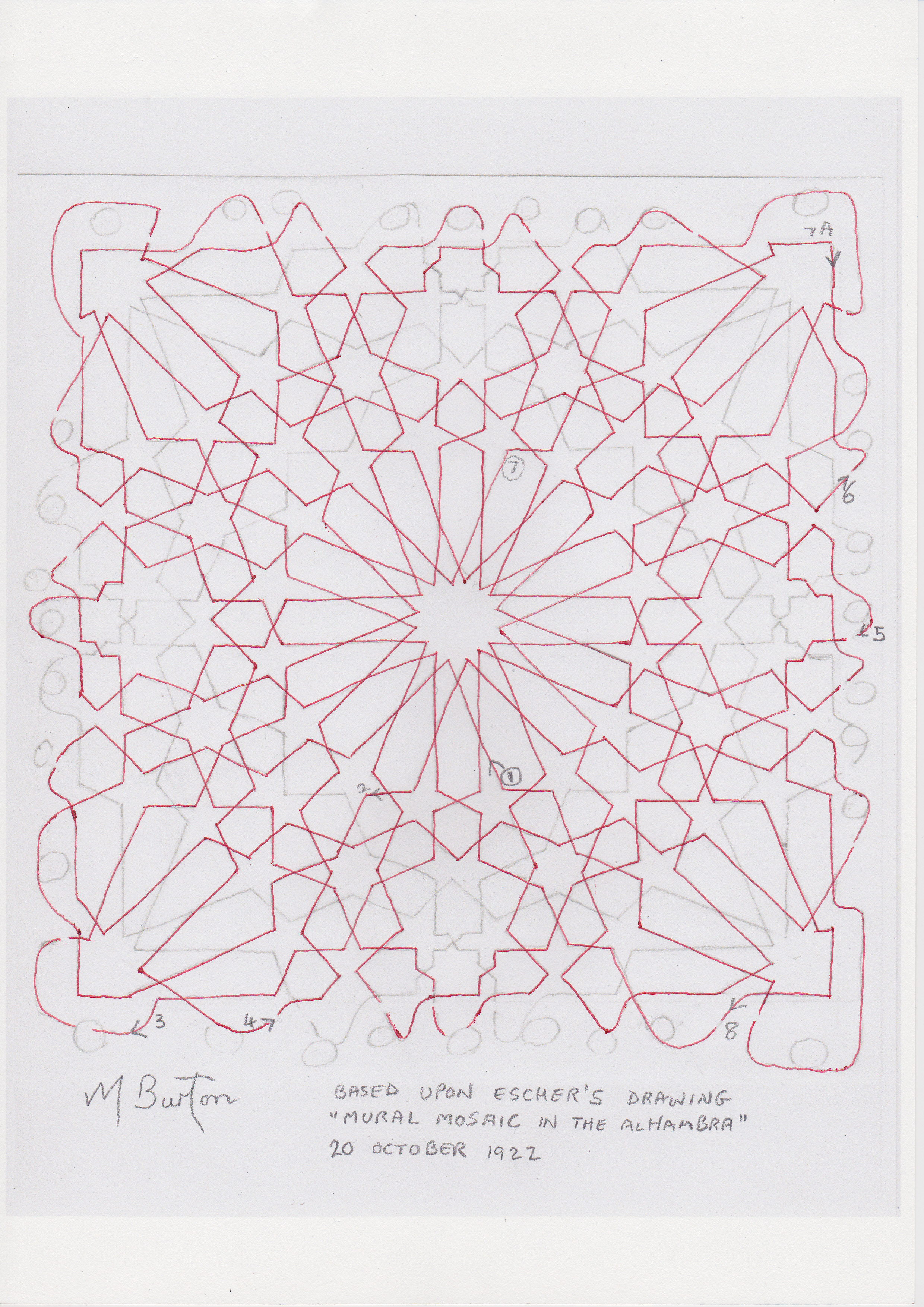
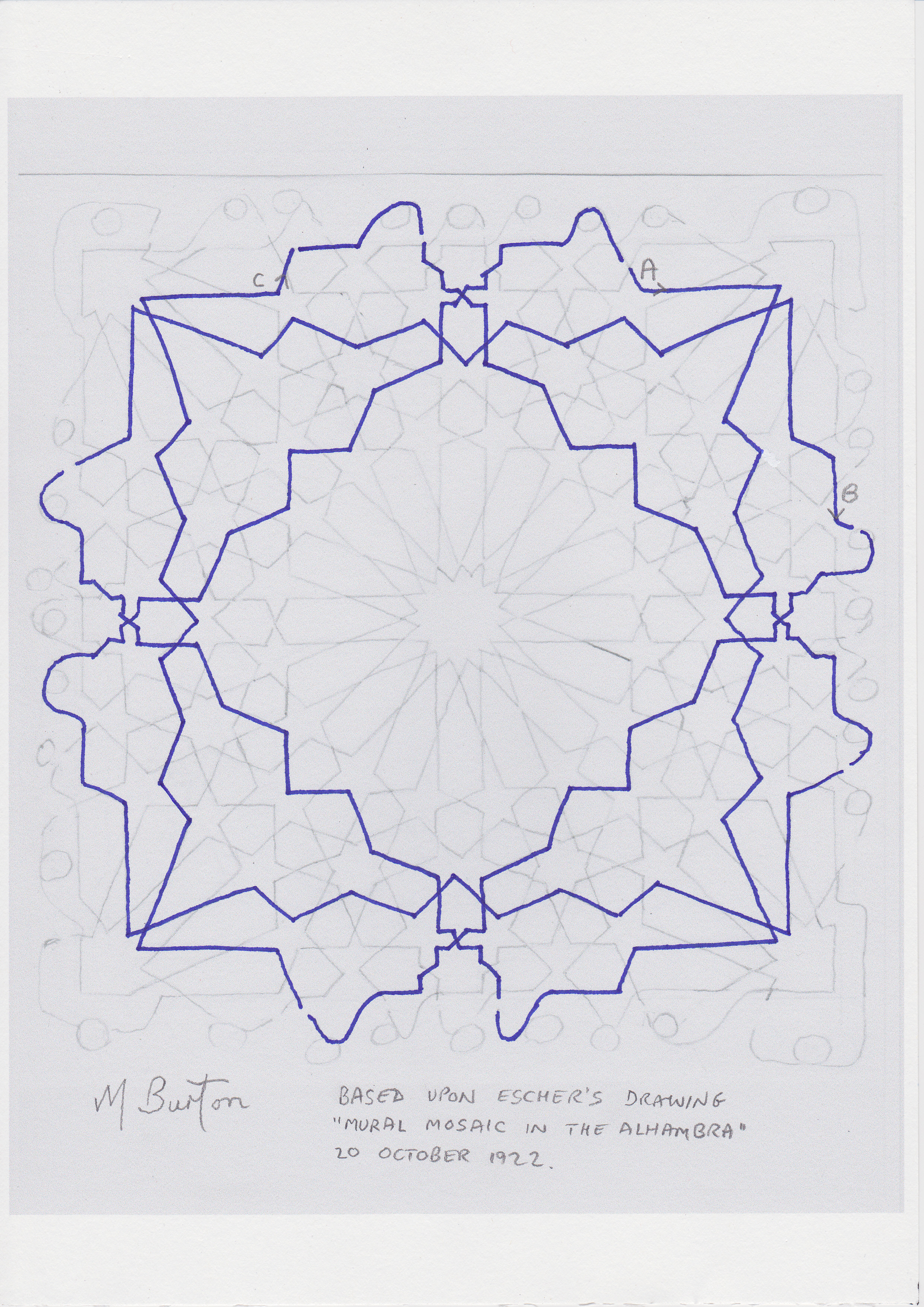
When I traced over the lines I found that there were in fact two continuous lines making up the whole design.  Here are the two results, a Main continuous line (in red) and a Minor one (blue).

Main continuous line, one of two. Escher Islamic tile design. Mick Burton continuous line study.

Main continuous line, one of two. Escher Islamic tile design. Mick Burton continuous line study.

Minor continuous line, 2nd of two. Escher Islamic tile design. Mick Burton continuous line study.

Minor continuous line, 2nd of two. Escher Islamic tile design. Mick Burton continuous line study.


By experimenting with border changes, a bit like swapping wiring connections, I did come up with a single continuous line, but the borders were no longer symmetrical.  It seems likely that the artist realised that two continuous lines was the best he could hope for whilst retaining overall symmetry.   In a LATER POST I will show how a border can be “tweaked” by a slight alteration to make one continuous line in the mural mosaic, and how this answer is achieved.  I will also show how the artist is likely to have worked out how to achieve two continuous lines by connecting up the correct loose ends.

I now needed to know  “How important continuous lines were, within this design, to the artist?”   It could be that Continuous Lines were incidental to other aims, or they may have been of prime importance.

In my NEXT POST I will apply my Alternate Overdraw technique to produce a Template of closed lines, which I use to decide upon the colours to allocate.   I will also suggest what the artist’s ideas were for the design and his colour selection.  In a FURTHER POST you will see how my colour allocation compares with the original colours and to what extent I feel that my ideas were the same or similar to those used by the artist.

All this has been done without any reference to the construction of the original line structure.  I have taken the completed structure as a starting point to apply my ideas.  I did not research in any detail on Islamic line construction, until after my whole study was completed.

I have recently found YouTube demonstrations by Eric Broug entitled “How to Draw a Mamluk Quran Page” and “How Grids and Patterns Work Together”, which gave me a good insight into pattern construction and include an explanation of a larger tile containing this Escher Mosaic design as a section.  This is a fascinating process used by the Islamic artists over 500 years ago.  Otherwise, I have not found any reference to borders, colouring, or specific meaning of this design.

Possibly my ideas will generate a new view on aspects of the creation of this and other Islamic designs. 

Mick Burton, Continuous Line Blog. Continue reading