Category Archives: Animals

Continuous line drawing at St Gemma’s Leeds Art Exhibition 2014

St Gemma's Leeds Art Exhibition.  Mick Burton continuous line.

St Gemma’s Leeds Art Exhibition. Mick Burton continuous line.

I have entered seven paintings in St Gemma’s Leeds Art Exhibition, which starts on Thursday 23 October 2014 at Leeds Grammar School.  There are over 800 pictures for sale.  I felt I had to put this in my continuous line blog.

I have entered in the previous 2 years since I started painting again and managed to sell work each time.  Its well worth a visit.  And its in aid of St Gemma’s Hospice.

Here are three of my paintings as a taster.  All are in acrylic on canvas.


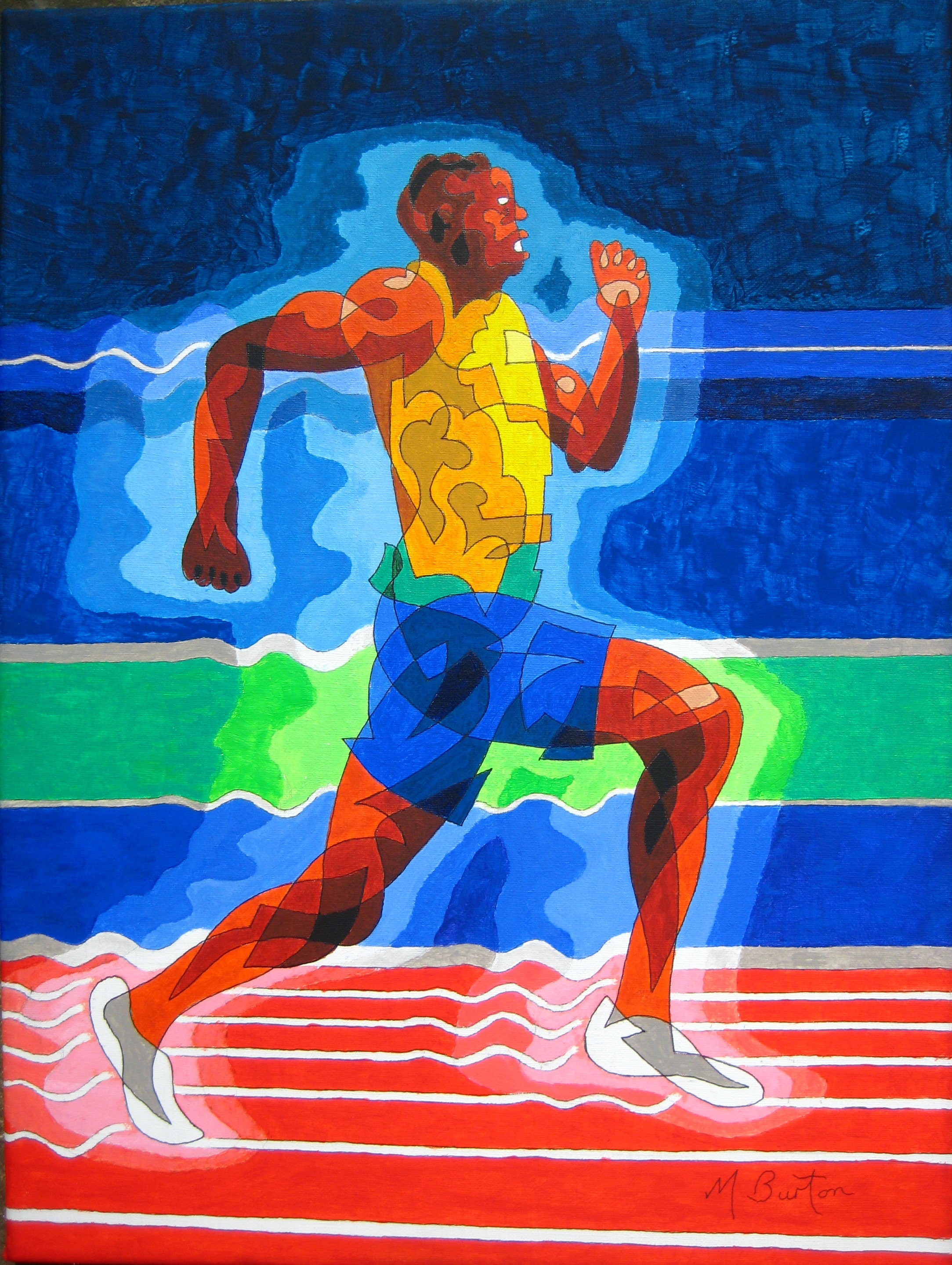
Usain Bolt continuous line drawing.  Several colour sequences.  100 metre Olympic final at night.  Mick Burton, 2013.

Usain Bolt single continuous line drawing. Several colour sequences. 100 metre Olympic final at night. Mick Burton, 2013.

I have been a big fan of Usain Bolt and wanted to use my style to try to capture the dynamic speed and flowing movement of this great athlete.

As the race took place under floodlights, I have used a shimmering effect against the dark background.


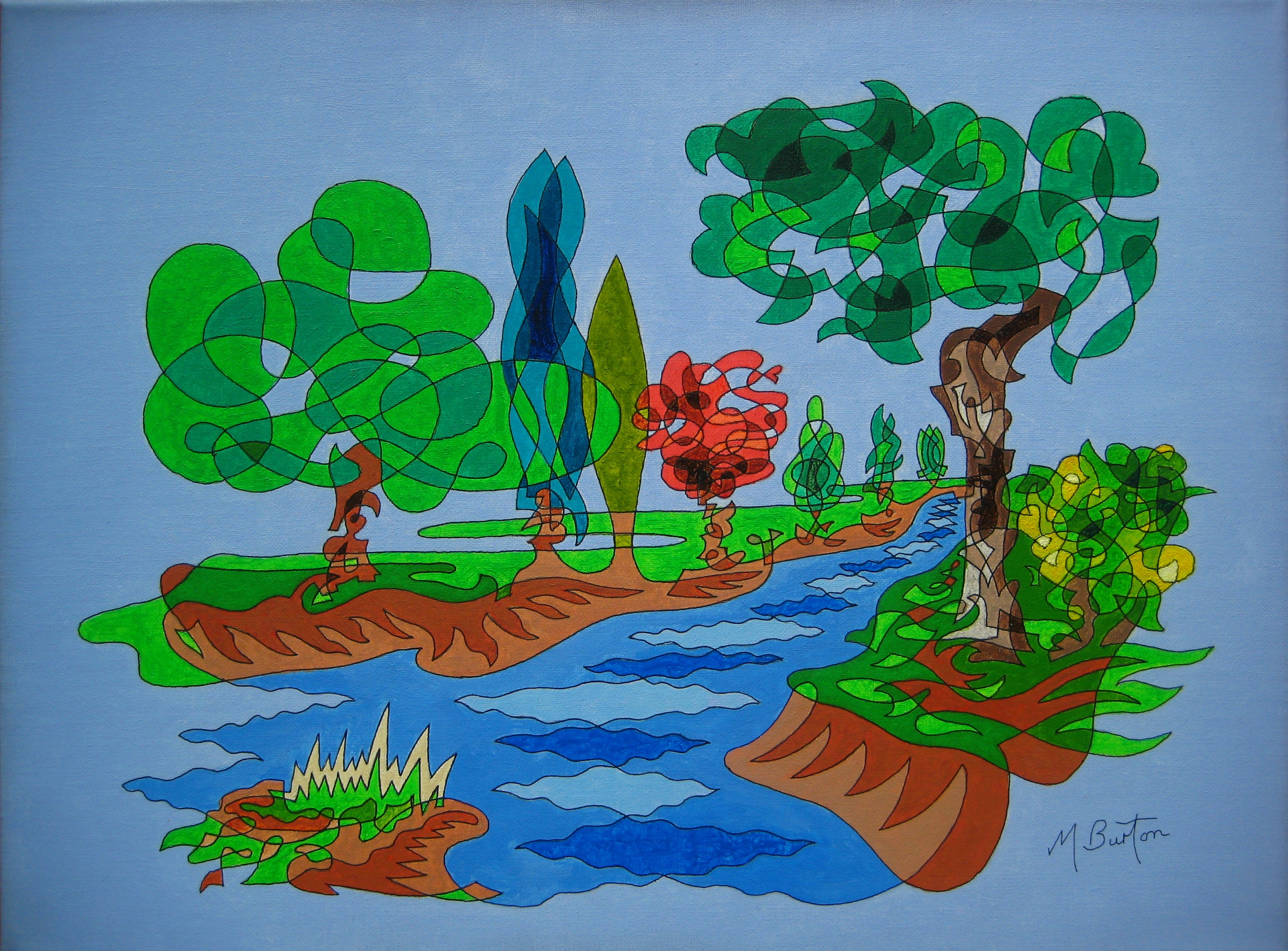
Skelldale is totally drawn with one continuous line and various colour sequences have been used. Mick Burton, 2013.

Skelldale is totally drawn with one continuous line and various colour sequences have been used. Mick Burton, single continuous line artist 2013.

I was brought up in Ripon, a North Yorkshire small market town.  There are three rivers which virtually surround the place – the Laver, the Skell and the Ure  in order of increasing size.

I lived near to the Skell, and we sometimes would walk along it upstream to Fountains Abbey.  One of the local myths was that there was an ancient  tunnel from Ripon Cathedral to Fountains Abbey and we would discuss where the route might be.

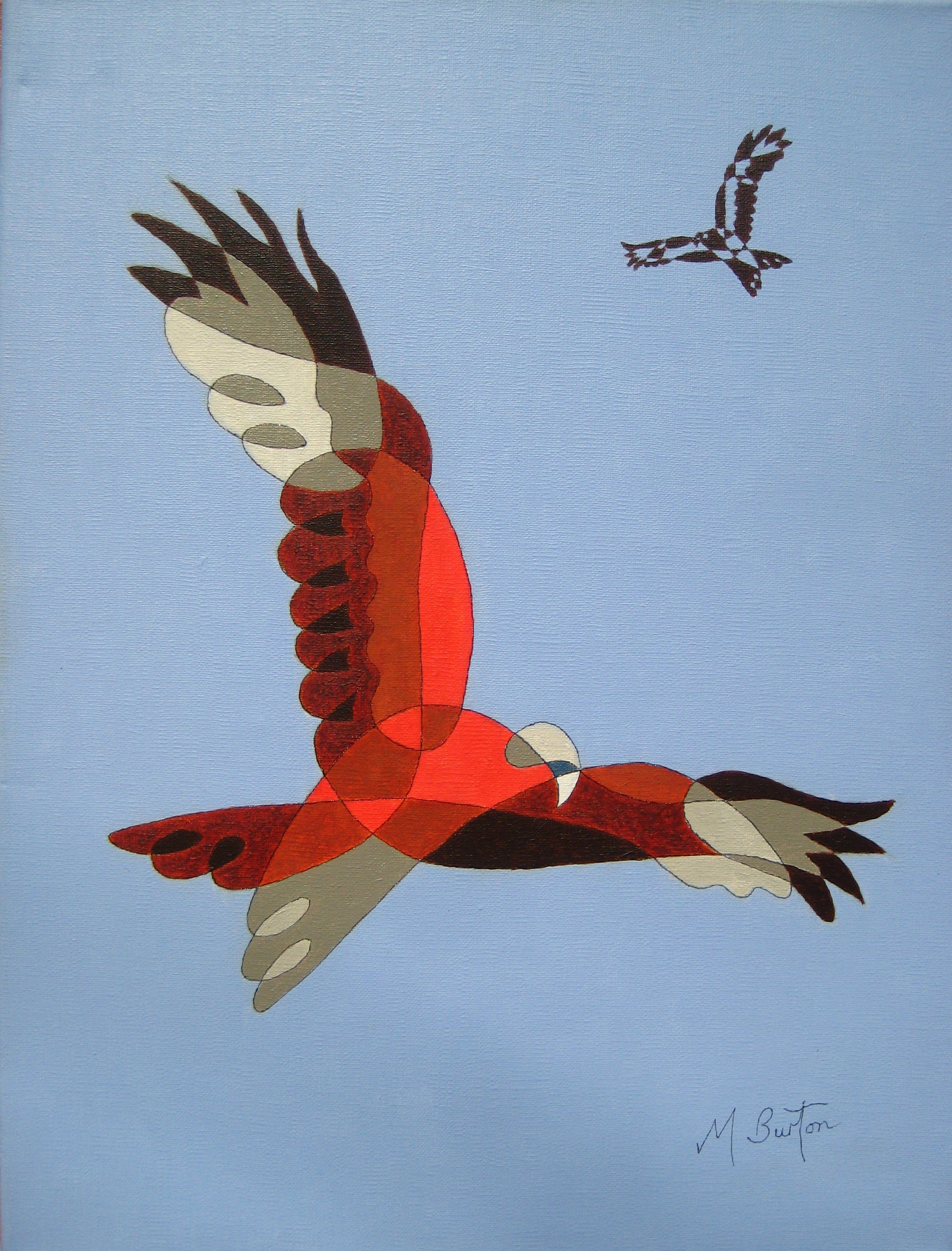
Red Kites at Harewood, continuous line and colour sequence. Mick Burton, 2013.

Red Kites at Harewood, single continuous line drawing and colour sequence. Mick Burton, 2013.

Yesterday, on the bus back from Harrogate to Leeds, we approached Harewood Bank and saw the herd of deer in the park and above there were six red kites circling.  I have never seen that many at once. 

Since they were re-introduced near Harewood they have spread many miles and sometimes float above our house in Gledhow Valley in Leeds.

I had to try to capture this amazing bird with my continuous line and colour sequence.


Continuous Line Drawing Alternate Overdraw embedded image.


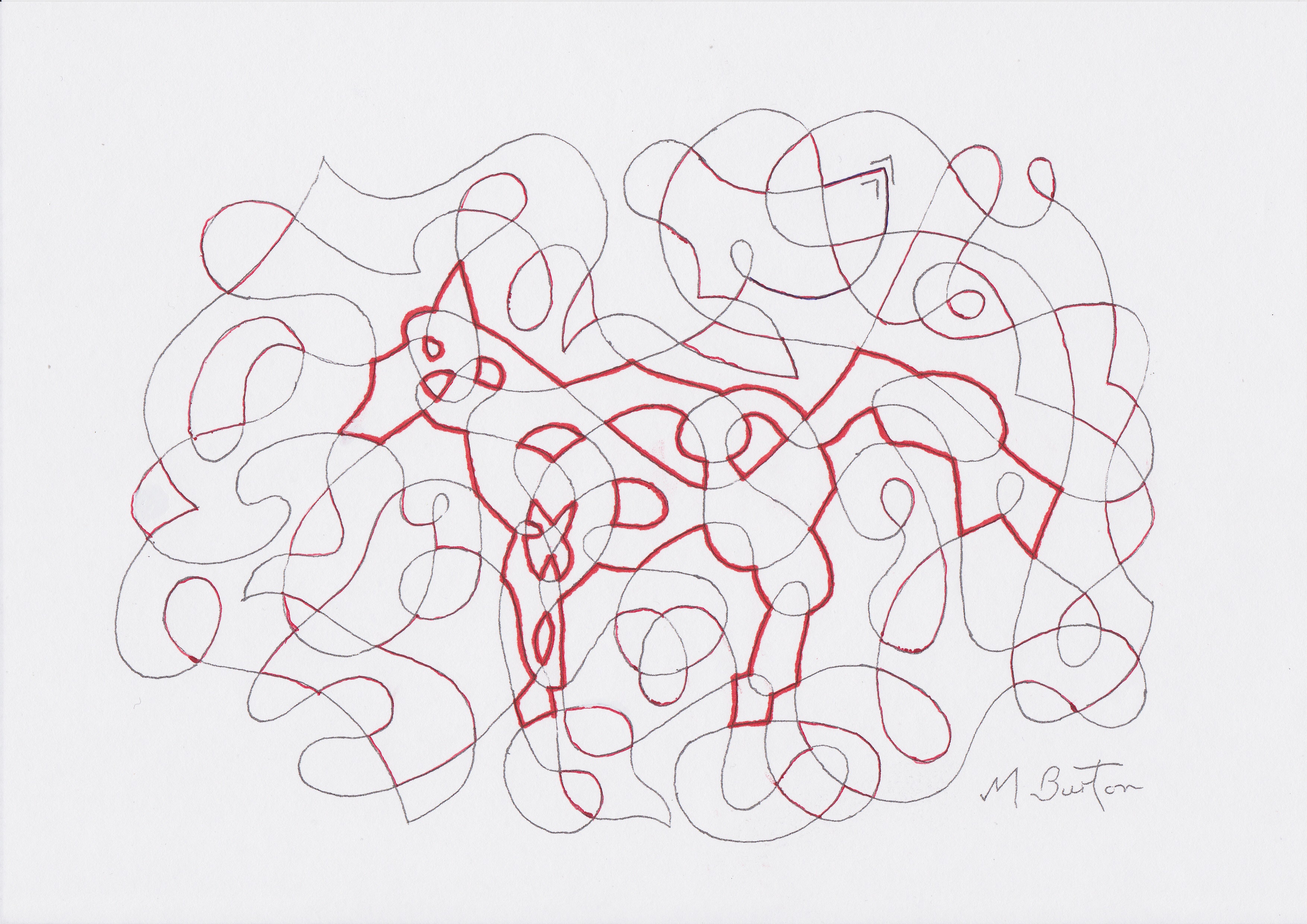
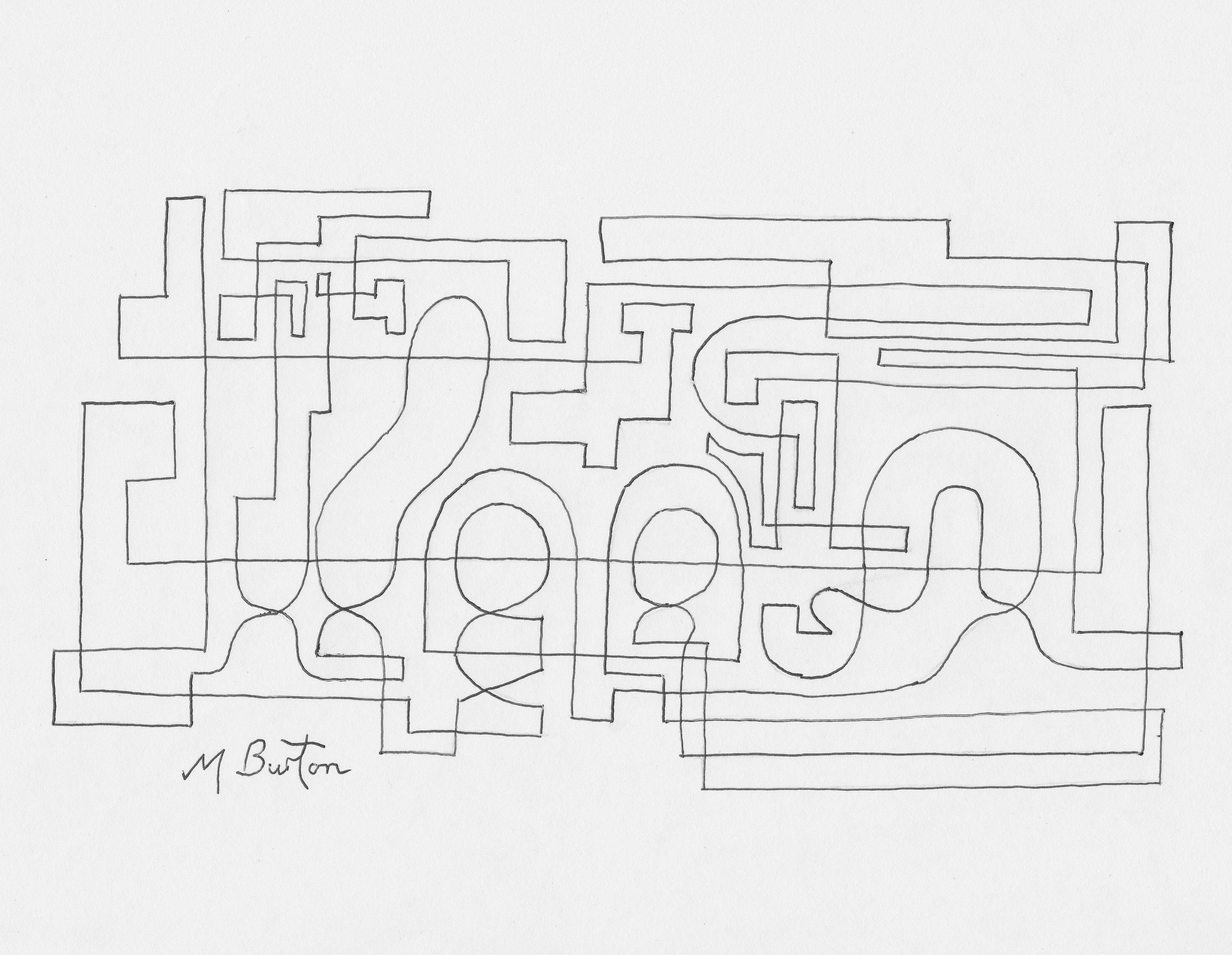
Abstract before Alternate Overdraw  embedded Dog appears.  Mick Burton, Continuous Line.
Abstract before Alternate Overdraw embedded Dog appears. Mick Burton, Single Continuous Line Drawing.


Here is an abstract Continuous Line Drawing which conceals an image of a dog.  Possibly you can see some clues as to where the outline of the dog is.  The idea is to carry out an Alternate Overdraw along the line throughout the picture which will produce the image of the dog.  Start the overdraw with the arc marked with chevrons.

After I developed Alternate Overdraw in 1970, which enabled me to allocate my colour sequence to continuous line drawings, other possibilities started to occur to me.  The first was that you could hide an image of an animal within what looked like a totally abstract continuous line drawing.

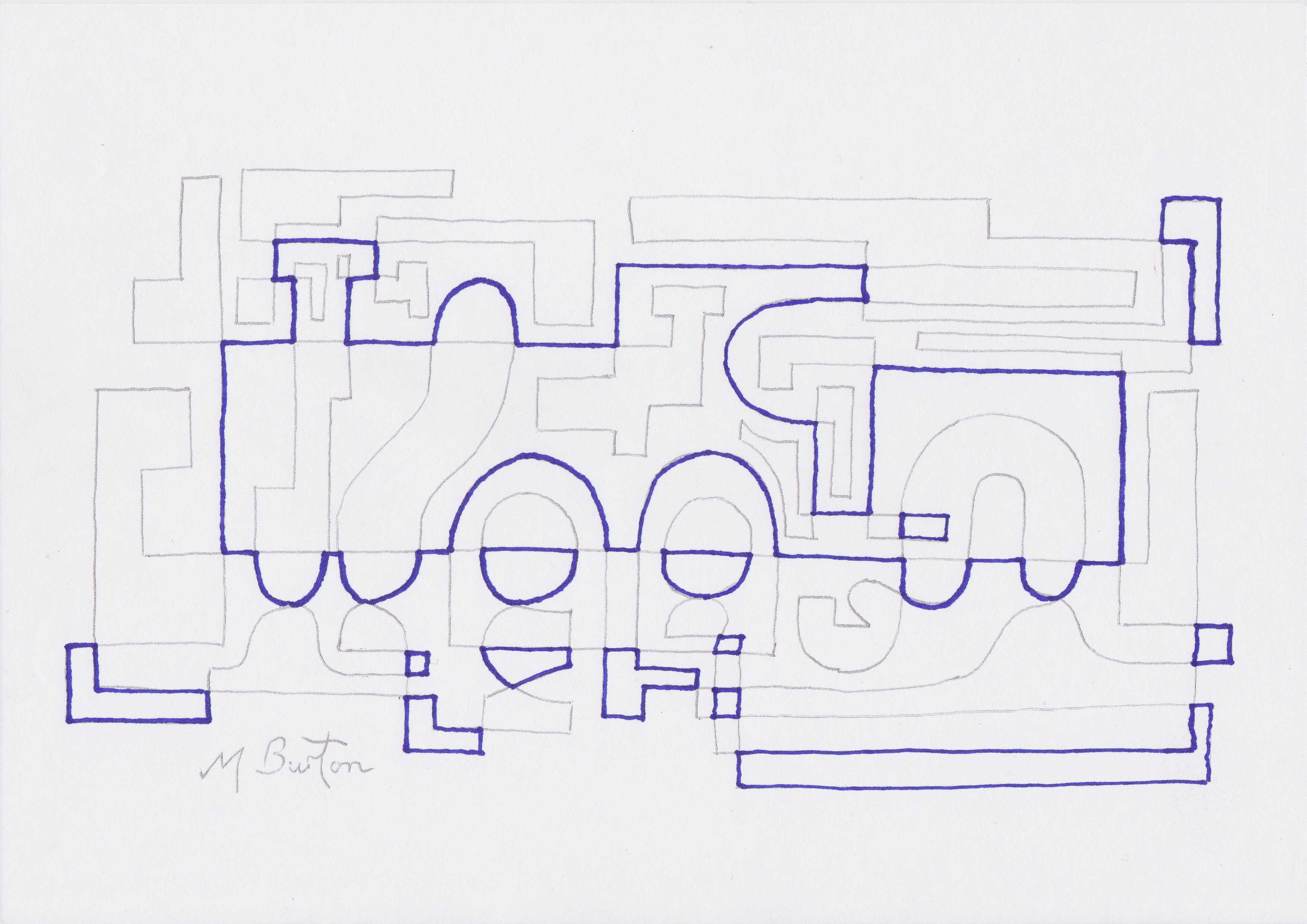
See below how the dog finally appears.  In fact it looks a bit like Ben, who we have been looking after this week.

Alternate Overdraw embedded dog appears.  Mick Burton, Continuous Line Drawing.

Alternate Overdraw embedded dog appears. Mick Burton, Single Continuous Line Drawing.

The start of the process was to sketch a simple dog outline and then , knowing that the outline had to include many crossing lines, I broke the outline down into short lines or arcs which were at an angle to each other.

Next, I needed to run lines through the dog, from various directions, which used these arcs.  For it to work, there had to be an odd number of arcs in each line which went across the dog, between each two outer arcs.  This was so that, after completion, when you drew an alternate overdraw across the dog, both arcs on the outline were overdrawn.  This would result in all the arcs around the outline being overdrawn, thus forming one loop of overdraw. 

Within the body of the dog, several overdraw loops were also formed.  Similarly in the background a number of overdrawn loops and inner loops resulted. 

Of course, trial and error is involved in connecting up all the loose ends (of the lines running through the dog) to achieve a single continuous line through the whole drawing.

Finally, having completed a continuous line, I needed to check that there were no obvious sections which would indicate that an animal was in there. 

I did one more embedded image in 1970 before moving on to other things.  This time, instead of making the abstract continuous line from flowing curves with no straight lines, I decided to use mostly straight lines and right angles.

Abstract before Alternate Overdraw embedded steam engine appears.  Mick Burton, Continuous Line Drawing.

Abstract before Alternate Overdraw embedded steam engine appears. Mick Burton, Single Continuous Line Drawing.


This time I  was concealing a steam engine and the Alternate Overdraw result is shown below.

Alternate Overdraw embedded steam engine appears.  Mick Burton, Continuous Line Drawing.

Alternate Overdraw embedded steam engine appears. Mick Burton, Single Continuous Line Drawing.


As always with my various styles, I wonder who else may be using them  and whether they were in use long ago.

Colour Sequence on Continuous Line Drawing

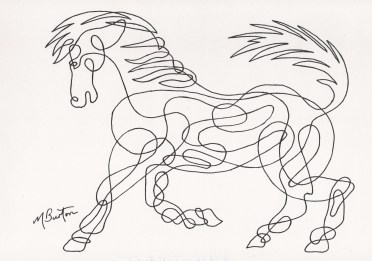
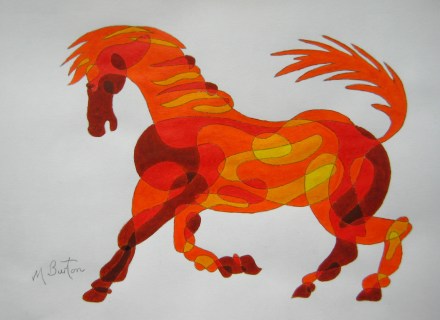
Fig 1. Completed Colour Sequence on Continuous Line Drawing of horse. Mick Burton, Continuous Line Blog.

Fig 1. Completed Colour Sequence on Single Continuous Line Drawing of horse. Mick Burton, Continuous Line Blog.

How do I apply Colour Sequence to my Continuous Line Drawings, which I first developed in the late 1960,s ?  In my last blog post, about Alternate Overdraw of My Continuous Lines, I pointed out that Colour Sequence was the next stage and so here we go.  I will now show the stages involved in completing the colouring of this Horse.
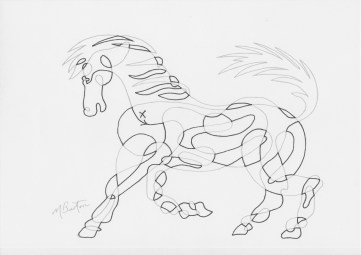
Other Alternate Overdraw on Continuous Line of horse.

Fig 2. Alternate Overdraw on Single Continuous Line Drawing of the Horse, as the first stage of Colour Sequence. Mick Burton, Continuous Line Blog.

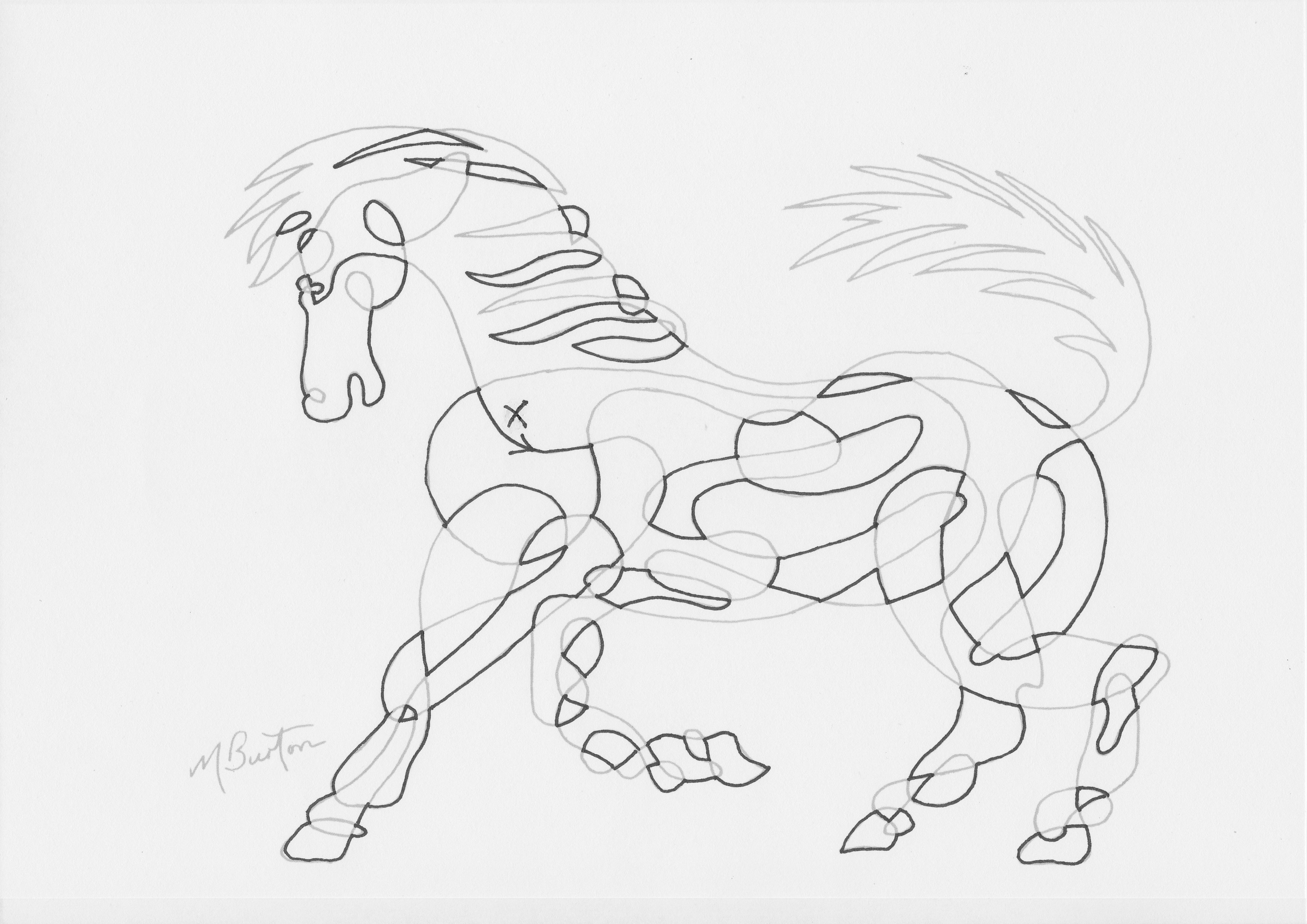
From the two Alternate Overdraw examples in the previous post, I have chosen Fig 2 commencing at point “X” for this example (either “A” or “X” would result in the same colour sequence).

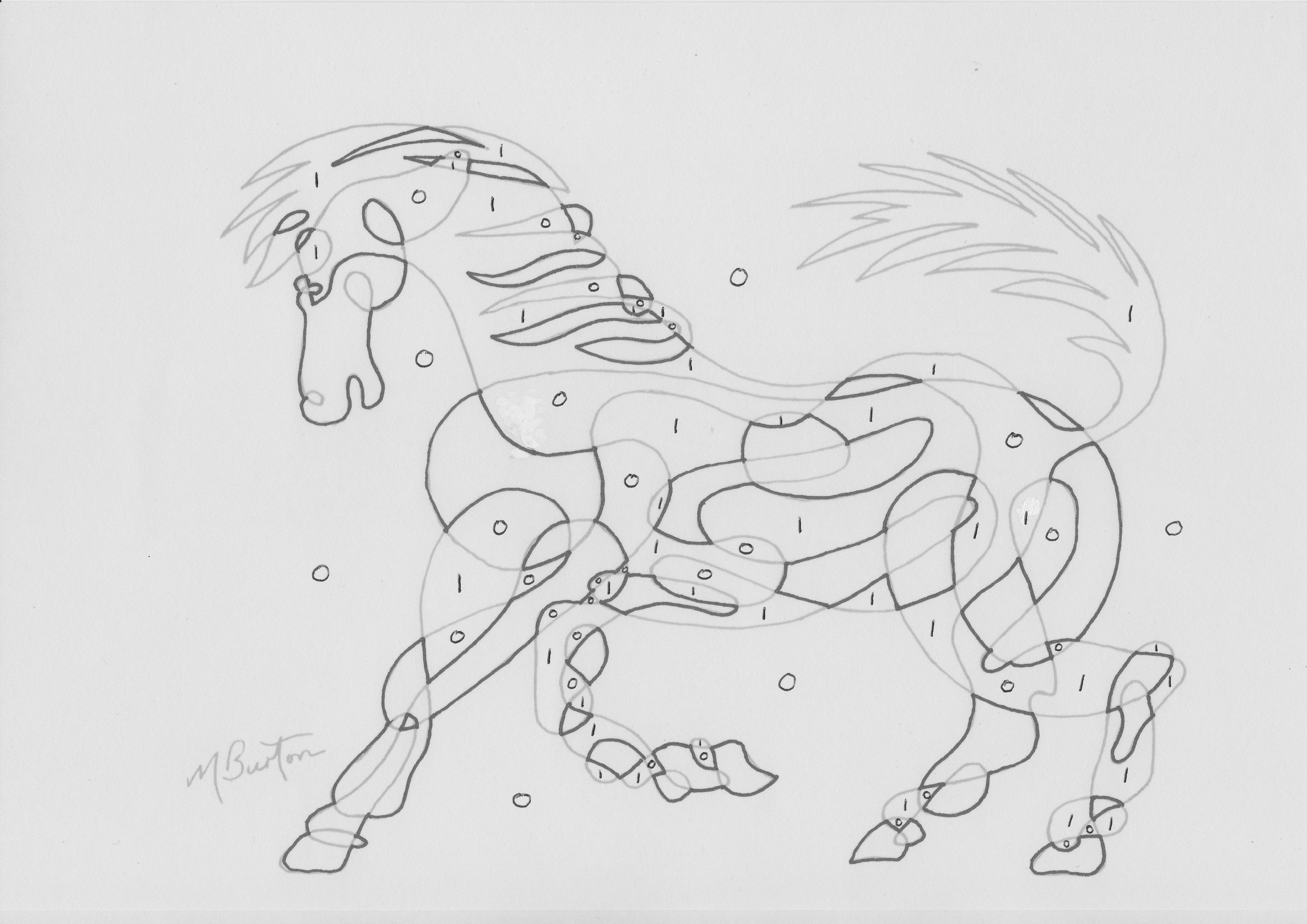
We are going to number all areas of the drawing, commencing with the background which will be numbered “0”.  In this example the background will remain uncoloured but “0” will also occur within the drawing and have a colour. 
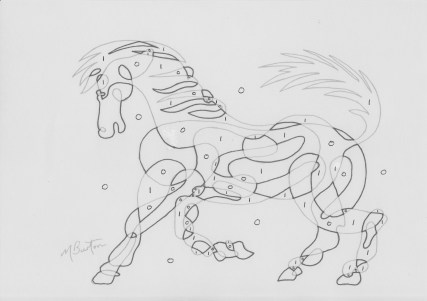
Fig 3. Initial numbering (0 and 1) of channels between Alternate Overdraws on the Continuous Line Horse.

Fig 3. Initial numbering (0 and 1) of channels between Alternate Overdraws on the Continuous Line Horse.

You will notice that between all the closed lines, formed by the Alternate Overdraws, there are channels of areas.  These can be completely numbered alternately by only two numbers, which in this case are 0 and 1.  So, starting with 0 on the background, work through all these linked channels, see Fig 3.  This also sets the direction of the number sequence throughout the drawing.
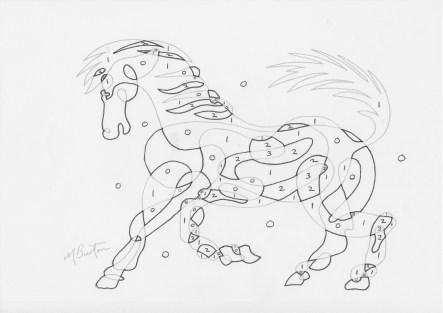
 

Fig 4. Colour Sequence numbers 2 and 3 on the Continuous Line Horse.

Fig 4. Colour Sequence numbers 2 and 3 on the Continuous Line Horse.


The numbering progresses both upwards through positive numbers and downwards through negative numbers.  We will start with the positive direction and allocate the next pair of numbers, 2 and 3.  By moving from an 0 area into a 1 area, and on through its Alternate Overdraw border, we will enter an un-allocated area we can mark 2.  Now deal with all the other areas in this new channel, marking alternate areas 3 and 2, to complete this allocation.  After this we need to check for any further Alternate Overdraw channel, or channels, at this level adjacent to 1 areas and then allocate 2 and 3 to them also, see Fig 4.

We then need to check for any further Alternate Overdraw channels enclosed within any of the 2 and 3 channels.  If we found one we would allocate 4 and 5 to the new channel or channels.  In this case there is no higher level channel. 

Fig 5. Colour Sequence numbers (-)1 and (-)2 on the Continuous Line Horse. Mick Burton, Continuous Line Blog.

Fig 5. Colour Sequence numbers (-)1 and (-)2 on the Single Continuous Line Horse. Mick Burton, Continuous Line Blog.

Having  completed the numbering of areas in the positive direction, we now go into the negative in Fig 5.  By looking at an area 1 and moving through a 0 area with an Alternate Overdraw border we can cross through that into a (-)1 and (-)2 channel.  Mark the initial one (-)1 and then allocate alternately through the channel with (-)2 and (-)1.  After completing that channel, look for other un-allocated channels adjacent to 0 areas and allocate (-)1 and (-)2 to them.  Now look for further channels in the negative direction enclosed within a (-)1 and (-)2 channel.  There is one such, a single area (enclosed by its own Overdraw) in the front leg of the horse, which I have left blank in Fig 5 , which will be (-)3.
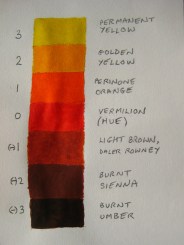
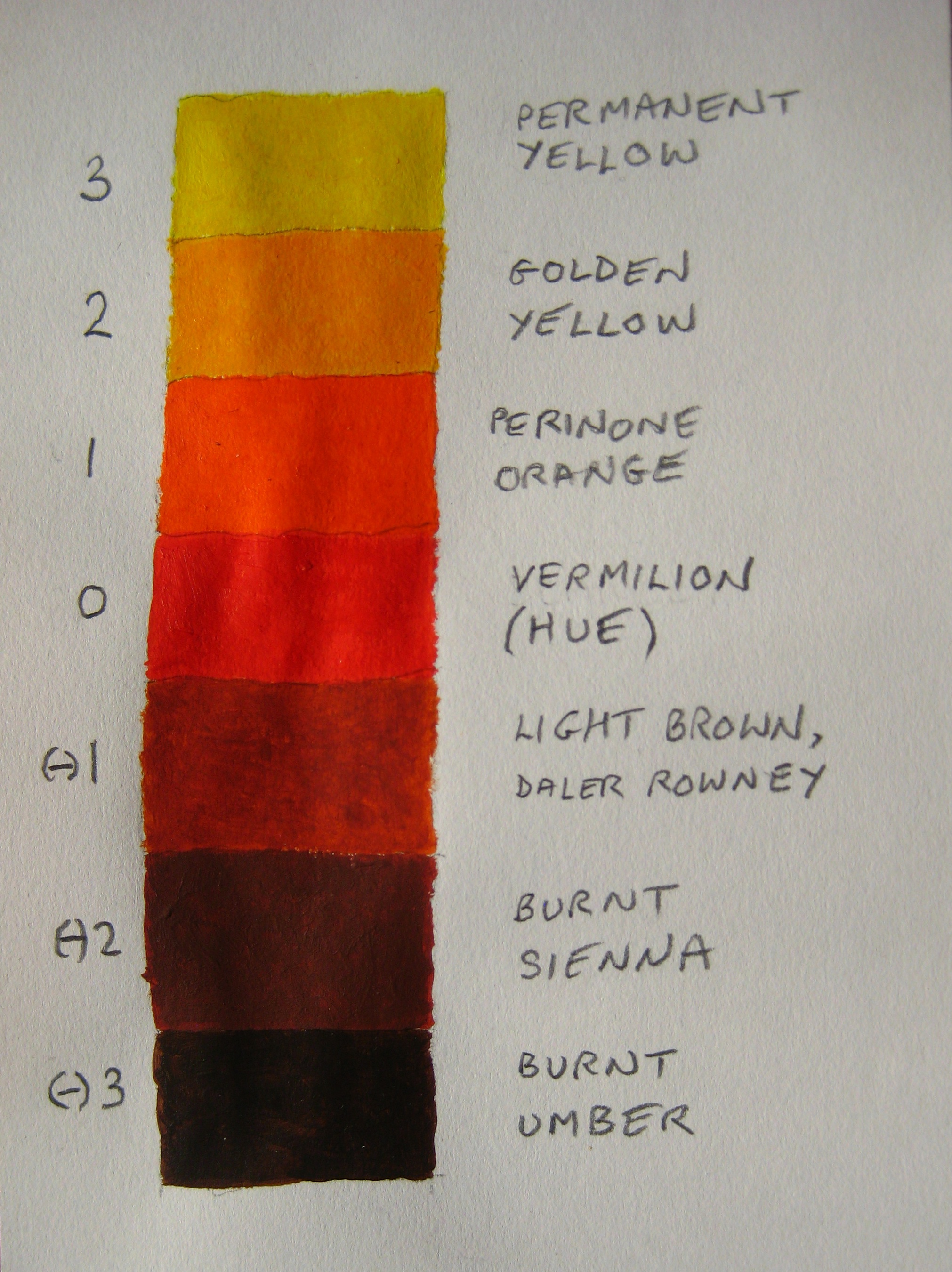
Fig 6. Colour Sequence colour chart for Continuous Line Horse. Mick Burton, Continuous Line Blog.

Fig 6. Colour Sequence colour chart for Continuous Line Horse. Mick Burton, Continuous Line Blog.

I was inspired by Rainbows in deciding on the sort of Colour Sequences I wanted to use for my Continuous Lines.  For shorter sequences, I settled for “partial rainbows” involving two prime colours only with a progression of colour mix and tones from light to dark.  For the Elephant I used yellows, greens and blues and for the Horse it was yellows, orange, red and browns in Fig 6.

I have carefully selected colours which have a stepped progression, both in colour and tone, and where possible I apply them from the tube (poster colour in the late 1960’s or acrylic now) to achieve an even and solid result.  I avoid mixing if I can, to retain the pure consistency of colour application across the painting, but sometimes it is necessary.
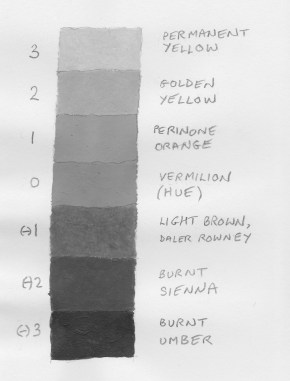
 

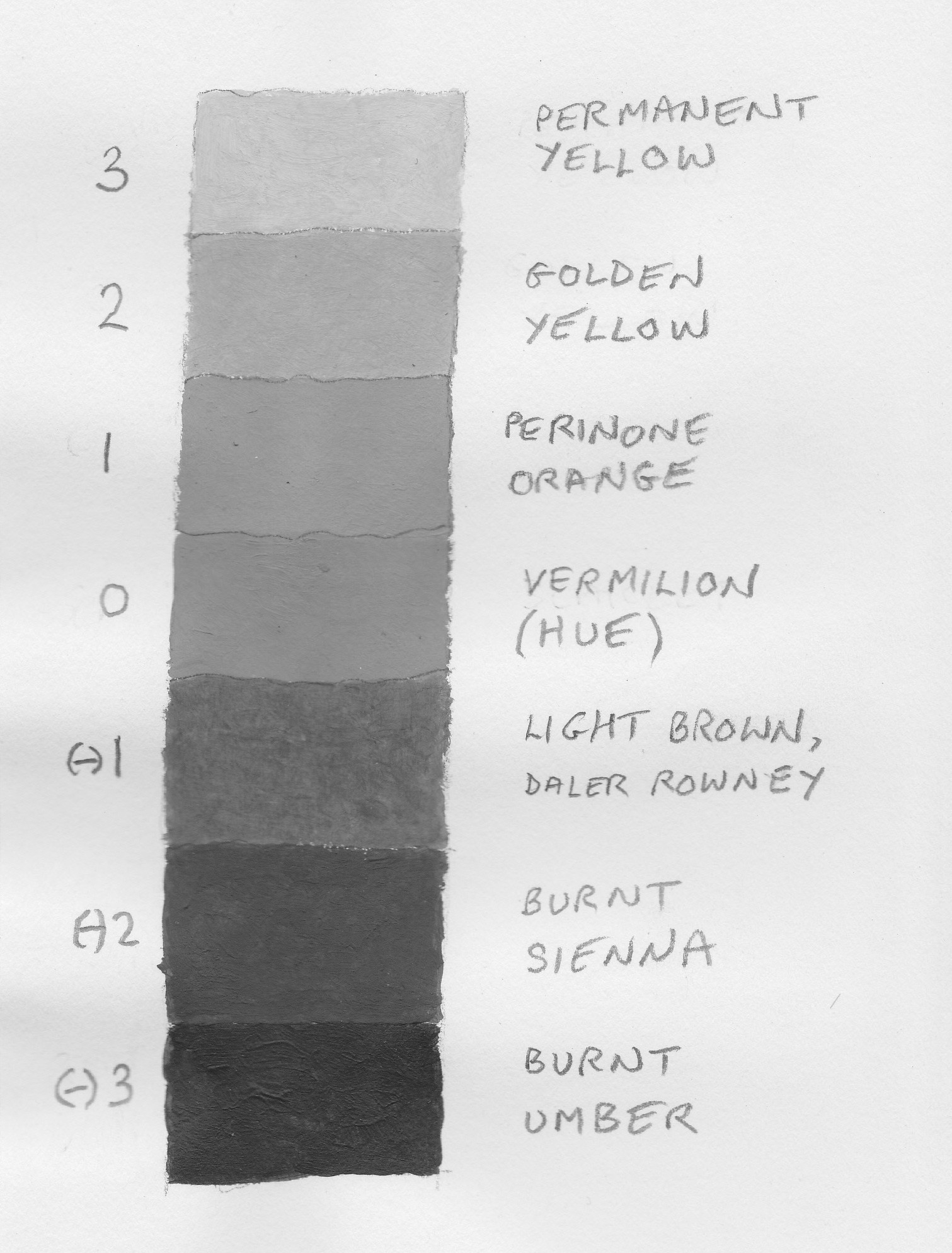
Fig 7. Black and white photocopy of Colour Chart for Continuous Line Horse.

Fig 7. Black and white photocopy of Colour Chart for Continuous Line Horse.


To assess the accuracy of the progression steps of my Colour Sequence chart, I do a black and white (or grayscale) photocopy of my chart to check that the steps still work in monochrome, see Fig 7.

Having produced the Colour Sequence chart, we need to decide the direction of the colours matched to the numbers, ie. Light to dark in an upward or a downward direction.  Generally I see whether a scale would mostly coincide with where a natural highlight would be, or have more darks towards the lower parts in a drawing to infer shadow.  Usually it is fairly obvious, but you can always start again with the other direction of colours.  Note that my style may take advantage of natural hints of highlight or shadow on a subject, but generally these aspects (along with perspective) are absent.

I remember that when doing equations at school, which produced two answers (+ or (-) ), was a puzzle to me which no one could explain.  I understand the concept of a practical outcome from having two answers a bit better now.
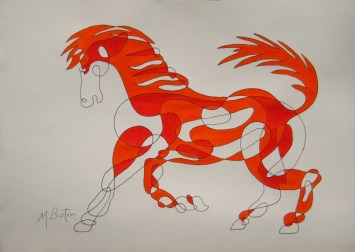
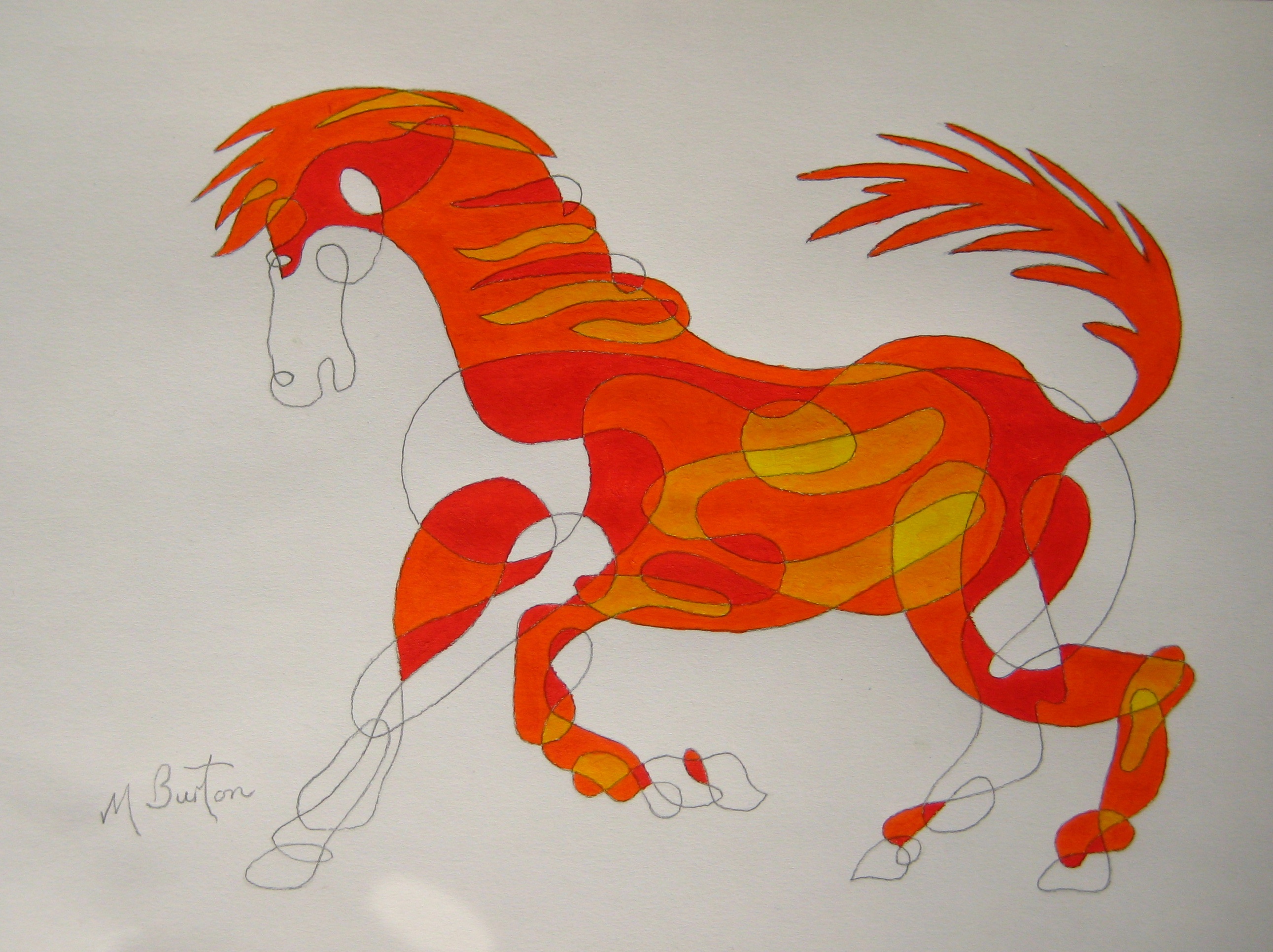
Fig 8. Initial Colour Sequence pair of colours on Continuous Line Horse. Mick Burton, Continuous Line Blog.

Fig 8. Initial Colour Sequence pair of colours on Continuous Line Horse. Mick Burton, Continuous Line Blog.

Once we have decided on the colour match with the numbers, the initial two colours can be painted in, ie.  Vermillion = 0 and Orange = 1, see Fig 8.
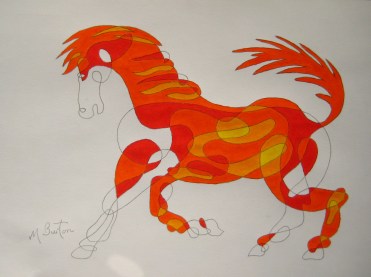


Fig 9. Second Colour Sequence pair of colours on Continuous Line Horse.

Fig 9. Second Colour Sequence pair of colours on Continuous Line Horse.


We can then match numbers 2 and 3 in areas to the colours required in the next channels up, or simply apply Golden Yellow to areas across the overdraw from Orange and then its alternate colour Permanent Yellow, in Fig 9.
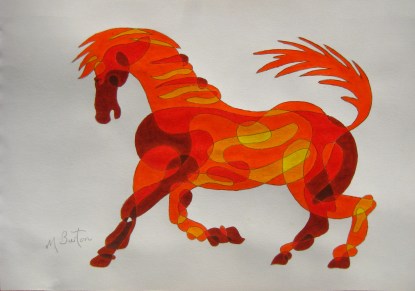


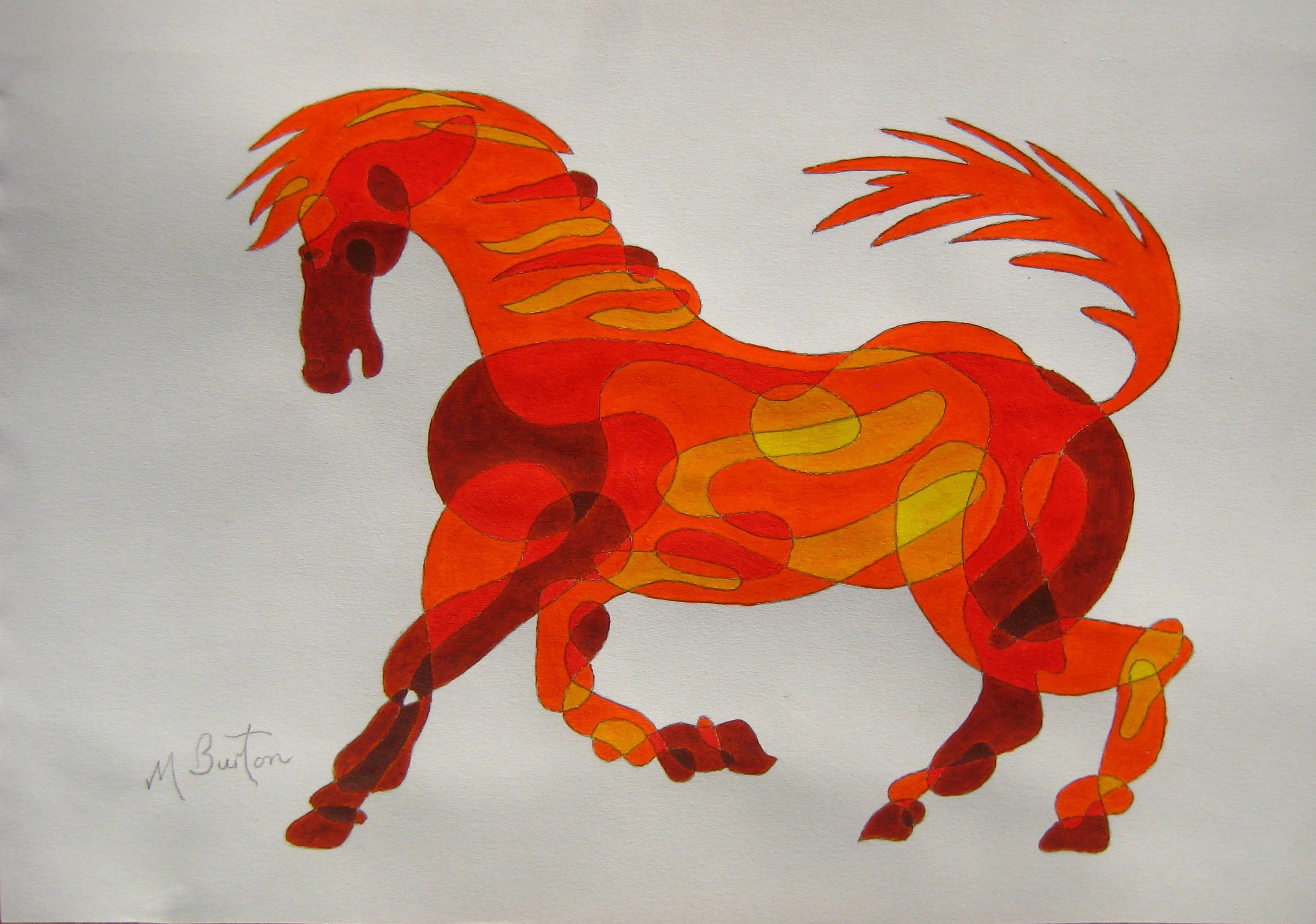
Fig 10. Third Colour Sequence pair of colours, in the negative direction, on the Continuous Line Horse. Mick Burton, Continuous Line Blog.

Fig 10. Third Colour Sequence pair of colours, in the negative direction, on the Single Continuous Line  Drawing of Horse. Mick Burton, Continuous Line Blog.

Now we can match numbers (-)1 and (-)2 in the negative direction, or simply apply Light Brown to areas across the Overdraws from Vermillion.  When these Light Brown and Burnt Sienna channels have been completed the last channel colour is (-)3 which is Burnt Umber.  In Fig 10 I have left this final area blank  (on the front left leg of the Horse).

So you have seen my Colour Sequence method, using Alternate Overdraw, for Continuous Line Drawings.  Sorry if it has been a long explanation (particularly if you grasped it quickly or had already come across parts of it), but I have tried to pitch it as helpfully as I can, based on my demonstration sessions.    

A couple a years after I started Colour Sequence I came across the Winding Number Theory.  There is a connection and I did pick up one or two ideas from it.  I will talk about this in a later post, but as always I am not a trained mathematician and so I will keep talking in pictures. 

 I hope that you will give it a try and I am sure you will enjoy the ride, as I have for so long.

If you display or publish your results, it would be great if you could specifically acknowledge me and my ideas.

Alternate Overdraw on Continuous Line Drawing

After my early attempts at continuous line drawing, and then alternate shading, I tried Alternate Overdraw on top of my continuous line drawings.  This produced some fascinating results which led to developments throughout my art.

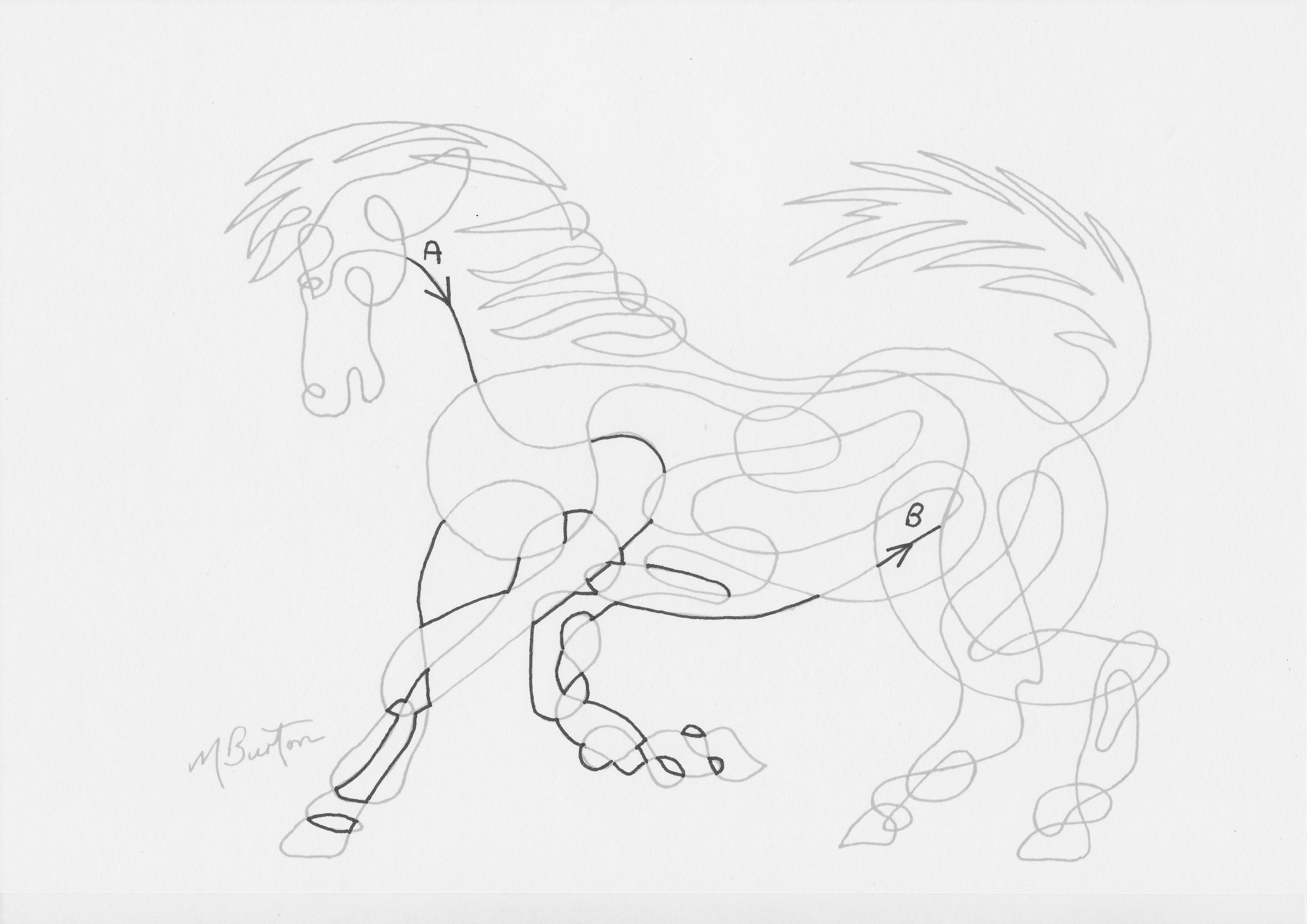
Alternative Overdraw on Continuous Line of the Horse, start A to B.

Draw from A to B to start Alternate Overdraw on Single Continuous Line Drawing of the Horse.

Lets use the Horse as an example.  Here is a lightly drawn Continuous Line (sorry if you have to tilt your lap top to see it all).  Start at point A and use a thicker pen or marker and draw over the first section of line, in the direction of the arrow, between the two crossovers.  Then miss a section before overdrawing the next section of line.  Keep going overdrawing alternate sections to point B.  You will see that already some overdraw sections are forming closed lines.


Alternate Overdraw of continuous line of horse.

Complete Alternate Overdraw of Continuous Line Drawing of horse from point A.


The next illustration shows the complete Alternate Overdraw and all these new darker lines form closed lines.


Naturally, if we start the Alternate Overdraw in a section which was not overdrawn in the above example (eg at X below), then this produces a result where a completely different set of closed lines appear.


Other Alternate Overdraw on Continuous Line of horse.

Other Alternate Overdraw on Single Continuous Line Drawing of horse, starting at X.


From the above findings I first developed my Colour Sequence ideas, which I will expand upon in the next post.

Later I used the closed lines to help in the construction of large models of my continuous line drawings as well as to devise hidden drawings within continuous lines.  More later on those.

The Alternate Overdraw method also led to a way to find a path through Four Colour Theory maps as part of my attempt to prove that theory nearly 40 years ago.

So, watch this space !!

Continuous Line Zebra

I visited Yorkshire Wildlife Park in June 2014, along with fellow members of the Association of Animal Artists.  It was an introduction viewing of the animals to be followed up by an Exhibition of our paintings which took place at the Park on Saturday 26 July.  Tigers, Lions, a Leopard and the Zebras were particularly impressive in their large enclosures. 

I have aways been keen to draw a Zebra in my style but the stripes are such a strong feature that I could not work out a way of doing the animal justice with my crossover continuous lines.  Of course I had seen prints of Victor Vasarely intertwined Zebras, done before the war, which helped kick start Optical Art.

Zeus, 5 year old stallion Zebra at Yorkshire Wildlife Park

Zeus, 5 year old stallion Zebra at Yorkshire Wildlife Park

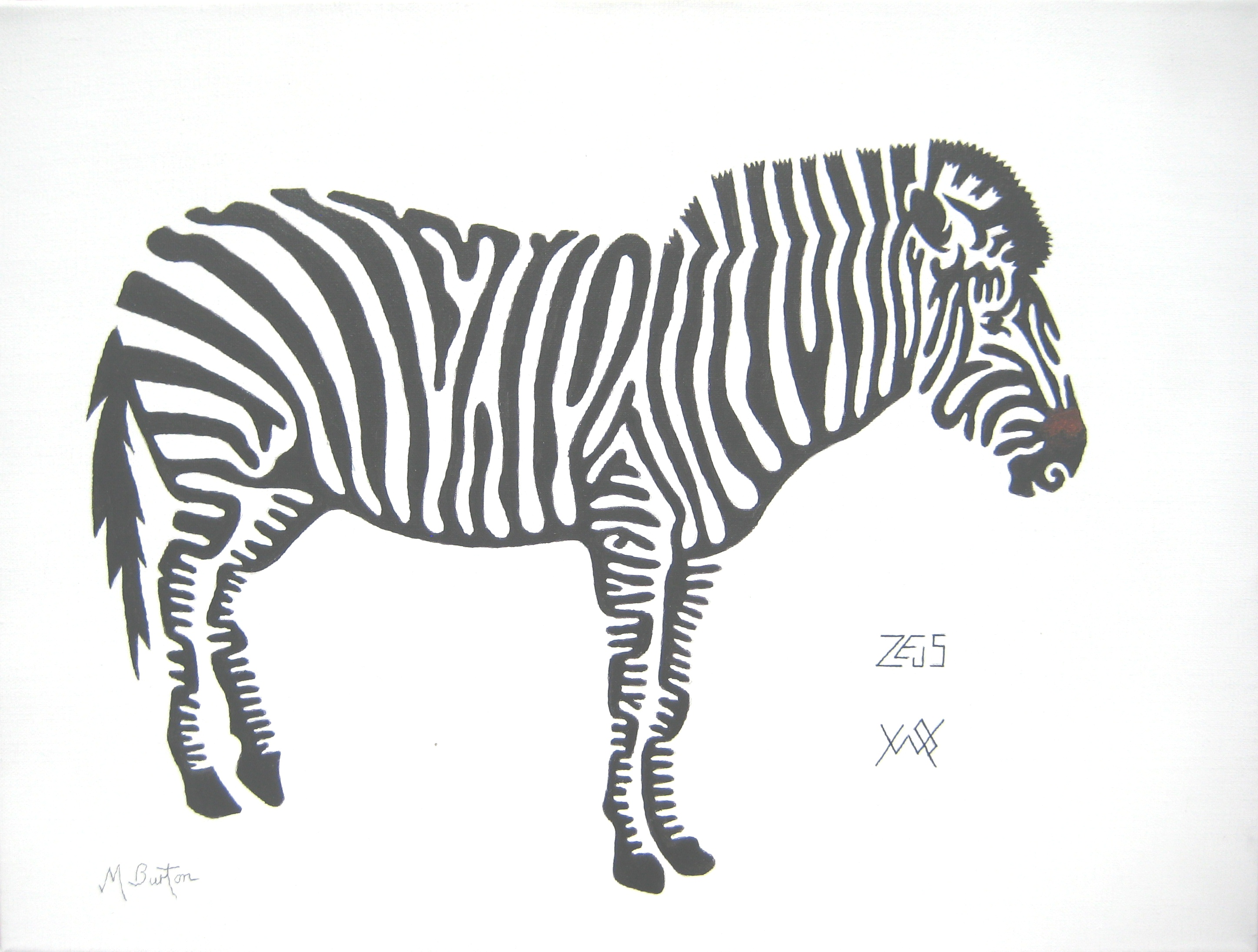
Here is my photo of Zeus, a 5 year old stallion Zebra (with a brown nose). 


I decided that I could use a continuous line, without any crossovers, to follow the pattern of the stripes as far as possible.  As the background of my picture is white, the gaps in the lines around black stripes allow the white to flow through and become white stripes.


Zeus, Zebra at Yorkshire Wildlife Park

Zeus, single continuous line drawing of Zebra at Yorkshire Wildlife Park


Of course I like to have a separate picture of the continuous line drawing without any shading  or colour and I considered calling this version “Albino Zebra”.  However, on searching this phrase on Google it turns out that there is only one albino Zebra in captivity in the world and that is in Hawaii (and this is not really an albino but a White Golden Zebra with a lack of pigment in its stripes).  In the wild the stripes are pretty essential for camouflage and “albinos” do not survive for long.  The Hawaii Zebra is a female called Zoe and so is smaller (and a bit scruffier) than Zeus.  I therefore had to do a specific continuous line drawing of Zoe with a faint slate colouring.

Zoe, albino Zebra, Three Ring Ranch, Hawaii

Zoe, albino Zebra, Three Ring Ranch, Hawaii.  Mick Burton single continuous line drawing.

Why “Continuous Line” ? What is the point of it ?

You may ask why I am so bothered about the line being “Continuous”.  Well here we go –    Skelldale. Continuous line drawing.

The Continuous Line gives the drawing an enclosed flexible structure, or environment, which in turn means that all parts are related to some degree.  If I modify sections of a drawing there can be ramifications elsewhere, which may be small or extensive.  “Skelldale” was one of my earliest continuous line drawings.

When I compose a drawing I have to bear in mind that the line must return to the start point.  This is a lot of fun when I do an abstract, but for a figurative drawing it is more difficult as I am aware that the drawing will constantly change.  However, I have learned that this difficulty can help to trigger the creative force that often lies within the drawing.

This discipline of having to make choices on the route of the line, or modifying the route, can produce an extra structural effect or dynamic of movement which I may not have foreseen.  This creation of a result beyond my intention is similar to what happens in nature, where the practical necessity of combining all the elements needed in an animal or a plant often evolve into a tremendous design.

        Lizard. Continuous line with colour sequence. Mick Burton, 1971

A further result of the Continuous Line is its creative effect on colours applied.  I worked out a method of applying colour sequences which can further enhance the natural structure and dynamic effect.  A colour only occurring once can be in a key area, eg. the eye of the Iguana.  I used a special repeat pattern for the scale effect.


Flame on the Sun. Spherical continuous line. Mick Burton, 1972My “spherical” drawings, where the line goes out of one side of the page and in at the opposite side, also produce a special arrangement of colours which can apply to a sphere.  The “Flame on the Sun” has coloured areas which match if the picture has its sides pulled around to meet in a cylinder.  However, there is no such match top to bottom, where a “bunching” effect would form the “poles” to complete a sphere. 

Africa. Four colour map theorem. Continuous line. Mick Burton, 1974.

My knowledge of Continuous Lines also lead to my creating them within natural structures when I researched the Four Colour Map Theorem 40 years ago.  This single line along boundaries of the countries of Africa (from my 1950’s school atlas), goes through every boundary junction once only.  I could connect up the two loose ends to make it “Continuous” !  You can use two alternate colours for countries inside the line and another two alternate colours for countries (and the sea) outside the line and you have your Four colours.  Proving that you only need four colours for any map is a different matter !

 So there we are, my fascination with my lines continues.  I will cover all these types of line further subsequently.


Black and White Alternate Shading

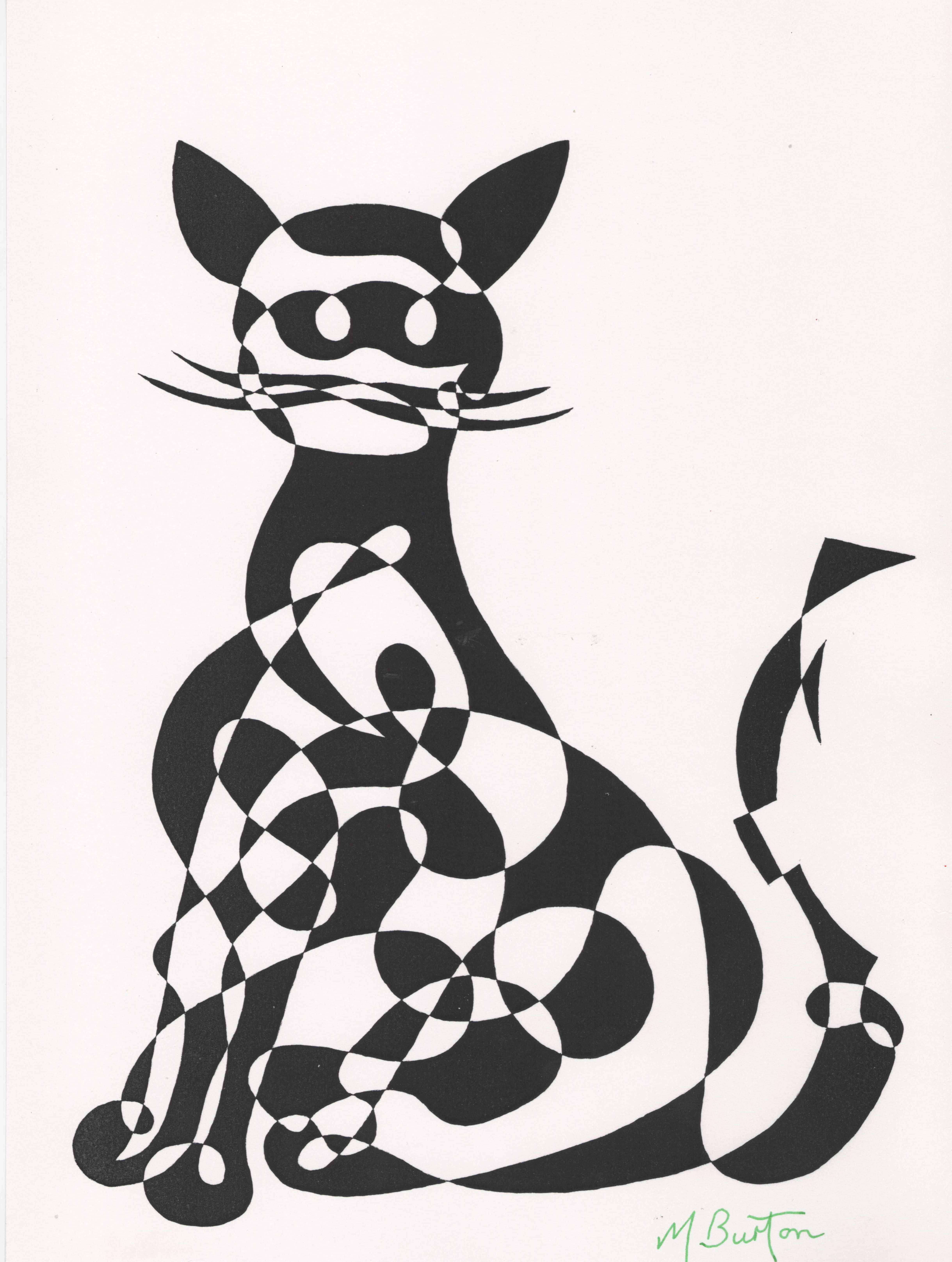
010. 1966-9. Cat, or Ragamuffin. Alternate shade, black. Whilst doodling at work (I was articled to a Chartered Accountant) I was already using alternate shading on some drawings.   I realised that if you initially shaded one outer area on a continuous line drawing, and then worked alternately through the doodle, all outside areas became shaded.   Bridget Riley’s Optical Art (or Op Art) in black and white, with its shimmering effect, suddenly appeared in the early 1960’s.   I started black alternate shading on some of my new figurative drawings.   I now realise that most of Op Art was abstract to make the most of the effect, whereas I was doing animals, people and landscapes.

My Lion in particular produced its own shimmering effect.
016. 1967-9. Lion. Alternate shading, black.


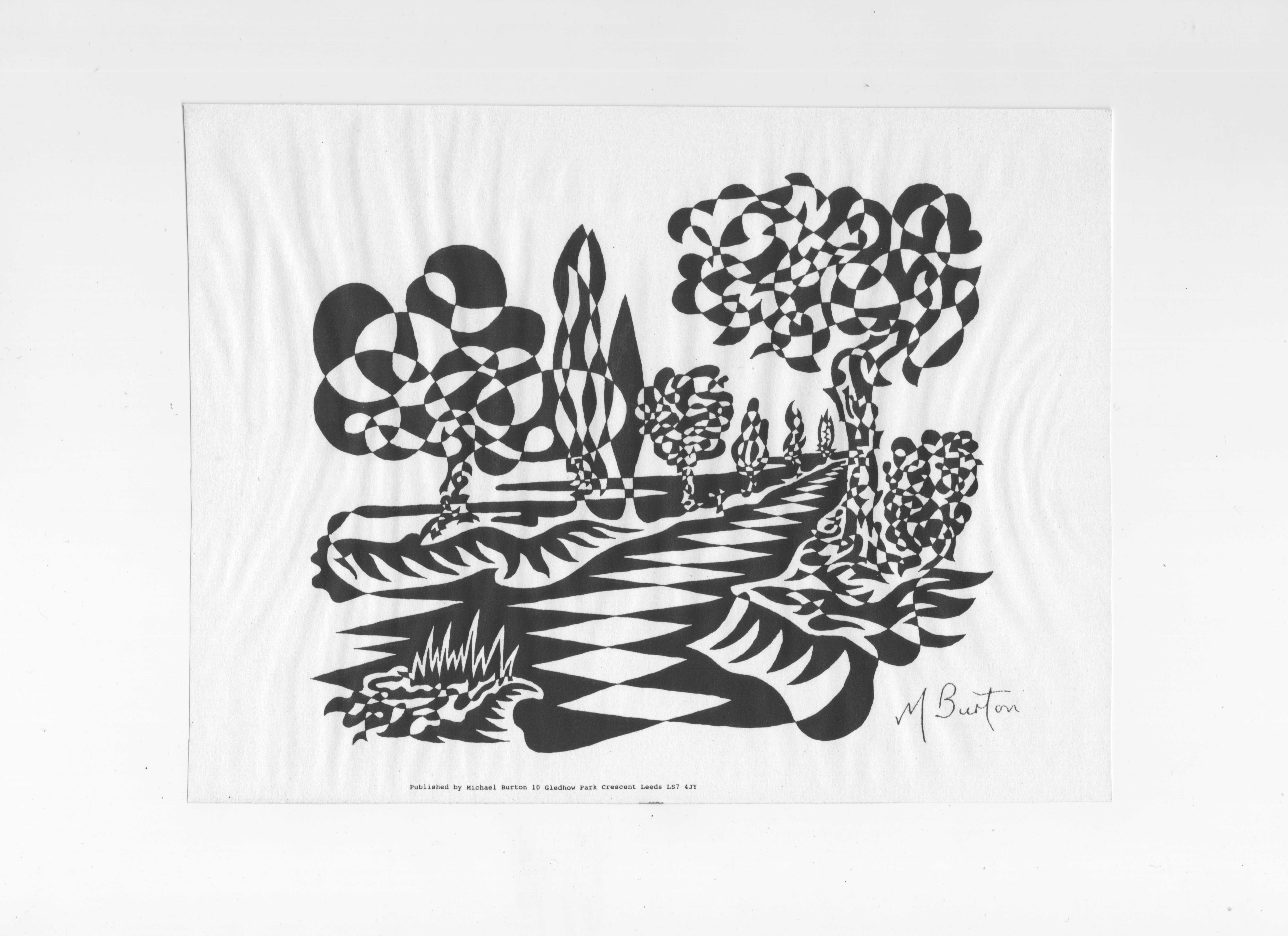
To extend the scope of my continuous line drawings, along with the alternate shading, I had a go at a landscape based upon the countryside where I grew up near Ripon and called it Skelldale.   I could walk along the banks of the River Skell upstream to Fountains Abbey.

006. 1966-7. River, Skelldale. Alternate shading, black.

An exception to the abstraction in Op Art was Zebras (in 1937) by Victor Vaserely, in which he used the black and white stripes of intertwined zebras, and it was one of the very first Op Art pictures.   He then became largely abstract in the 1950’s.   He was unknown to me until several years after I started in 1965.

This was In about 1971 when I walked past Christies Auction house in London, when taking my pictures to an exhibitions agent, and I saw through a window some black and white abstract drawings which had a similarity to mine.   I went in and was amazed at the variety of drawings, so many having aspects which I had experimented with.   The lowest estimate was £14 and I considered leaving a bid, but I decided that it was a lot of money (then) and that I had similar ones at home (stupid boy).   A week or so later I read in the newspaper that Vaserely had been selected to design the emblem for the next Olympic Games (1974).   I should have left that bid !


Association of Animal Artists Annual Competition Winner !

Mick Burton.  PANTHER (continuous line drawing).

I joined the Association of Animal Artists in November 2013 and have entered two of their exhibitions so far – at Martin Mere Wetland Centre, Lancashire from December to February, which was for British animals and birds, and now their Annual Exhibition at Castle Park Arts Centre in Frodsham, Cheshire which runs from 11 April to 18 May 2014, for world wide species.

Julie Cross, the AAA Secretary and Exhibitions Co-ordinator has just informed me that my ‘Panther’ drawing has been awarded winner of the ‘Creative Creatures’ category in the annual competition.  She said that the judge, Andrew Beckett, liked all my work, particularly ‘Mayer’ the lion, but plumped for ‘Panther’ because of the apparent simplicity and pared-down nature of the image.

Joan and myself are delighted with the news.  Also my daughter Kate Burton, who is a professional artist and short film maker, has said that the ‘Panther’ is her favourite of my pictures. 

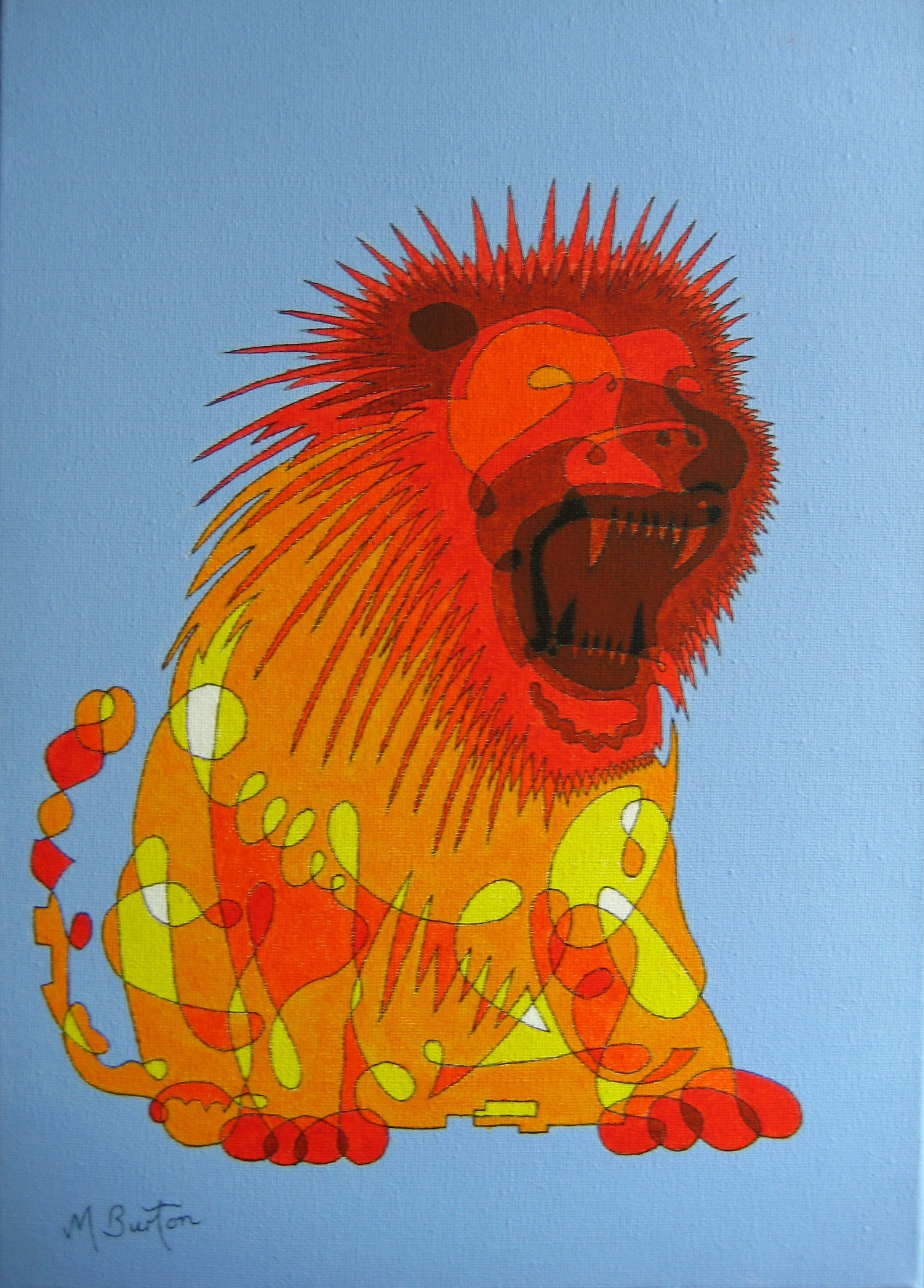
Here is ‘Mayer’ the Lion which I coloured in reds and browns 18 months ago, plus the poster for the current exhibition.

Lion in Continuous Line and Colour Sequence.  Mick Burton, 2012

Lion in Continuous Line and Colour Sequence. Mick Burton, 2012

AAA annual exhib Apr to May 2014.

Animals in My Art – How I Started.

My first Animal drawn with a continuous line was the Horse, which was based upon a painting by George Stubbs, where a horse is savaged by a lion. I used the general image of the horse, but with a calm and flowing style (rather than it appearing to be scared witless).003. 1966-5. Horse. Cont line.The Cat was drawn quickly, in about 15 minutes, without reference to any picture. My main memories of cats in my childhood were at my Dad’s work, a market garden in Ripon where he was the foreman. There were always several cats around, which were kept to control the mice and rats in the gardens. Dad called every one “Tib”. The downside was the periodic drowning of kittens to keep the numbers in check. I particularly liked one cat which always appeared to have been in a fight, and so I drew a dislocated tail on my cat. This sort of tail became a trademark in some later animals.
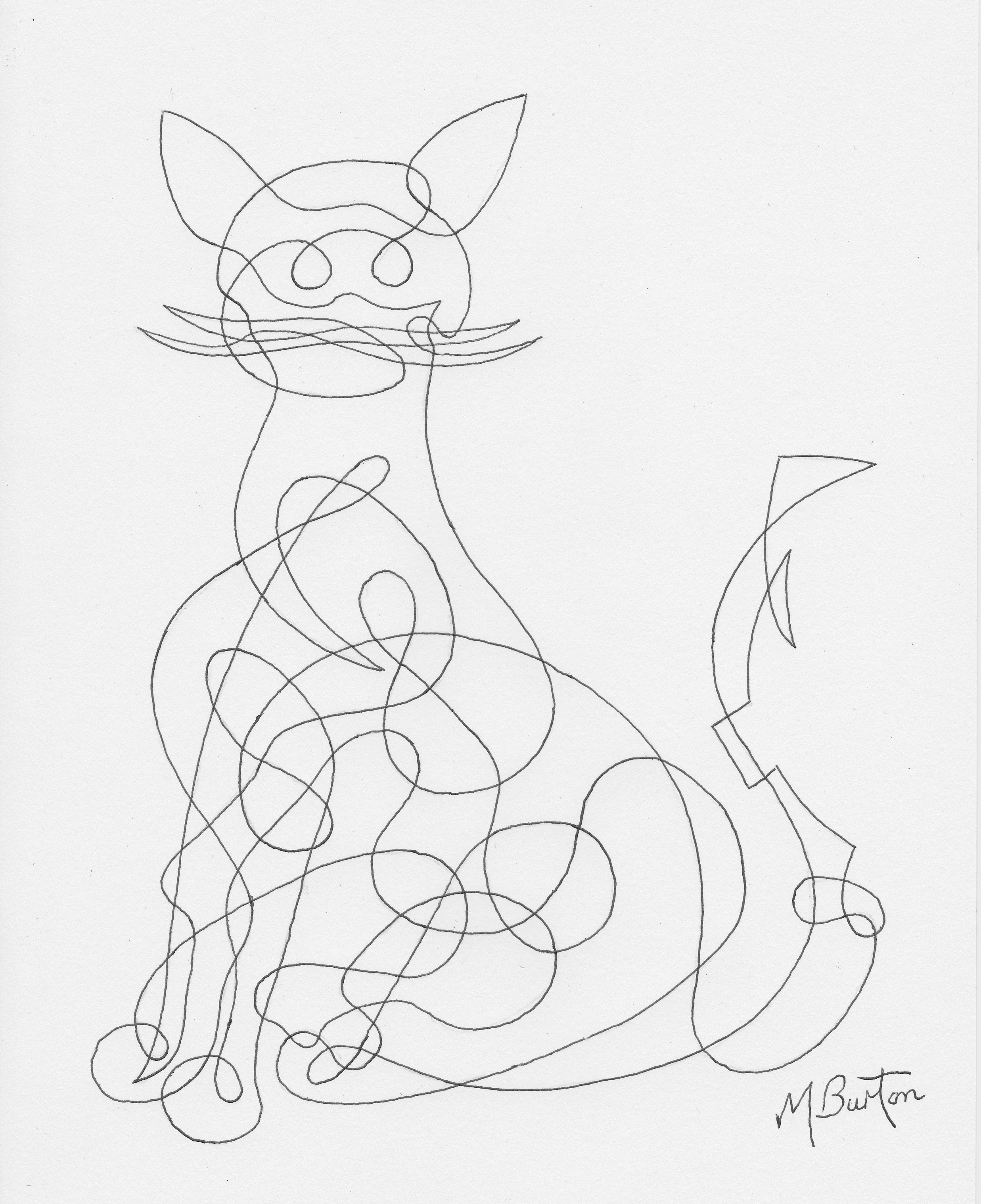
Cat, continuous line.

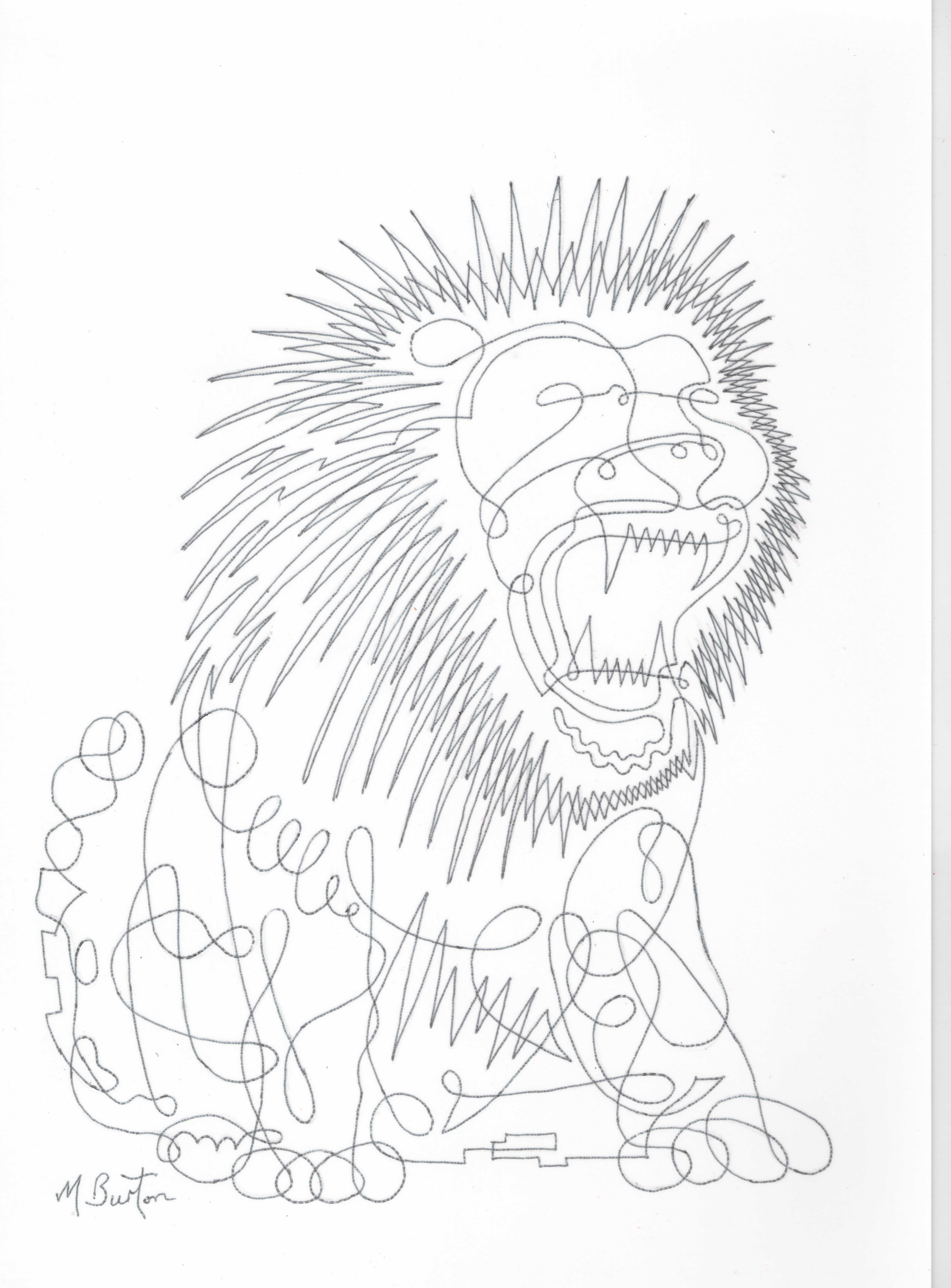
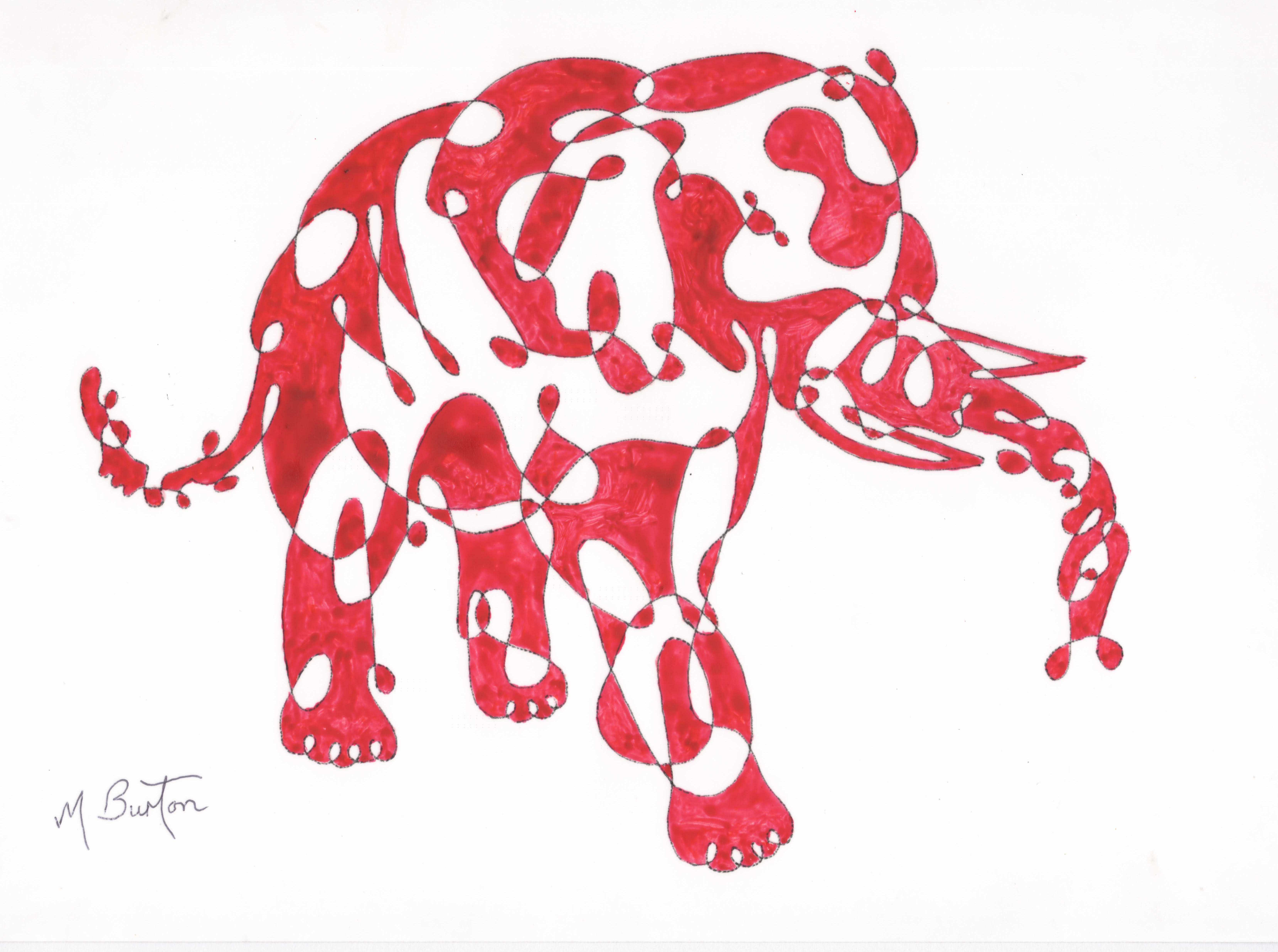
Following our April Fools Day party on 1 April 1966 (the day after the General Election) when I did my Harold Wilson continuous line, our next venture was a Pink Elephant party.  So I was asked to do another picture.  This elephant was based upon a drawing in a book of animals.  I added a dislocated tail and appropriate colour.012. 1967-3. Pink Elephant. Alternate shading.People said that the flowing lines on the Horse and the Elephant gave an appearance of elegance, whereas some animals were a bit more aggressive.  So I decided that I would draw a Lion in a seated position, with the lower part of its body at ease and relaxed, but with the head suddenly giving out a great roar.  The roar was based upon the opening sequence of Metro Goldwyn Mayer films, where the lion roars through a gap in the logo.

I have a strong memory of sitting with a blank piece of paper in front of me and thinking that I had done the Horse, Cat and Elephant and they had all turned out well.  I had not yet failed to create a picture better than I had anticipated.  Would the Lion work out ?  You just have to start and see what happens.             015. 1967-8. Lion, or Mayer. Cont line.

On the Internet, a couple of years ago, I saw a feature which allowed you to put your own face in the Metro Goldwyn Mayer logo.  Of course I chose to put my Lion’s head in there. Their Lion was called Leo, but I prefer Mayer.pixiz_4f02e0881fb14[1]