Tag Archives: Thomas Mace

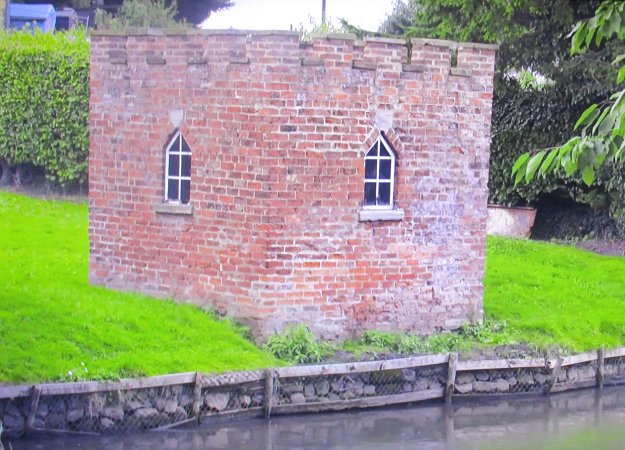
Leech House, Bedale Beck, on BBC’s Escape to the Country.

IMG_5048 Escape to the Country, North Yorkshire, first aired 17.12.18, S19, E11. - Copy

My mother’s family (Mace) house garden, in the 1920’s to 1950’s, contained the Leech House, Bedale Beck, North Yorkshre.   Now a Grade 2 listed building, seen on Escape to the Country, “North Yorkshire”, first aired on BBC, 17.12.2018.

Joan was watching a repeat of  “Escape to the Country” on BBC TV and shouted for me to come and look at the Leech House, by Bedale Beck, in Bedale, North Yorkshire.  I used to play in the the garden containing this turreted brick building when visiting my Aunt Alice and Uncle Teddy in the 1950’s.  It was like a miniature castle to me and I was later told about the leeches.  It is the only surviving Leech House in the UK.

Here is Alistair Appleton, a presenter on Escape to the Country, explaining how 200 years ago the small building was full of leeches.  These were kept alive with fresh water from the Beck and put into jars by the apothocary, who delivered them to doctors when the leeches were needed for “blood letting” on a patient.
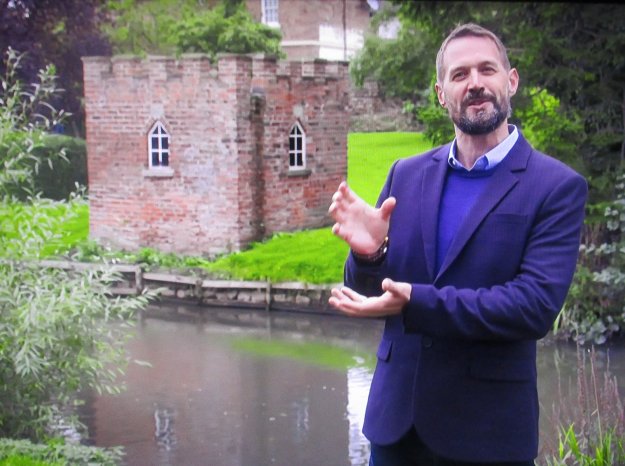
IMG_5051 Alistair Appleton explaining that leeches but in jars. - Copy

Alistair Appleton, presenter on Escape to the Country, explaining how leeches were put into jars by the apothocary in Bedale.  BBC programme “Escape to the Country” first aired 17.12.18.

Park House, Bedale (in the background of the above picture) is next to the railway level crossing of the road connecting Bedale and Aiskew and is now offices.  The garden stretching down to the Beck is now publicly owned and a tourist attraction because of the Leech House.  The railway line and the nearby station are now part of the Wensleydale Railway, which re-opened the Bedale Station in 2004.

In the 1950’s, a raised siding came from the railway station almost to the house and lorries could back in underneath the railway trucks to be loaded with coal being dropped through the bottoms of  the trucks, etc.

My mother, Brenda Mace, was born in the family pub, the Oddfellows Arms (now The Three Coopers), on Emgate, in 1909.   Park House was the local Police Station of the North Riding Police and when it was no longer required, in the 1920’s, my grandfather Thomas Mace bought it.   My grandparents moved out of the pub with their younger children, leaving one of his elder sons, John and his family, at the pub.

I have seen the Leech House on the television before, when Janet Street Porter did a programme 20 years ago about the book Yorkshire: The North Riding by Pevsner, the famous writer on architecture.  She showed Castle Howard, Whitby Abbey and then, suddenly, it was my mother’s garden and the Leech House.

This building with turrets reminds me of the Mace family’s relationship with castles and fortifications and in particular artisan and artistic ancestors.

Conway Mace, born in Lisburn, near Belfast in Ireland, in 1669  was the son of the Rector of Lisburn Cathedral, who was born in Cambridge, and a local Irish mother.  He was initially a goldsmith in Dublin before starting, in 1694, a long career as an army officer.  He served under Marlborough and then in Menorca before being in the 1727 siege of Gibraltar.  He ended his service at Plymouth Citadel, where he died in 1733.

Here is an engraving produced by Sandford Mace in 1737 of the Citadel of Plymouth, which he presented to Charles Churchill the Governor of Plymouth.  Sandford, along with his brother James, took leave from the Royal Artillery to produce the map.  The names listed on the map include General Borgard, commander of the Royal Artillery, and Colonel Adam Williamson, Deputy Governor of the Tower of London, who served with Conway Mace in 1707-8.
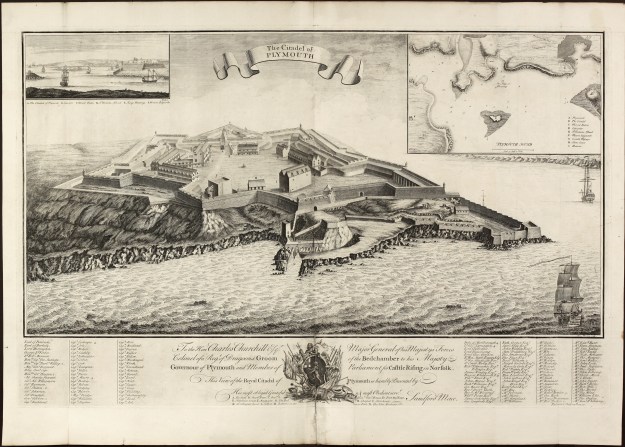
91516 from Paulus Swaen (full density)

Engraving of The Citadel of Plymouth presented by Sandford Mace in 1737 to Charles Churchill, Governor of Plymouth.  From the Brenda Mace Collection.

Sandford Mace then joined General Ogglethorpe’s new Regiment as a junior officer, when it was formed in 1738, and was in charge of cannon in Florida when a Spanish Fortress was taken in 1740.  Sandford drew the Fort and also a plan of the positions of different combatants, including local Indians.  He died in Georgia in 1745.

James Mace returned to the Royal Artillery and rose to the rank of Captain.  When serving at Gibraltar in 1751 he produced an engraving of Gibraltar.
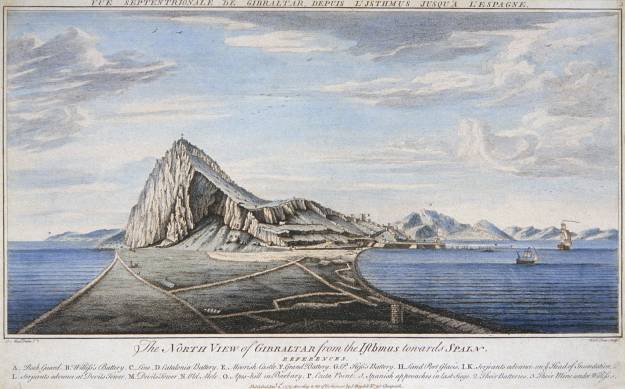
North View of Gib by James Mace & Tomms. 03648-2

North View of Gibraltar by James Mace and Thomms. 1751.  This print presently hangs in the Governor’s House in Gibraltar.

James, as a boy aged 11, used to visit the Tower of London and Deputy Governor Adam Williamson recorded that James drew the portrait of John Plunket, who was imprisoned in the tower for Treason.

In 1756 James was promoted to Major whilst in Gibraltar to be head of the fleet charged with defending Menorca against the French.  Unfortunately (or fortunately for him) before he got there the French had captured the island.  General Clive, in Calcutta, then requested expert assistance to build fortifications for if the French attached Calcutta and James was dispatched.  He was delayed in Bombay, involved in the building of a new harbour, where he died in 1765.

A similar view was painted in the 1780’s by John Mace, who may have been the son of James.
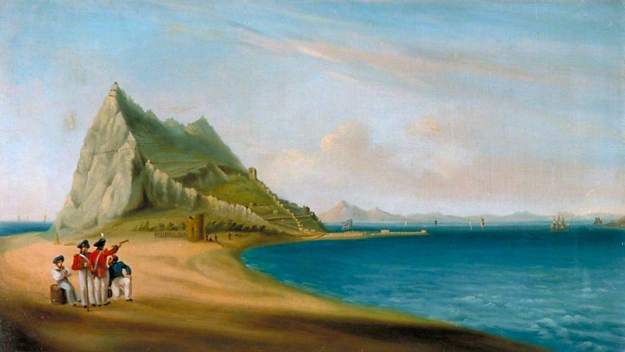
Mace, John, active 1780-1790; North View of Gibraltar from Spanish Lines

North View of Gibraltar from Spanish Lines, by John Mace, active 1780-90. Art UK image, Government Art Collection.
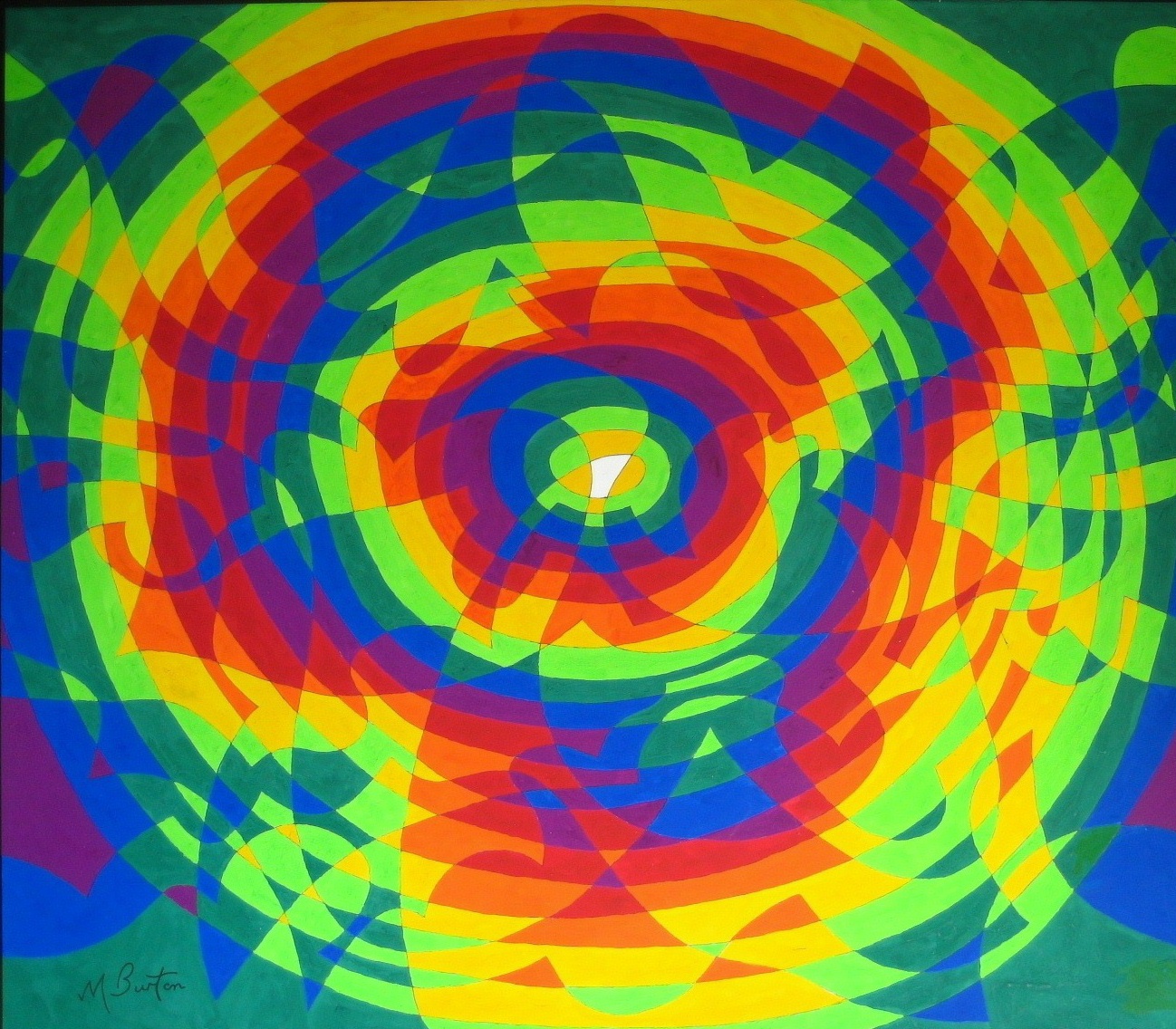


Winding Number Theory and Continuous Line Drawing


Whirlpool in Space, or Petrol Poluted Puddle. Spherical continuous line with repeat colour sequence with Rainbow colours. Mick Burton, Continuous Line, 1971.

Whirlpool in Space, or Petrol polluted Puddle. Spherical single continuous line drawing with repeat colour sequence with Rainbow colours. Mick Burton, Continuous Line, 1971.

This painting was one of two pictures hung at the Chelsea Painters Open Exhibition, held at the Chenil Galleries, Chelsea,1971.  I walked along the Kings Road looking for the gallery (I had submitted through and agency) and it was great to see the Whirlpool first in a window by the entrance.

The design was triggered by a browse through mathematics books in the library and coming across Winding Number Theory.  This used a continuous line and every time the line was drawn winding in a counter-clockwise direction a level was added and if you wound back in a clockwise direction a level was taken off.

So far, in my colour sequence numbering based upon Alternate Overdraw, I had not had a sequence of colours greater than about nine.  If I used the Winding Number method and continued to wind around counter-clockwise many times I could have a long colour sequence.  I went a bit mad with the Whirlpool, which was done on a spherical basis (allowing drawing out of one side of the paper and back in at the opposite side), and has a sequence of 20.

I did not simply go from light to dark over the whole 20 (the steps in shade between each colour would have been too small), but oscillated up and down with a smaller range of colours similar to a rainbow.  I had seen the rainbow effect produced by sunlight on petrol spilt on a puddle.

Alternate overdraw with colour sequence numbers. Continuous Line, Mick Burton.

Alternate overdraw with colour sequence numbers. Continuous Line, Mick Burton.

To illustrate the difference between my Alternate Overdraw and the Winding Number, I start with the Alternate Overdraw in Red on the left.  As shown in earlier posts, each channel of areas between overdraws has two numbers alternately.  You move naturally up to a higher channel or down to a lower channel, through the red line and continue the numbering.

As before, you start with “0” on the outside and 0 can also appear within the drawing.


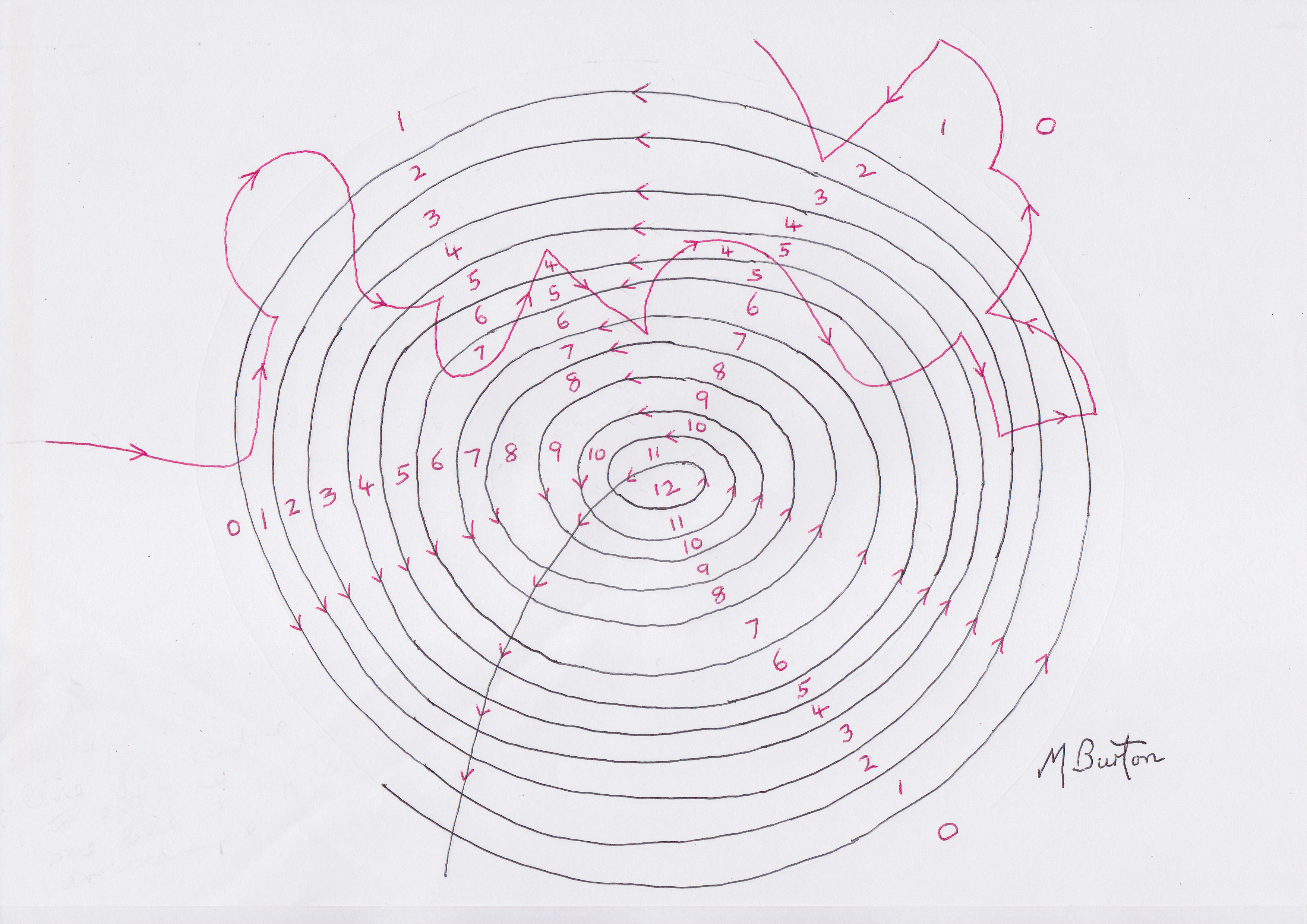
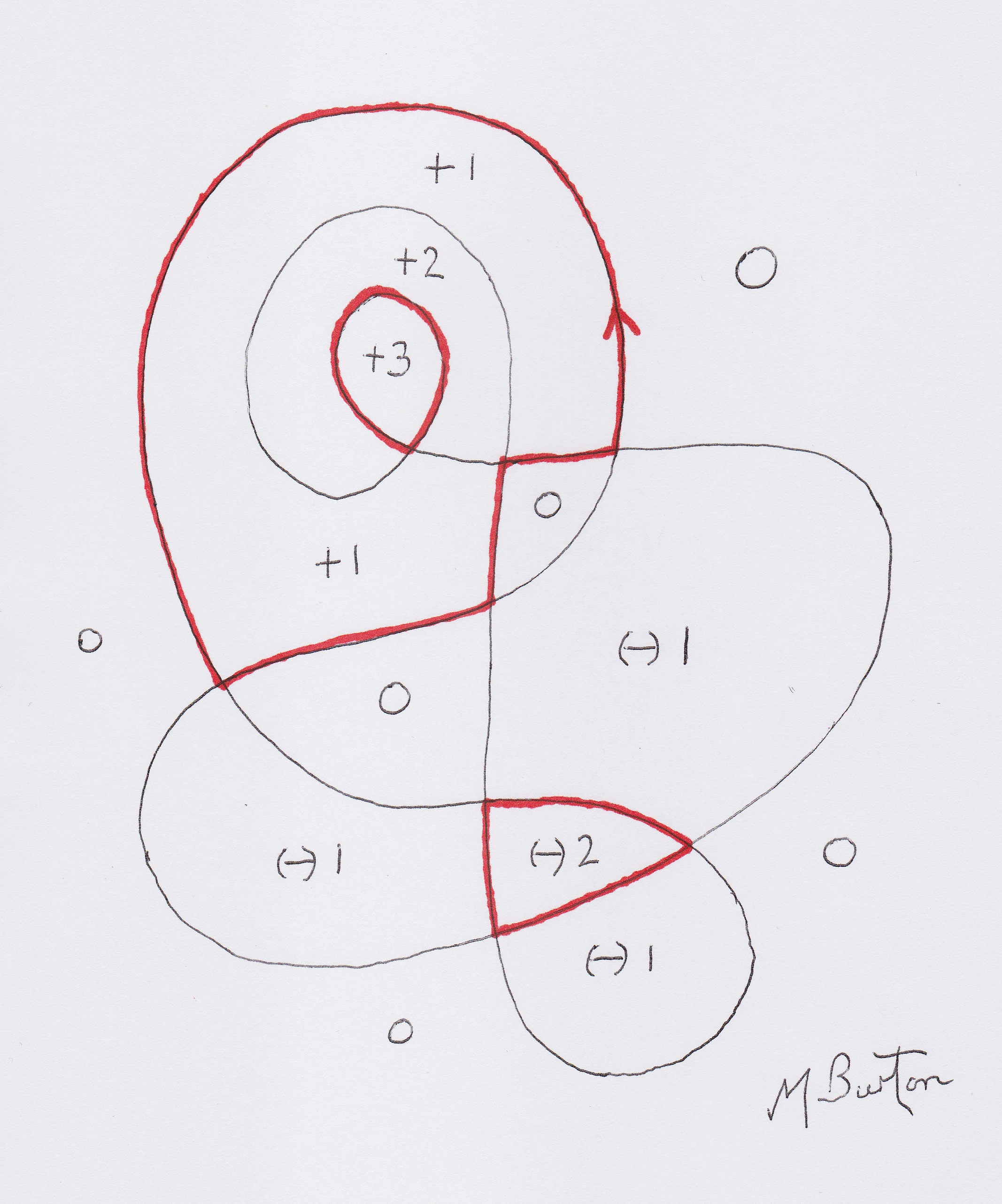
When we come to Winding Number allocation, we can use the same basic drawing with little arrows showing the direction it has been drawn.  It can be either direction of course, but I have chosen one which will match the result above.

Winding number allocation. Continuous Line, Mick Burton.

Winding number allocation. Continuous Line, Mick Burton.

Starting at “0” for the outside, if we cross to another area through a counter-clockwise border for that area, it will be a level higher.  If we cross through a clockwise line we reach a lower area.

Here the + areas are of course higher levels and the (-) areas are lower.

The numbering matches the Alternate Overdraw illustration above.


Now, just to show the initial thrust of the drawing for the Whirlpool, with many levels, the next illustration shows a line spiralling from the centre outwards and I have shown just 13 winds.

Part of initial Winding Number spiral for Whirlpool painting. Mick Burton, continuous line.

Part of initial Winding Number spiral for the Whirlpool in Space painting.    Mick Burton, single continuous line drawing.

Then I have drawn a line from the centre of the spiral directly back to the bottom of the picture as the first phase of breaking up the spiral so that lots more areas start to  appear.  The next such phase is a meandering line near the top of the picture. 

As I have said, this is a shorter version than the one usd for the main Whirlpool in Space picture above.

Next I have decided that the direction of  the line will be counter-clockwise starting from the bottom of the spiral, so that the levels go up towards the centre.  The numbers have then been added.

On the original painting, which is 24″ x 20″, I used alternate overdraw to allocate the colours.  This was because I was used to using that method and I think it is better for an artist anyway.  The Winding Number theory was simply the inspiration for producing a sequence of 20 or more.

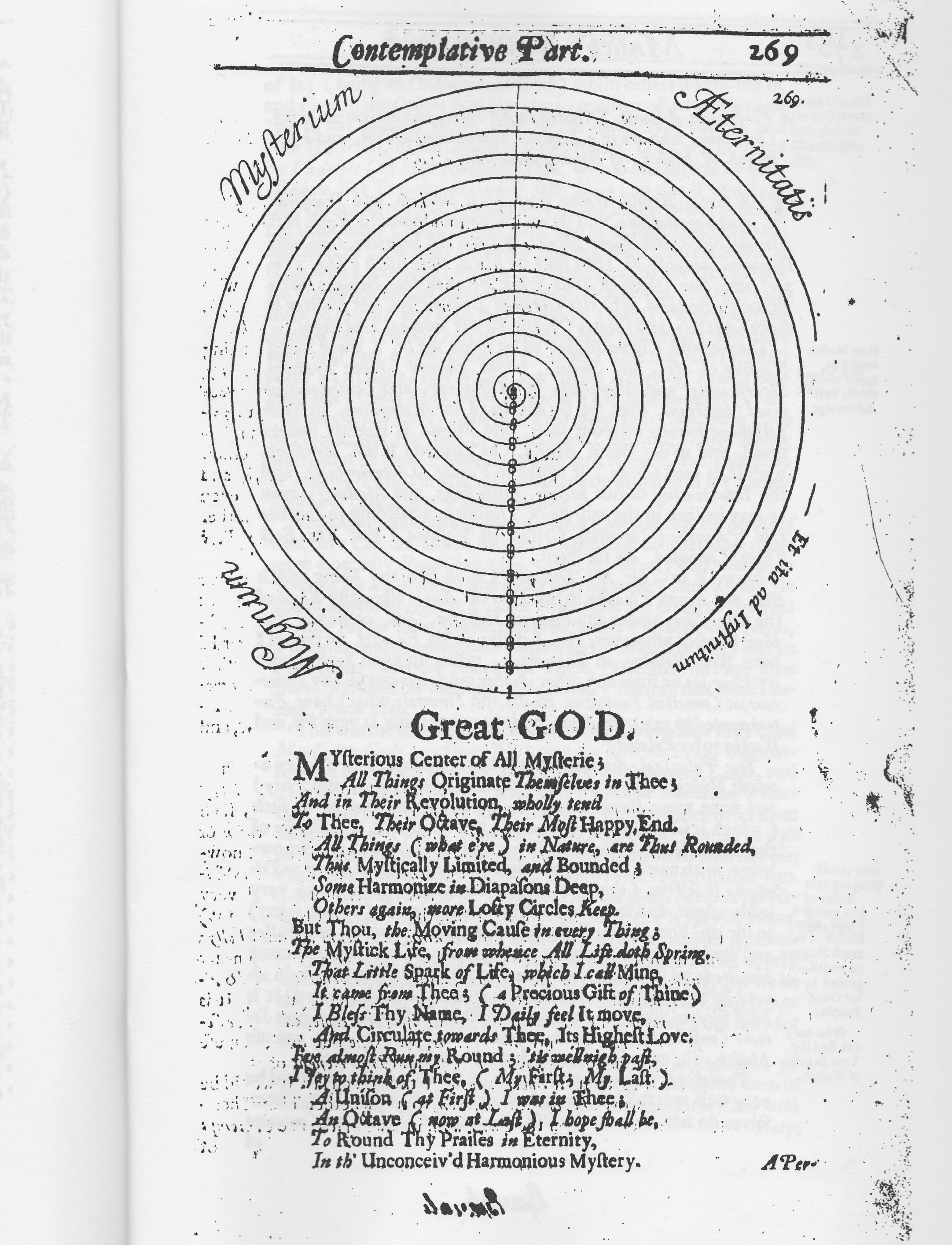
Now, to go off at a tangent, I am interested in other artists in the family who keep coming to light.  As part of my research into my mother’s family, the Mace’s from Bedale (from 1825) and much earlier from Cambridge, I have come across a book by Thomas Mace called “Musick’s Monument” published originally in 1676.  It was published again about six years ago.  Amongst his own illustrations within the book is this one of a spiral depicting his idea of God’s world.


“Mysterious Centre of All Mysterie…” in Musick’s Monument, by Thomas Mace, 1676. Continuous Line, Mick Burton.


Thomas was a famous composer of the 17th century, and craftsman who made lutes and viols, whose main job was a chorister at Trinity College, Cambridge.

To add to this “sort of” co-incidence, my Uncle Harry Mace from Bedale, North Yorkshire, was a joiner and builder.  When he retired he started to make old style instruments, such as viols, and sold them to a music shop in Leeds.  I am sure he did not know about Thomas of Cambridge.

Thomas was not too impressed with a relatively new instrument in his time, the violin.