Tag Archives: Mick Burton continuous line

Four Colour Theorem continuous line overdraw.

Continuous lines overdrawn on Skydiver formation design, using Four Colour Theory method. Mick Burton

Continuous lines overdrawn on Skydiver formation design, using Four Colour Theory method. Mick Burton

My recent post about the formation design used by the record breaking skydivers included a continuous line overdraw of their design (modified slightly be me to complete links which would have been present with more skydivers).  I said that I would explain how the overdraw (above) was completed.

The structure is made up of circles which have 3 way junctions throughout (3 handed in the case of skydivers ! ).  This can be regarded a map and so I will apply my Four Colour Theorem continuous line overdraw which I devised in the early 1970’s.

I was trying to prove the Four Colour Theorem, which states that no more than four colours are required to colour all the regions of a map.  My basic idea was that drawing a single continuous overdraw throughout a map would split it into two chains of alternate regions, which would demonstrate that only 4 colours were required.  If more than one continuous overdraw resulted then there were still only two types of chains of alternate regions.

As you will probably know, this theorem has many complexities which I will not attempt to cover here.  In the mid 1970’s I corresponded with two mathematicians at the Open University about my approach, Robin Wilson and Fred Holroyd, who were both very helpful and encouraging.  The theorem was proven in 1976 by Kenneth Appel and Wolfgang Haken, running one of the biggest computers for over 1000 hours.  I soon decided that it was time to go onto other things!  However, my journey had been fascinating with numerous amazing findings which have been so useful in my art.

I can keep to relatively simple methods for my pictures.

 Here is the design, used above, with my initial overdraws shown in red.
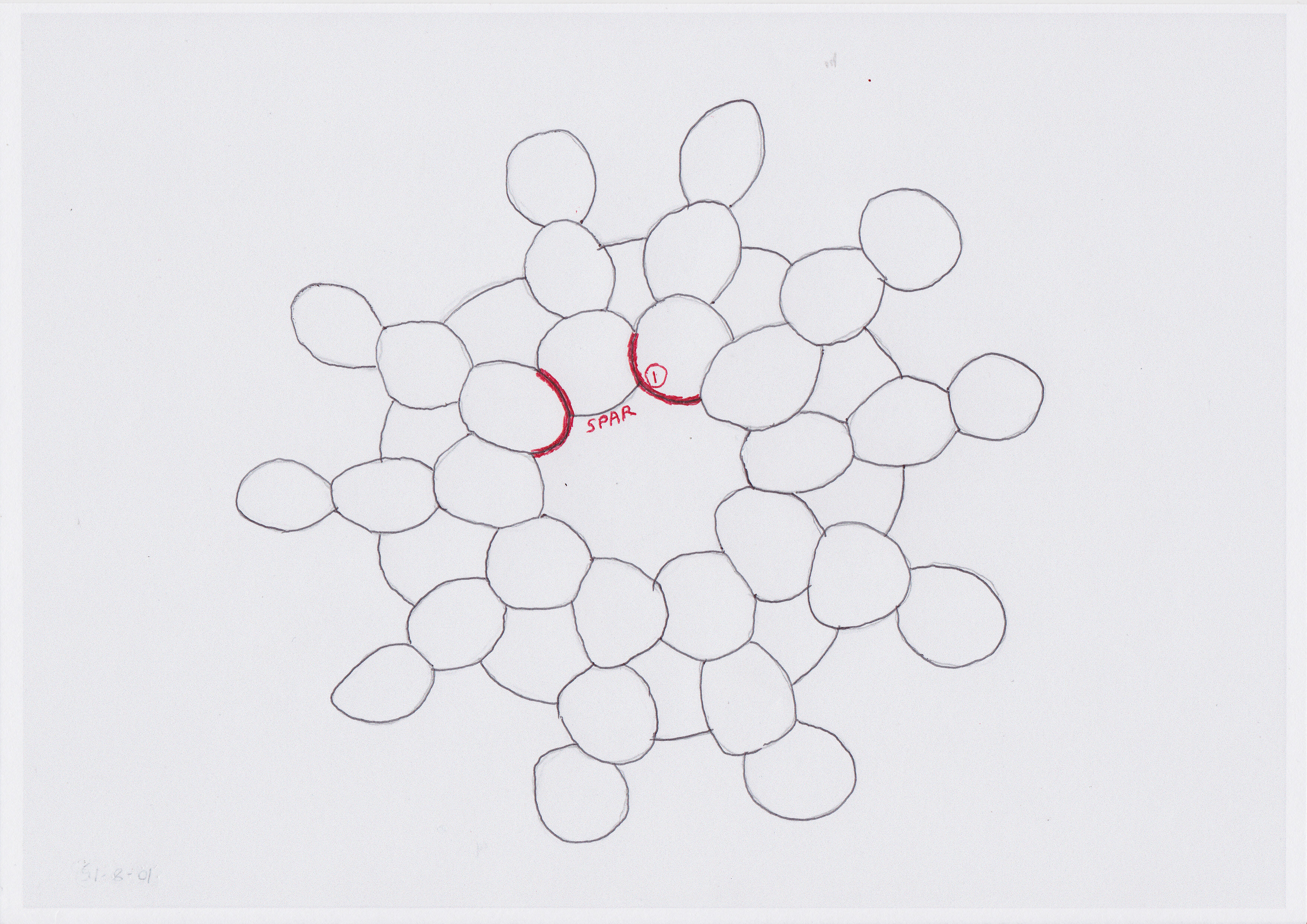
Assumed formation design used by Skydivers, with initial overdraws. Mick Burton four colour overdraw.

Assumed formation design used by Skydivers, with initial overdraws. Mick Burton four colour overdraw.

On final completion of the overdraws, every junction should have two of its three legs overdrawn and so the start decision (1) above overdraws two legs and this means that the third leg, which I call a “spar”, links to another junction where the other two legs must be overdrawn.

We then carry on making decisions which trigger other overdrawn lines across spars.  Usually there is a “knock on” effect where new overdraws connect with already overdrawn lines which then trigger more overdraws.

If we go wrong and a junction is triggered which has all three legs overdrawn, or none, we have to go back and change earlier decisions in a controlled process.  I usually photocopy the overdraws completed, every two or three stages, so that going back is not too time consuming.

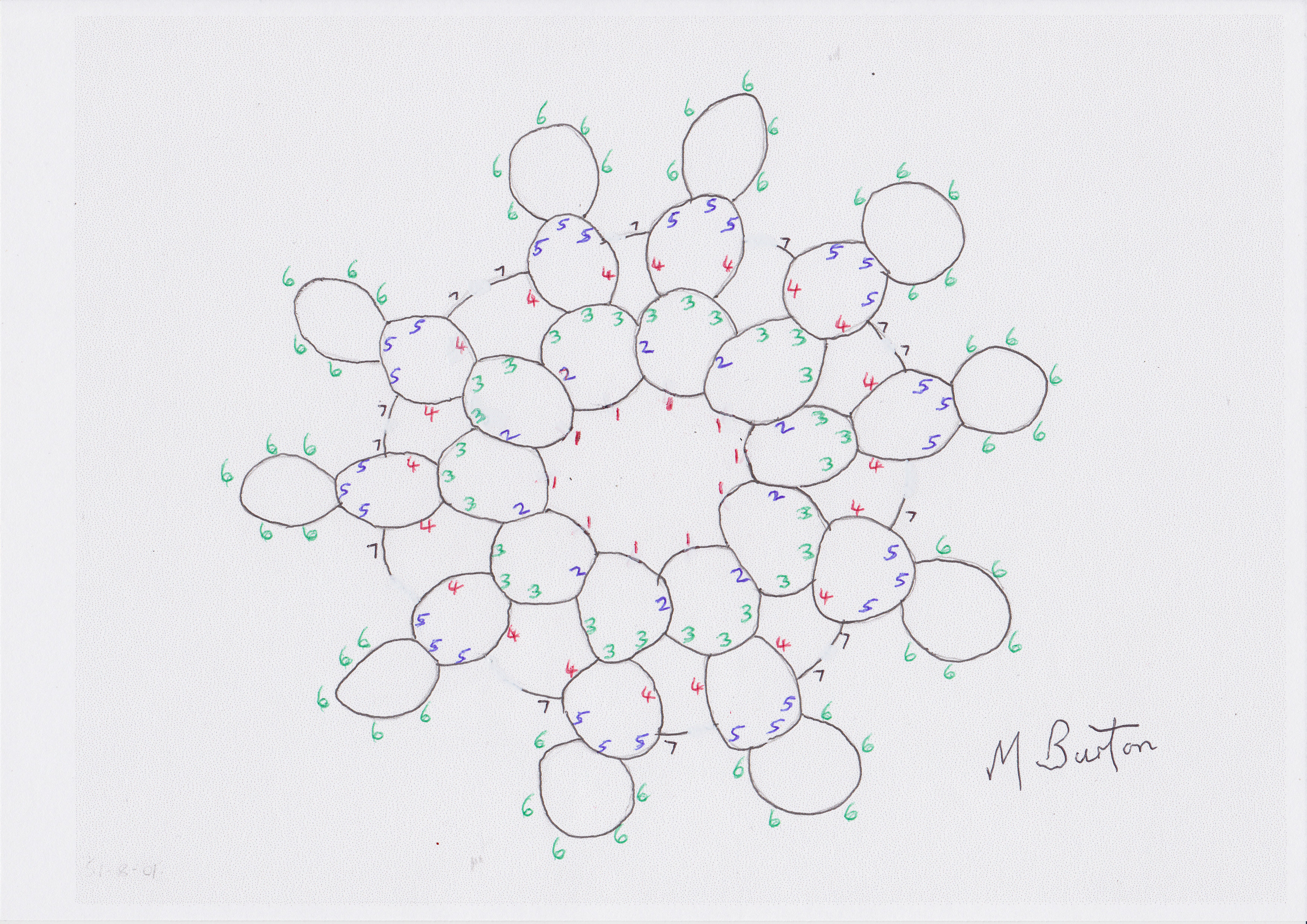
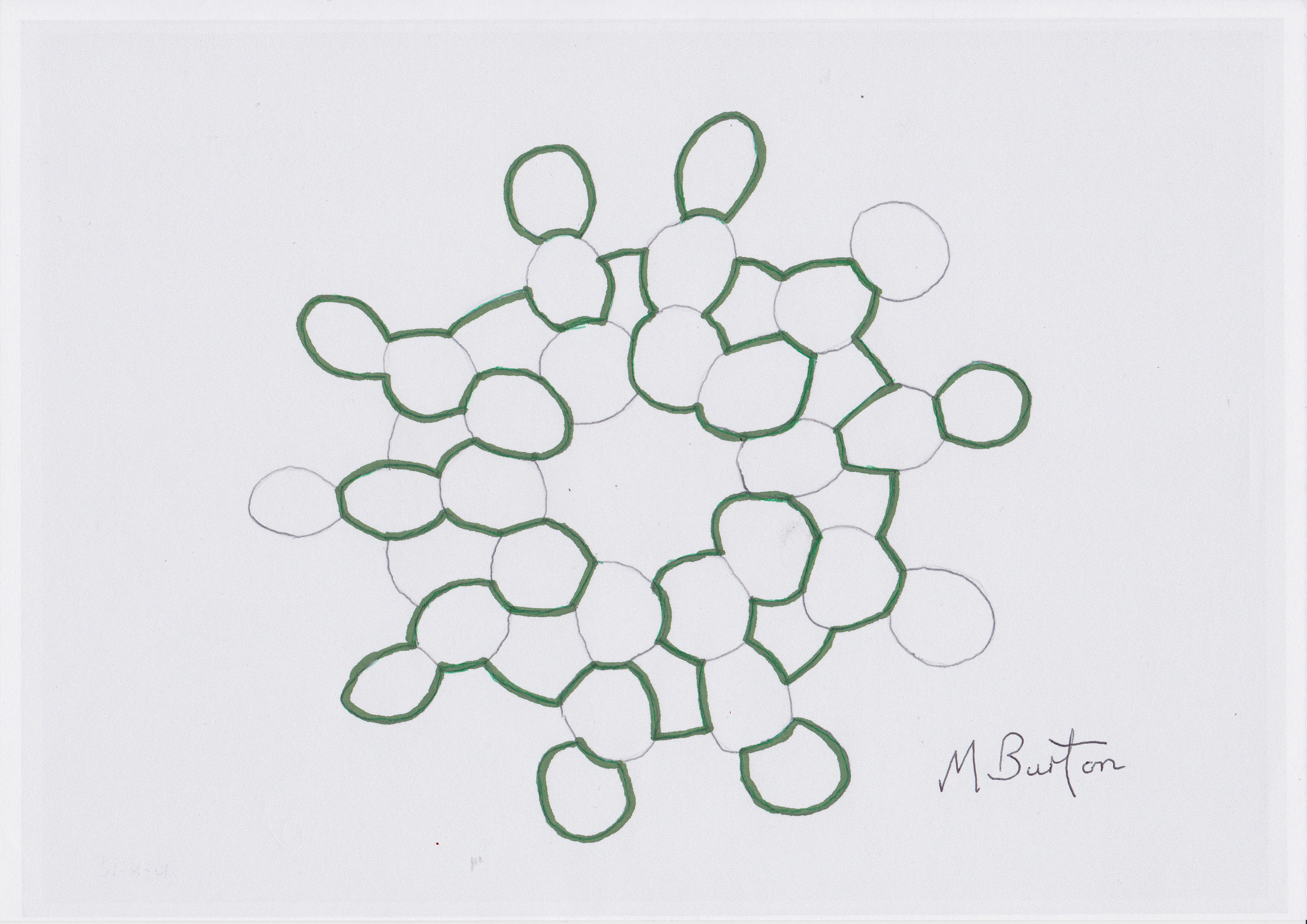
Here is the situation after decision (3).  Decision (2) in blue had only triggered two overdraw sections but decision (3), in green, has triggered ten sections to be overdrawn in green.

Four Colour Overdraw decision 3 triggers 10 further overdraws, in green. Mick Burton, continuous line artist.

Four Colour Overdraw decision 3 triggers 10 further overdraws, in green. Mick Burton, continuous line artist.

Here is the completed overdraw.  It can be seen that some decisions still only trigger one or two overdraws, but decisions 5 and 7 triggered 13 and 12 overdraws respectively.  There are 80 junctions in the design and it took 11 decisions to complete the overdraws.
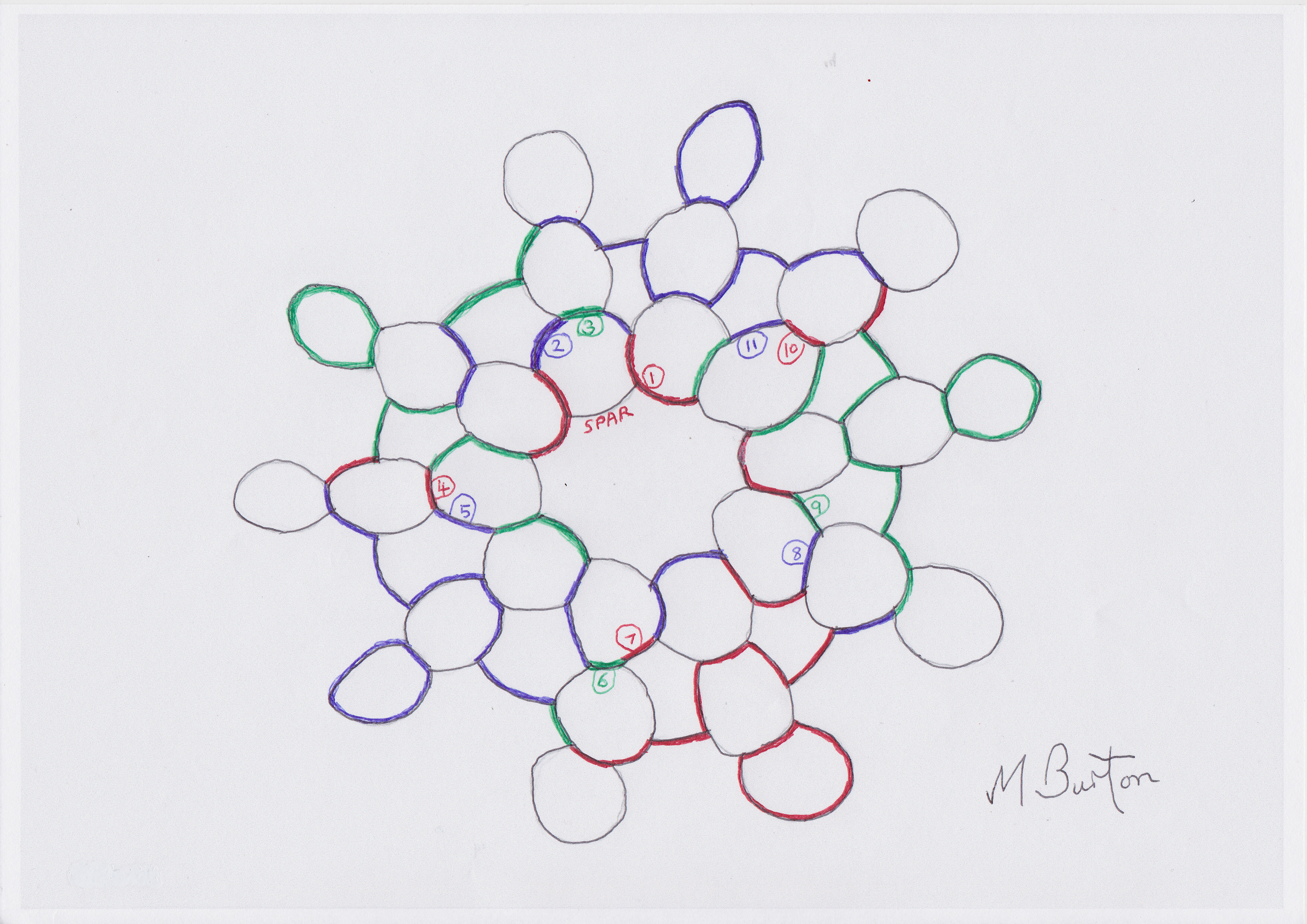
completed Four Colour Theorem overdraw, on design based upon Skydivers formation design. Mick Burton, continuous line artist.

completed Four Colour Theorem overdraw, on design based upon Skydivers formation design. Mick Burton, continuous line artist.

The completed overdraw has several continuous overdraws.  I tried other variations but had to accept that this design cannot be overdrawn with a Single Continuous overdraw.  This is due to the design having basically only two full rings of circles, which means that some tips of petals cannot be included in a continuous overdraw.

Continuous lines overdrawn on Skydiver formation design, using Four Colour Theory method. Mick Burton

Continuous lines overdrawn on Skydiver formation design, using Four Colour Theory method. Mick Burton

This situation can be overcome by adding links between the tips of the petals to produce that extra ring of areas.  Here is the expanded design and the stages of overdraw.  I managed to complete the Single Continuous overdraw in one sequence without having to go back to change any decisions.

Increased size design with successful Single Line Overdraw using Four Colour Theorem method. Overdraw decisions shown. Mick Burton.

Increased size design with successful Single Line Overdraw using Four Colour Theorem method. Overdraw decisions shown. Mick Burton.

Of course it looks better with one solid colour overdraw and no decision numbers.

Skydiver formation design with links between out petals completed, overdrawn with a Single Continuous Line using Four Colour Theorem method. Mick Burton.

Skydiver formation design with links between out petals completed, overdrawn with a Single Continuous Line using Four Colour Theorem method. Mick Burton.

I have said that the method of overdraw was developed with Four Colours in mind, and so you could use one pair of colours alternately within the above overdraw and another pair of colours on the outside of the overdraw (which can include the background).

I have found another interesting result in that if you use strong colours inside the overdraw, as it is the main image, and neutral colours outside (or even leave the outside blank) then the gaps between the “petals” show good use of space.  Here is the design simply coloured in strong red inside the overdraw, which creates a good contrast as the background seeps in. 
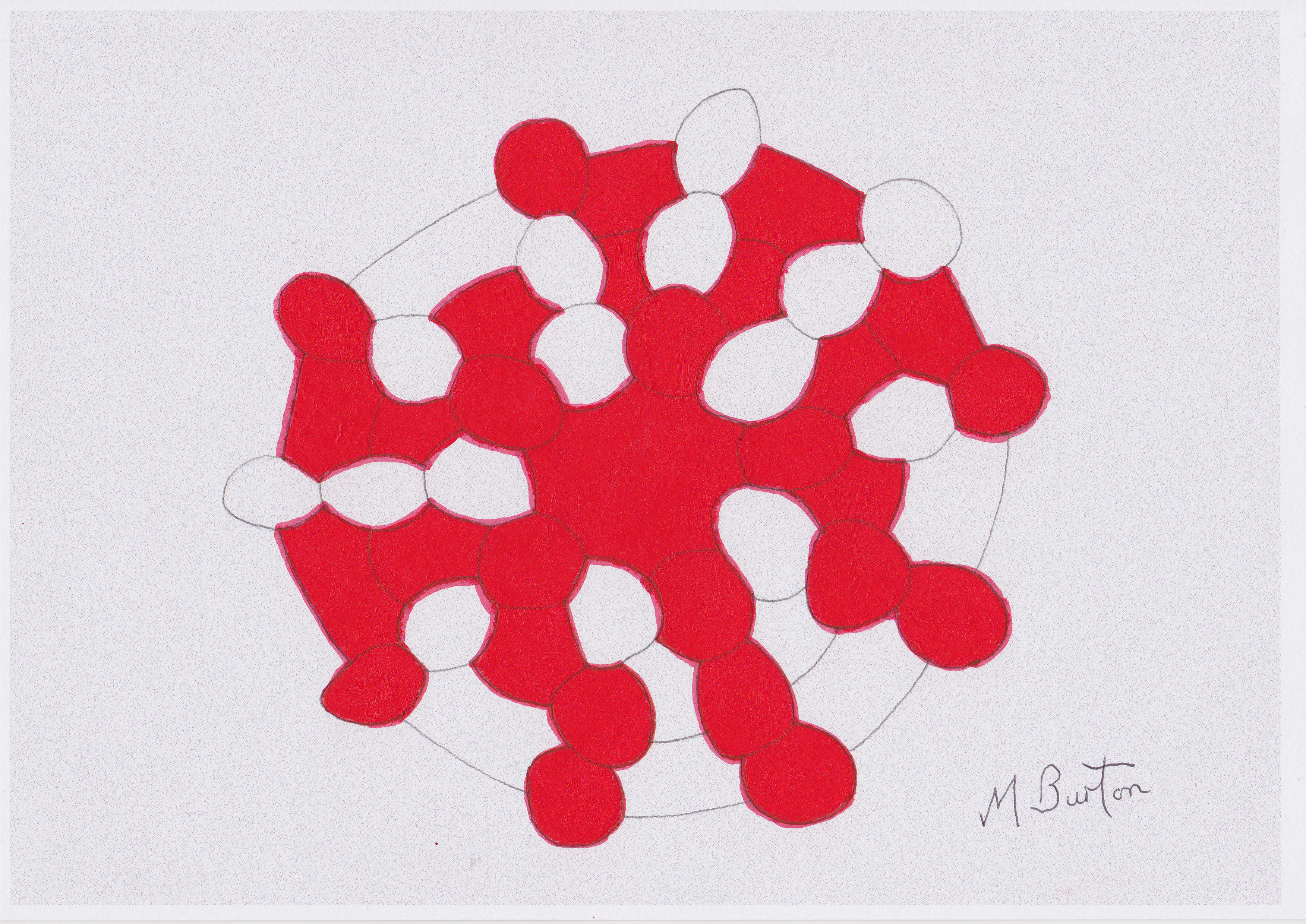
Solid colour within single continuous overdraw, with Four Colour method, showing good use of space. Mick Burton.

Solid colour within single continuous overdraw, with Four Colour method, showing good use of space. Mick Burton.

The chains of areas produced by the continuous overdraws can be coloured, not just in two pairs of colours to demonstrate Four Colours, but with a colour sequence or a mixture of sequence, alternate colours or even one colour.  In the last picture I have used colour sequence on main chains of areas related to the central space and, as a contrast,  light grey on the chains connected to the outside of the design.
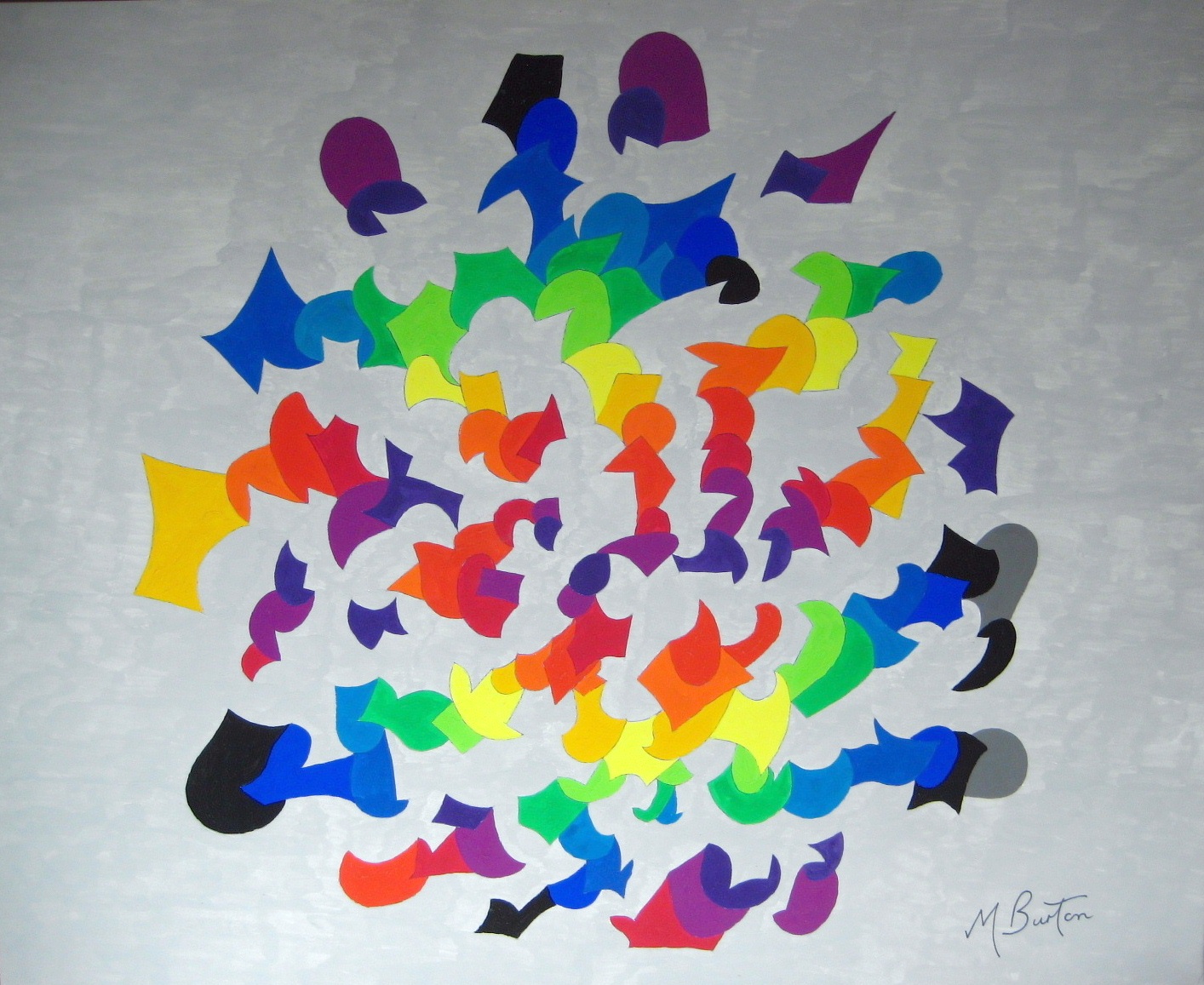
Star Burst. Four Colour Theorem applied to a map of shell shapes wound round from the centre. Rainbow sequence of colours. Mick Burton, 1971

Star Burst. Four Colour Theorem applied to a map of shell shapes wound round from the centre. Rainbow sequence of colours. Mick Burton, 1971

This is one of the first paintings that I produced after discovering my Four Colour Theorem overdraw in 1971. I called the picture “Star Burst”, one of my first planetary pictures.
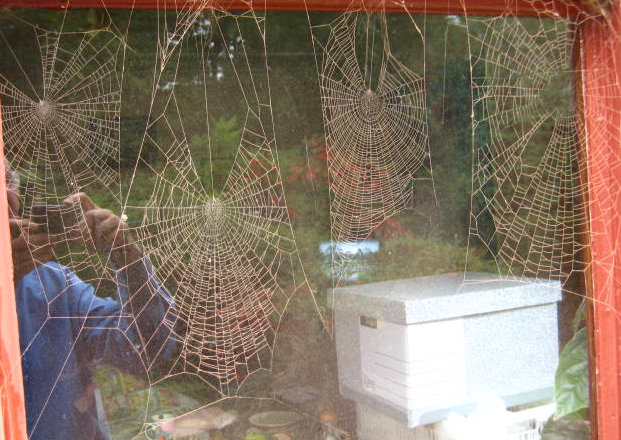
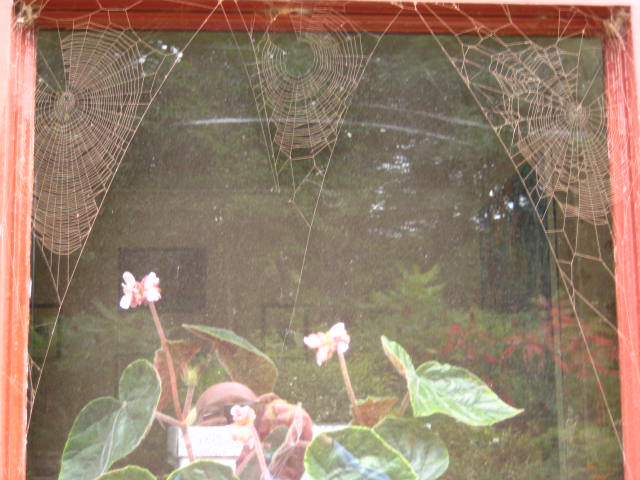


Gledhow Valley amazing cobwebs.

I must apologise for a silly thing that I did yesterday.  I photographed a spider using the sun to obtain glistening images of the spiders web.  Only when I had set it all up and published it did I remember that one of my main supporters does not like looking at spiders and may never, ever, look at my web site again if I left them up.

So I have removed them all and I hope that I have not upset search engines too much.  It should be alright to leave images of cobwebs only so here are some images from 2009.

Previously I have had the assistance of red brick dust when our kitchen was extended in 2009.  A total of eight cobwebs on three separate dining room window panes. 

Four cobwebs on dining room windows covered in red brick during work on kitchen extension in 2009. Mick Burton, continuous line artist.

Four cobwebs on dining room windows covered in red brick during work on kitchen extension in 2009. Mick Burton, continuous line artist.

Three cobwebs, on another dining room window, covered in red brick dust in 2009. Mick Burton, continuous line artist.

Three cobwebs, on another dining room window, covered in red brick dust in 2009. Mick Burton, continuous line artist.

Large cobweb, on third dining room window, covered in red brick dust after work on kitchen extension in 2009. Mick Burton, continuous line artist.

Large cobweb, on third dining room window, covered in red brick dust after work on kitchen extension in 2009. Mick Burton, continuous line artist.

Eventually the window cleaner came and sorted all the cobwebs out.

Skydivers in Ten Petal Flower Formation, link to Four Colour Theory continuous line.

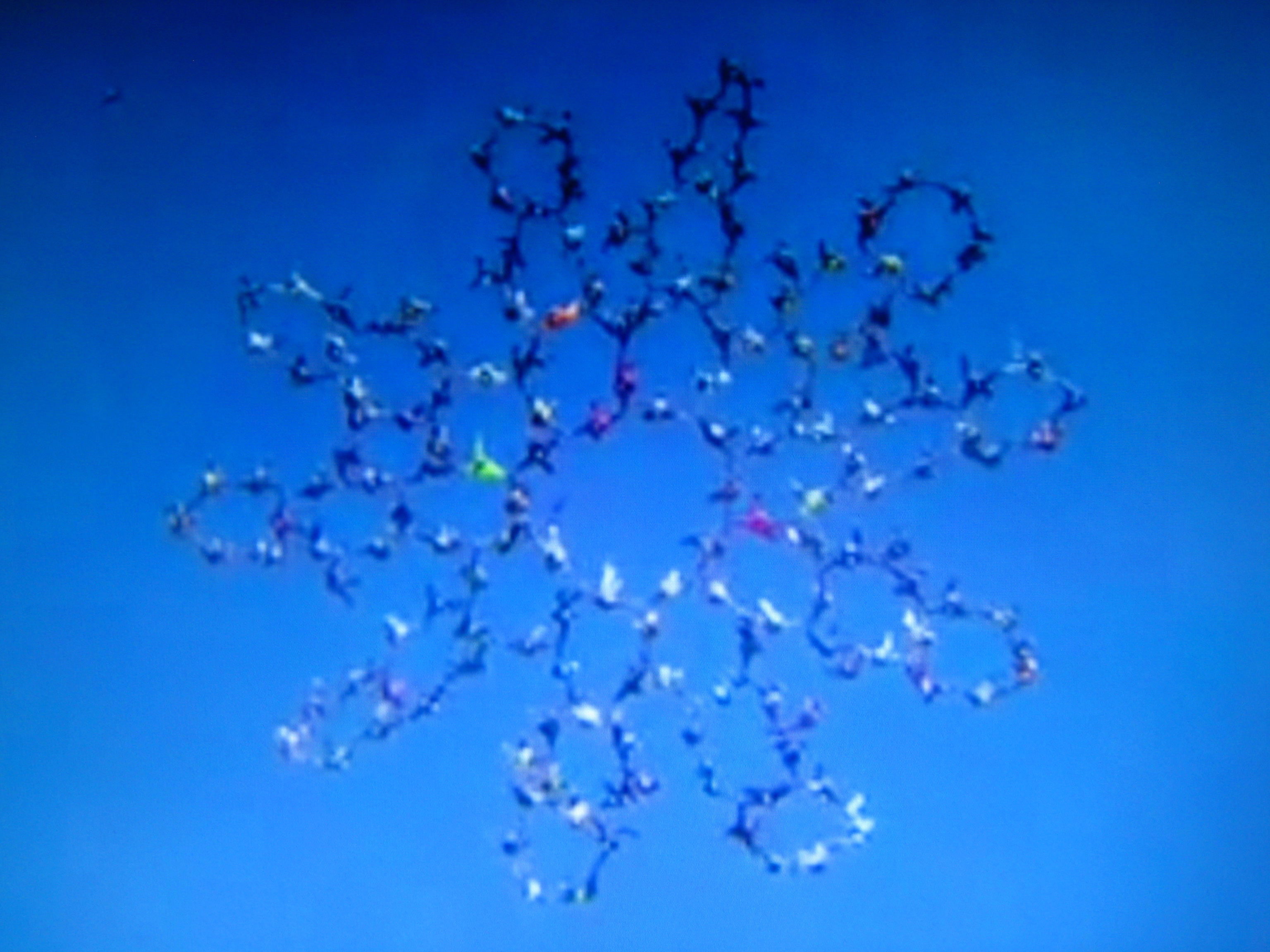
164 Skydivers head down record in Illinois, 31 July 2015.

164 Skydivers head down record in Illinois, 31 July 2015.

Two weeks ago 164 skydivers, flying at 20,000 feet and falling at 240 miles an hour, set the “head-down” world record in Illinois. The international jump team joined hands for a few seconds, in a pre-designed formation resembling a giant flower, before they broke away and deployed their parachutes.

I was intrigued by the design of the formation. I have found many qualities in ten petal (or star) designs and, of course, I look for continuous lines in all sorts of designs that I find and in particular the possibility of a Single Continuous Line.

Here is my sketch of the skydivers formation.  It is made up of many linked circles, starting with a central ring of ten circles which radiate out to ten “petals”.  The plan seemed to involve six skydivers forming each circle by holding hands.  Some extra skydivers started links between petals.  I checked to see if I had included all the skydivers, which made my sketch look like a prickly cactus.

Cactus Count, 164 Skydivers all Present and Correct. Mick Burton, continuous line artist, August 2015

Cactus Count, 164 Skydivers all Present and Correct. Mick Burton, continuous line artist, August 2015

This was such a tremendous achievement by very brave men and women.  My only experience of heights is abseiling 150 feet down a cliff in the Lake District.  I realise that the jump would have been very carefully planned using the latest science and involved a lot of training, etc. but I am particularly interested in the part that the formation design played.

The hexagon appears to be an essential element so that hands can be joined at 3 way junctions.  A core circle of hexagons would naturally be 6, but more would be required for this jump.  The next highest near fit would be 10, which is fine given the variations in human proportions.  This also naturally allows linking between middle circles in the petals to complete a second ring of circles, which was partly done in this jump.

Every participant would need to know exactly where their place would be in the design and yet it is so symmetrical that I struggle to get my sketch the right way up.  Also with the short time involved co-ordination of planned stages would be difficult.  This made me think of a flock (or murmuration) of starlings performing their remarkable patterns in the sky and how they manage to co-ordinate. Apparently each bird relates and reacts to the nearest birds around it.  Absolute simplicity and ruthless efficiency with no critical path.

If the skydivers have adopted a similar approach then the design is ideal. The design is basically 30 circles in sets of 3 in a row making up 10 petals. The process is fluid and adaptable, building outwards from the centre. Think 10 individuals linking hands to start off with, which then recognisably evolves into 10 petals, and think 6 individuals in each of the 30 circles.  Everyone is dropped (there were 7 aircraft I think) in an order which anticipates being able to take up a place a certain distance from the centre of the structure and within a specific circle. As they approach they can recognise the progress and assess whether they can link in as expected or whether a modified position may need to be taken up (and being guided by the people already in place). The last individuals to be dropped will not have  a planned position in any circle but will form the start of the links between the central of the 3 circles in the petals. They need to be prepared to become part of an outer circle which has not been completed.

I have done a sketch of how this may work, with the numbers indicating my thoughts on the expected order of arrival in the building of the formation.

Skydiver formation with possible roles and order of arrival of individuals. Mick Burton, continuous line artist.

Skydiver formation with possible roles and order of arrival of individuals. Mick Burton, continuous line artist.

I hope this was a useful exercise, in trying to work out how the formation worked, and not total tosh (if so my apologies to all concerned).

To help my attempt to apply my continuous lines to the design I have completed the links between middle circles, which was partially done this time and I suppose will be considered for the next larger attempt at the record (say 180 skydivers).  The Continuous Lines are intended to pass through every three handed junction once only (I normally would say three legged ! ).

The method I use to complete the overdraw was developed in the early 1970’s when I was working on trying to prove the Four Colour Theorem.   A single continuous overdraw throughout a map would split it into two chains of alternate colours which would demonstrate that only four colours were needed.  I will explain how this is done in a future post.

Continuous lines overdrawn on Skydiver formation design, using Four Colour Theory method. Mick Burton

Continuous lines overdrawn on Skydiver formation design, using Four Colour Theory method. Mick Burton

This overdraw has resulted in several continuous lines and no alternative would produce a Single Continuous Line. This is due to the lack of width going around the structure.

Consequently, I have extended the design further by adding linking lines between all outer petals and succeeded in drawing a Single Continuous Line on that. A future Skydiver jump completely assembling this design would require about 220 participants (I am not suggesting that this be attempted) !

Skydiver formation design with links between out petals completed, overdrawn with a Single Continuous Line using Four Colour Theorem method. Mick Burton.

Skydiver formation design with links between out petals completed, overdrawn with a Single Continuous Line using Four Colour Theorem method. Mick Burton.

Spherical Continuous Line Abstract with Colour Sequence.

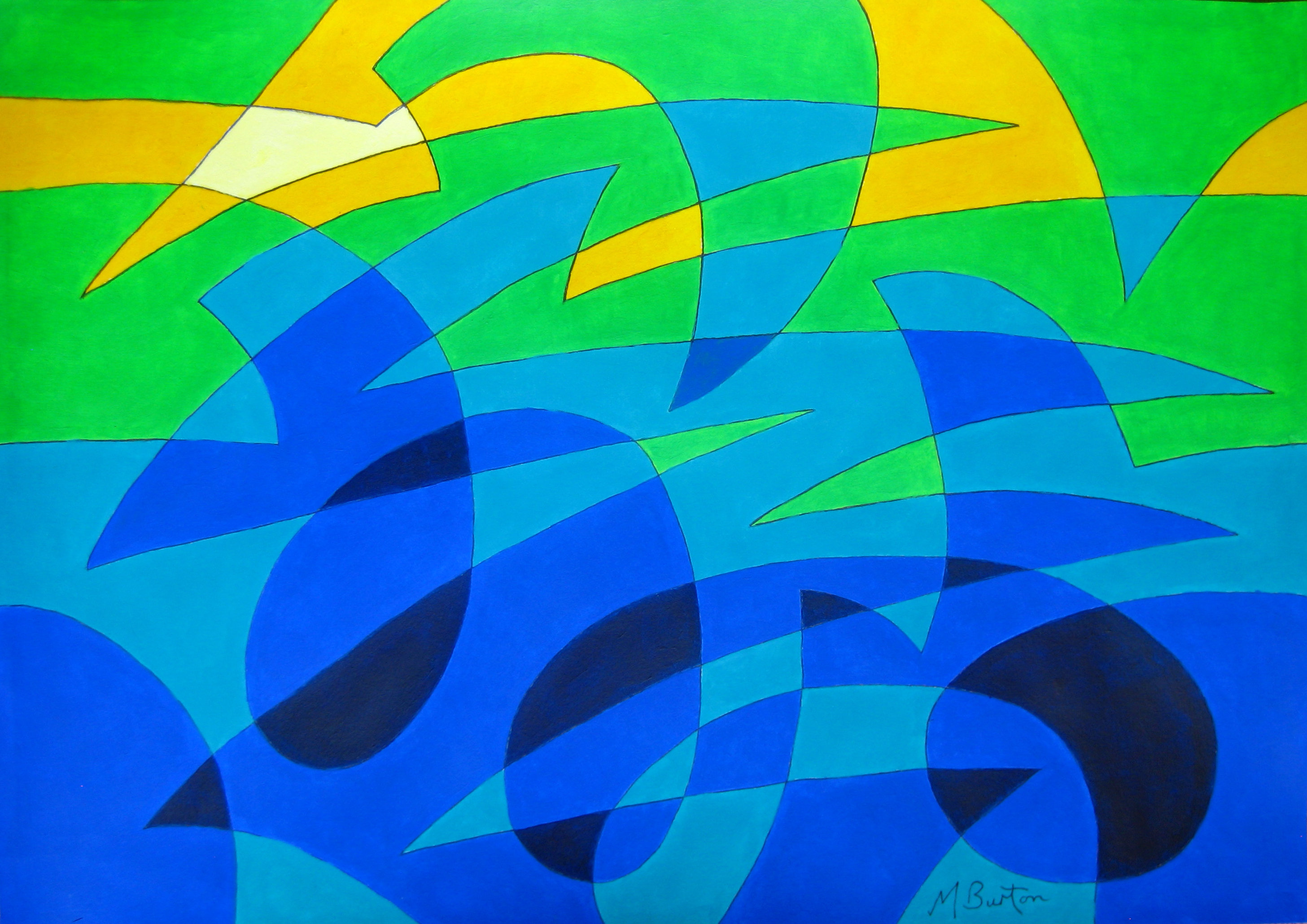
Spherical continuous line with colour sequence. Flypast Over Rolling Hills. Mick Burton 2015.

Spherical single continuous line drawing with colour sequence. Flypast Over Rolling Hills. Mick Burton, continuous line artist 2015.

I have modified my Spherical approach to continuous line from the method I described in my Continuous Line Blog post of 9 July 2014, which did not quite reflect the reality I was seeking.

I have kept the idea that when you draw out of one SIDE of the paper you need to return at the opposite SIDE at the corresponding point, so that the pattern matches vertically and after colour sequence the colours also match if you pull the paper round into a tube shape.  This is similar to the equator on a globe of the world matching.

Previously I had said that when going out of the top of the drawing you also need to return at the corresponding place at the bottom.  I was correct to say that the colours would not match, which would be equivalent to the poles on the globe of the world not meeting, but the treatment of the lines needed to be modified.

I realised that the bunching effect of the top being pulled together totally separately to the bottom being pulled together was fine regarding separate sets of colours but matching the line patterns from top to bottom was the wrong approach.

So, when I go out at the TOP now I need to come BACK IN AT THE TOP at the corresponding distance from the other end of the top.   Similarly if I go out at the bottom I come back in at the bottom.  You could then imagine that folding the picture vertically down the middle would mean that both pattern and colour sequence would now match at the top and bottom respectively (don’t actual fold it and spoil the picture ! ).

I recently drew the following for a demonstration/workshop at Stainbeck Arts Club in Leeds.  I started drawing the line a couple of inches in from the top left side and did a few rolling curves diagonally down from left to right, followed by several exits and returns to the picture – initially out at the lower right side and back in at the lower left side, then down and out at the bottom left and back in at the bottom right.

Spherical continuous line drawing with rolling and jagged lines. Mick Burton 2015.

Spherical single continuous line drawing with rolling and jagged lines. Mick Burton, continuous line artist 2015.

I later tried some “shark fin” curves and a couple of large jagged sequences.

All the time I tried to draw the line cleanly through existing shapes (avoiding going near previous junctions) and being aware of areas I had not visited much.  Finally I needed to work out how to get back to my start point without spoiling the composition too much (here going out and back in can be handy).

I hope you can check the route of the line through the whole picture fairly easily.  I then applied my Colour Sequence to produce the picture at the top of this post.

The first stage is my usual alternate overdraw of the line (if you are overdrawing a section as you go out of the picture you need to continue to overdraw as you re-enter, or if not overdrawing going out it’s not overdrawing when you re-enter).  See my post of 10 September 2014 for the full ALTERNATE OVERDRAW process and my post of 27 September 2014 for the COLOUR SEQUENCE process.

I have used a series of 6 colours from Pale Yellow through greens to Prussian Blue which I have tried to work out in steps of tone.  This is partly to highlight the overlap effect of continuous lines and the natural depth of the abstract.  As always, there is choice of direction of colours – light to dark or dark to light.  Here it seemed best to have the single lightest area at the top and several darker areas across the lower part of the picture.  The picture also has an Optical Art look about it.

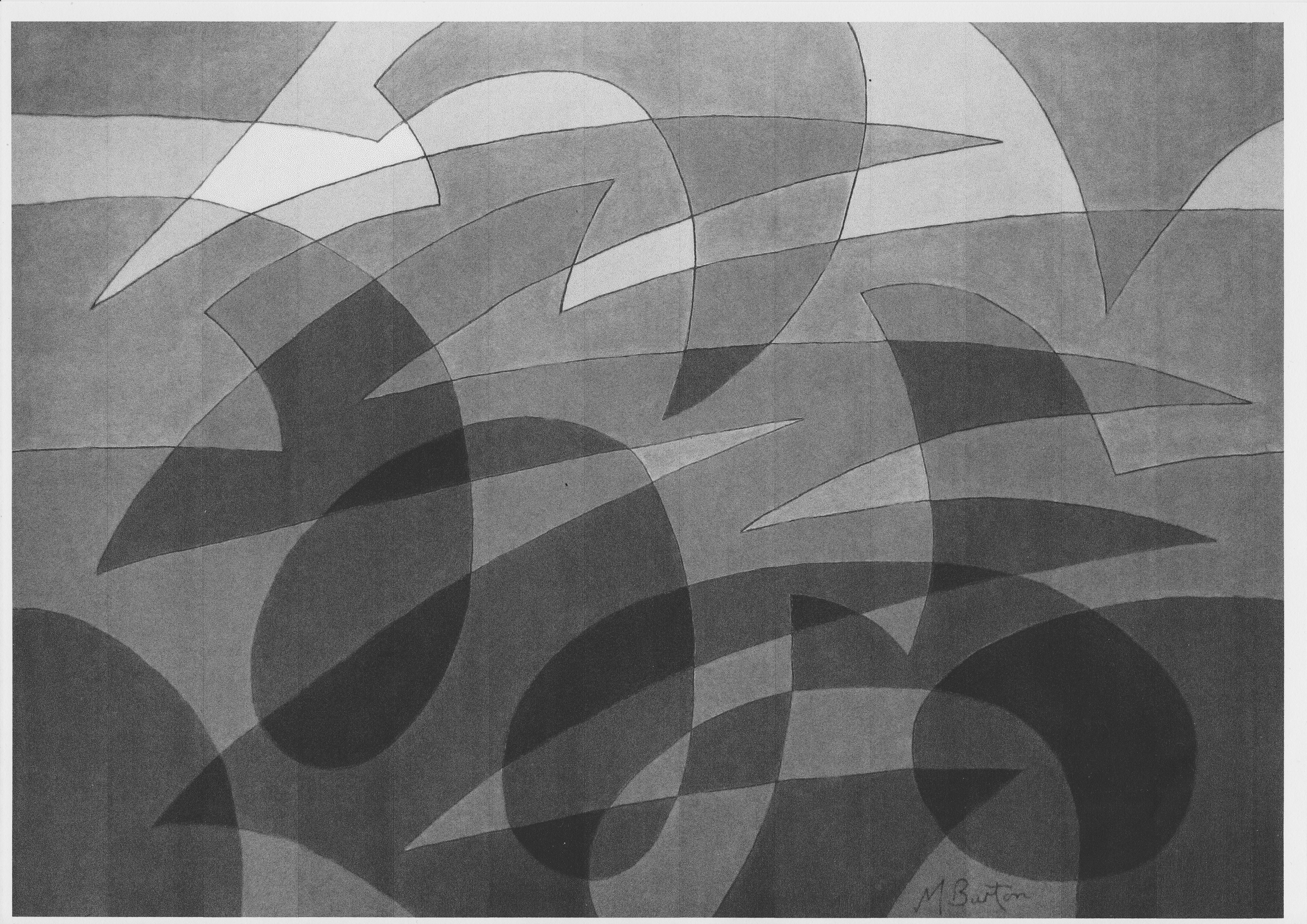
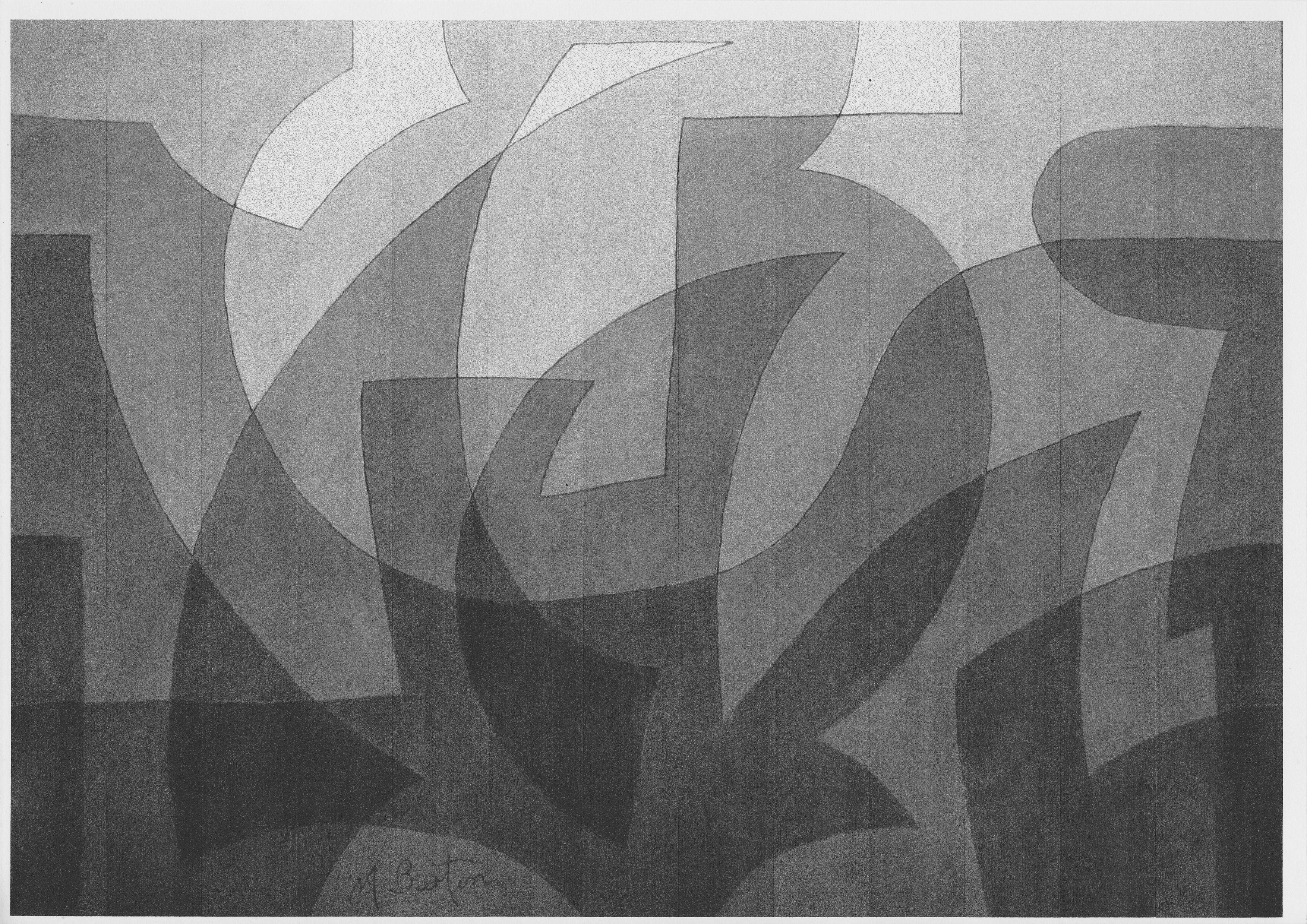
Printing the picture in Monotone is usually a good way of checking the steps of colour and light to dark.  So here it is.

Monotone of Spherical Continuous Line

Monotone of Spherical Single Continuous Line Drawing “Flypast Over Rolling Hills”. Mick Burton 2015.

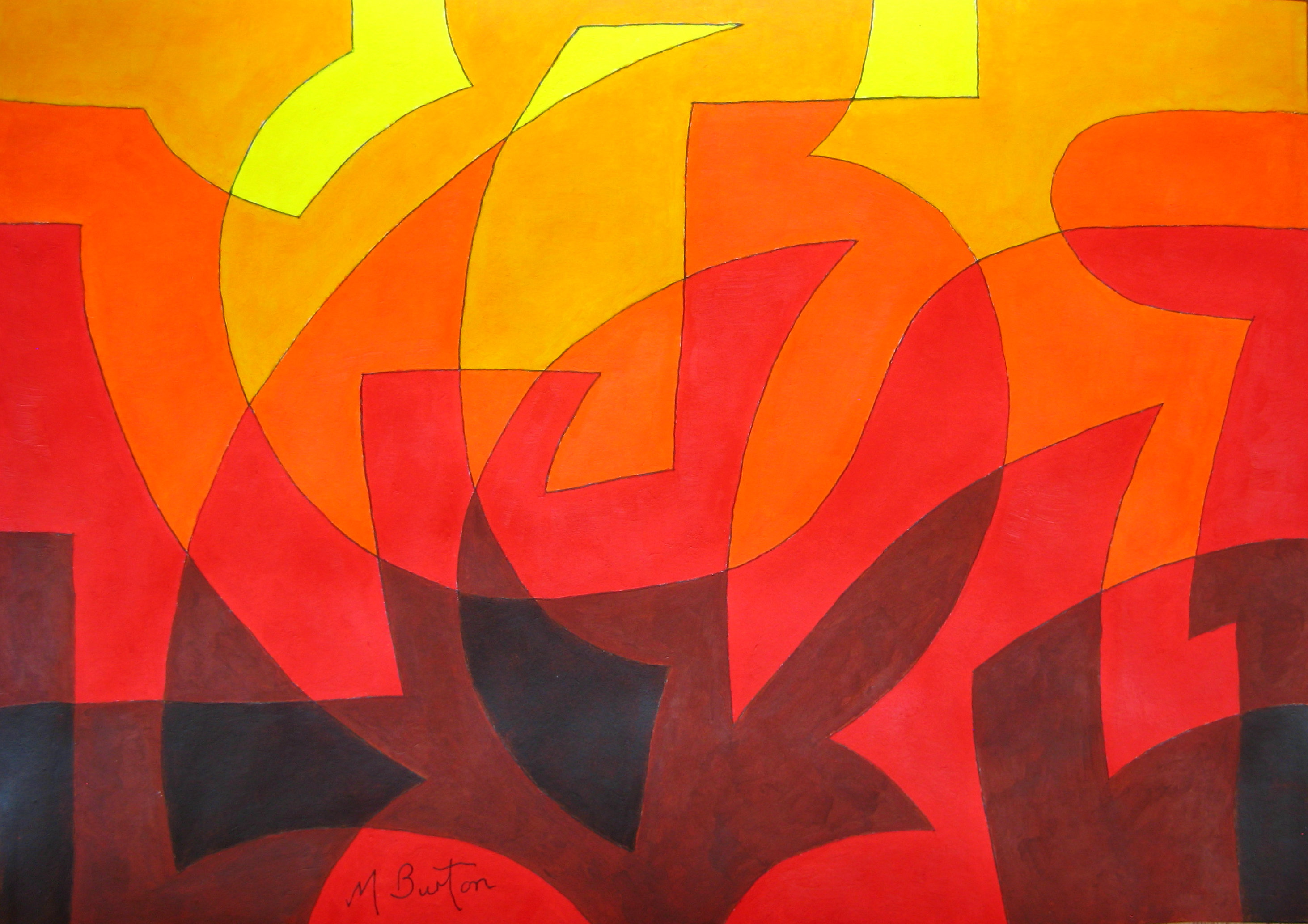
I also produced another similar abstract for the Demonstration at Stainbeck Arts Club to show the Spherical approach with a different flow of lines and colours.  I had coloured the drawing with a sequence from Yellow through Reds to dark Brown.

Spherical Continuous Line with Colour Sequence. Forest Fire. Mick Burton 2015.

Spherical Single Continuous Line Drawing with Colour Sequence. Forest Fire. Mick Burton 2015.

Here is the Monotone of this picture.

Monotone of Spherical Continuous Line

Monotone of Spherical single continuous line drawing “Forest Fire”. Mick Burton 2015.

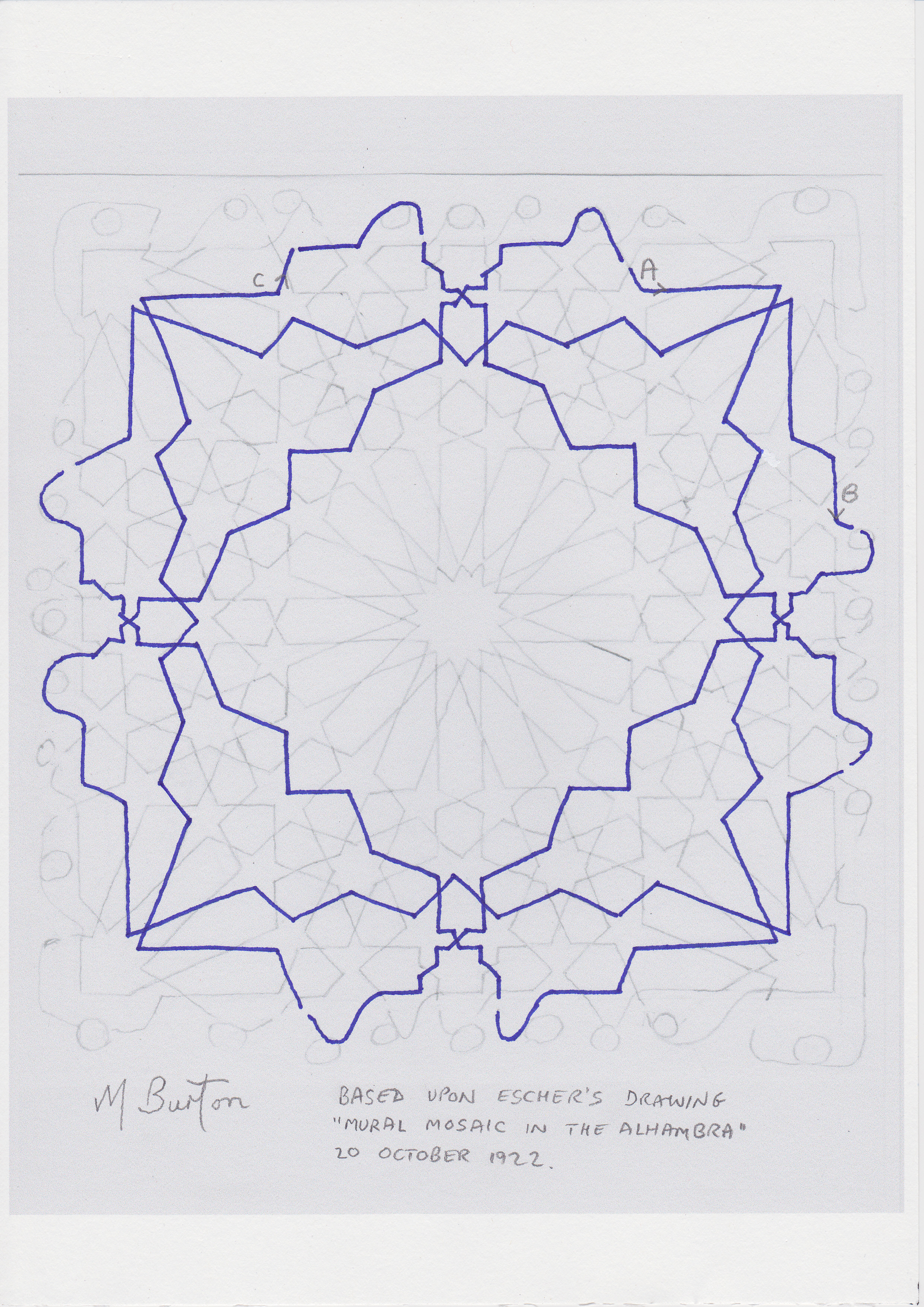
Escher Islamic Mosaic Continuous Lines, Create and Change Border. STAGE 4.

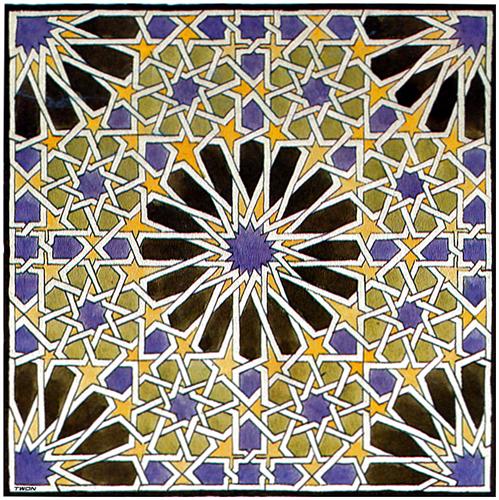
A key part of the Mural Mosaic tile painting by Escher in 1922, is that he has included the Border in detail. The Border gives an indication of what happens to the lines when they hit the sides and where they feed back into the design. In the quarter section detail of the mural below you can see marks on the Border.

A line leaving the design either joins the border (so that you can follow where it goes) or goes under the border (and you can deduce where it re-emerges).  It is not easy to work all these paths out at first, but there is a logic to it.  If in doubt between two choices, one of them usually has a clear answer leaving only one option for the other.  Another aid to us is that each side of the Border is identical in the same direction around the design, so if the marks are not clear on one side you can check at a corresponding point on another side.

Detail to show Border. Escher mural mosaic in the Alhambra. WikiArt. Mick Burton study.

Detail to show Border. Escher mural mosaic in the Alhambra. WikiArt. Mick Burton study.

.
When I first started this research I did a basic hand copy showing all the lines hitting the sides and then showed each one as a loose end outside the square.  I then studied the border on the Mosaic to work out how all the loose ends should be joined up and charted them – this initial chart was in STAGE 1, and I show it again at the end of this post.

That was relatively easy, observing the result of what artist had done.  The hard bit is working out  from scratch which loose ends to tie up to produce continuous lines in a way which would still enable the colours to be allocated by the Alternate Overdraw (or equivalent process used by the artist).

According to Eric Broug in his demonstration video’s, the tile rectangle containing the design would be selected out of a larger pattern area.  In my own art, when I have drawn a large continuous line pattern and completed the Alternate Overdraw (so that I know the colour sequence everywhere) I can pick out a small section to display which of course already has the Alternate Overdraws.  Similarly, the Islamic artist producing the Mosaic would know the full colouring etc for the tile section.

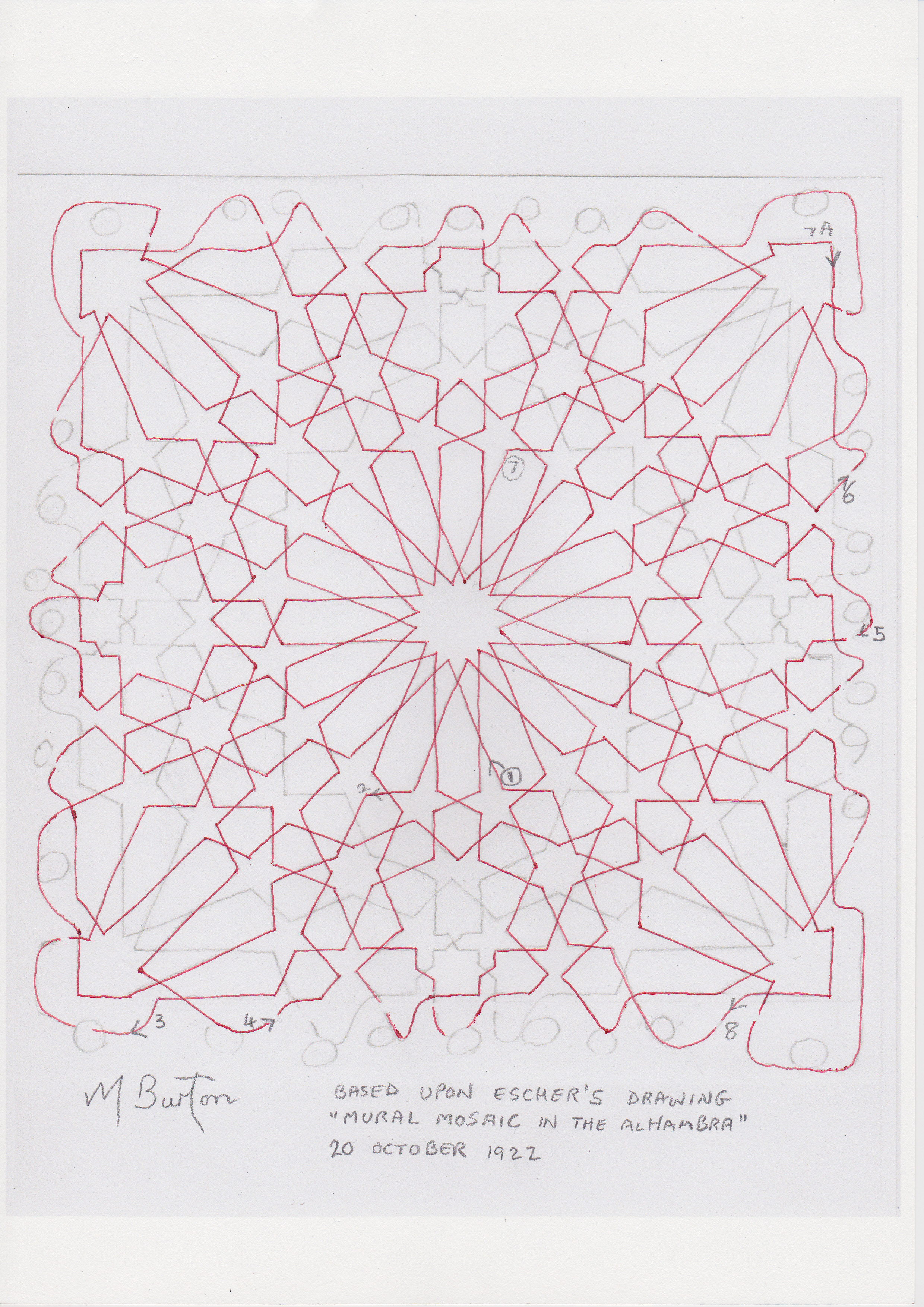
I show below the design with all the loose ends and Alternate Overdraws in Red.  At this stage the artist would not know how many continuous lines would occur in the tile section on its own.  He will have also needed to produce a straight edge on the corners and other parts of the perimeter to block unwanted lines which encroached from the outside pattern.

Section of larger pattern with Alternate Overdraws and loose ends showing whether overdrawn. Mick Burton study.

Section of larger pattern with Alternate Overdraws and loose ends showing whether overdrawn. Mick Burton study.

You will see from the loose ends that half of them are overdrawn in Red and half not. If you connect up pairs of the overdrawn, and pairs of the not overdrawn, loose ends then there will be continuous lines throughout the design and the Alternate Overdraw Template will be unaffected. If I connect up the not overdrawn pairs around each corner of the design, then working along the sides both overdrawn pairs and not overdrawn pairs work out consecutively. This matches the line direction message in the Border on the Mosaic design.  Here is a chart (previously in STAGE 1) showing all the loose end connections.  We know from STAGE 1 that there are two continuous lines, which makes the case strong regarding the artist using Alternate Overdraw, but it would not have mattered if there were more than two.

Escher Islamic Tile. Basic line structure, with border connections. Mick Burton continuous line study.

Escher Islamic Tile. Basic line structure, with border connections. Mick Burton continuous line study.

Having looked at Borders in detail, that prepares us for the final STAGE 5 where I show how we can turn this into a Single Continuous Line design.  

I will also give you my opinion on what the original Artist thought about a Single Continuous Line and why I think he is definitely an Artist and not just a craftsman.

Mick Burton Continuous Line Blog.

Continuous Lines in Escher Islamic Mosaic painting, STAGE 1.

Escher painting 1922 of Islamic Mosaic tile at the Alhambra. WikiArt. Continuous line study by Mick Burton.

Escher painting 1922 of Islamic Mosaic tile at the Alhambra. WikiArt. Continuous line study by Mick Burton.

I look for continuous lines in all forms of art.  I first saw this design in my daughter Kate’s book “Escher, The Complete Graphic Work”, by J.L. Locher.   We are both long term admirers of this artist.  Escher did this detailed painting  in 1922 when in Granada at the Alhambra, and its quality really hit me.  It was of an Islamic mural Mosaic tile,  which was made up of those geometric lines which are often seen in Islamic art, and I assessed it for continuous lines.  

I could see that the overall symmetrical  pattern and I saw that Escher had painted the design BORDER, which seemed to indicate what happened to the lines after they hit the sides of the square.  I then worked out, from the Border Pattern, that the lines were fed back in the same routes on all four sides of the square.  From the point of view of finding a single continuous line, in my experience, such overall symmetry of the structure meant that it was very unlikely that there was only one line. 

Here is the basic structure which I arrived at, which shows the “wiring” connections indicated by the border.  Let’s see how many continuous lines there are.

Escher Islamic Tile. Basic line structure, with border connections. Mick Burton continuous line study.

Escher Islamic Tile. Basic line structure, with border connections. Mick Burton continuous line study.

When I traced over the lines I found that there were in fact two continuous lines making up the whole design.  Here are the two results, a Main continuous line (in red) and a Minor one (blue).

Main continuous line, one of two. Escher Islamic tile design. Mick Burton continuous line study.

Main continuous line, one of two. Escher Islamic tile design. Mick Burton continuous line study.

Minor continuous line, 2nd of two. Escher Islamic tile design. Mick Burton continuous line study.

Minor continuous line, 2nd of two. Escher Islamic tile design. Mick Burton continuous line study.


By experimenting with border changes, a bit like swapping wiring connections, I did come up with a single continuous line, but the borders were no longer symmetrical.  It seems likely that the artist realised that two continuous lines was the best he could hope for whilst retaining overall symmetry.   In a LATER POST I will show how a border can be “tweaked” by a slight alteration to make one continuous line in the mural mosaic, and how this answer is achieved.  I will also show how the artist is likely to have worked out how to achieve two continuous lines by connecting up the correct loose ends.

I now needed to know  “How important continuous lines were, within this design, to the artist?”   It could be that Continuous Lines were incidental to other aims, or they may have been of prime importance.

In my NEXT POST I will apply my Alternate Overdraw technique to produce a Template of closed lines, which I use to decide upon the colours to allocate.   I will also suggest what the artist’s ideas were for the design and his colour selection.  In a FURTHER POST you will see how my colour allocation compares with the original colours and to what extent I feel that my ideas were the same or similar to those used by the artist.

All this has been done without any reference to the construction of the original line structure.  I have taken the completed structure as a starting point to apply my ideas.  I did not research in any detail on Islamic line construction, until after my whole study was completed.

I have recently found YouTube demonstrations by Eric Broug entitled “How to Draw a Mamluk Quran Page” and “How Grids and Patterns Work Together”, which gave me a good insight into pattern construction and include an explanation of a larger tile containing this Escher Mosaic design as a section.  This is a fascinating process used by the Islamic artists over 500 years ago.  Otherwise, I have not found any reference to borders, colouring, or specific meaning of this design.

Possibly my ideas will generate a new view on aspects of the creation of this and other Islamic designs. 

Mick Burton, Continuous Line Blog. Continue reading

Salvador Dali continuous line drawing

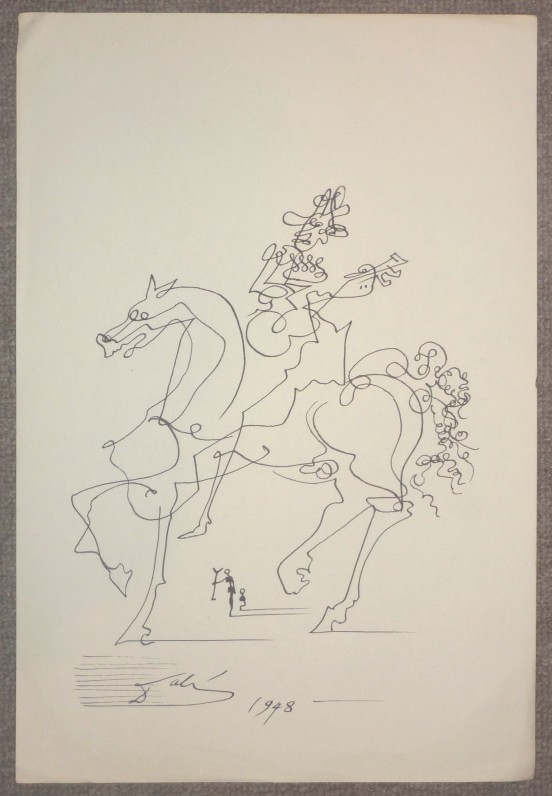
Dali continuous line drawing in pen and ink, guitar player on horse, dated 1948.

Dali continuous line drawing in pen and ink, guitar player on horse, dated 1948.

 This is an original pen and ink drawing on paper and is dated 1948 and signed Dali.  I have referred to One Line drawings by Picasso in a previous post, but this drawing is virtually a continuous line drawing.

When I say virtually, I mean that the artist has used a series of lines throughout the drawing which could be connected up.  I presume that using a dip pen meant that as ink ran out he took the pen off the paper to dip the nib and then continued from a point nearby. 

In effect, he has drawn all the key areas in single lines, which is the initial stage in my drawings, but presumably with no intention of connecting them up or reviewing them further.  I have little doubt that the whole drawing would have been completed relatively quickly in one session.

I bought the drawing “in the manner of Salvador Dali”, as there was no provenance with it, but my first glance convinced me that I had to have it if possible.  It was the continuous line drawing effect, with an added bonus when I saw the signature.  Whoever did the drawing greatly impressed me and my researches into Dali pictures of around that time confirmed that he was producing drawings similar to this, with several elements the same. 

Many of these elements appear in “50 Secrets of Magic Craftsmanship” by Salvador Dali published in 1948.  In fact he seems to have done a quick drawing inside the front cover of  some of the original edition copies.