

Phormium, New Zealand Flax. Mick Burton, continuous line artist.
We have just had snow from Storm Burt and it weighed down some of the sword-like leaves of our sturdy Phormium. Here is the photo below.
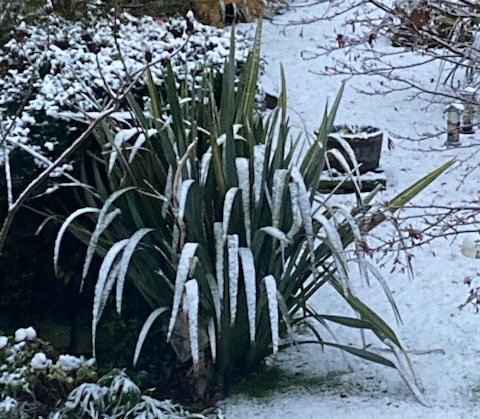
Phormium, after snow weighed down the leaves. Photo Mick Burton, continuous line artist..
I considered that the mixture of curved drooping leaves and straight upright leaves would make a good contrasting straight and curved overlapping continuous line.
As soon as the snow went, the leaves sprang back upright again. The leaves are pretty rigid and I prune them with a hack saw.
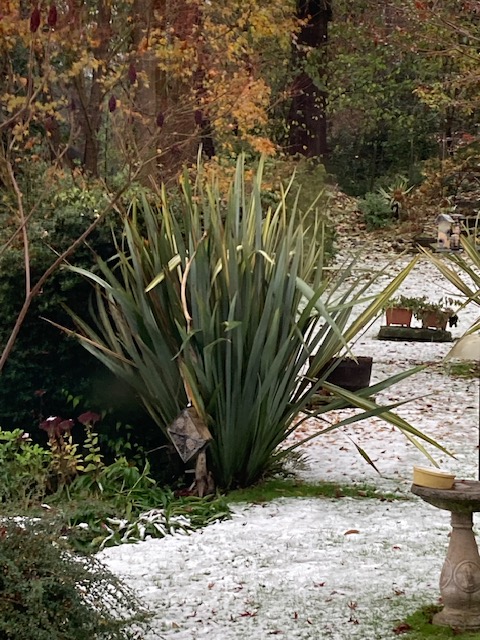
After the snow melted the sword-like leaves returned to straight up. Photo Mick Burton, continuous line artist.
Captain Cook and Joseph Banks recorded the plant in New Zealand in 1770. The Museum of New Zealand states that “Russia, the main supplier of sailcloth and rope for the Royal Navy, had restricted sales to England and Cook considered the New Zealand flax as and alternative for making these vital supplies.”
We had good fox tracks in the snow this time. In one direction it was a single line of spaced prints and in the other it was pairs of prints spaced out.
Before the snow came, I had raked up all the leaves and produced our biggest pile yet, for the first stage of producing soil from leaf mould. It is far bigger than the pen I built for leaves. Of course, some are blown in from Gledhow Valley Woods.
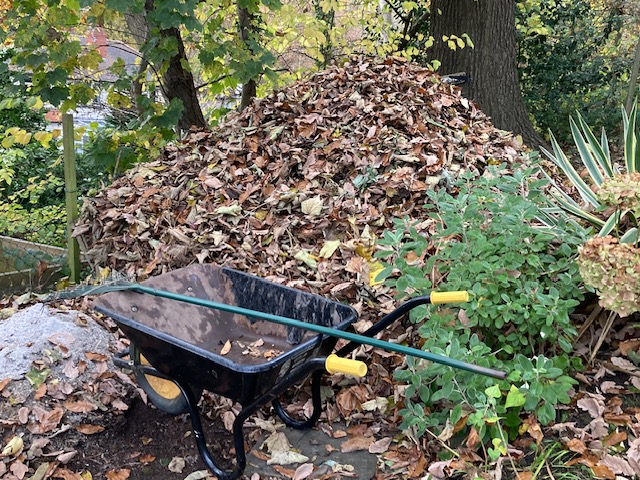
Largest leaf pile to date. Photo Mick Burton, continuous line artist.
As the leaf pile has spilled across the slab path up the garden I was interested to see what the Fox did when using the path – would it go round? Nope, it staggered over the right hand side of the pile.
One strange thing every year is the the Red leaved Acer drops its leaves before all the other trees and the Bronze leaved Acer is usually the last.
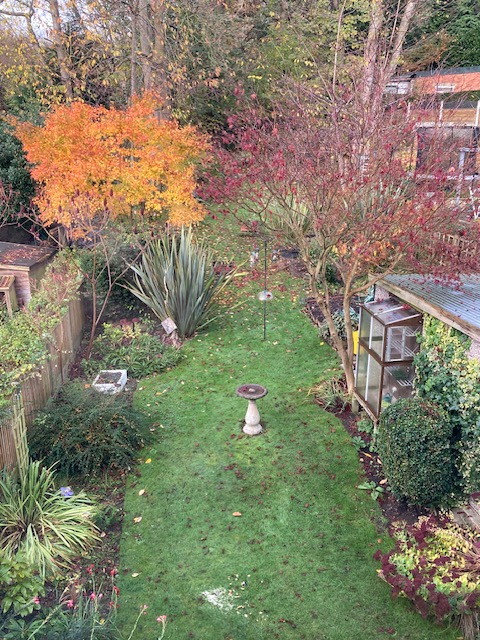
Red leaved Acer next to the garage drops leaves long before the bronze leaved one on the left. Photo Mick Burton, continuous line artist.
In the lawn, under the leaves I found that the Bumble Bee hole was still there. The hole is near the bottom of the photo below. On the internet it says that the holes are in use for a few months and then not used again, as the queen builds a new one next year.
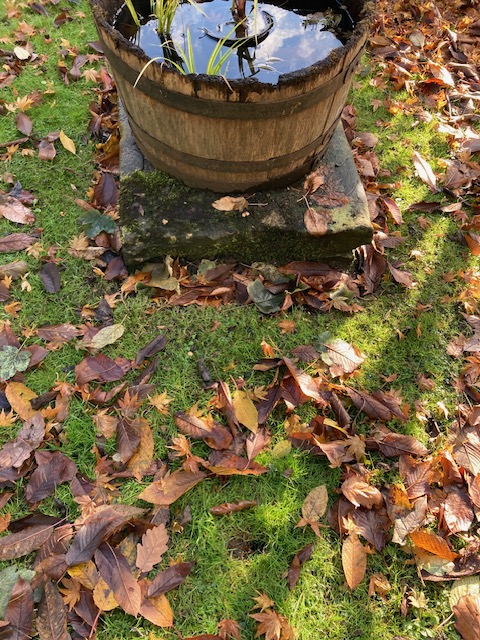
Bumble Bee hole in the lawn. Photo Mick Burton, continuous line artist.
When I first spotted the hole in the lawn in late May there was a Bee just emerging from it. The black patch at the very bottom of the photo is the shadow of the bee.
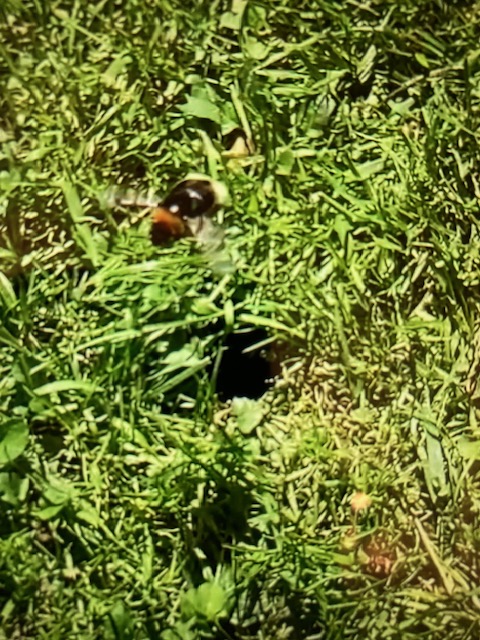
Bumble bee leaving the nest hole in the lawn. Photo Mick Burton, continuous line artist.
I first found out about Bees nesting in the ground when I was digging the tiers in the bank at the top of the garden. I became aware that an increasing number of bees were circling around me. It was just couple of Bumble Bees at first then all sorts of sizes of bees, some appearing to be similar to hive bees, flying around me. I realised that I must have disturbed their nest and so I stopped the digging for the day. The next day I came to look and there was a new hole in the bank and bees coming out, so I just abandoned my digging for the summer.
 Mick Burton